
Treatments
Lung Cancer ADC Evaluation in China: Biomarker and Treatment Records to Prepare
A practical record checklist for international patients preparing pathology, biomarker, imaging and treatment history before a lung cancer ADC discussion in China.
MedToChina Editorial Team · 9 min read · October 14, 2026

Quick Summary
Antibody-drug conjugates (ADCs) are cancer medicines designed to carry a treatment payload to cells with a particular target. In non-small cell lung cancer (NSCLC), ADC research, regulatory status, testing practices, and treatment pathways continue to evolve. A discussion about an ADC should start with accurate pathology, biomarker, imaging, treatment-history, and safety records rather than an assumption that a named medicine, trial, or treatment pathway will be available.
This guide explains how to organize those records for an international patient considering a further-care discussion in China. It does not recommend an ADC, determine eligibility, interpret a laboratory result, or establish access to a medicine or clinical trial. Those decisions belong to qualified clinicians after reviewing the patient's condition and locally applicable requirements.
Reviewed October 14, 2026.
What an ADC Is, in Plain Language
An antibody-drug conjugate has three broad parts: an antibody that recognizes a cell-surface target, a linker, and a treatment payload. The antibody is intended to bind a target associated with cancer cells; after internalization and processing, the payload can exert its effect. This does not mean every tumor with a marker can be treated with every ADC.
In NSCLC, potential targets under study or with different clinical relevance include HER2, HER3, TROP2, MET, and others. A molecular alteration, protein-expression result, or biomarker name is not automatically a treatment instruction. Relevance depends on cancer subtype, stage, prior treatment, assay, current evidence, local authorization, and clinical judgment.
Start With the Current Clinical Situation
New or worsening breathlessness, chest pain, coughing blood, fever, confusion, uncontrolled pain, new weakness, or other serious symptoms need prompt local medical assessment. Do not delay urgent care while organizing files or making travel arrangements.
Before planning international travel, ask the current oncology team whether the patient is medically stable to travel and whether a recent scan, laboratory test, or symptom requires immediate follow-up. Do not start, stop, or adjust anticancer medicines, steroids, anticoagulants, oxygen, antibiotics, or other prescribed medicines based on an online guide.
Confirm the Diagnosis and Disease Context
Lung cancer is not one single disease. For an ADC-related discussion, a receiving team usually needs the original pathological diagnosis and current disease context. Start with the pathology report that states whether the cancer is NSCLC or another type and, where applicable, the histologic subtype.
Keep together:
- Original biopsy or surgical pathology report
- Pathology review after progression or a new biopsy
- Cytology and cell-block information when a small sample was used
- Immunohistochemistry results and laboratory method details
- Biomarker and molecular reports, including specimen date and site
- A note showing whether tissue was primary tumor, metastatic site, blood, pleural fluid, or another specimen
Only the treating clinical and pathology teams can decide whether existing material is adequate or whether another test is appropriate.
Collect Complete Biomarker Reports Without Self-Interpreting Them
For advanced NSCLC, a care team may use molecular and protein tests to inform treatment discussions. Your task is not to decide which marker qualifies a patient for a therapy. Provide complete, dated reports and preserve the original wording.
Collect the full PDF for genomic testing, not a screenshot of a positive or negative result. For a next-generation sequencing panel, include specimen adequacy, variant list, laboratory interpretation, and date. Keep reports for driver alterations and relevant protein assays ordered by the treating team, such as EGFR, ALK, ROS1, BRAF, KRAS, MET, RET, NTRK, HER2, and PD-L1. Not every marker is relevant in every setting, and not every biomarker used in ADC research is a validated treatment-selection test.
For target-related markers, save the complete IHC report, including the antibody or assay where stated, scoring method, percentage or intensity, and pathologist interpretation. Do not convert an IHC score, gene alteration, amplification, or RNA result into a conclusion that an ADC is appropriate. Methods and cutoffs can differ across studies, products, and laboratories.
Treatment History Is as Important as the Biomarker Name
Create a chronological treatment table with:
- Month and year of diagnosis and stage, if known
- Surgery, radiation, systemic therapy, targeted therapy, immunotherapy, and clinical-study participation
- Regimen or medicine name as documented, dates, and cycles when known
- Best response or reason for stopping from the clinician's record
- Major toxicities, admissions, dose reductions, interruptions, allergies, and current supportive medicines
- Prior lung inflammation, pneumonitis, interstitial lung disease, liver problems, neuropathy, eye problems, or other documented events
Safety history is not an administrative extra. Different ADCs can have different risk profiles, and a clinician may need to review prior toxicities before discussing any possible pathway. A patient should not use this list to rule a treatment in or out independently.
Imaging and Current Disease Evidence
Include radiology reports and, whenever possible, actual image files. Relevant documents may include CT, PET/CT, brain MRI, bone scans, or other studies. Place the most recent report beside the last scan showing response or stable disease. This helps a reviewing team see the timeline without relying on an informal summary.
Ask the originating imaging department how to export DICOM files or provide a secure viewing link. A written report may not substitute for images when a specialist review is needed. Include recent clinic notes describing symptoms, oxygen requirements if any, performance or mobility information, and disease sites reported by the treating team. Do not infer progression solely from a symptom or tumor-marker change without clinical review.
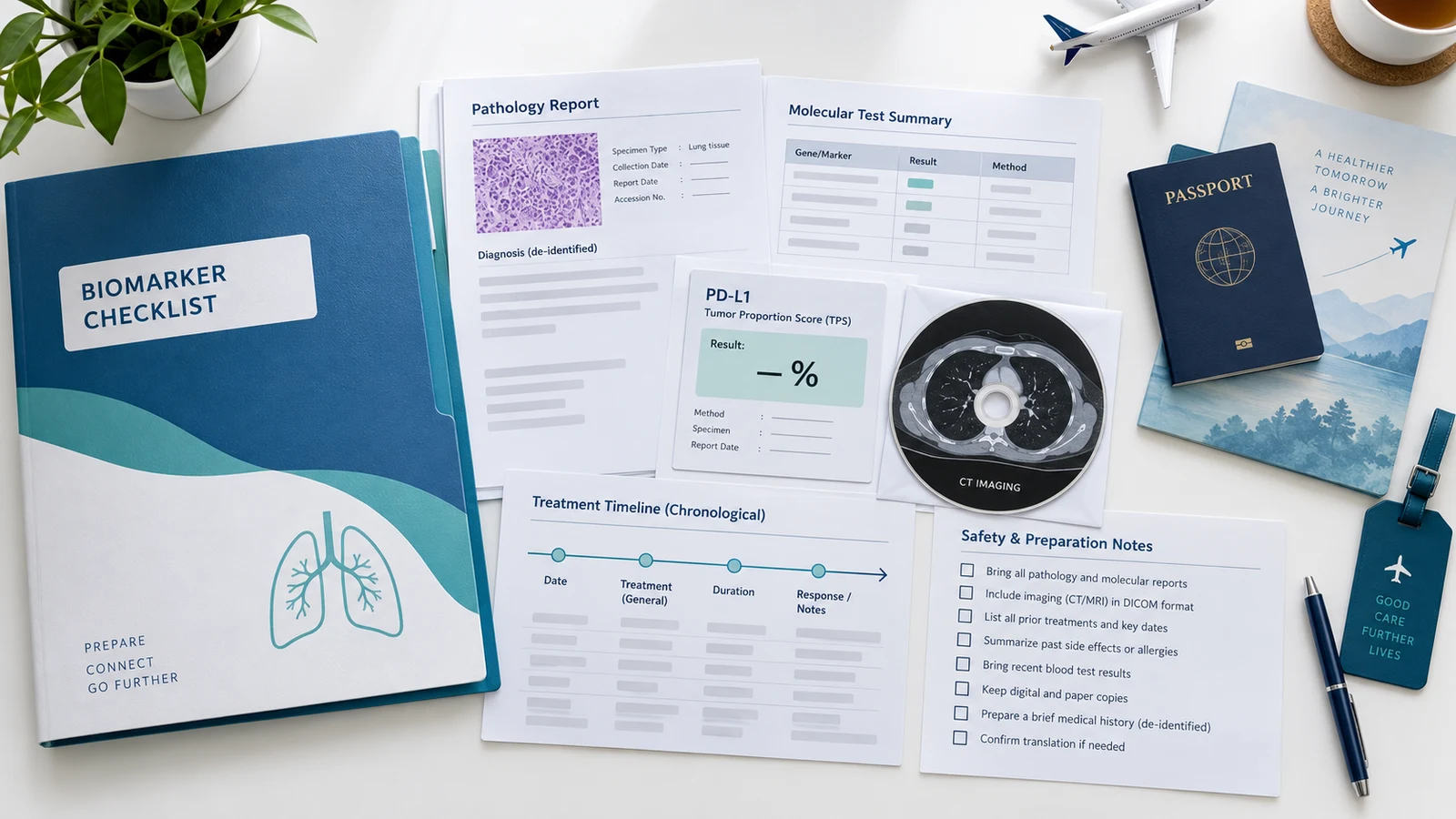
A Practical Records Checklist
Create five dated subfolders:
- Pathology and specimens: original pathology, later biopsies, cytology, IHC, molecular reports, and a note about tissue blocks or slides. Do not send samples across borders without clear instructions from institutions.
- Biomarkers and laboratory testing: full NGS and single-gene reports, protein-assay reports, specimen details, and relevant blood tests. Keep original language and any translation separately labeled.
- Imaging: reports plus DICOM images or source-facility links, organized chronologically with a one-page index.
- Treatment and safety history: timeline, infusion or chemotherapy summaries, radiation records, discharge summaries, current medicines, adverse-event documentation, allergies, and recent blood results.
- Current status and administration: latest oncology note, a short symptom summary, treating-team contacts, and a separate secure folder for identity or travel documents.
Keep original reports even if they are not in English or Chinese. A useful translation preserves dates, units, medicine names, test names, specimen details, and uncertainty. It should not turn suspected or indeterminate findings into a definite diagnosis.
Questions That Stay Realistic
Sending information does not establish treatment eligibility, medicine supply, a clinical-study place, hospital admission, insurance coverage, or travel clearance. For a practical service conversation, ask which documents need translation, whether DICOM imaging is needed, whether the current pathology is sufficient for a discussion, and which recent safety events and medicines should be included.
MedToChina can help international patients organize questions and identify information useful for a China-care service conversation. This is communication and logistics support; it does not assess a patient, advise a treatment, or decide treatment eligibility.
Common Questions
Does a TROP2, HER2, HER3, or MET result mean I can receive an ADC in China?
No. A biomarker result is one part of a clinical picture. Its significance depends on test method, cancer type, stage, treatment history, evidence, local requirements, and clinician judgment. It does not confirm availability or suitability.
Should I request a new biopsy before contacting a China care service?
Do not arrange a procedure based on this article. Bring existing pathology, biomarker, imaging, and treatment records first. The treating clinical team can advise whether new tissue, blood testing, or another assessment is appropriate.
Are blood-based tests enough?
Blood-based and tissue-based testing can provide different information. The appropriate approach depends on the clinical question, available tissue, disease status, test characteristics, and the treating team's judgment.
Can MedToChina tell me which ADC I should take?
No. MedToChina does not provide treatment recommendations or determine eligibility. It can receive records and questions, identify missing information, and explain practical preparation steps.
Is it safe to travel while receiving lung cancer treatment?
Travel suitability must be discussed with the current treating clinical team. Active symptoms, oxygen needs, infection concerns, recent complications, and planned treatments can affect travel planning.
Related MedToChina Resources
- Cancer mutation reports and targeted therapy questions
- Investigational cancer drugs and trial pre-screening records
- China cancer trial eligibility checklist
- China-ready medical records checklist
- Medical clearance before treatment in China
Send Your Records or Questions Through WhatsApp
If you are an international patient or caregiver considering a lung cancer ADC discussion in China, submit your information or send medical-record questions through WhatsApp. Include a diagnosis summary, biomarker and treatment reports, recent imaging, current medicines, travel period, and practical questions. MedToChina can identify missing information and explain preparation steps for a service conversation.
Medical Disclaimer
This article is general information only. It is not medical advice, diagnosis, treatment advice, clinical-trial advice, travel clearance, or a promise that any medicine, study, hospital service, insurance outcome, or treatment result will be available. Lung cancer can require urgent evaluation. Decisions about tests, treatments, medicines, and travel must be made with qualified clinicians who know the patient's condition. Seek urgent local medical care for concerning symptoms.
References
- College of American Pathologists. PD-L1 and TMB Testing of Patients With Lung Cancer for Immunooncology Therapies.
- ASCO. Therapy for Stage IV Non-Small Cell Lung Cancer With Driver Alterations: ASCO Living Guideline.
- Zanchetta C, et al. Antibody-Drug Conjugates in Non-Small Cell Lung Cancer. International Journal of Molecular Sciences. 2024.
- Hirsch FR. Antibody-Drug Conjugates in Non-Small Cell Lung Cancer: Where Are the Target and the Biomarker?. Clinical Cancer Research. 2025.
- Khadela A, et al. Exploring the Potential of Antibody-Drug Conjugates in Targeting NSCLC Biomarkers. Clinical Medicine Insights: Oncology. 2024.