
Treatments
Investigational Cancer Drugs in China: Records Needed Before Trial Pre-Screening
Prepare pathology, imaging, biomarker and treatment records before discussing cancer trial pre-screening in China. Learn eligibility and travel limits.
MedToChina Editorial Team · 8 min read · September 16, 2026
Quick Summary
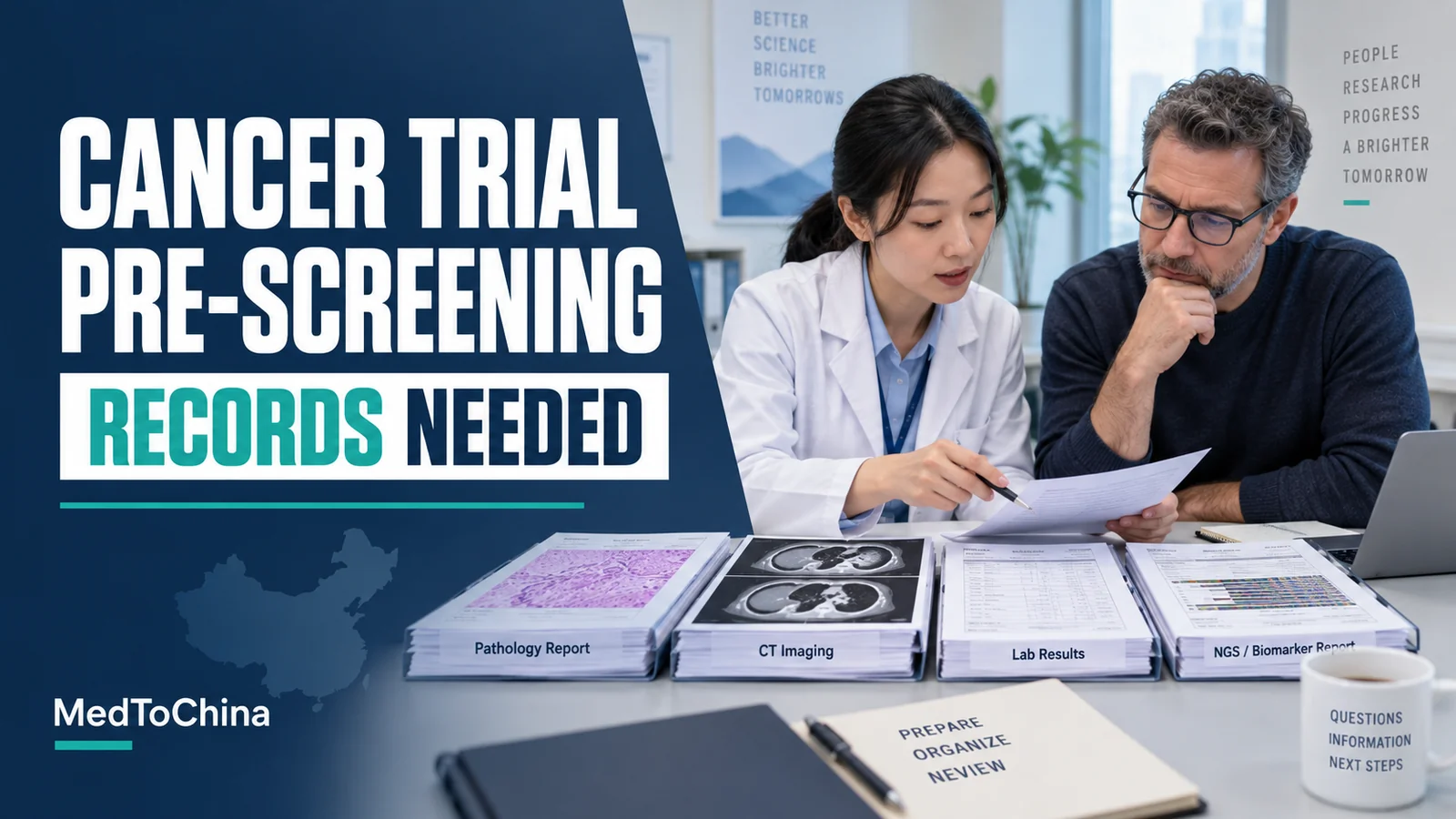
International cancer patients often ask whether China may have investigational cancer drugs or clinical trial pathways relevant to their diagnosis. The first practical step is not travel or enrollment. It is record preparation. Trial pre-screening may require pathology, staging, imaging, biomarker reports, prior treatment history, response history, recent laboratory tests, performance status, medication list, infection history, organ function and travel constraints. Eligibility is determined by the clinical trial protocol, investigator review, ethics requirements, regulatory rules and patient safety. MedToChina can help overseas patients organize basic information and send key records through WhatsApp, so later discussion about China medical resources is clearer and medically cautious.
Why investigational cancer drug questions need careful preparation
When standard cancer treatments are limited, patients and families naturally search for investigational cancer drugs, clinical trials, early access pathways and newer therapies in other countries. China has an active oncology research environment, and some international patients want to understand whether treatment in China may be worth exploring.
The topic must be handled carefully. An investigational drug is not the same as an approved routine treatment. A clinical trial is a research study with a protocol, eligibility criteria, informed consent, safety monitoring and oversight. A drug being studied in one cancer type, stage or biomarker group may not be relevant to another patient. A trial that appears promising online may be closed, unavailable to foreign patients, limited to a specific hospital, or unsuitable because of previous treatment, lab values, organ function or current symptoms.
For this reason, the useful first question is not "Can I get this drug in China?" A better question is: "What records are needed before anyone can judge whether a China oncology trial or investigational drug discussion is realistic?"
MedToChina does not provide diagnosis or decide trial eligibility. The practical role is to help overseas patients organize records, submit basic information and communicate through WhatsApp before deeper service discussion. The later China resource conversation should depend on the patient's real diagnosis, documents, timeline, budget range, language needs and travel safety.
What "investigational cancer drug" means
An investigational cancer drug is a medicine being studied for safety, dosing, activity or effectiveness. It may be tested alone or in combination with chemotherapy, immunotherapy, targeted therapy, radiotherapy, cell therapy or another treatment. It may be studied in phase I, phase II, phase III or post-marketing research, depending on the drug and question.
The National Cancer Institute explains that clinical trials use eligibility criteria to identify who can take part. These criteria may include health, medical history, age, treatment history and the tumor's genetic changes. ClinicalTrials.gov also describes eligibility criteria as study-specific rules such as age requirements, health status or other characteristics.
In China, drug clinical trials are also regulated. The National Medical Products Administration describes drug clinical trials as research conducted with humans to establish safety and efficacy for drug marketing registration, and states that trials should be conducted in qualified and filed clinical trial institutions with ethics committee review.
For patients, this means that a trial is not a simple product request. It is a structured research pathway. The patient must fit the protocol, and the research team must judge whether participation is medically and ethically appropriate.
Trial phases in plain language
Phase I trials usually focus on safety, dosage, side effects and how the drug behaves in the body. Some phase I oncology studies enroll patients with advanced cancers after standard options have been used. These studies may include dose escalation or expansion groups.
Phase II trials usually look more closely at activity in a defined cancer type, biomarker group or treatment setting. They may study response, disease control, side effects and whether the drug should move to larger testing.
Phase III trials compare a new approach with an existing standard or another treatment strategy in a larger patient group. These trials usually have stricter eligibility and more defined endpoints.
Post-marketing or phase IV studies may occur after a drug has been approved for certain uses. These studies can monitor safety, effectiveness or use in broader populations.
Patients should not assume that a later phase is always better for them, or that an early phase is automatically too risky. The relevance depends on the disease, prior treatments, trial design, current health and available alternatives.
What pre-screening can and cannot do
Pre-screening is an early review of whether a patient may appear relevant for a trial or investigational pathway. It usually happens before formal screening. It may involve reviewing diagnosis, stage, biomarker status, prior therapies, imaging, lab values, performance status and travel ability.
Pre-screening can help decide whether it is worth gathering more documents or contacting a formal clinical research team. It can also identify obvious barriers, such as the wrong cancer type, missing biomarker, recent conflicting treatment, uncontrolled infection, poor organ function, unstable symptoms or incomplete records.
Pre-screening cannot enroll the patient. It cannot replace investigator review, hospital registration, formal consent, required testing, ethics-approved procedures or protocol-defined screening. A patient who looks potentially relevant in early communication may still be found ineligible after formal assessment.
Reviewed September 17, 2026. The NCI's trial-search steps emphasize collecting the details of diagnosis and treatment before looking for a study. ClinicalTrials.gov's study guidance explains that eligibility is study-specific; a listed study is not proof of open recruitment or suitability. In China, the NMPA's drug-registration provisions require appropriate trial institutions and ethics processes. A patient should confirm current recruitment, foreign-patient acceptance and protocol requirements with the actual research team before planning travel.
This is why patients should avoid making irreversible travel decisions based only on a trial name or a social media post. The record package comes first.
Core records patients should prepare
Start with a one-page cancer summary. Include cancer type, diagnosis date, stage, metastatic sites, current symptoms, current treatment status, major medical history, allergies, medications, and the main question about China trial pre-screening. Use the China-ready medical records checklist to make the package easier to review.
Prepare pathology records. These may include biopsy report, surgical pathology, immunohistochemistry, tumor grade, histologic subtype and specimen source. If pathology was done years ago and the disease has changed, mention whether a recent biopsy exists.
Prepare imaging records. Recent CT, MRI, PET-CT, ultrasound, bone scan or endoscopy reports may be needed depending on cancer type. DICOM files are often more useful than written reports alone. Label images by date and body region.
Prepare biomarker and molecular reports. These may include NGS, single-gene testing, FISH, PCR, MSI, TMB, PD-L1, HER2, BRCA, HRD or other cancer-specific markers. Send the full report, not only the summary page. If tissue and liquid biopsy results differ, send both. The cancer mutation report guide explains why these results need clinical context.
Prepare the treatment timeline. List surgery, radiation, chemotherapy, immunotherapy, targeted therapy, hormone therapy, cell therapy, local ablation and previous clinical trial exposure. Include drug names, start and stop dates, response, progression date if known, reason for stopping and major side effects.
Prepare recent laboratory tests. Trials may review blood counts, liver function, kidney function, electrolytes, coagulation, infection markers, tumor markers and other cancer-specific tests. Lab results should be recent because eligibility can depend on current values.
Performance status, organ function and safety
Cancer trial eligibility often depends on performance status, meaning how well the patient can perform daily activities. A patient who is fully active is different from a patient who is bedbound or needs oxygen. Eastern Cooperative Oncology Group performance status is commonly used in oncology, although exact requirements vary by protocol.
Organ function matters. Many investigational drugs are processed through the liver or kidneys, affect blood counts, influence the immune system or interact with other medicines. Severe anemia, low platelets, abnormal liver enzymes, kidney dysfunction, heart disease, uncontrolled infection, active bleeding or brain metastasis symptoms may affect eligibility and safety.
Medication history also matters. Steroids, anticoagulants, anti-seizure medicines, antibiotics, immune suppressants, herbal products and recent cancer drugs can influence screening. Some trials require washout periods after chemotherapy, immunotherapy, targeted therapy or radiotherapy. Others restrict certain concurrent medications.
Patients should not hide symptoms or medicines in hopes of being accepted. Trial screening is designed to protect participants and research integrity.
China-specific planning points
China oncology trials may be registered through official drug clinical trial information platforms or listed in hospital and sponsor channels. The NMPA service information for drug clinical trial registration refers to the Drug Clinical Trial Registration and Information Disclosure Platform. Patients should understand that public registration does not mean a trial is open, suitable, accessible to foreign patients or available at the patient's preferred city.
For overseas patients, language, travel timing, visa status, payment, accommodation and follow-up all matter. Some trials require repeated visits, hospitalization, frequent lab monitoring, imaging at set intervals, adverse event reporting and long-term follow-up. A patient who can travel once for a short visit may not be able to meet protocol schedules.
China also has multiple oncology resource centers in cities such as Beijing, Shanghai, Guangzhou and other regions. Hospital resource discussion should happen after records are reviewed and practical needs are understood. The website should not present a specific institution or clinician as the answer before that step.
How to send records through WhatsApp
A useful first WhatsApp message should include age, nationality, current country, cancer diagnosis, stage, biomarker status if known, current symptoms, prior treatments, current therapy, recent imaging date, possible travel month, companion needs and the main trial-related question.
Do not send many unlabelled images at once. Organize files by category and date:
- Cancer summary.
- Pathology and immunohistochemistry.
- Biomarker or NGS reports.
- Imaging reports and DICOM files.
- Treatment timeline.
- Recent lab tests.
- Medication list and allergies.
- Discharge summaries or operation notes.
- Prior trial records if any.
- Travel, payment and follow-up questions.
If your records are not in English or Chinese, prepare translations for the most important reports. Accurate translation of drug names, mutation names, dates, doses and pathology terms is important.
Common mistakes to avoid
The first mistake is sending only a drug name. Trial relevance depends on diagnosis, stage, biomarkers, prior treatments and current condition.
The second mistake is sending only an NGS report. A mutation report needs pathology, imaging and treatment context.
The third mistake is ignoring prior therapies. A trial may require previous treatment, exclude certain prior drugs, or require a washout period.
The fourth mistake is assuming that trial listing means immediate access. Formal screening, consent, investigator review and protocol rules still apply.
The fifth mistake is planning travel before confirming whether the record package is complete enough for meaningful discussion.
FAQ
Can international patients join cancer clinical trials in China?
Some trials may be able to consider international patients, while others may not. It depends on the protocol, institution, sponsor, language requirements, follow-up schedule, regulatory process and patient suitability.
Does having a mutation report make me eligible?
No. A mutation report may be relevant, but eligibility also depends on cancer type, stage, prior treatment, organ function, performance status, lab values and trial-specific criteria.
Is pre-screening the same as enrollment?
No. Pre-screening is an early review. Formal screening, consent, investigator assessment and protocol-defined tests are required before enrollment can be considered.
What records should I send first?
Send a cancer summary, pathology, biomarker reports, recent imaging, treatment history, recent labs, medication list, performance status details and your main question about China trial discussion.
Can MedToChina choose a trial for me?
MedToChina can help organize records and questions through WhatsApp. Trial suitability and participation must be reviewed through the relevant clinical and administrative process.
Should I stop current treatment while looking for trials?
Do not stop or change treatment without your treating oncologist's guidance. Trial exploration should be coordinated carefully with current medical care.
Related MedToChina Resources
- China-ready medical records checklist
- Cancer mutation reports and targeted therapy questions
- CAR-T pre-screening record preparation
- Commercial CAR-T and clinical trial pathways
- Hospital cost estimates before China medical travel
WhatsApp CTA
Considering investigational cancer drug options or clinical trial discussion in China? Submit your basic information or send your cancer summary, pathology, mutation reports, recent imaging and treatment timeline through WhatsApp. MedToChina can help organize your record package before travel planning.
Medical Disclaimer
This article is for general educational and planning purposes only. It does not provide medical diagnosis, treatment recommendation, clinical trial enrollment advice, legal advice, visa advice, or any assurance that an investigational drug, trial, hospital document or medical service will be available. International patients should consult licensed oncologists and official clinical research teams before making medical or travel decisions.
References
- National Cancer Institute - How Do Clinical Trials Work?
- National Cancer Institute - Steps to Find a Clinical Trial
- ClinicalTrials.gov - Learn About Studies
- National Medical Products Administration - Provisions for Drug Registration
- National Medical Products Administration - Drug Clinical Trial Registration