
Treatments
Heart Failure Evaluation in China: Symptom Changes and Hospital Records to Prepare
A practical records checklist for international patients preparing for heart failure evaluation in China, including symptoms, admissions, tests, and medication history.
MedToChina Editorial Team · 9 min read · October 27, 2026

Quick Summary
Heart failure is a clinical condition in which the heart cannot meet the body's needs in the usual way. Causes, symptoms, test findings, and care plans vary widely. For an international patient considering evaluation in China, a useful first step is to organize existing information: the diagnosis already given, symptom changes over time, recent hospital stays, imaging and laboratory reports, medication history, device information if applicable, and contact details for the current care team.
This guide explains how to make that record set easier for a China cardiac team to review. It does not diagnose heart failure, interpret test results, assign severity, recommend medication changes, or decide whether travel is medically appropriate.
Reviewed October 27, 2026.
Why a Timeline Matters for Heart Failure Evaluation
Heart failure is not a single, identical experience. Some people notice breathlessness or fatigue; others have swelling, changed activity tolerance, sleep disturbance, or a recent hospital stay. A single report may not show how the situation changed over weeks or months. A concise timeline can help a receiving team understand important events without requiring a patient or family to explain everything from memory.
The goal is not to judge whether a symptom is mild or severe. Preserve facts: when a change was noticed, what the person was doing, what contact or hospital visit followed, and what documents exist. The clinical team, not a travel coordinator, family member, or online guide, interprets those facts in context.
Original documents, translated summaries where requested, and a clear index are more useful than a large unlabelled file collection.
What Heart Failure Means in Plain Language
Heart failure does not mean the heart has stopped. It describes a syndrome in which the heart's pumping or filling function is affected and the body may not receive blood flow in the usual way. It can be associated with coronary artery disease, prior heart attack, high blood pressure, valve disease, heart rhythm problems, cardiomyopathy, congenital conditions, or other causes. Some people have a reduced ejection fraction, while others do not; a number alone does not explain the whole clinical picture.
Breathlessness, fatigue, swelling, rapid changes in wellbeing, or reduced activity tolerance should not be self-interpreted from a checklist. New, severe, or worsening symptoms need timely assessment from the local clinicians responsible for the patient's care or emergency services when appropriate.
Build a One-Page Symptom and Event Timeline
Use dates or approximate time periods if exact dates are unavailable. One row can cover a hospital stay, emergency visit, significant symptom change, major test, or medication change made by the treating team.
For each event, record:
- date or date range and country or city;
- what changed in everyday terms, such as breathlessness during usual activity, swelling, waking discomfort, tiredness, palpitations, dizziness, or another observed symptom;
- activity or situation in which it was noticed, without drawing a conclusion about cause;
- whether the patient contacted a clinician, attended an emergency department, or was admitted;
- name and date of the related report, discharge summary, imaging study, or test result;
- what the treating team said to do, recorded from an existing document; and
- whether the change improved, persisted, or led to another documented event.
Do not turn a log into a self-treatment plan. Do not use it to decide fluid intake, diuretic use, medication doses, or exercise limits. Those decisions require individualized clinical advice.
Hospital Admissions and Urgent Visits: Documents to Collect
Recent admissions often contain details that do not appear in a short outpatient note. Keep the full discharge summary and key reports from each hospital stay or emergency visit where possible. Label files by date and location, not only by generic names.
Useful documents may include admission and discharge dates, department and hospital name, discharge summary and problem list, emergency-department notes, echocardiogram, cardiac MRI, CT, coronary angiography, chest imaging, ECG and rhythm-monitoring summaries, dated laboratory reports, procedure reports, a medication list at admission and discharge, and follow-up instructions already issued by the hospital.
Do not remove apparently repetitive pages. A receiving team may need report date, measurement method, or original wording. If a document is unavailable, note the hospital and approximate date rather than reconstructing a result.
Tests and Numbers: Preserve Context, Do Not Self-Grade
Patients often focus on a single result, such as ejection fraction, biomarker value, creatinine, blood pressure, or body weight. These data can matter clinically, but their meaning depends on timing, method, other conditions, medication, and overall state. Comparing numbers from different laboratories or imaging methods without context can be misleading.
Save the complete report. In the index, include test name, date, facility, and report language. If there are several echocardiograms, list them chronologically and keep the original report with each date. If a local clinician gave a written explanation, keep it with the result.
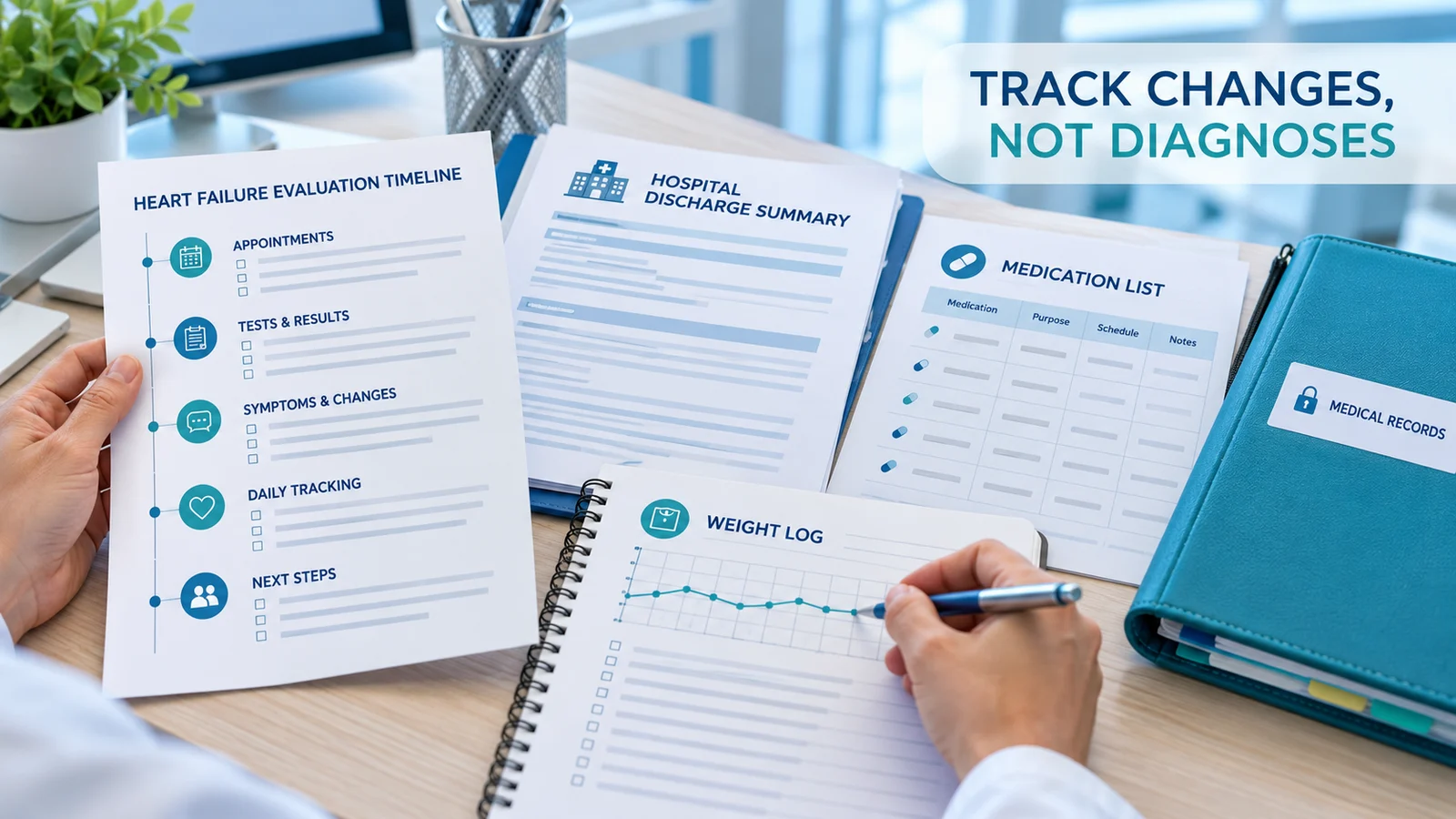
Home records of weight, pulse, blood pressure, symptoms, or activity can be useful only if they already exist; make clear what device and units were used. Do not start a measurement routine, change medication, or decide the significance of a reading from this article.
Medication History: Make It Readable, Not Prescriptive
Create one medication page using labels on medicines or the most recent clinician-issued list. Include generic and brand name where known, dose and schedule exactly as written, reason if an existing record states one, start or stop date if known, and documented adverse effects or intolerances.
Include non-cardiac medicines, supplements, and injections. Bring photos of labels if names are difficult to translate, but do not rely on photos alone when a formal list exists. Never stop, restart, divide, or change a medicine to prepare for a China evaluation unless the prescribing clinician instructs you to do so.
Devices, Procedures, and Contact Details
For a pacemaker, implantable cardioverter-defibrillator, cardiac resynchronization device, valve replacement, coronary stent, bypass history, or another cardiac procedure, add a separate section. Include device card or procedure report, implant date, manufacturer and model as recorded, recent follow-up reports, and the contact details of the team following the condition.
This does not establish that a particular China hospital can support a device or perform a procedure. The receiving institution must confirm its own capability and requirements. Do not infer device compatibility with imaging, airport screening, monitoring systems, or travel arrangements from a general article.
Preparing Documents for a China Cardiac Team
Organize files in a practical order:
- One-page patient profile: name as on passport, date of birth, country of residence, current clinician, emergency contact, and preferred language.
- One-page event timeline: diagnosis history, symptoms, admissions, and major tests by date.
- Current medication and documented-intolerance list.
- Recent discharge summaries and outpatient letters.
- Cardiac imaging, ECG, rhythm-monitoring, catheterization, and laboratory reports, with dates.
- Device or procedure records, if applicable.
- A short list of questions to discuss in China.
Ask the receiving institution what file format, language, translation, image-sharing method, and identity documents it requires. Do not assume every imaging file can be sent by email. Use the specified channel and preserve originals.
Travel and Safety Boundaries
Whether a person can travel, fly, walk through an airport, stay away from the current care team, or delay local assessment depends on that person's clinical condition. Discuss these questions directly with treating clinicians.
If breathlessness, chest discomfort, fainting, confusion, severe swelling, a sudden decline, or another concerning symptom occurs, seek timely local medical care. Do not wait for document review, a future international visit, or a WhatsApp reply.
How MedToChina Can Support Preparation
MedToChina can help overseas patients prepare an organized administrative record package and practical questions. Submit information or send available records and questions through WhatsApp. After understanding the condition, existing records, timeline, country preference, and practical needs, customer service can discuss possible China care resources.
MedToChina does not diagnose, interpret echocardiograms or laboratory results, decide a heart-failure stage, change medication, determine travel readiness, or promise appointment availability, hospital admission, treatment, cost, or outcome. Clinical decisions remain with appropriate healthcare professionals and institutions.
Frequently Asked Questions
Do I Need to Calculate My Heart Failure Stage Before Travelling to China?
No. Do not assign your own stage from symptoms, ejection fraction, weight, or an online chart. Bring existing reports and ask the cardiac team to interpret them in context.
Which Records Are Most Useful After a Recent Admission?
The discharge summary, medication list, major test reports, procedure reports, and follow-up instructions are a practical starting set. Keep original dates and hospital names visible.
Should I Change Diuretics or Fluid Intake Before Travel?
Do not make those changes based on this guide. Ask the clinician who currently manages your care for individualized advice.
What if I Do Not Have Every Old Test Report?
Record the hospital, city, and approximate date, then send the materials you have through the channel requested by the receiving institution. Do not invent a result from memory.
Can MedToChina Tell Me Whether I Am Fit to Fly?
No. Travel readiness is a clinical decision for the treating team. MedToChina can help organize non-clinical preparation questions.
Does Sending Records Confirm Treatment in China?
No. Records submission does not confirm acceptance, an appointment, admission, a procedure, or a treatment plan. The receiving institution must confirm any next step.
Contact MedToChina on WhatsApp
Submit your information or send heart records and practical questions through WhatsApp. MedToChina can help prepare an organized administrative record checklist before discussing possible care in China.
Medical Disclaimer
This article provides general information for international patients considering heart failure evaluation in China. It is not medical, diagnostic, treatment, medication, nursing, insurance, visa, or travel advice. It does not interpret symptoms or tests, establish severity, determine fitness for travel, or confirm appointment availability, hospital admission, treatment, cost, or outcome. Seek individualized advice from clinicians responsible for your care. For urgent or severe symptoms, seek timely local emergency care.
References
- Heidenreich PA, et al. 2022 AHA/ACC/HFSA Guideline for the Management of Heart Failure.
- McDonagh TA, et al. 2021 ESC Guidelines for acute and chronic heart failure.
- American Heart Association. Heart Failure.
- Centers for Disease Control and Prevention. Medical Tourism.
- GOV.UK. China travel advice: health.