
Visa & Travel
If Your Phone Becomes Unavailable During Care in China: Offline Contact and Itinerary Backups
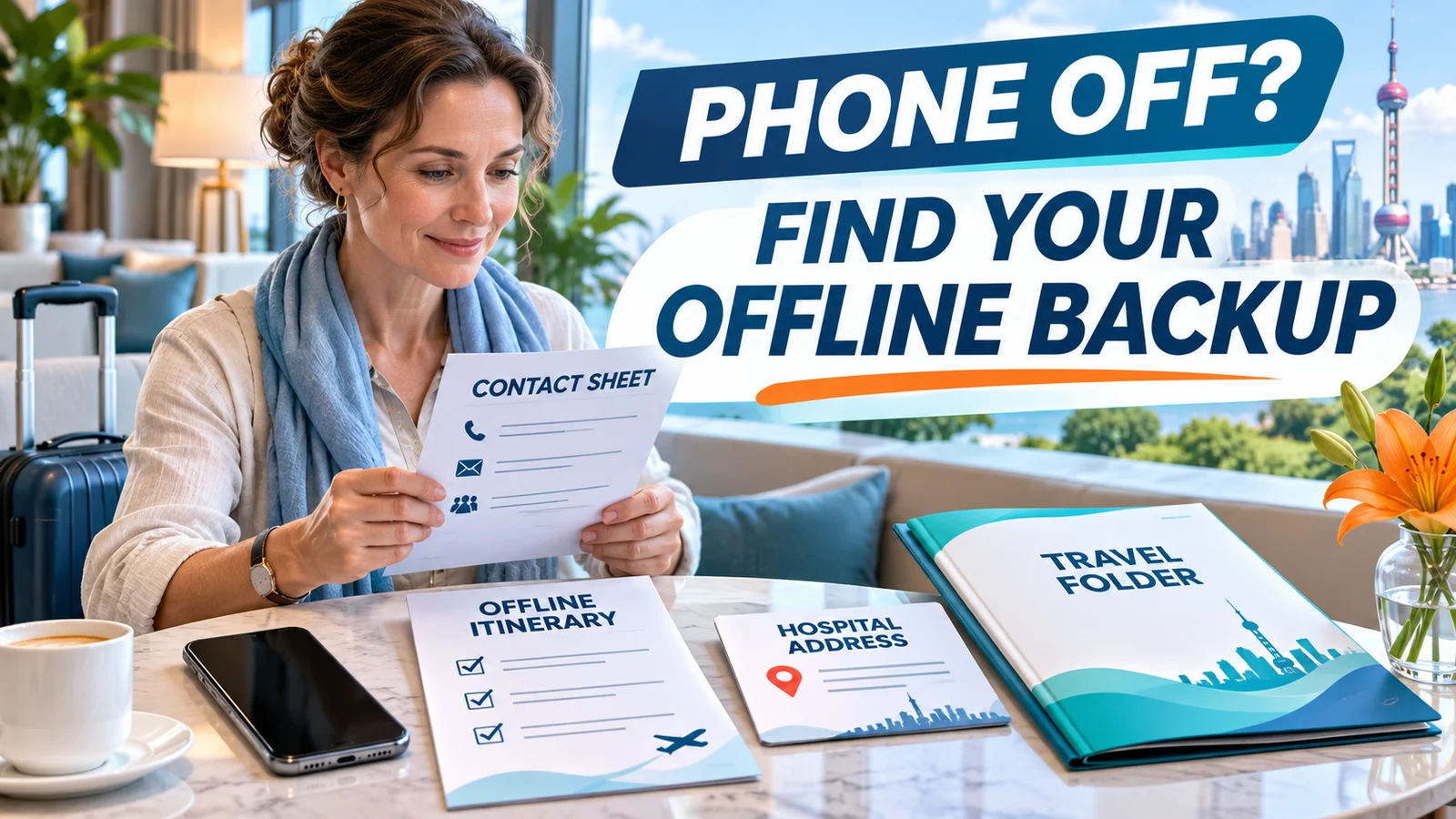
Prepare offline contact details and itinerary backups before travelling to China for medical care, so a phone problem does not hide essential next steps.
MedToChina Editorial Team · 10 min read · November 22, 2026
Quick Summary
- A lost, broken, uncharged, or inaccessible phone can interrupt maps, messages, appointment reminders, and access to travel documents during a China medical trip.
- Prepare a short offline pack before travel: a paper contact sheet, a compact itinerary, facility addresses, appointment references, accommodation details, and a list of what each contact can help with.
- Keep only the minimum information needed to find the next step. Do not print passwords, account recovery codes, full medical records, payment-card details, or private logins.
- Separate a device problem from an account-recovery problem. A phone replacement, a failed app login, and a missing verification code need different support; do not send passwords or one-time codes to anyone.
- If you have urgent or worsening symptoms, seek urgent local medical help rather than waiting for a phone, travel, or coordination problem to be solved.
Why an offline backup matters during care travel
For many visitors, a phone holds the whole journey: airline details, hotel address, maps, messages, translated notes, appointment reminders, payment access, and family contacts. During a medical trip, losing access can feel more serious because the information may be needed on a fixed date or at an unfamiliar location.
An offline backup is not a replacement for secure accounts or clinical instructions. It is a small, readable bridge that helps you find the next authorized contact or location when a device is unavailable. It should be useful even if a battery is empty, a screen is damaged, a SIM is not working, an app is logged out, or data service is temporarily unavailable.
The aim is simple: keep enough verified information on paper or another trusted offline format to identify your next step, without turning that backup into a bundle of sensitive data.
Build a one-page contact sheet
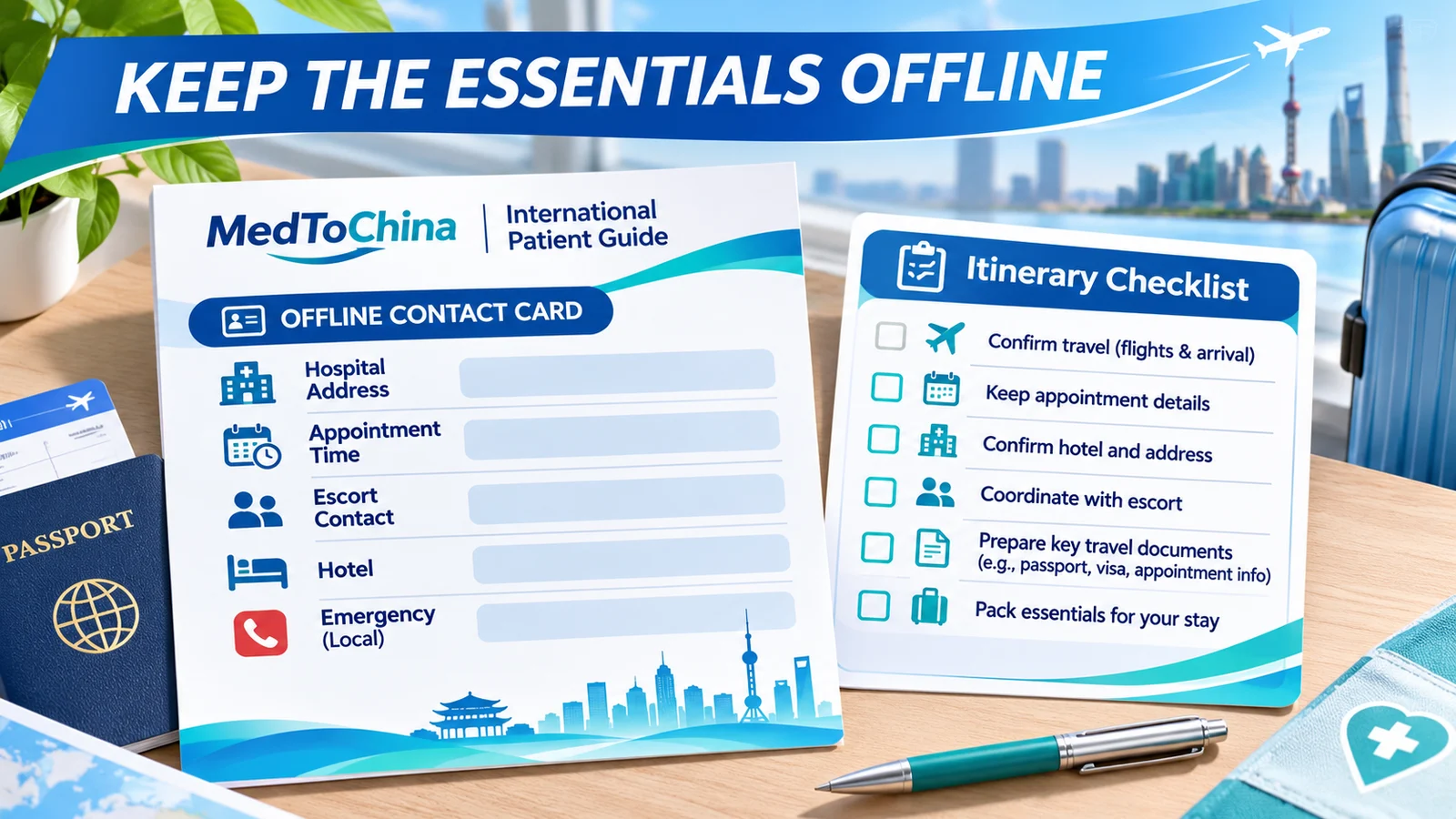
Make one contact sheet for the trip and keep a second copy separately. Use large text and short labels. For each entry, write the person's or service's role before the name or number.
Useful entries may include:
- The hospital's official main contact channel, not only a personal number.
- The confirmed facility name and full address in the language provided by the hospital, plus an English version if available.
- Appointment date, local time, department or service name, and confirmation reference if one was issued.
- Your accommodation name, address, front-desk contact, and check-in dates.
- A travel companion or trusted family contact who has agreed to be listed.
- A local emergency number and your home country's embassy or consular contact, where appropriate for your own travel plan.
- The MedToChina WhatsApp contact and a note saying what information you can share for coordination.
Do not use the sheet to record passwords, banking details, account-recovery codes, identity numbers beyond what is essential, or clinical conclusions. A contact sheet is for finding people and places, not for granting access to your accounts. For consent and role questions when listing a trusted person, see the emergency contact card guide.
Make a compact itinerary, not a full life archive
Your offline itinerary should show the order of the next few steps. It does not need every flight, receipt, medical document, or chat history. Keeping it short makes it easier to use under stress and reduces the privacy risk if it is misplaced.
For each planned day, include the date, local time, location, the purpose in ordinary language, and the next contact if a plan changes. For example: “Tuesday, 09:00, outpatient building, registration; if delayed, use hospital main contact.” Avoid writing medical details that are unnecessary for navigation.
Keep addresses in the exact format supplied by the service or facility. A broad city name or hospital group name may not be enough when there are multiple campuses. If you receive an update, cross out the old item clearly and write the date of the change; do not rely on memory. Use our booking changes and cancellations checklist to separate a requested change from one the relevant provider has confirmed.
Store backups in two different places
One paper copy in a travel folder and one copy with a trusted companion can work better than putting every copy in a single bag. If travelling alone, consider a sealed copy in a different piece of luggage or with accommodation reception only when you understand the privacy implications.
You can also keep a local offline file on a second device that is protected by its own device lock. The offline file should contain the same minimal details as the paper version, not copies of credentials. Test that you can open it without internet before leaving home.
Do not assume a screenshot stored only on the affected phone is a backup. A backup must remain reachable when that phone cannot be used.
Device problem or account problem?
A phone is unavailable for different reasons, and the safe next step depends on which one applies.
Device or power problem
If the phone is broken, lost, drained, or charging poorly, use the offline sheet to find a safe place to charge, a trusted companion, accommodation staff, or an official service contact. Do not delay urgent medical care while trying to restore a device.
Connectivity or SIM problem
If the phone works but calls, data, or messages do not, the offline itinerary still helps you reach the next physical location or ask for the official contact channel. Do not assume that a message failed because an appointment was cancelled; verify through an authorized contact.
Account-access problem
If an app asks for a password or verification code, pause before taking action. Follow the account provider's official recovery process. MedToChina and a hospital coordination contact should never need your password, bank credentials, or one-time code to help with an itinerary question. For the separate issue of report portals and overseas phone numbers, read the hospital portal access guide.

*Illustrative recovery note: keep only official support contact information, never passwords, one-time codes, or account-recovery codes.*
A safe response when the phone stops working
- Check whether there is an urgent health issue first. Seek urgent local care if needed.
- Find your paper contact sheet and identify the next planned location or official contact.
- Tell a trusted companion or accommodation contact that you have lost access to the device, without sharing account credentials.
- Use an official hospital number, address, or agreed communication channel to verify a time-sensitive appointment.
- Record any confirmed change on the paper itinerary with the date and the name or role of the person who confirmed it.
- Use official provider recovery channels for accounts; do not send screenshots containing passwords, codes, or private account information.
This process does not guarantee that an appointment can be changed or that any service is available. It simply helps you preserve a clear communication path.
Before you travel: a five-minute review
Before departure, ask yourself whether another person could use your offline material to help you locate the right building and contact the appropriate service without seeing unnecessary private information. If the answer is no, simplify the sheet.
Check that dates and time zones are correct, facility addresses are specific, and the contact roles are clear. If a hospital or travel arrangement changes, update both copies. Let a trusted person know where your spare copy is stored, but only with your consent.
If you have medical records, keep an index listing document names and dates rather than carrying an uncontrolled full copy everywhere. Records can be sent through agreed secure channels when needed; the offline pack should help you find the right channel. The China-ready medical records checklist can help you organize the separate document set without placing sensitive records on a public-facing contact sheet.
How MedToChina can support communication
MedToChina can help international patients organize non-clinical questions, record agreed communication points, and discuss possible China-care coordination steps through WhatsApp. You may submit your information or send records and questions you are comfortable sharing. After understanding your available records, country preference, budget, and timeline, customer service can discuss possible China hospital resources and communication steps.
This support does not recover private accounts, receive passwords or verification codes, confirm clinical decisions, or promise appointment availability. Hospitals and treating teams decide clinical acceptance, scheduling, and care instructions.
Share the plan before the phone problem happens
An offline pack works best when the people listed on it know their role in advance. Before travelling, tell a companion or trusted family member which copy they may hold, what they should do if you cannot be reached, and which details they should not share. A simple arrangement might be: they can confirm the facility address and appointment time, but they cannot access your accounts or make clinical decisions on your behalf.
If you expect language support or an escort, write down the confirmed contact channel and the date it was confirmed. Do not assume that a general service number is a guaranteed on-site arrangement. If a change occurs, use an official channel to ask what has been updated and write the response into the itinerary.
Consider your route between accommodation and the planned facility too. Keep the full destination address, a landmark if the facility supplied one, and a note on which entrance or building was confirmed. This is navigation information, not evidence that an appointment has been accepted or will proceed as planned.
Finally, test the pack without your main phone: Can you read the address, contact the person named, and identify the next step? If not, simplify it before travel. A clear one-page backup is usually more useful than a large folder that is difficult to search when you are tired or worried.
Review the sheet after every confirmed itinerary change, including location changes.
FAQ
Should I print my full medical record in case my phone fails?
Usually, a short index is safer for an offline pack. Keep the document name, date, and agreed delivery channel. Carry or share full records only where appropriate and through the channels you have chosen.
Can a hotel or another person reset my medical or messaging account?
Use the account provider's official recovery process. Do not give passwords or one-time verification codes to hotel staff, coordinators, or contacts helping with travel logistics.
What if I miss a hospital message because my phone is unavailable?
Use the official hospital contact and your appointment reference to ask whether there is an updated instruction. Do not assume a cancellation or confirmation from a missing notification alone.
Should I put emergency medical details on the paper sheet?
Include only information you decide is necessary for immediate communication. Keep privacy in mind and seek advice from your usual clinician about any health information you may need to carry.
Can I send my backup list through WhatsApp?
You can send non-sensitive itinerary or contact questions through WhatsApp. Do not send passwords, payment credentials, or verification codes.
Discuss Your Questions Through WhatsApp
Preparing an offline backup for a China medical trip? Send your records or questions through WhatsApp, or submit your information. MedToChina can help organize non-clinical communication questions and possible next steps for care travel in China.
Medical Disclaimer
This article is general travel and communication information, not medical advice, emergency guidance, or a guarantee of hospital services or appointment timing. It does not replace instructions from a treating medical team. Seek urgent local medical care for urgent or worsening symptoms.
References
- MedToChina. Patient Services. Accessed November 22, 2026. Used only for the website's public service-context description; this article does not promise any service availability.