
Visa & Travel
Scheduling a Hospital Callback Across Time Zones Before Travel to China
Confirm China hospital callback times across time zones, record both local dates and times, and use an official follow-up route after a missed call.
MedToChina Editorial Team · 10 min read · November 15, 2026

Quick Summary
Before travel to China, an overseas patient may need to confirm a non-clinical callback with a hospital or patient-service contact. A simple time-zone mistake can turn one agreed time into the wrong date, a late-night call, or a missed ring that nobody can explain later.
For every proposed callback, record both sides of the plan: the hospital's city and local date/time, your city and local date/time, the time-zone label or UTC offset shown by a current device, the phone number or official channel, and the purpose of the call. Confirm whether the call is an administrative update, a records question, a travel-planning question, or another practical matter. Do not represent it as a clinical consultation or an appointment confirmation.
This guide helps international patients coordinate communication. It does not confirm a callback or appointment, provide a diagnosis, collect verification codes, or replace urgent local care.
Why a callback needs two dates, not one
“Friday at 10:00” is incomplete when the caller and recipient are in different places. It may be Friday in Beijing and Thursday evening elsewhere. Even where the date is the same, a daylight-saving change, an out-of-date device, or an unclear city name can shift the expected time.
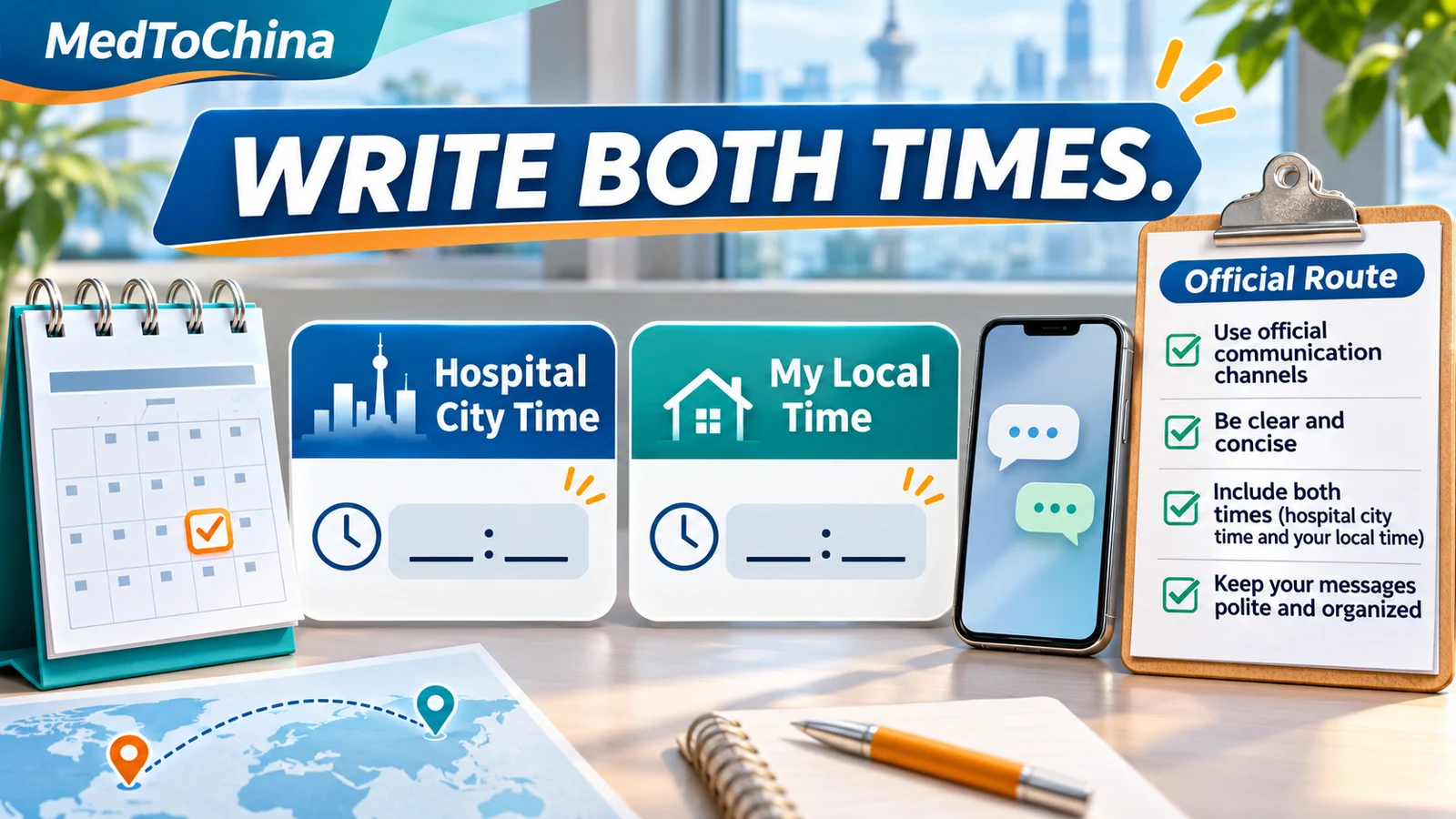
Write the time as a pair:
Hospital: Beijing, China - Friday 15 May, 10:00 local time
Patient: Toronto, Canada - Thursday 14 May, 22:00 local time
Purpose: administrative records follow-up
Channel: official hospital phone number / verified messaging route
The example shows a format, not a recommended time or a promise that a hospital will call. Replace each city and date with the actual information supplied by the hospital. Use a current time-zone tool on your device shortly before the call rather than relying on a conversion you saved weeks earlier.
Time-zone rules can change. The IANA Time Zone Database is updated to reflect government changes to offsets and daylight-saving rules, and operating systems and apps may receive those updates at different times. 1 For a scheduled call, use a named city as well as a time-zone abbreviation. “China time” may be clear in context, but “Beijing, Friday 10:00” is easier to verify and record.
Start with the hospital's exact local time
When a hospital or official patient-service channel suggests a callback, first ask which local city time they mean. Do not assume the hospital uses the same time zone as a city you plan to visit, especially if the hospital group has more than one location or the person calling works from another office.
Ask for these five details in one message:
- The hospital city or campus relevant to the call.
- The local date and time proposed by the hospital.
- The purpose of the callback.
- The official number or verified channel from which the contact may occur.
- The official follow-up route if the call is missed.
You do not need to ask a hospital to disclose its staff member's personal number. A hospital may use a switchboard, patient-service desk, call center, or official messaging account. Your goal is to know which official route should be used for a practical reply, not to obtain a personal contact.
Convert the time once, then confirm it in writing
After you have the hospital's local time, convert it to your own city. Send back one concise confirmation that includes both dates and times. For example:
“To confirm, I will be available on Thursday 14 May at 22:00 Toronto time, which is Friday 15 May at 10:00 Beijing time. Please use the official callback route noted below. If we miss each other, may I reply through [official channel]?”
This does three useful things: it exposes a date-crossing mistake, gives the hospital a chance to correct the conversion, and creates a written record of the agreed communication window. Do not add medical questions, record attachments, payment information, passport details, or one-time codes to a simple time-confirmation message unless the hospital has directed you through a secure, official process.
The U.S. Department of State advises travellers to confirm how their phone will work abroad, save important numbers, and carry a backup contact list in case a device is unavailable. 2 Test the calling or messaging method before your planned window, particularly if you expect to use international roaming, a local SIM, Wi-Fi calling, or a messaging app.
Use a callback record, not a loose calendar note
A calendar reminder is useful, but it does not preserve the details you need after a missed call. Make a small callback record for each planned communication.
- Hospital / campus city: The specific city or campus tied to the official contact.
- Hospital local date and time: Copy it exactly as confirmed.
- Your local date and time: Record the converted date as well as the hour.
- Time-zone reference: Named city and current UTC offset if your device shows it.
- Purpose: Administrative update, records question, travel preparation, or another non-clinical topic.
- Official route: Hospital switchboard, patient-service number, official email, portal, or verified account.
- Missed-call route: The route the hospital asks you to use if no connection is made.
- Access date: When you confirmed the details.
Keep this record separate from your medical records. It should contain only practical communication data. If a hospital sends a link, note the source and access date. Do not use a result from a web search, an unofficial social-media account, or an unknown caller ID as proof that the call is legitimate.
Set up your phone without creating a privacy problem
Before the window opens, check that your phone can receive the relevant type of contact. The exact setup depends on your carrier, device, country, and chosen communication method. The U.S. Department of State notes that phone plans may not include international service by default and that users should consider a backup communication method. 2
Practical steps:
- Save the official number with its full country code when you have one.
- Keep your device charged and keep its clock set to automatic time.
- Set a reminder for both your local time and the hospital's local time.
- Check that voicemail or an alternative contact method is active if you choose to use it.
- Tell a trusted contact your planned communication window only if you want them to know. Keep this separate from your emergency contact card for travel.
- Do not share passwords, bank details, passport numbers, records, or verification codes in response to an unexpected caller.
An official hospital call may still be missed because of a network issue, a delay, a blocked unknown number setting, or a misunderstanding about the time. Missing a call does not establish that the hospital rejected your inquiry or that an appointment has been cancelled. Use the official follow-up route you recorded instead of repeatedly calling an unknown number.
If you miss the call, follow a calm verification sequence
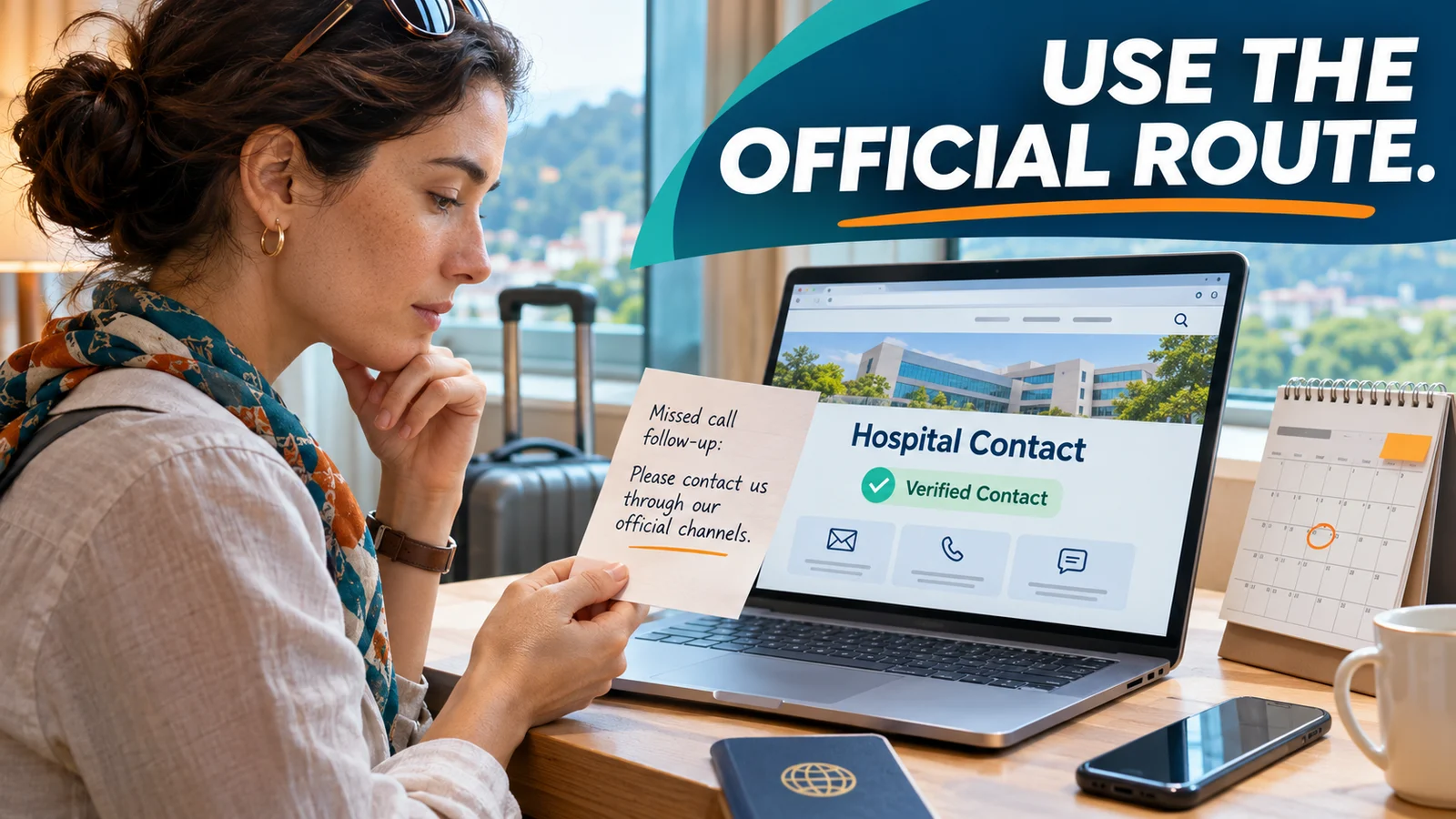
Do not guess who called or send sensitive information to a number that appears on your screen. First compare the time and number with your callback record. Then use the hospital's official patient-service, portal, email, or switchboard route to state that you missed the planned administrative callback.
Your short follow-up can include:
I am following up on a planned administrative callback.
Hospital / campus: [name]
Planned window: [hospital city date/time] / [my city date/time]
Preferred official reply route: [route]
Please let me know the appropriate next administrative step.
Do not write that the hospital “promised” to call, demand an immediate new time, or interpret the missed call as a medical decision. Ask for the appropriate next administrative step. The hospital may suggest a different channel, another written reply, or a new practical time window. That does not establish acceptance, scheduling, or care.
Common errors that create avoidable confusion
Recording only the hour
“10:00 China time” omits the city, date, and the patient's local time. Always record both local dates and cities.
Using a fixed conversion for a future call
Your location or the other party's location may observe daylight-saving changes. Check the conversion close to the time of the call. NIST notes that daylight-saving rules differ by jurisdiction and can change. 3
Treating the call as an appointment or medical consultation
A callback about records or travel preparation is not a clinical assessment, a remote diagnosis, a treatment recommendation, or an appointment confirmation. Keep the purpose narrow and follow the hospital's official process for any clinical or administrative next step. See what counts as a confirmed hospital booking before treating an administrative message as a scheduled visit.
Calling back an unverified number with sensitive data
An incoming number can be incomplete, spoofed, or unrelated to the hospital. Start from the official route you recorded. Do not provide an SMS code, password, financial information, identity-document number, or medical files merely because a caller says they are from a hospital.
How MedToChina can help with practical preparation
MedToChina can receive your planned China travel period, preferred language, basic records, and practical communication questions through the website or WhatsApp. You can share an official hospital message or callback window and ask how to organize the information for a later service conversation.
The service team can discuss practical preparation and available cooperation-resource processes after understanding your situation. This page does not arrange clinical calls, automatically select a hospital or clinician, confirm a callback, or provide clinical assessment.
FAQ
Should I write Beijing time or my own time?
Write both. Include the hospital city and local date/time first, then your city and local date/time. A date may differ across the two locations.
What if I do not know which number will call me?
Ask the hospital for the official follow-up route rather than a personal number. Save the switchboard, patient-service channel, portal, or official email that the hospital identifies.
Does a missed callback mean my appointment was cancelled?
No. A missed call alone does not establish appointment status or a medical decision. Contact the hospital through the official route and ask for the appropriate administrative next step.
Should I send my records after a missed call?
Only send records through the official route the hospital has identified and only in the format it requests. Do not attach sensitive material to an unknown number or unsolicited message.
What if I have urgent symptoms while waiting for a callback?
Seek timely local medical care. Do not wait for an administrative callback or an online reply.
Discuss Your China Medical-Travel Preparation
Submit your information and questions through MedToChina or message us on WhatsApp if you are preparing to communicate with a hospital in China. Include your preferred language, intended travel period, the official channel you are using, and the practical question you want to clarify. Do not send verification codes or unnecessary sensitive details in a general message.
Medical Disclaimer
This article provides general communication and travel-preparation information only. It is not medical advice, a diagnosis, an appointment confirmation, an emergency service, a hospital authorization, or a promise that a hospital will call, accept a case, or provide care. For urgent symptoms or immediate danger, seek local emergency assistance without waiting for a callback or online response.
References
- Internet Assigned Numbers Authority, Time Zones.
- U.S. Department of State, Communicating While Abroad.
- National Institute of Standards and Technology, Local Time FAQs.
- Centers for Disease Control and Prevention, Before You Travel.