
Visa & Travel
Travelling Alone for Care in China: Preparing an Emergency Contact Card
Prepare an emergency contact card for solo medical travel to China: consented contacts, country codes, language, time zones and a paper backup.
MedToChina Editorial Team · 10 min read · November 15, 2026
Quick Summary
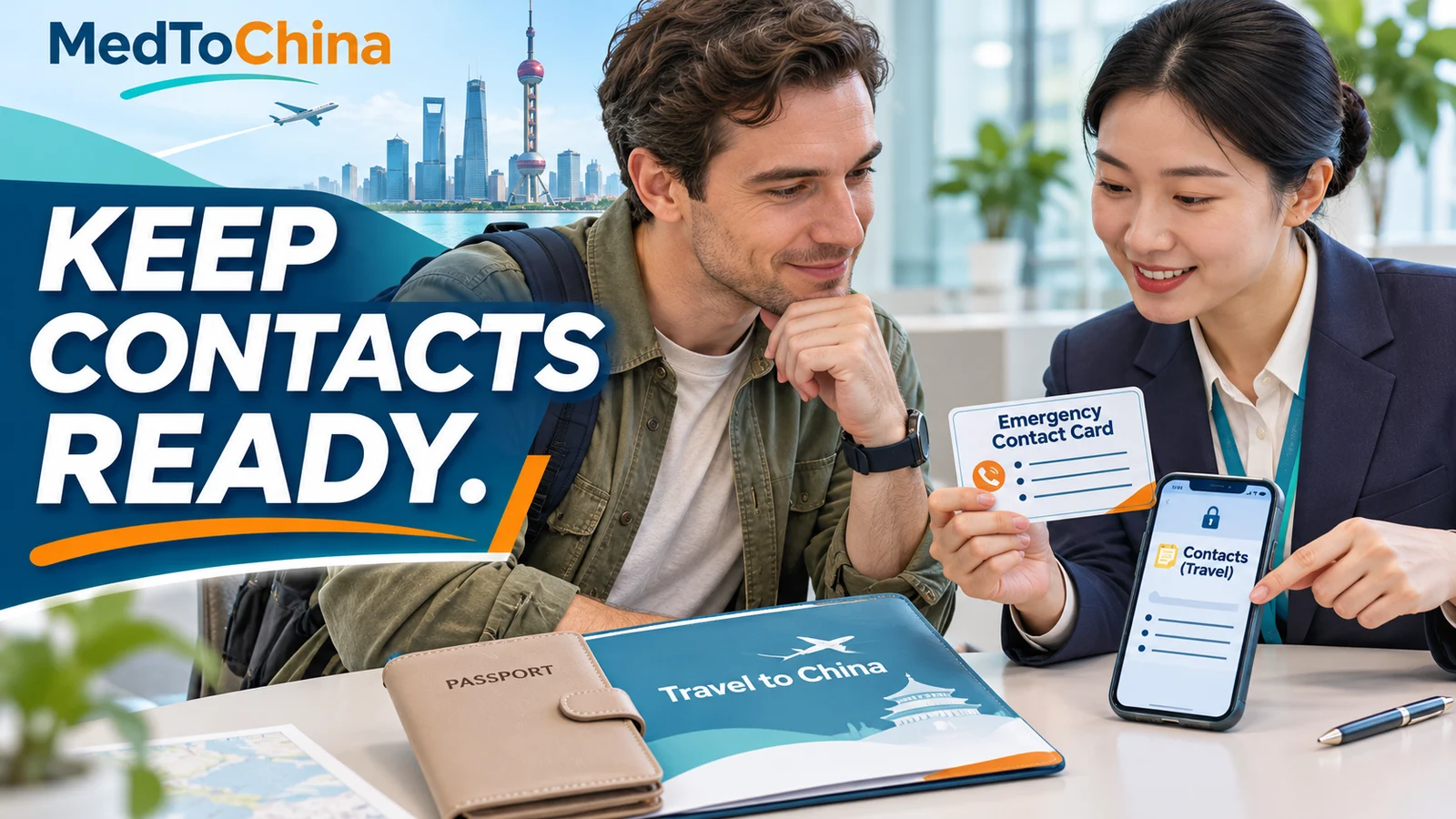
If you are travelling alone to China for medical care, prepare one concise emergency contact card before departure. It should help someone identify the person you want contacted, the best way to reach them, their language and time zone, and what practical travel details can help them understand where you are.
The card is not a medical power of attorney, consent form, hospital authorization, insurance approval, diagnosis summary, or substitute for local emergency services. It does not give another person automatic access to records or the right to make decisions for you. It is simply a practical, patient-controlled reference to use if you cannot readily explain whom to contact.
The CDC advises travellers to carry emergency contacts, keep important contact information accessible, and make sure someone at home knows how to reach them in an emergency. 1 For solo medical travel, a small written card and a securely saved phone copy can reduce avoidable confusion when a phone battery, network connection, language, or time-zone difference gets in the way.
What an emergency contact card can and cannot do
An emergency contact card is a communication aid. It allows you to state, in advance, who should be contacted if you are unable or unavailable to do so yourself. It can be useful during travel, at accommodation, while moving between a hospital and your lodging, or during an unexpected communication problem.
It does not replace any document that a hospital, insurer, embassy, airline, or public authority may require. It does not establish legal authority, consent to treatment, access to your health information, financial responsibility, or permission for another person to sign on your behalf. Requirements for these matters vary by situation and institution; ask the relevant organization directly if you need a formal authorization.
Treat the card as a contact tool, not a file of sensitive medical or financial data. It should be clear enough to use quickly but limited enough that losing it does not expose more information than necessary.
The minimum information to include
Use information you have permission to share. Confirm each contact first and ask how they prefer to be reached while you are in China.
- Your name: Your preferred name and passport name if they differ. Why it matters: Helps contacts and service staff identify whose card it is.
- Your reachable number: A phone number that works during the trip, if known. Why it matters: Shows a direct route to try before contacting someone else.
- Primary contact: Full name, relationship, country code, preferred contact method. Why it matters: Gives one clear first person to try.
- Backup contact: Full name, relationship, country code, preferred contact method. Why it matters: Helps if the primary contact is asleep, travelling, or unreachable.
- Language: The language each contact can use comfortably. Why it matters: Supports a practical communication handoff.
- Time zone: City or UTC offset, checked before travel. Why it matters: Helps avoid calling at an unsuitable hour.
- Travel reference: Hotel name, planned city, and travel dates only if you choose. Why it matters: Gives limited context without listing a full itinerary.
- Optional service note: “For practical travel questions, contact patient directly when possible”. Why it matters: Keeps the card's purpose narrow.
Do not add passport numbers, bank-card details, account passwords, medical-record copies, diagnoses, medication lists, insurance policy numbers, or private family information unless a specific organization has told you it is necessary and you have a secure way to provide it. A contact card should not become a wallet-sized dossier.
Choose contacts who have agreed to the role
Do not list someone just because they are a relative, colleague, or former caregiver. Ask first. A suitable contact understands that they may receive a call or message at an inconvenient time and knows what you expect them to do.
Discuss these questions before you leave:
- May I list your name and number as my emergency contact during my China medical trip?
- Which phone number and messaging method should be tried first?
- What hours are you normally reachable, and what time zone should I write down?
- Who is the backup person if you cannot respond?
- What basic information are you comfortable receiving or sharing if someone cannot reach me?
- How should we check in during travel and after a hospital visit?
The last question is practical rather than legal. Agreeing to receive a call does not grant a contact authority to receive records, make treatment choices, access payment accounts, or speak for you in every setting. If you need formal arrangements, obtain appropriate advice from the organization or qualified professional involved.
Make time zones and phone details usable
An international number is only helpful if it can be dialled. Save contacts with their country code, then test the calling or messaging route before departure. Do not assume the app you normally use will work on every connection. The U.S. Department of State recommends keeping important numbers accessible and carrying a printed list as a backup in case a phone is lost or unavailable. 2
For each contact, write a city and a time zone rather than a vague label such as “home.” If daylight-saving changes may apply in their location, recheck the offset shortly before travel. Use a clear rule in your card or phone note, such as: “Please try text or WhatsApp first between 08:00 and 22:00 in Toronto time; call only if urgent.” Do not assume China time is the same as a contact's local time.
Keep the information accurate but brief. For other communication preferences, see hearing and vision support during hospital visits. You do not need to publish your room number, full daily location, flight confirmation, or live location on the card. Send changing travel details directly to the trusted person who needs them.
Use two formats and update both
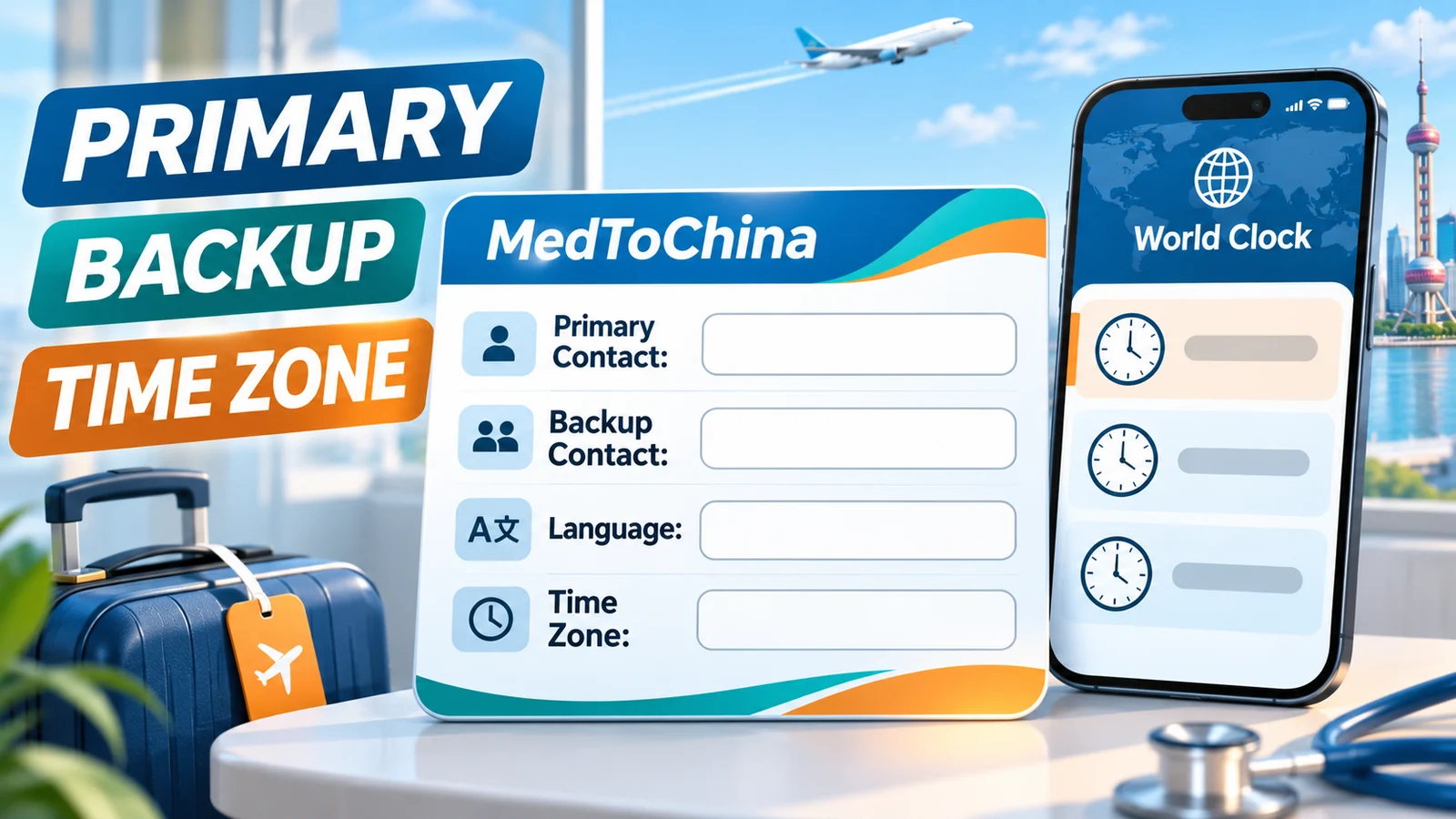
A paper card helps when your phone is charging, locked, lost, or out of data. A digital copy is easier to update. Keep the two versions consistent.
Paper copy
Keep one card in an easy-to-find place, such as a wallet, travel document holder, or the first page of a small travel folder. Use legible writing and avoid folding it so tightly that a number cannot be read. Tell your emergency contacts that you carry it, but do not post a photograph of it on social media.
Phone copy
Save the same information in a clearly labelled note or emergency-information feature on your phone. Check how that feature appears when the phone is locked; settings differ by device. Protect your phone with a passcode and use only the minimum information you are comfortable making available.
Trusted person at home
Give a current itinerary summary, accommodation contact, and a copy of key travel documents only to a trusted person who has agreed to hold them. The CDC recommends leaving copies of important travel documents and contact information with someone at home. 1 This is separate from the small card you carry.
Keep the card separate from clinical and legal documents
An emergency contact card has a narrow purpose. Mixing it with other documents can create confusion. For the separate discussion before treatment, see informed consent explanations and questions.
- Emergency contact card: Wallet and secure phone note. Why it is separate: Quick contact reference.
- Passport and visa copies: Secure travel folder and trusted-person backup. Why it is separate: Identity and travel documentation.
- Medical records: Secure file or the route requested by the hospital. Why it is separate: Clinical material may need translation or a designated upload route.
- Insurance and payment details: Secure insurer or payment channel. Why it is separate: Contact card is not a payment instruction.
- Formal authorization: Organization-specific process. Why it is separate: A card does not create legal decision-making authority.
This separation also helps you describe the right question to a hospital. Rather than handing over a card and assuming it changes permissions, you can ask: “What written authorization, if any, would your institution need before communicating with this person?”
A practical card template
Copy this template and remove anything you do not want to carry.
EMERGENCY CONTACT CARD - MEDICAL TRAVEL TO CHINA
Cardholder name: [fill in]
Preferred language: [fill in]
My reachable number during travel: [fill in]
PRIMARY CONTACT
Name / relationship: [fill in]
Phone with country code: [fill in]
Preferred contact method: [fill in]
Language: [fill in] City / time zone: [fill in]
BACKUP CONTACT
Name / relationship: [fill in]
Phone with country code: [fill in]
Preferred contact method: [fill in]
Language: [fill in] City / time zone: [fill in]
Travel context I choose to share:
Planned city: [fill in] Travel dates: [fill in]
This card lists contact preferences only. It does not grant consent,
access to records, payment authority, or medical decision-making authority.
Fill it in with the contact's permission. Before printing, have each person confirm their spelling, international number, preferred communication app, language, and time zone.
Before departure: a five-minute check
- Call or message both contacts through the method written on the card.
- Confirm their number includes the country code and that the backup contact is different from the primary contact.
- Recheck the time zone and daylight-saving status.
- Remove excess sensitive information.
- Put the paper card in its chosen location and update the phone copy at the same time.
Repeat this if a contact changes number, moves, becomes unavailable, or if your travel dates change. A short current card is more useful than a detailed card with outdated details.
How MedToChina can support practical preparation
MedToChina can receive your basic travel context, preferred language, existing records, intended travel dates, and practical questions through the website or WhatsApp. You may also tell us that you are travelling alone and ask what information you should prepare for the service conversation.
The service team can explain practical preparation and available cooperation-resource processes after understanding your circumstances. This page does not provide emergency response, decide clinical care, automatically select a hospital or clinician, or create formal authorization for another person.
FAQ
Should I put my full medical history on the card?
Usually no. Keep the card focused on consented contact details and basic travel context. Send clinical records only through the secure route requested by the relevant hospital or clinician.
Is an emergency contact card the same as medical consent?
No. It identifies someone to contact. It does not grant medical decision-making authority, access to health information, payment authority, or authorization to sign documents.
Can I list a friend in another time zone?
Yes, if they agree. Write their country code, preferred method, language, city, and time zone, then add a backup contact in case they cannot respond.
Where should I keep the card?
Carry one paper copy in an easy-to-find travel item and keep a matching secure phone copy. A trusted person at home can hold fuller travel and document information separately.
What should I do in an immediate emergency in China?
Seek urgent local assistance first. The card is only a communication aid; it does not replace local emergency services, medical evaluation, insurance assistance, or consular guidance.
Discuss Your China Medical-Travel Preparation
Submit your information and questions through MedToChina or message us on WhatsApp if you are planning care in China. You can share your preferred language, intended travel dates, whether you are travelling alone, and the practical preparation questions you want to discuss. Do not send unnecessary sensitive details in a general message.
Medical Disclaimer
This article is general travel-preparation information, not medical, legal, insurance, emergency-response, or privacy advice. It does not create consent, authority, hospital access, insurance coverage, or a clinical relationship. For urgent symptoms or immediate danger, seek local emergency help without waiting for a contact card or online response.
References
- Centers for Disease Control and Prevention, Before You Travel.
- U.S. Department of State, Communicating While Abroad.
- American Red Cross, Disaster Preparedness Plan: Make a Plan.
- Centers for Disease Control and Prevention, Travel Insurance, Travel Health Insurance, and Medical Evacuation Insurance.