
Visa & Travel
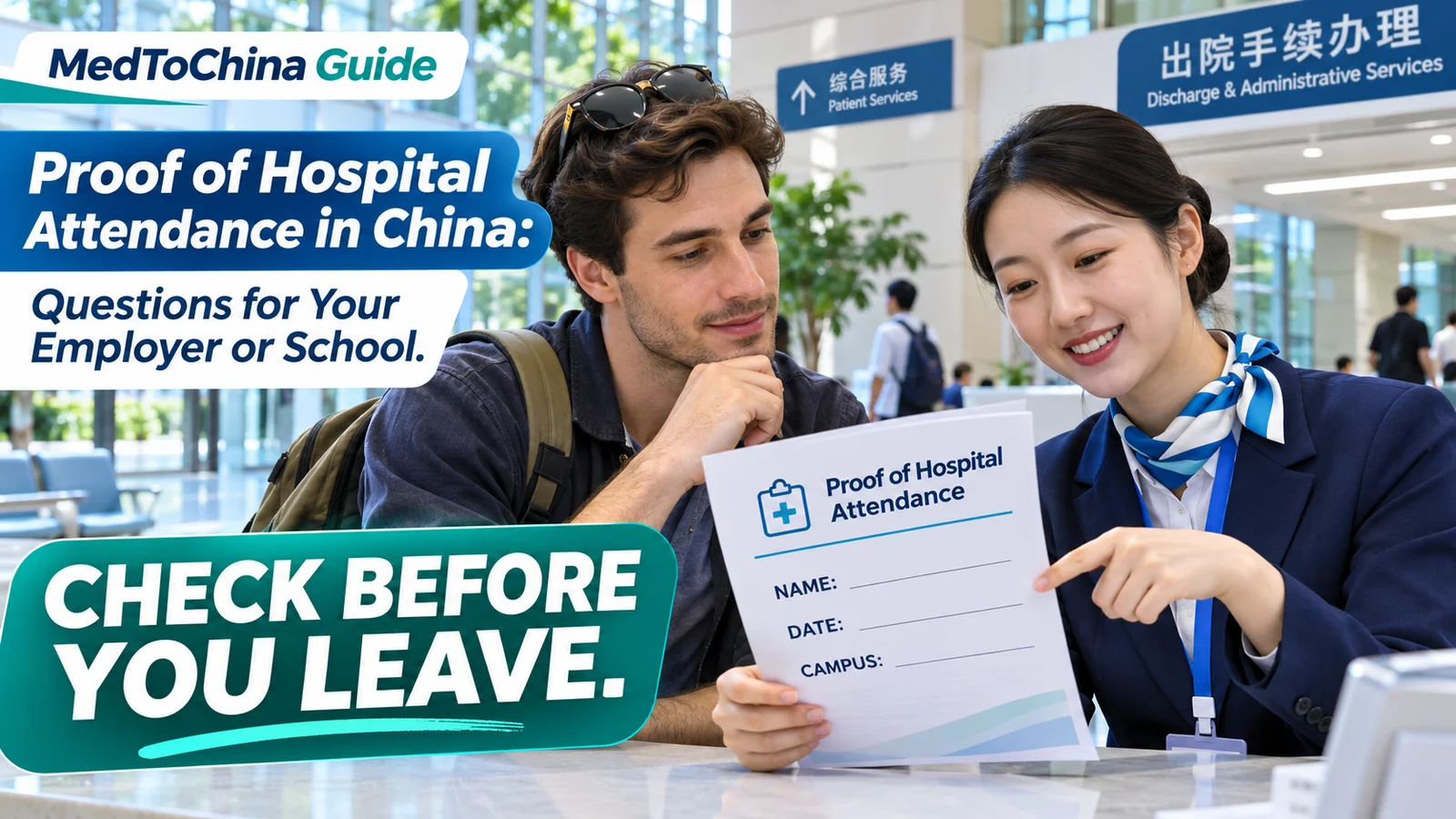
Proof of Hospital Attendance in China: Questions for Your Employer or School
Prepare proof of hospital attendance in China: check employer or school requirements, names, dates, campus, originals and privacy before leaving.
MedToChina Editorial Team · 10 min read · November 16, 2026
Quick Summary
If you are travelling to China for medical care and need to explain an absence to an employer, university, school, or training provider, start by asking that organization what it will accept. A China hospital may be able to confirm limited administrative facts, such as the patient's name, the facility or campus, and the date or dates of attendance. It may not issue a document in the format used by your home country, and it may not be able or willing to state that you were unable to work, fit to fly, eligible for leave, entitled to insurance payment, or medically excused from a particular activity.
The useful question is not simply, “Can I get a medical certificate?” It is: “What exact facts does my employer or school require, in what language, and by what deadline?” Clarify this before you leave the hospital. Then ask the administrative desk or the channel named by the hospital whether it can provide a factual attendance confirmation.
This guide is for international patients coming to China. It is not legal, employment, immigration, insurance, privacy, or medical advice. Rules differ by country and organization.
First, separate attendance proof from a medical certificate
These documents are often treated as if they mean the same thing. They do not.
An attendance confirmation may record that you registered, attended an outpatient appointment, underwent admission or discharge administration, or were present at a named hospital location on a given date. It is a factual record of contact with a facility.
A fitness-for-work note, sickness certificate, disability form, insurance report, academic accommodation form, or fit-to-fly statement serves a different purpose. Each may require a clinical assessment, a local legal format, a named professional, or information that the hospital does not provide to overseas patients in that form.
For example, UK government guidance describes a fit note as evidence based on an assessment of a person's fitness for work, rather than merely evidence that the person attended a health facility. 1 That rule is specific to the UK, but it illustrates the practical difference: an attendance letter should not be treated as a conclusion about what you could or could not do.
Use precise language when you ask. “Proof of attendance” or “attendance confirmation” is safer than asking a hospital to certify an outcome it has not assessed.
Ask your employer or school before you request anything
The receiving organization decides whether a document is enough for its own absence, leave, enrollment, examination, or accommodation process. A hospital cannot promise that an employer, school, visa office, insurer, or licensing body will accept its letter.
Send a short written question before your China visit if time allows. Ask:
- Is a factual hospital-attendance letter acceptable for my absence record?
- Which facts must appear: full name, dates, hospital name, campus, department, admission/discharge status, stamp, signature, or contact details?
- Does the document need to be in English, bilingual, translated, certified, notarized, or issued on a particular format?
- Is a digital scan acceptable, or must I retain the original?
- What is the submission deadline and which internal team receives it?
- Do you need evidence of attendance only, or are you asking for a separate medical, leave, insurance, or accessibility process?
Keep the answer. It gives you a practical checklist when you speak with the hospital. It also avoids requesting a diagnosis or a statement about work capacity that the recipient did not actually need.
Check the policy of the actual institution or employer, rather than a general online discussion. The relevant contact may be student services, a registrar, a manager, HR, or an absence-policy team. Do not assume a rule from one country applies in another.
What a factual China hospital attendance document may include
Hospital practices vary. A hospital may provide a receipt, registration record, discharge-related paper, appointment record, or short confirmation letter. Decide the minimum facts you need.
- Patient name: Must match the receiving organization's record. Boundary: Check spelling against your passport and school/employer record.
- Attendance date or date range: Establishes when you were at the facility. Boundary: Ask whether it is an appointment date, admission date, discharge date, or all applicable dates.
- Facility and campus: Large systems may have more than one site. Boundary: A hospital group name may not identify the campus you attended.
- Department or service location: May help the recipient understand the document's administrative context. Boundary: Do not ask for a diagnosis just to make the letter look more detailed.
- Issuing office and contact route: Lets a recipient ask a factual verification question if permitted. Boundary: Confirm the contact route is official and do not share private staff details.
- Language and format: Determines whether you need a separate translation. Boundary: Do not alter the original document yourself.
An attendance document does not need to disclose more clinical information than the receiving organization needs. In many situations, a date, facility name, and patient identity are enough to establish that you attended. Ask whether a diagnosis is truly necessary before requesting or sharing it.

Before leaving the hospital, do a five-point document check
Once the hospital has provided any attendance-related paper, check it while you are still able to ask an administrative question. Do not edit the original. Instead, confirm whether the document accurately records the facts you asked it to record.
1. Confirm the name
Compare the name on the document with the name used by your employer or school. If your passport name, preferred name, and institutional record differ, ask the recipient how it wants you to handle that difference. Do not ask hospital staff to guess which version another organization will accept. See questions to resolve name differences across hospital records.
2. Confirm the dates and location
Read every date carefully. A registration date, procedure date, admission date, discharge date, and date of issue are not interchangeable. Also check the specific hospital campus, especially if the organization uses a group name with several locations.
3. Confirm the document's purpose
Ask the hospital whether the paper is a visit confirmation, receipt, discharge record, or another administrative document. Describe it accurately when you submit it. A receipt is not automatically a clinical certificate, and a discharge document is not automatically a work-capacity opinion. See hospital invoices and itemized bills for the separate payment-document checklist.
4. Ask about originals, copies, and translations
Ask whether a scan is sufficient and whether translation is needed. Preserve the original and a scan. Do not annotate or alter the hospital's original document.
5. Check the official follow-up route
If a correction is needed after you leave, record the official administrative contact channel, opening hours, and any case or registration number you are allowed to retain. Do not rely on a personal messaging account or a photographed staff badge. Use the hospital's official contact path and avoid sending sensitive records or identity documents unless that route specifically instructs you to do so.
Do not ask an attendance letter to prove something it cannot prove
International travel adds pressure to make one document solve several issues. That can create problems for both the patient and the receiving organization.
An attendance confirmation normally cannot, by itself:
- establish eligibility for paid leave, sick pay, reimbursement, or insurance;
- confirm that you were unable to work, attend class, travel, or take an exam;
- authorize a visa extension, border decision, or change of travel plan;
- replace a formal disability, accommodation, workplace, or insurance form;
- prove that a clinical service was medically necessary;
- guarantee that an employer, school, insurer, or authority will accept it.
If the recipient needs a separate form, ask it for the exact form and its instructions. Then ask the hospital only whether it has a suitable administrative route to consider the request. Do not promise a result to your school or employer until you have checked both sides.
The CDC advises people travelling for medical care to bring copies of relevant medical records and to plan for follow-up care after returning home. 2 Keeping an orderly copy of attendance documents alongside your travel and clinical records can help your own administration, but it does not change the recipient's policy or create a clinical conclusion.
Protect your privacy when submitting the document
Send only what the recipient says it needs. An employer or school may need confirmation of dates, not test results, treatment details, payment documents, passport copies, or a full hospital record.
Before sending a file, check:
- the recipient's official email address or portal;
- whether a secure upload route is required;
- whether you should send a scan, translation, or both;
- whether the file includes more personal information than necessary;
- whether the receiving team has a deadline and a confirmation process.
Keep the original and a clean scan. Record when you sent the document and to whom, but do not mistake a sent email for acceptance. Ask the receiving organization to confirm receipt through its normal process.
The UK guidance also notes that employers should obtain the employee's permission before requesting a health report and should handle health information confidentially. 1 Local law and organizational practice vary, so treat this as a privacy principle, not a universal rule. Ask the specific recipient how it handles medical information.

A practical request script at the hospital
You can use a simple, factual request. Adapt it to the hospital's language support and instructions.
I need a document for my employer or school confirming that I attended this hospital.
They need my name, the attendance date(s), and the hospital or campus name.
Do you have an official administrative document or contact route for this purpose?
I understand it does not need to state a diagnosis, work capacity, insurance eligibility, or travel fitness.
If your employer or school has specific wording, show the requirement rather than asking the hospital to infer it. Do not ask staff to backdate a document or state facts the record does not support.
How MedToChina can help with practical preparation
Before you travel, you can submit your basic information and non-clinical questions, or send your questions through WhatsApp. Tell us your destination city, expected dates, document purpose, preferred language, and any written requirements from your employer or school.
MedToChina can help you organize the practical questions to raise through the appropriate administrative channel and explain what travel and document details to prepare. We do not issue hospital letters, decide whether an organization will accept a document, provide employment or school advice, or make clinical judgments.
FAQ
Is a hospital receipt enough for my employer or school?
Possibly, but only the receiving organization can decide. Ask it whether a receipt is acceptable or whether it needs a factual attendance confirmation with particular details.
Can a China hospital write that I was unable to work or attend class?
Do not assume so. That is different from confirming attendance and may require a separate clinical or administrative assessment. Ask your employer or school what it needs, then ask the hospital whether it has an appropriate process.
Should I request the document in English?
Ask the receiving organization first. It may accept the original, require a translation, or specify a format. The hospital may have its own available languages and processes.
What if I notice an error after leaving China?
Use the hospital's official administrative contact route. Describe the factual error, keep your original document, and ask what correction process is available. Do not alter the document yourself.
Should I send my full medical record to my school or employer?
Usually, send only what it explicitly requires. A factual attendance document may be enough. Ask about a secure route if sensitive information is needed.
Discuss Your China Medical-Travel Preparation
Need help preparing practical questions before medical travel to China? Submit your information or send your non-clinical document questions and available records through WhatsApp. Our team can discuss the next administrative steps and China care-travel preparation after understanding your timeline and available information.
Medical Disclaimer
This article provides general travel and administrative information for international patients considering medical care in China. It is not medical, legal, employment, school-policy, insurance, immigration, privacy, or translation advice. Requirements and document availability vary by hospital, recipient organization, and jurisdiction. For urgent medical symptoms, seek prompt local medical help.