
Visa & Travel
China Hospital Portal Access: Overseas Phone Numbers and Report Login Questions
A practical checklist for international patients to confirm hospital portal registration, overseas phone verification, report access, and official alternatives before care in China.
MedToChina Editorial Team · 11 min read · November 10, 2026

Quick Summary
- Many hospitals in China use a website, app, mini-program, call center, or on-site desk for registration, payments, appointment details, and some report access. The available functions and identity requirements differ by hospital and department.
- Before travel, ask the hospital through an official channel how an overseas patient should register, which identity document is accepted, whether an overseas phone number can receive verification messages, and what to do if it cannot.
- Never send passwords, one-time codes, passport scans, or medical records through an unverified contact. Do not ask another person to create an account in your name or to bypass identity checks.
- Confirm whether reports will appear in the portal, how long they remain available, whether a companion can be authorized under the hospital's own rules, and what official collection route applies if portal access is unavailable.
- Save the answer with the hospital name, campus, department, date, official contact, and any appointment or registration reference. Treat an unanswered point as unconfirmed.
For an international patient travelling to China, a hospital account can look like a small administrative detail. In practice, it may affect how you receive registration notices, locate a department, pay a fee, see a result notice, or understand where to collect a report. It is therefore worth clarifying before travel, particularly when a patient uses a phone number from another country or will leave China soon after tests are completed.
This guide is about access preparation, not medical advice. It does not tell you how to create an account at a particular hospital, interpret a report, share credentials, or circumvent a verification rule. The useful goal is to identify the official route and a lawful alternative if a portal is unavailable.
China's health system has expanded digital services for registration, payment, appointments, and health information, while national sources also emphasize data safety and identity verification.[^1][^2] That does not mean every hospital portal works the same way or that every function is available to every visitor. A clear question list is more reliable than assumptions based on another hospital, a travel forum, or an old screenshot.
Start with the right question: which service, at which hospital, for which visit?
The phrase “hospital app” can describe several different systems. A hospital may use a website, app, mini-program, official telephone line, in-person desk, or a city- or province-level platform. One channel may show appointments but not reports; another may require identity verification before payment or access to personal data.
Before contacting the hospital, write down the basic context:
- hospital and campus;
- the department, examination center, clinic, or inpatient service;
- the visit date or approximate travel window;
- whether you already have an appointment reference;
- the identity document you expect to use for registration;
- whether your usual phone number is an overseas number;
- whether your question is about registration, verification messages, appointment notices, payment information, reports, or an official alternative.
This makes it easier for a hospital contact to answer a specific administrative question. It also keeps you from asking a general channel to make a medical decision. A customer-service or registration team may clarify where an account is used; it does not decide what tests or treatment are appropriate.
Why overseas phone numbers need an explicit check
Some online systems send a verification message to a phone number. Whether a specific overseas number can be entered or receive a message depends on the individual platform, its current settings, identity procedure, mobile carrier conditions, and the service being requested. Do not assume that an international dialing prefix, roaming, a local SIM card, or a family member's number will solve the issue.
Ask the official hospital channel these limited questions:
- Can an international patient register with the identity document planned for this visit?
- Does this registration route accept an overseas mobile number for verification messages?
- If it does, what number format should be entered according to the hospital's instructions?
- If it does not, is there an official on-site registration or account-help desk?
- Is a local contact number required for a particular purpose, such as a day-of appointment notice, and who can explain the permitted options?
- What should the patient bring to the desk: passport, appointment reference, payment record, or another document?
The right outcome may be “use the desk on arrival” rather than “make the portal work from abroad.” Record the named desk, location, and official contact.
Never share an account password or a one-time verification code with a coordinator, companion, agent, or unverified message sender. A code may provide access to sensitive personal or financial information. Keep control of your own device and account. If the hospital offers a patient-authorized representative process, ask the hospital how it works rather than assuming that a relative can use the patient's login.
Registration, identity, and account ownership are separate questions
Patients sometimes group all digital tasks under “registration,” but these can involve different steps:
- Appointment reference: a confirmation number, department, date, or queue information;
- Identity registration: linking the visit to the patient's own accepted identity document;
- Account login: the credentials needed to access a particular platform;
- Phone verification: a message or call used to confirm a number or action;
- Payment function: a separate route for fees, receipts, or deposits;
- Report access: viewing a result notice, a document, image access, or a collection instruction.
Do not assume success in one step confirms the others. A patient might receive an appointment confirmation but still need to register on site. A portal might display that a report is ready without providing a full document. A report may be collected from a department even if online viewing is not available. The National Health Commission's materials describe both the growth of digital health services and the importance of privacy and secure handling of health information.[^1][^3]
Use the patient's own correct identifying information. Do not ask a friend or service provider to register under their own identity, lend an account, invent contact details, or work around a failed verification process. Incorrect identity data can make a later report, receipt, account recovery request, or records question harder to resolve.
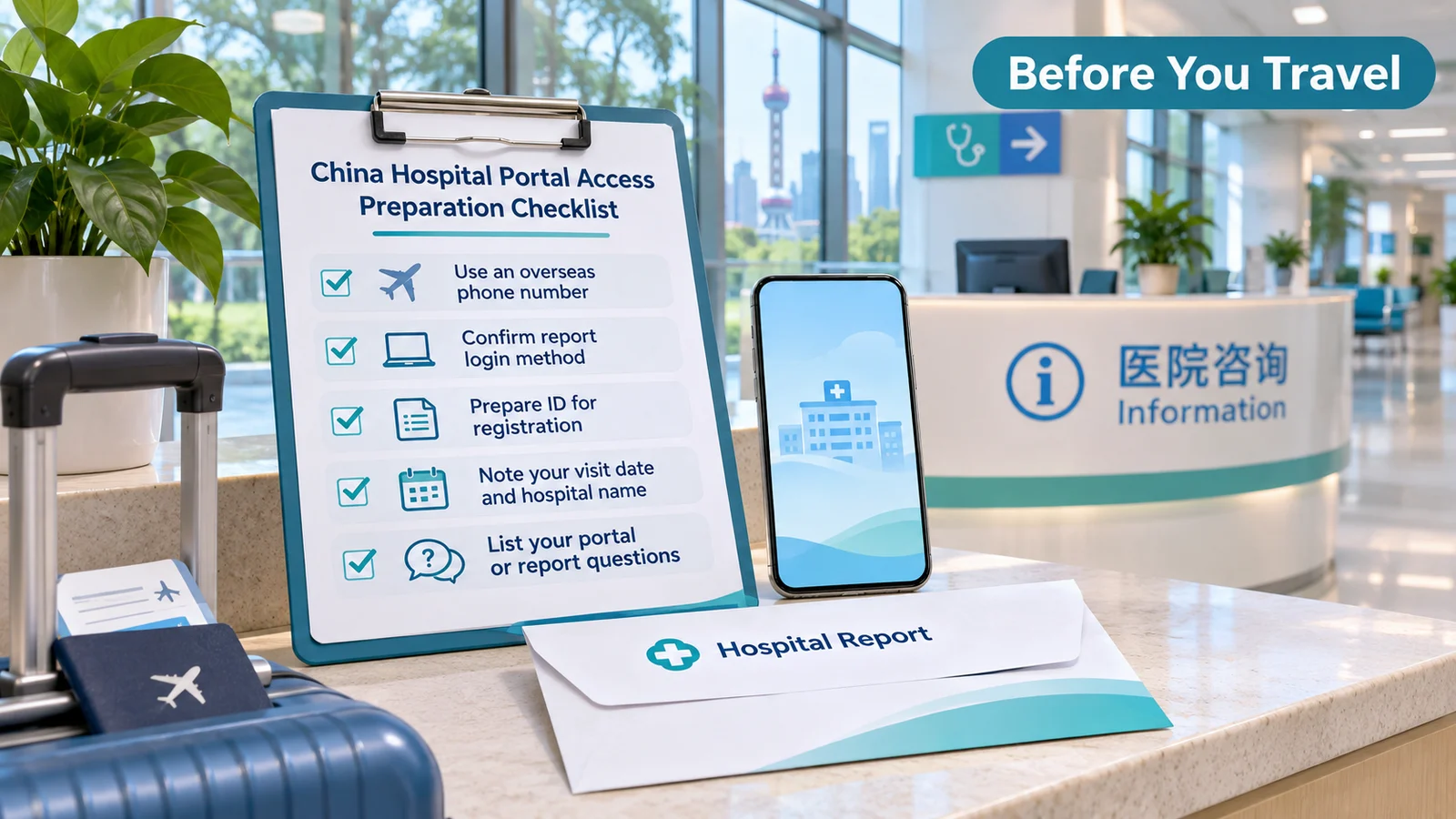
A pre-travel portal and phone checklist
Make a short table or note before you travel. Keep it administrative; do not put passwords or verification codes in a shared document.
- Item: Official channel; Question to confirm: Which official website, app, mini-program, call line, or desk applies?; What to record: Link/name, date, contact
- Item: Patient identity; Question to confirm: Which document is used for this visit?; What to record: Document type; do not store full number in shared notes
- Item: Account route; Question to confirm: Is a portal account required before arrival?; What to record: Yes/no and stated procedure
- Item: Overseas number; Question to confirm: Can the planned number receive system messages?; What to record: Stated answer and format guidance
- Item: Alternative; Question to confirm: What is the official route if verification is unavailable?; What to record: Desk, building, hours, documents
- Item: Appointment; Question to confirm: Where can date, department, and reference be checked?; What to record: Official confirmation route
- Item: Reports; Question to confirm: Will this service show a notice, a report, images, or only collection instructions?; What to record: Function described by hospital
- Item: Access period; Question to confirm: Is there a stated window for online access or collection?; What to record: Date/time stated; verify again if travel changes
- Item: Authorized person; Question to confirm: Is there a hospital process for a representative, if needed?; What to record: Official policy contact, not assumptions
- Item: Day-of help; Question to confirm: Which information desk or official number handles access trouble?; What to record: Campus, desk, phone, hours
Ask “What official alternative applies if my number does not receive a message?” rather than “Can someone register for me?” This keeps the question within the hospital's own process.
Report access is not the same as receiving clinical advice
International patients may reasonably want to know how to obtain reports before leaving China. However, portal availability does not turn a result into a diagnosis, and a digital notice is not a substitute for speaking with the responsible clinical team about what a result means.
Ask the hospital or relevant department:
- Will the report be available through an official account, collected at a desk, sent through another official method, or handled through a stated records process?
- Does the portal show a readiness notice, a downloadable report, images, or a limited record view?
- Which department owns the report-access question: clinic, radiology, laboratory, pathology, medical-records office, or another unit?
- If the patient departs China before the expected result time, what official route should be used to ask about collection or records access?
- What identification or authorization documentation, if any, is required for the hospital's stated process?
Do not ask MedToChina, a messaging group, or a general registration contact to interpret a report. Medical interpretation belongs with an appropriate clinician. If a patient develops urgent symptoms or is told to seek urgent care, they should use local urgent or emergency services rather than wait for an account response.
Protect privacy while asking practical questions
Digital health records contain sensitive information. Global health guidance recognizes privacy, confidentiality, accurate records, and usable patient access as important issues, while noting that access models differ across systems.[^4][^5] In a cross-border setting, it is sensible to use the minimum information needed for each administrative request.
Useful safeguards include:
- use the hospital's published website, app listing, verified switchboard, or clearly identified desk rather than a search-ad link or unsolicited message;
- check the domain, account name, and hospital contact details before sharing documents;
- keep passwords, verification codes, payment-card information, and passport images out of informal group chats;
- ask whether a secure upload channel is available before sending medical records;
- save official instructions, removing sensitive details before forwarding;
- bring an offline copy of essential appointment details;
- ask the hospital what to do if the account name, document type, or contact information appears incorrect instead of creating a second account.
MedToChina can help you make this question list clear and organize non-sensitive administrative details for an inquiry. We do not hold passwords, receive verification codes, impersonate patients, register accounts under someone else's identity, or bypass a hospital's identity and privacy rules.
What to do when something does not work
An error message, missing code, untranslated screen, or unavailable report button does not necessarily mean an appointment has failed. Identify the exact point of failure and use the official route for that function.
Record whether the issue concerns account creation, identity entry, message delivery, login, appointment display, payment, report notice, or document collection. Note the date, campus, and reference number, but do not circulate private codes or identifiers. Ask the official hospital contact which desk or department handles it.
Avoid repeatedly opening accounts with different names, numbers, or documents. Multiple inconsistent accounts can create confusion. Do not rely on an online portal as your sole proof of a visit. Carry the official appointment details and the required identity document, and arrive with enough time to use the stated in-person process if needed.
How MedToChina can support preparation
For international patients planning care in China, MedToChina can help organize a concise, patient-owned checklist covering the hospital name, department, travel dates, account questions, overseas phone situation, and report-access questions. You may submit your information or send your medical records or questions through WhatsApp. After understanding your condition, travel timeline, country preference, budget, and available records, our customer-service team can discuss possible care pathways and China hospital resources.
This article does not promise that a particular hospital portal, language interface, phone-number method, report route, department, or appointment will be available. The relevant hospital remains the source of current administrative requirements and clinical teams remain responsible for medical decisions.
FAQ
Can I assume my overseas phone number will work with every hospital portal in China?
No. Ask the specific hospital through an official channel whether its current registration or verification process accepts your planned number and what official alternative applies if it does not.
Should I give my WhatsApp verification code to someone helping with my visit?
No. Do not share passwords or one-time codes. Ask the hospital about its own authorized support or representative process if another person needs to assist with an administrative task.
Does a portal report mean I have received medical advice?
No. A portal may show a notice, document, image, or collection instruction. Questions about the meaning of a result need an appropriate clinical discussion.
What if I cannot log in after I return home?
Use the official hospital contact and the records or department route stated by the facility. Keep your visit details, identity document information, and official confirmation records available, but do not create an account using another person's identity.
Can MedToChina create or manage my hospital account?
No. We can help you organize questions for official hospital channels. We do not collect passwords, verification codes, or credentials, and we do not bypass identity verification.
WhatsApp CTA
Preparing for hospital registration, overseas phone verification, or report access in China? Send your non-sensitive questions and visit details through WhatsApp, or submit your information. MedToChina can help you structure a practical confirmation checklist for the relevant official channels.
Medical Disclaimer
This article provides general administrative information for international patients considering medical care in China. It is not medical, legal, cybersecurity, immigration, insurance, or financial advice. It does not create a hospital account, confirm identity requirements, guarantee portal access, interpret reports, or determine whether a patient should travel or receive any test or treatment. Hospital procedures can change. Confirm current requirements directly with the relevant official hospital channel. For urgent symptoms or an emergency, seek appropriate local urgent or emergency care.
Related Guides
References
[^1]: National Health Commission of the People's Republic of China. China's cabinet issues guideline on “Internet Plus healthcare”. [^2]: The State Council of the People's Republic of China. China achieves interconnectivity of citizens' health information. [^3]: National Health Commission of the People's Republic of China. Electronic data improve patient services. [^4]: World Health Organization. Patient access to and control of data. [^5]: World Health Organization. World health statistics 2024: right to access medical records.