
General
Privacy and Chaperone Questions for Intimate Examinations in China
Prepare privacy and chaperone questions for an examination in China: who may be present, language support, preferences and how to ask for a pause.
MedToChina Editorial Team · 10 min read · November 19, 2026

Quick Summary
If you may need an intimate examination while seeking care in China, it is reasonable to prepare clear questions about privacy, who may be in the room, language communication, and how to express your preferences. The most useful approach is to ask before the examination begins, explain your needs calmly, and confirm what the hospital can and cannot arrange for that particular visit.
Do not assume that a policy from your home country applies in the same way at a hospital in China. Do not assume a specific staff member, interpreter, family member, or chaperone will be available. This guide helps international patients prepare questions for possible in-person care in China. It does not establish legal rights, guarantee a particular staffing arrangement, provide remote clinical assessment, or replace urgent local care.
What is an intimate examination?
An intimate examination can involve an examination of areas that a person may reasonably regard as private, including the breasts, genitals, rectum, or other sensitive areas. The exact reason, scope, timing, and clinical need are matters for the treating clinical team. For an international patient, uncertainty may also involve language, unfamiliar hospital processes, cultural expectations, a companion's role, and the amount of privacy available in a busy clinical setting.
The UK General Medical Council's guidance describes intimate examinations as situations requiring sensitive communication, including discussion before the examination and consideration of the role of a chaperone. 1 That guidance is useful as a communication reference only. It is not a statement of Chinese law, a promise about any hospital in China, or a reason to delay care when urgent assessment is needed.
Ask the practical questions before you enter the room
When you know an examination may be discussed, ask a staff member or your designated point of contact what can be confirmed for that visit. You do not need to explain every preference in public. A short written list can reduce stress and help avoid misunderstandings.
Consider asking:
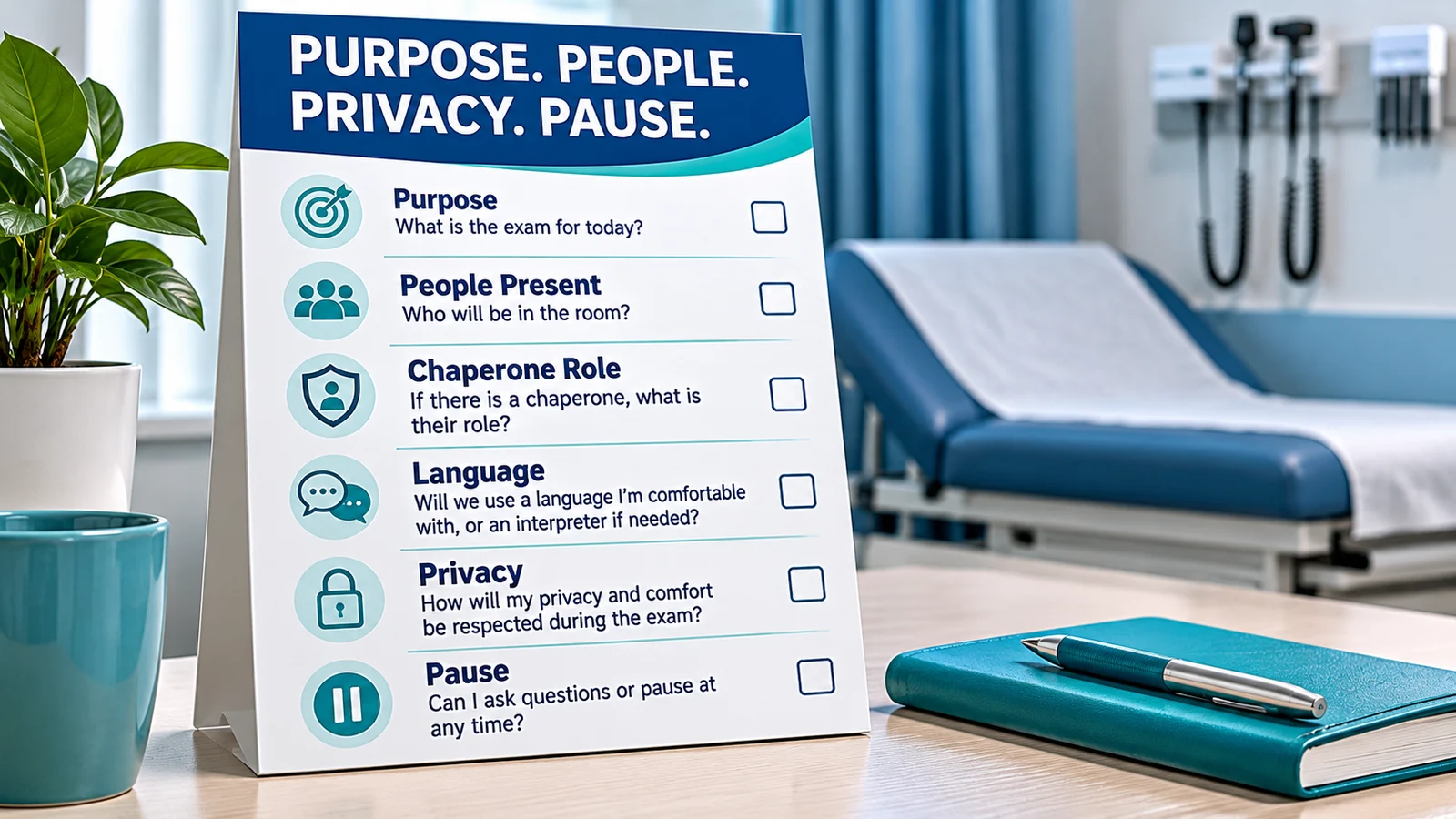
- What is the purpose of the proposed examination, and what area may need to be examined?
- Which people are expected to be present, and what is each person's role?
- Can the team explain how privacy will be protected while changing, covering, or positioning?
- Is a chaperone normally available for this examination, and what is that person's role?
- Can I request a chaperone, a clinician of a particular gender, or a support person? If a request cannot be met, how will that be explained?
- Can a family member or companion be in the room, and are there limits based on space, infection control, safety, or the examination itself?
- How will language interpretation be handled, and who will interpret non-clinical and clinical information?
- What should I do if I feel uncomfortable, do not understand, need a pause, or want to ask a question before proceeding?
These are questions, not demands or guarantees. A hospital may need to consider the clinical setting, staff availability, privacy needs of others, urgency, and local procedures. Asking early gives the team more time to explain realistic options.
Describe your preferences clearly and briefly
You can communicate a preference without needing to give a long personal explanation. For example:
- “I would like to know who will be in the room before the examination starts.”
- “Please explain each step before it happens.”
- “I prefer a chaperone if one is available. Can you tell me the person's role?”
- “I have a language preference. Please tell me how communication will be managed.”
- “I may need a short pause if I do not understand something.”
- “Can you tell me whether my companion may be present and, if not, why?”
Keep the request separate from a medical conclusion. You do not need to say that a prior experience proves a current risk, or that a particular arrangement is medically required, unless your existing clinical record says so. If you have relevant accessibility, trauma-informed communication, religious, cultural, or gender-related preferences, share only the amount of information you are comfortable sharing and ask how the hospital can discuss practical options.
Understand the difference between a chaperone, companion, and interpreter
These roles are not interchangeable. A chaperone may be a staff member whose role is connected to the examination and the professional setting. A companion is a person you bring for personal support. An interpreter supports communication across languages. Depending on the setting, one person may not be able to take on another role, and a hospital may have rules about who can be present.
Before the examination, ask each person's role rather than assuming it. If an interpreter is involved, clarify how your questions and the clinician's explanation will be conveyed. For broader preparation, see the language support guide for Chinese hospitals. If a companion cannot be present, ask whether they can wait nearby, help you prepare questions beforehand, or receive only the information you authorize after the visit.
Do not rely on a companion to interpret sensitive medical discussion unless the clinical team confirms an appropriate arrangement. Family members can miss details, feel pressure to summarize, or have their own privacy interests. The hospital should explain what communication support is actually available for the visit.
Prepare a short privacy and communication note
For a future visit, you may prepare a one-page note in plain language. It can include your name as used in the booking process, preferred language, key privacy preferences, whether you would like information explained before an examination, and a list of questions. Do not include more sensitive clinical history than is necessary for the purpose of the note.
Example structure:
- Preferred language: __________
- Before any intimate examination, please explain:
- the purpose and area involved
- who will be present and each person's role
- available privacy and covering arrangements
- whether a chaperone or interpreter is available
- If I need a pause or have a question, I will say: __________
- Questions I want answered before proceeding: __________
Bring the note on your phone and a printed copy if useful. It is a communication aid, not a consent form, clinical order, or guarantee that every request can be met. For the separate consent discussion, see the informed consent questions guide. The clinical team must still discuss the proposed examination directly with you in the actual setting.
Confirm how a stated preference will be handled
Giving staff a note is only the first step. Before an examination begins, ask how the information will be used for that visit. For example: “Who has seen this note?”, “Can we review the questions together before I change or enter the examination area?”, and “If a requested arrangement is not available, who can explain the reason and the next practical options?” These questions help separate what has been communicated from what the team can confirm in the moment.
Keep the conversation focused on the immediate visit. You may ask whether the note should be shown again if the room, clinician, interpreter, or proposed examination changes. You may also ask how to raise a concern during the appointment, such as speaking to the clinician, a nurse, a patient-relations contact, or another designated member of staff. The answer can vary by hospital and clinical context. The hospital feedback contacts guide can help you organize practical questions about where to raise a concern.
It can be useful to write down the name or role of the person who explains the plan, along with the date and the questions that remain open. This is for your own recall and follow-up; it does not replace a hospital record or create an entitlement to a particular arrangement. If you later communicate with a coordinator, describe the unanswered practical question without sending more sensitive information than necessary.
What to do if plans change on the day
Staff assignments, room availability, interpreter arrangements, and the proposed scope of an examination may change. If that happens, ask for a fresh explanation before proceeding. You can ask who is now present, why an additional person is needed, whether your preference can still be considered, and what alternatives exist if it cannot.
If you do not understand, say so. You can ask the team to repeat information more slowly, use plain language, write down a question, or pause the discussion while communication support is clarified. A pause for explanation is different from deciding whether an examination is clinically urgent; the treating team should explain the immediate clinical context.
Avoid recording staff or other patients without permission. If you want personal notes, ask whether you may write them, use your own phone for a non-recording note, or have a companion keep a written list of questions outside the room.

Records, privacy, and sharing information after the visit
Ask how visit information, test instructions, and follow-up questions will be shared. Confirm which contact details you authorize for non-clinical coordination, whether a companion may receive information, and whether you need an official copy of a visit note or discharge document. Do not assume that a companion can receive your health information without your permission or that a WhatsApp conversation is the same as a clinical record.
When sending records for practical preparation, share only what is needed through the requested channel. You can tell MedToChina your preferred language, the type of visit you anticipate, and practical privacy or communication questions. We can discuss how to organize questions and China care-travel preparation; we do not decide examination staffing, obtain consent on behalf of a hospital, or make clinical decisions.
When not to wait for privacy planning or travel
Privacy planning does not replace urgent medical care. If you have severe pain, heavy bleeding, a rapidly worsening condition, fever with concerning symptoms, trouble breathing, fainting, or another urgent concern, seek prompt local medical help. Do not wait for a WhatsApp reply, travel arrangement, interpreter scheduling, or a future visit in China.
FAQ
Can I guarantee that a particular gender of clinician or chaperone will be present?
No. You can state a preference and ask what is possible for the particular visit, but staffing and clinical circumstances vary. The hospital should explain the available arrangement.
Can my family member interpret during an intimate examination?
Ask the clinical team how communication will be handled. A companion, interpreter, and chaperone have different roles, and a family member may not be appropriate or available for every role.
Can I ask to pause the examination?
You can say that you need clarification or a pause. The clinical team should explain what is happening and any urgent clinical considerations.
Does this article state my legal rights in China?
No. It is a practical question list for international patients. Hospital procedures and applicable requirements can differ by setting.
Can WhatsApp arrange a clinical chaperone or approve my examination plan?
No. WhatsApp can be used for practical preparation and China care-travel questions. Examination arrangements and clinical consent are handled by the relevant hospital team.
Discuss Your China Medical-Travel Preparation
Preparing for a possible hospital visit in China and want to organize privacy or communication questions? Submit your information or send your practical questions through WhatsApp. Our team can discuss China care-travel preparation and how to keep your questions clear for a future visit.
Medical Disclaimer
This article provides general communication and care-travel preparation information for international patients considering medical care in China. It is not legal advice, a statement of hospital policy, clinical consent, a diagnosis, a treatment recommendation, a travel-clearance assessment, or emergency-care substitute. For urgent symptoms, seek prompt local medical care.
References
- General Medical Council. Intimate examinations and chaperones.