
General
Clinical Guidelines and Expert Consensus for China Care: Checking Sources and Versions
Check clinical guidelines and expert consensus before care in China: verify the publisher, version, patient group, evidence scope and practical limits.
MedToChina Editorial Team · 11 min read · November 20, 2026

Quick Summary
When you see a clinical guideline or expert consensus mentioned in relation to medical care in China, do not start by asking whether it proves that a treatment is right for you. Start by checking what the document actually is: who published it, when it was issued or updated, which patient group it covers, what question it answers, and whether it is a guideline, a consensus statement, a research paper, a news item, or an advertisement.
A well-known document can still be the wrong source for your situation. It may apply to a different condition stage, age group, country setting, or type of facility. A guideline is not a prescription, an expert consensus is not a drug or device approval, and neither is a promise that a hospital in China will offer a specific test or treatment. This guide helps international patients prepare practical questions before an in-person visit in China. It does not diagnose, select treatment, or replace advice from the treating clinical team.
Why source checking matters before care in China
Medical information travels quickly. A friend may forward a screenshot, an agency may quote an expert, a clinic page may cite a guideline, or a social post may claim that a new consensus “recommends” a particular option. A document title alone does not tell you whether the claim is current, complete, applicable, or accurately described.
For an international patient, this matters even more because there may be language differences, translated excerpts, unfamiliar names for professional societies, and different care pathways between countries. The useful question is not “Which country's guideline wins?” It is: “What does this document say, for whom, and what would the treating team need to know before discussing whether it is relevant to my case?”
The World Health Organization's handbook describes guideline development as a structured process for planning, developing, and publishing recommendations that meet an organization's standards. 1 That does not mean every document carrying the word “guideline” has the same scope or authority. It also does not turn a published recommendation into an individual medical plan.
First, identify the type of document
Before reading a recommendation, classify the document. This prevents a common mistake: treating all medical-looking material as equivalent evidence.
Clinical guideline
A clinical guideline generally brings together evidence and recommendations about defined clinical questions. It may state the organization that issued it, methods used, evidence review dates, recommendation strength, conflicts of interest, and update process. Read the scope before jumping to a single recommendation.
Expert consensus statement
An expert consensus usually reflects structured agreement among specialists on a topic. It can be useful where evidence is evolving or where practical details need discussion. However, a consensus can have a different methodology, audience, and level of certainty from a formal guideline. Ask who participated, what evidence was considered, and whether the statement says when it should be reviewed.
Research article or conference abstract
A single study may be important, but it is not automatically a guideline and does not necessarily represent routine care. A conference abstract can be preliminary. Check whether the result has been published in full, independently reviewed, and placed in the wider evidence base. Our medical breakthrough news and study-stage guide explains the separate question of what stage a reported study has reached.
Regulatory approval, hospital announcement, or advertisement
Approval status, a hospital's announcement, and marketing material answer different questions. Regulatory approval may concern a specific product and indication. A hospital announcement may describe a program, equipment, or service event. Neither alone proves individual suitability, current departmental availability, cost, or clinical outcome. The hospital equipment announcement checklist covers questions about the specific campus, department and service.
Use the five-point source check
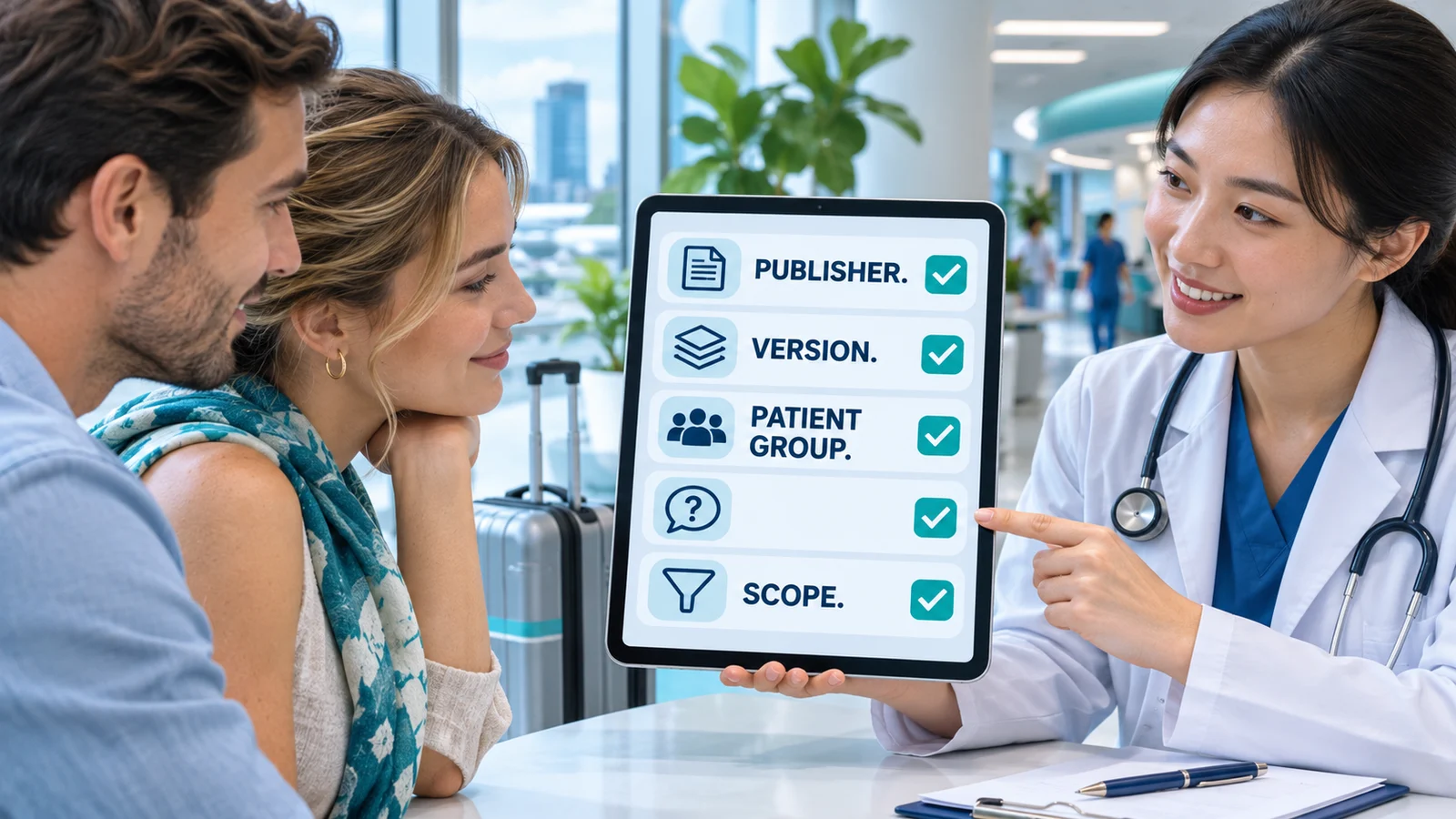
You do not need to become a medical researcher. Use this short checklist when you receive a link, PDF, translated excerpt, or social-media claim.
1. Who published it?
Look for the original issuing organization, not only the page that quoted it. This may be a public health body, professional society, academic group, journal, hospital, or company. Record the name, direct web address, and whether you are viewing the original document or a summary.
Ask: “Is this an official publication from the named organization, or a third-party interpretation?” If you only have a screenshot, search for the original title and publication page. A logo in an image is not enough evidence of authorship.
2. What is the date and version?
Check the publication date, version number, update date, and whether the page says it has been replaced, corrected, or archived. A document can remain online after a newer version appears. If no update date is shown, do not assume it is current.
The date should be considered alongside the topic. Some subjects change quickly because evidence, safety information, technology, or regulatory status changes. Other documents may remain useful for longer. A newer date alone does not make a document better; it must still be from a credible publisher and address the right question.
3. Which patients does it cover?
Read the population and setting. A recommendation may be limited by age, diagnosis, disease stage, prior treatment, pregnancy status, organ function, test results, care setting, or a country's health system. “For cancer,” “for diabetes,” or “for surgery” is not specific enough.
Write down the exact words that define the population. If the document is for adults with a confirmed diagnosis after first-line treatment, it may not apply to a child, a person without confirmation, or someone at a different stage. This is a boundary check, not a self-triage tool.
4. What question does it answer?
A source may discuss screening, diagnosis, treatment, monitoring, rehabilitation, follow-up, safety, or organization of care. It might compare options but not recommend one for every patient. Locate the clinical question and read nearby conditions, exceptions, and implementation notes.
If a quote says “recommended,” ask: recommended for whom, compared with what, based on which outcomes, and with what limitations? Do not treat a heading, press release, or social-media caption as the full recommendation.
5. What does it not establish?
This final question protects against overclaiming. A guideline or consensus normally does not establish that you are eligible, that your records meet a hospital's requirements, that a test is available at a particular location, that a doctor will recommend a particular option, or that an insurer will pay. It also does not establish travel fitness, appointment timing, total cost, or a clinical outcome.
Check the original language and translation trail
For care in China, you may encounter Chinese-language documents, English abstracts, machine translations, or translated quotations. A translation can help you understand a topic, but it can omit qualifiers such as “conditional,” “consider,” “insufficient evidence,” or “in selected patients.”
Keep the original link or PDF with the translation. If you send a guideline excerpt with medical records, label it clearly as a question: “I found this document. Can the clinical team explain whether it is relevant to my situation?” Do not present a translated sentence as a treatment request that must be followed.
If a term is unclear, ask for the original document title, issuing organization, version, and page or section number. These details are more useful than a cropped image. They also allow a hospital team to identify whether the material has been updated or is being cited out of context. For the practical communication arrangements, see our language support guide for Chinese hospitals.
Separate evidence from access and travel planning
A source can be credible and still not answer the practical questions of travelling for care. Keep three folders or note sections:
- Clinical information: guideline, consensus, research, test reports, and questions for the clinician.
- Hospital-visit information: department, appointment communication, document format, language questions, and required records.
- Travel information: passport and visa process, companion needs, accommodation, timing, and non-clinical logistics.
Do not use a clinical document to infer access. For example, a guideline discussing a test does not confirm that a specific China hospital department offers it at a particular time. Likewise, a hospital announcement does not prove that the recommendation applies to you. Keep the questions separate so the right person can answer each one.
A practical note to prepare before you send records
Use a short note so that your sources and questions remain organized:
- Document title: __________
- Publisher / issuing organization: __________
- Date / version / link: __________
- Patient group described: __________
- Topic or recommendation I am trying to understand: __________
- Question for the clinical team: __________
- What I do not know yet: __________
Avoid sending a large collection of unlabelled links. Prioritize the documents directly related to your condition and the questions you need answered. Keep personal information to the minimum needed for preparation and use the requested channel for records. The China-ready medical records checklist can help you organize the original files alongside your questions.
Questions to ask during a China care discussion
When an in-person consultation is being considered, you can ask the hospital team through the available communication arrangement:
- Is this guideline or consensus relevant to my diagnosis, stage, and previous treatment history?
- Which version is the team using, and has it been updated or replaced?
- Does this document discuss a general approach, or does it apply to a decision in my situation?
- What records, imaging, pathology, or test results would need review before any clinical discussion?
- Which parts of the document relate to care pathways, and which parts relate to an individual decision?
- What practical issues, such as safety, availability, timing, cost, or follow-up, are not answered by this document?
These questions do not require the team to promise a treatment path. They help you understand the difference between a source of information and a decision made after your own records are reviewed.
What MedToChina can and cannot discuss
You may submit information or send records and questions through WhatsApp before a possible care visit in China. MedToChina can help you organize the source title, publication link, version date, questions, language preference, and practical care-travel preparation needs for later communication.
MedToChina does not determine whether a guideline applies to you, interpret a scan or pathology report, recommend a treatment, or promise access to a particular department, clinician, medicine, device, or trial. A guideline check is not a clinical assessment. Medical interpretation and treatment decisions belong to the relevant hospital clinical team after appropriate review.
When not to wait for a document check or travel plan
Source checking should not delay urgent care. If you have severe or rapidly worsening symptoms, chest pain, difficulty breathing, heavy bleeding, fainting, signs of stroke, severe allergic symptoms, or another urgent concern, seek prompt local medical help. Do not wait for a WhatsApp reply, a translated document, travel planning, or a future visit in China.

FAQ
Does a guideline tell me which treatment I should choose in China?
No. A guideline may provide general recommendations for a defined group, but it does not replace an individual clinical assessment or the treating team's discussion of your records, risks, preferences, and practical circumstances.
Is an expert consensus less useful than a guideline?
Not necessarily. They answer different needs and can use different methods. Check the issuing body, purpose, evidence approach, patient group, date, and limits rather than relying on the label alone.
Does a newer document automatically override an older one?
Not always. Check whether the issuer says it replaces an earlier version, whether the subject and population are the same, and whether the newer document addresses your question.
Does a guideline prove a treatment is available at a China hospital?
No. A clinical document does not confirm departmental availability, timing, cost, eligibility, or a clinician's recommendation at a particular hospital.
Can WhatsApp tell me whether a recommendation applies to my case?
WhatsApp can be used to send records and practical questions for China care-travel preparation. Whether a medical recommendation applies to your situation must be discussed by the relevant clinical team.
Discuss Your China Medical-Travel Preparation
Have a guideline, consensus statement, or source link you want to keep organized for a future China care visit? Submit your information or send your records and practical questions through WhatsApp. Our team can discuss care-travel preparation and help you keep the source details and questions clear for later communication with a hospital.
Medical Disclaimer
This article provides general information-literacy and care-travel preparation guidance for international patients considering in-person medical care in China. It is not a diagnosis, treatment recommendation, legal advice, regulatory interpretation, confirmation of hospital service availability, clinical consent, travel-clearance assessment, or emergency-care substitute. For urgent symptoms, seek prompt local medical care.
References
- World Health Organization. WHO handbook for guideline development, 2nd edition.
- Guidelines International Network. GIN-McMaster Guideline Development Checklist. Used as a source-checking framework only; it does not establish Chinese hospital policy or individual treatment suitability.