
General
International Accreditation Claims in China: Checking the Organization and Current Status
Check a China hospital's international accreditation claim: issuer, organization, campus, scope, dates and current directory status before relying on a badge.
MedToChina Editorial Team · 10 min read · November 21, 2026

Quick Summary
- An international accreditation claim can be useful background information, but it is not proof that a hospital, department, doctor, or treatment is right for you.
- Check the accreditation issuer's current directory first. Then compare the listed organization name, location, facility or campus, program scope, and visible status with the claim you saw.
- A hospital group may have more than one campus, while a directory listing may apply to only one legal entity or facility. Do not assume that a group name covers every site.
- If you cannot verify a claim in the issuer's current directory, record it as unconfirmed. Absence from one directory does not prove that an organization has no accreditation or that care is poor.
- When considering care in China, send your questions and available records through WhatsApp. MedToChina can help organize non-clinical questions and discuss possible communication steps; treating teams make clinical decisions.
Why an accreditation claim needs a careful check
International patients often see terms such as “internationally accredited,” “JCI accredited,” “quality certified,” or “recognized for safety” while researching care in China. These phrases can sound like a simple quality ranking. They are not.
Accreditation is usually a formal assessment against a stated program or standard. It can describe an organization, a facility, a service type, or a management system. It does not automatically establish clinical suitability for an individual, a guaranteed outcome, available capacity, price, language support, visa support, or travel readiness.
The most practical question is: What exactly is accredited, by whom, and is that status currently visible for the specific place where I may receive care? This guide explains how to ask that question without turning an accreditation badge into a treatment promise.
Start with the issuer, not a marketing image
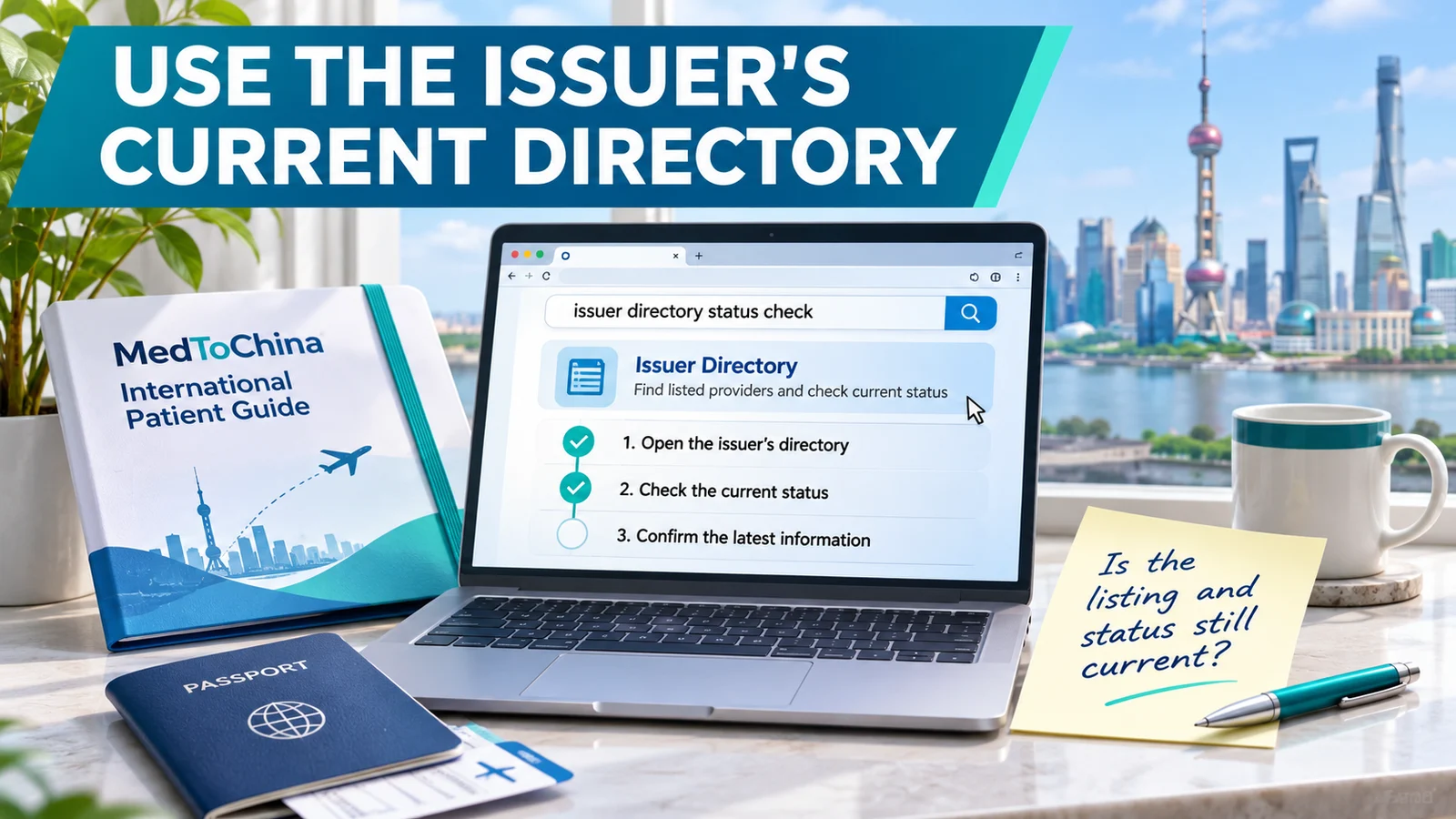
The issuer is the organization that grants or maintains the accreditation. A hospital website, brochure, search result, news article, or social-media post may repeat a claim, but it is secondary evidence. Start with the accrediting organization's own website or directory whenever one is available.
For example, Joint Commission International states that its page provides a list of current JCI-accredited organizations. 1 That can help you confirm whether a specific organization is listed at the time you search. It does not mean every service, campus, physician, or procedure is covered by the listing.
Before treating any logo or wording as current, save the directory link and the date you accessed it. Listings can change, websites can be updated, and older announcements can remain online after a status changes.
Five checks before relying on a China hospital accreditation claim
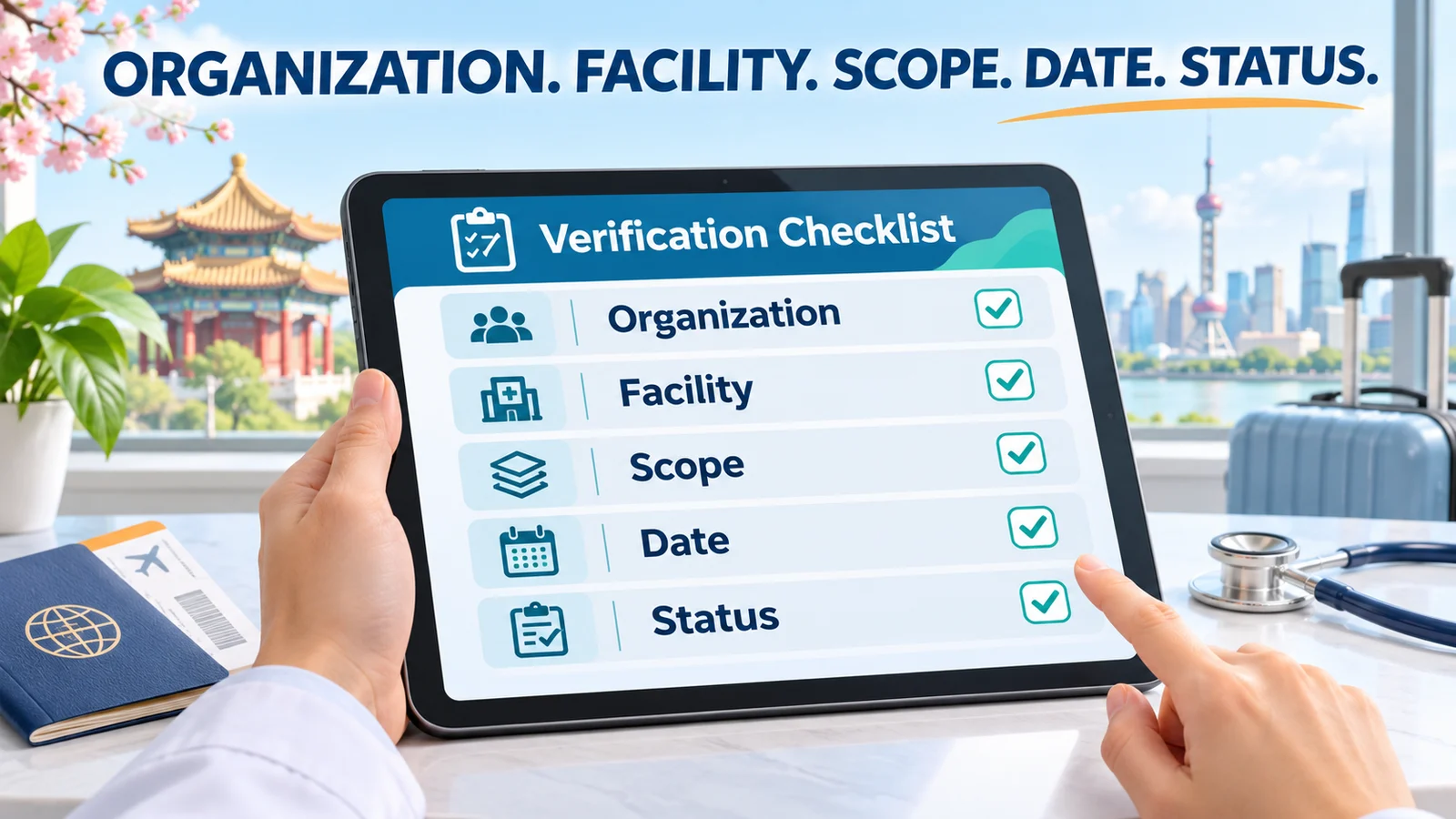
1. Confirm the organization name
Use the full name shown in the issuer directory. Compare it with the name in the hospital's English and Chinese materials where possible. Large healthcare groups may use a brand name that differs from the legal or directory name.
Small differences can matter. A city-wide brand, a parent group, a university affiliate, and a separately registered hospital may sound similar but refer to different entities. If the names do not clearly match, do not assume they are the same organization. Ask for the official name used in the issuer's listing. For the separate task of checking institution and clinician registration, see our hospital and doctor credentials guide.
2. Confirm the exact facility or campus
A group may operate a main hospital, satellite campuses, clinics, specialty centers, and international medical departments. Accreditation information can apply to one facility rather than every location using the group brand.
Ask for the physical address and facility name where the proposed visit would occur. Then compare that information with the directory entry. If the directory does not display an address, ask the hospital or coordination contact to explain the relationship between the listed organization and the planned campus.
This is especially important for overseas patients. A consultation, test, admission, surgery, rehabilitation appointment, and follow-up visit may occur at different locations. A claim associated with one location should not be carried over automatically to another. The equipment announcement and site-check guide explains similar location checks when a hospital announces a service or device.
3. Check what the accreditation covers
“Accredited” is not a universal description of every service. Look for a program name, service category, facility type, or scope statement. It may concern a hospital as an organization, a laboratory, an imaging service, a clinic, or another defined program.
Do not infer that an organization-level status verifies every department or clinical service. It also does not show that a particular service is currently offered to international patients. Questions about clinical appropriateness, service availability, and timing must be addressed through the relevant care team.
4. Check the visible date and current status
Look for language that indicates whether a listing is current, expired, inactive, under review, or historical. An old press release, award ceremony photo, or undated logo is not enough to establish present status.
Some directories do not display every date or detail publicly. If information is missing, say “I could not verify this from the directory” rather than guessing. Do not convert a missing date into an accusation or a conclusion that a hospital has no valid status.
5. Check the original source and save a record
Keep the directory URL, a screenshot or PDF where permitted, the access date, and the exact organization name searched. These notes make it easier to ask a focused follow-up question later. They also reduce confusion if an English name, a transliteration, and a local name appear different.
A step-by-step verification workflow
- Copy the exact accreditation wording you saw. Include the issuer name, claimed program, and any date.
- Open the issuer's official directory or current listings page, not only a search-engine preview.
- Search the full organization name and reasonable name variants. Record what the directory actually shows.
- Compare the listed entity with the intended facility, city, and address.
- Read any scope or program description carefully. Identify what is covered and what is not stated.
- Note any date, current-status wording, or limitation visible on the issuer's page.
- If uncertainty remains, prepare a plain question: “Can you confirm whether this specific facility is covered by this current listing, and where can I verify it?”
This workflow is for information checking. It does not rank institutions or decide where someone should receive care.
Questions an overseas patient can send before travel
When you are considering treatment in China, an accreditation question should sit alongside practical questions about records, the proposed location, language, estimated process, and follow-up planning. You could ask:
- What is the full legal or directory name of the organization?
- Which physical campus would be used for my appointment or admission?
- Which accrediting organization and program does the claim refer to?
- Is the status shown in the issuer's current directory? If so, may I have the directory link or search name?
- Does the listing identify a scope, facility type, or date that I should understand?
- Which questions must the treating team answer after reviewing my records?
Avoid asking a customer-service contact to turn accreditation into a prediction about your case. It cannot answer whether a treatment is clinically suitable, whether you are fit to travel, or whether an outcome will occur.
What accreditation can and cannot tell you
Accreditation can show that an organization has participated in a defined external program at a particular time. It may give you a starting point for further questions about processes and the organization named in the listing.
It cannot by itself establish that the organization is the best choice, that every unit follows the same scope, or that any particular clinician, procedure, schedule, price, insurance decision, or result is available. It is also not interchangeable with China's hospital classification, a professional license, government registration, research publication, patient review, or a ranking.
Use it as one item in a broader information file. For a clinical decision, relevant records and a discussion with the treating medical team remain necessary. Use the China-ready medical records checklist to organize the files alongside your questions.
If the directory search is unclear
Directory search tools may use different spellings, local-language names, or organization types. A result may be difficult to find because the name is abbreviated, the listing has been updated, the directory search is limited, or the claim refers to a different facility.
Try the exact name from the issuer's directory, then a city and organization combination if the directory permits it. Check whether the claim identifies a particular campus. If you still cannot confirm it, retain a neutral note: “not confirmed from the public directory on [date].” Ask for an official source rather than relying on a screenshot sent without a link.
An unclear search is not a clinical red flag by itself. It is a reason to seek clearer documentation before treating the claim as a decision factor.
How MedToChina supports communication
MedToChina can help international patients collect non-clinical questions, organize records, and communicate about possible care pathways in China. You may submit your information or send medical records and questions through WhatsApp. After understanding your records, country preference, budget, and timeline, customer service can discuss possible China hospital resources and next communication steps.
This support does not certify organizations, verify a clinical service for your case, make a treatment recommendation, or promise an outcome. The treating medical team must answer clinical questions and decide whether it is appropriate to proceed.
FAQ
Does international accreditation mean a China hospital is right for me?
No. It is one background item. It does not establish individual clinical suitability, the availability of a specific service, cost, timing, or expected result.
Is a hospital group listing valid for every campus?
Do not assume so. Verify the listed organization and the facility where you expect to receive care. Ask about the relationship if the names or addresses differ.
What if I cannot find a claim in a directory?
Mark it as unconfirmed from that public directory on the date you searched. Ask for the accreditor's official link or the exact listed organization name. Do not conclude from one search that care quality is poor or that no accreditation exists.
Is JCI the same as a hospital ranking or China's hospital classification?
No. These are different systems and should not be treated as interchangeable. Each has its own purpose, criteria, scope, and timing. Our Grade 3A hospitals and international departments guide explains the separate classification and access questions.
What should I send through WhatsApp?
You can send the link or screenshot of the claim, the organization and facility names you found, your questions, and records you are comfortable sharing for coordination. Do not send passwords or one-time verification codes.
Discuss Your Questions Through WhatsApp
Need help organizing questions about a China hospital accreditation claim? Send your records or questions through WhatsApp, or submit your information. MedToChina can help you prepare non-clinical verification questions and discuss possible next communication steps for care in China.
Medical Disclaimer
This article is general information for international patients considering care in China. It is not medical advice, a clinical recommendation, a quality rating, or a guarantee of any service or outcome. Accreditation information does not replace an assessment by a qualified treating medical team. Seek urgent local care for urgent or worsening symptoms.
References
- Joint Commission International. Find JCI Accredited Organizations. Accessed November 21, 2026.