
General
Language Support in Chinese Hospitals: A Practical Guide for International Patients
Learn how international patients can prepare for interpreters, translated records, consent, medication instructions and follow-up when seeking care in China.
MedToChina Editorial Team · 10 min read · September 28, 2026
Quick Summary
Language support can affect every stage of medical care in China, from registration and diagnosis to consent, medication and discharge. International departments at some Chinese hospitals offer multilingual staff, interpreters or translated documents, but services vary by hospital, specialty, time of day and language. Before travelling, confirm what support is available, send your records in advance, prepare a medication and allergy list, and identify the conversations that require a qualified medical interpreter. Use machine translation for simple navigation or administrative questions, not as the only method for complex clinical decisions. During each important discussion, ask for plain language, written instructions and teach-back to confirm that both sides understood the same plan.
Why Language Support Is Part of Safe Medical Care
Medical communication is more than translating individual words. A patient may need to describe symptoms, understand diagnostic uncertainty, compare treatment choices, disclose allergies, give informed consent, follow a medication schedule and recognize warning signs. A misunderstanding about a drug name, dose, unit, date or negative result can change the meaning of a care plan.
Communication also happens across registration, nursing, testing, consultation, pharmacy and discharge. Language support therefore needs to cover the patient journey, not only the main consultation.
China has expanded international medical services in major cities and selected medical zones. Official guidance from Beijing identifies institutions that provide full-process foreign-language services, while Shanghai policy encourages multilingual services and medical documentation for international patients. Hainan's Boao Lecheng area also describes foreign-language hotlines and international visitor services. Reviewed September 28, 2026. These examples show that multilingual care exists, but they do not mean every hospital, department or shift provides the same languages or level of support.
What “Language Support” May Include
The phrase can refer to several different services:
- A bilingual doctor, nurse or international-patient coordinator
- An in-person professional medical interpreter
- Telephone or video interpreting
- Translated registration, consent or discharge documents
- Help communicating with pharmacy, billing or admission teams
- Written summaries or bilingual patient instructions
Do not assume that an “English service” covers every clinical conversation. A hospital may have English-speaking staff in its international department but not in every imaging room, ward, emergency unit or pharmacy. Support may also be limited outside regular hours. Ask for the language, format, hours, clinical areas and possible fees before confirming travel.
Before You Travel: Prepare the Communication Plan
1. State your preferred language precisely
Tell the service team your preferred spoken and written language. Mention whether the patient can read medical English, needs an interpreter for complex discussions, has hearing difficulty, uses sign language or needs a companion present.
Ask these questions:
- Is a qualified medical interpreter available for my language?
- Is the interpreter in person, by phone or by video?
- Which appointments and departments can the service cover?
- Can interpretation be arranged for admission, consent and discharge?
- Are translated documents available, and is there an additional charge?
2. Send records before the visit
Provide the records requested by the service team, ideally in searchable PDF format. Keep the original report and any translation together. Useful materials may include a diagnosis summary, pathology, imaging reports, laboratory results, procedure notes, discharge summaries and a current medication list.
A translation should preserve dates, units, negative findings, staging terms, biomarker names, drug names and doses. Do not replace the original with an app-generated summary. For imaging, ask whether original DICOM files are needed with the report.
3. Build a one-page medical information sheet
Prepare a concise document containing:
- Full name and date of birth as shown on the passport
- Main diagnosis and important past conditions
- Current medicines, doses and schedules
- Drug, food and material allergies and the reaction caused
- Previous operations, implants or medical devices
- Anticoagulants, insulin, steroids or other time-sensitive medicines
- Emergency contact and companion contact
- Preferred spoken and written language
Carry a digital and printed copy. This sheet supports communication but does not replace a clinical history taken by the medical team.
4. Prepare questions in priority order
Put the three most important questions first. Use short sentences, one question at a time and avoid unexplained abbreviations. Confirm that the list reflects the patient's own priorities.
When a Qualified Medical Interpreter Matters Most
A bilingual companion can provide emotional support and remember practical details. However, family and friends may not know medical terminology, may summarize instead of interpreting everything, or may unintentionally soften difficult information. Children should not carry responsibility for interpreting critical medical discussions.
Request a qualified medical interpreter for conversations involving:
- A new or uncertain diagnosis
- Treatment choices, benefits, risks and alternatives
- Surgery, anesthesia or invasive procedures
- Informed consent
- Cancer staging, pathology or biomarker findings
- Medication changes, dosing or possible interactions
- Complications, unexpected findings or changes in condition
- Discharge instructions and urgent warning signs
The interpreter should convey each speaker's words rather than answer for the patient.
Where Machine Translation Helps, and Where It Does Not
Translation apps can help with signs, directions and simple administrative questions. A phone can also display a prepared address, allergy or emergency phrase.
They should not be the only communication method for informed consent, complex treatment choices, medication dosing, pathology terminology or serious changes in condition. Medical words can have multiple meanings, and speech recognition may mishear accents, numbers or drug names. Privacy also matters: avoid entering identifiable health information into an app unless you understand how the data is handled.
Confirm important numbers and names separately in writing. A human professional should review high-stakes information.
Communication at Each Stage of Care
Registration and appointment confirmation
Confirm the hospital campus, department, appointment date, arrival time and documents required. Chinese hospitals may have several campuses with similar names. Keep the address in Chinese characters for taxi or navigation use. Ask where the international-patient desk is located and whom to contact if a flight delay affects arrival.
Consultation
At the beginning, tell the clinician that interpretation is being used. Speak in short sections and pause for interpretation. Ask the clinician to explain unfamiliar terms in plain language. If the doctor refers to an image or report, make sure the patient, clinician and interpreter are looking at the same item.
Before leaving, confirm the working diagnosis, what remains uncertain, the next test or treatment step, and who will communicate results.
Tests and procedures
Preparation instructions may include fasting, stopping a medicine, drinking water, arriving with a companion or bringing earlier images. Repeat the date, time and preparation steps. Do not stop prescribed medicine solely because of translated general instructions; obtain patient-specific direction from the treating team.
For consent, the patient should understand the purpose, expected benefit, material risks, alternatives and what may happen without the procedure. Signing a translated form is not a substitute for an understandable discussion.
Inpatient care
Ask how to request language help on the ward, including at night. Confirm how nurses will communicate pain, dietary needs, mobility restrictions and changes in symptoms. Keep the call system and emergency contact method clear. If a companion is present, clarify visiting and caregiver rules with the hospital.
Pharmacy and medication
Drug brands may differ between countries. Confirm the generic name, strength, dose, route, frequency, duration and reason for each medicine. Ask what to do after a missed dose and which side effects require urgent help. Compare the discharge list with medicines brought from home to identify duplication or changes.
Discharge and follow-up
Obtain written instructions where possible. Confirm wound care, activity, diet, medication, follow-up timing, pending results and warning signs. Ask which records will be provided and in what language. If follow-up will occur in the patient's home country, request the clinical summary, procedure notes, pathology, imaging reports and medication list needed by the next doctor.
Use Teach-Back to Confirm Understanding
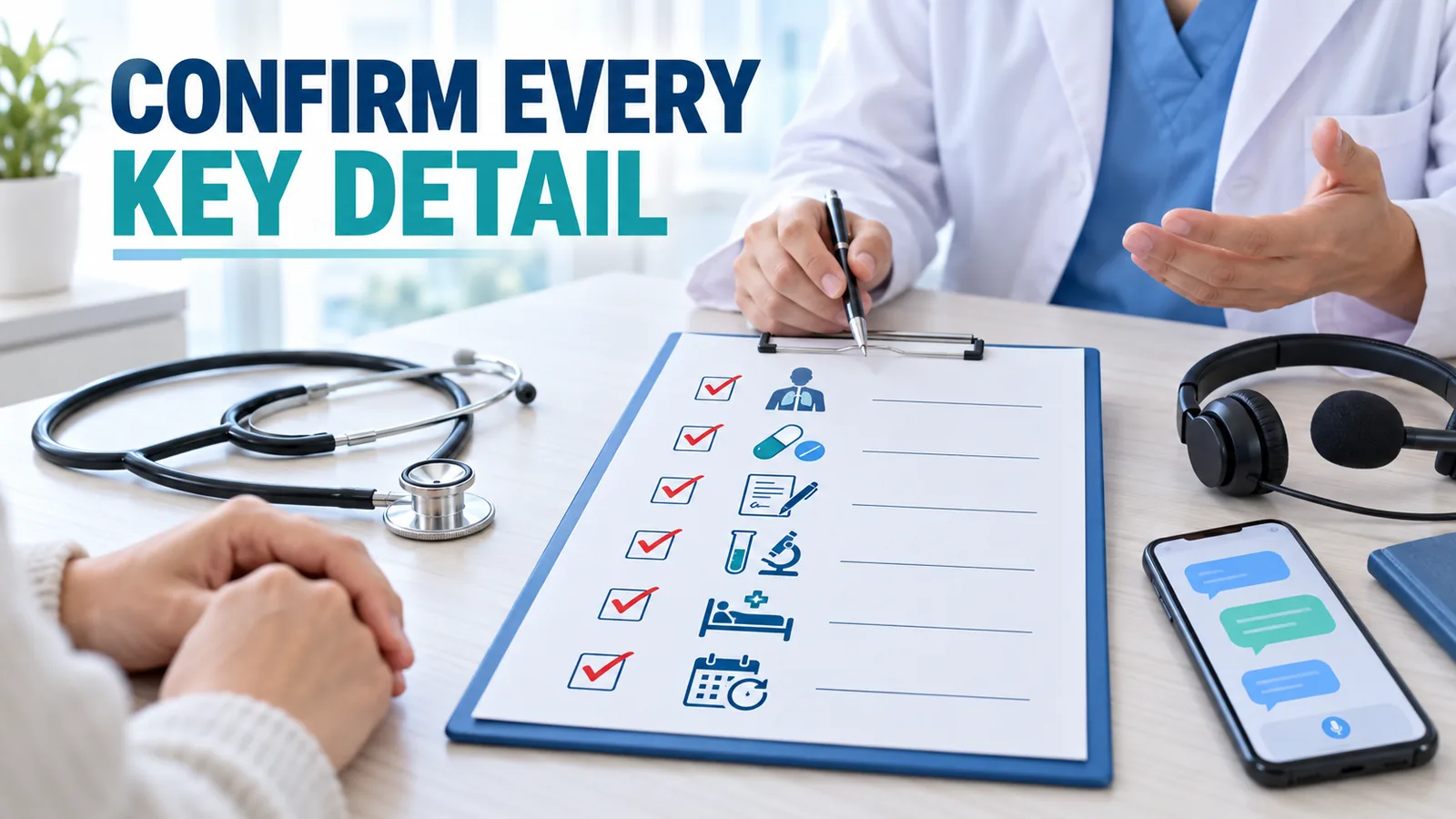
Teach-back is a safety technique, not a test of the patient. After an explanation, the patient repeats the plan in their own words. For example: “To make sure I understood correctly, I will take one 5 mg tablet every evening for seven days, and I should seek urgent help if I develop difficulty breathing. Is that correct?”
The clinical team can also use check-back by repeating names, doses, dates or test details. If the repeated information differs, stop and resolve the discrepancy. The most important items to check include:
- Diagnosis and remaining uncertainty
- Drug name, strength, dose and schedule
- Procedure name and body site
- Allergies and previous reactions
- Test date, fasting and medicine instructions
- Follow-up date and location
- Symptoms that require emergency care
A Practical Language-Support Checklist
Before departure
- Confirm spoken and written language needs.
- Ask what interpreting service is available and when.
- Send requested medical records and retain originals.
- Prepare a one-page medical information sheet.
- Translate priority questions and critical documents carefully.
- Save the hospital address and service contact in Chinese and English.
During care
- Request qualified interpretation for high-stakes discussions.
- Speak directly to the clinician and use short, clear statements.
- Verify names, dates, doses and units in writing.
- Use teach-back before consent, medication changes and discharge.
- Keep copies of updated instructions and test results.
Before returning home
- Obtain the medical summary and procedure or test reports.
- Reconcile all medicines with the pre-travel list.
- Confirm pending results and how they will be communicated.
- Record warning signs and the correct route for urgent care.
- Prepare documents for the doctor who will continue care at home.
How MedToChina Can Support Your Preparation
MedToChina helps overseas patients organize the practical information needed for a medical journey to China. You can submit your preferred language, diagnosis summary, key records, intended travel period and questions through the website or WhatsApp. The service team can clarify missing information and discuss available coordination steps through WhatsApp. Specific hospital language services must still be confirmed with the receiving institution.
MedToChina does not make clinical diagnoses through its website. Final clinical decisions, interpretation arrangements and treatment plans must be confirmed with the receiving medical institution and licensed clinicians.
Frequently Asked Questions
Do Chinese hospitals provide English-speaking services?
Some hospitals and international departments provide English-speaking staff or interpretation, especially in major cities. Availability varies by institution, specialty, department, time and clinical situation. Confirm the exact service before travel rather than assuming it is available throughout the visit.
Can I bring my own interpreter?
Hospitals may permit a companion or private interpreter, but policies differ. Ask in advance about registration, privacy, access to procedure areas and whether the hospital requires its own interpreter for consent or other high-stakes discussions.
Is a family member enough for medical interpretation?
A family member can support the patient, take notes and help with daily needs. For diagnosis, consent, treatment decisions, medication or discharge, a qualified medical interpreter is safer because medical vocabulary, completeness, neutrality and privacy matter.
Should all medical records be translated into Chinese?
Requirements vary. A concise translated diagnosis summary and key reports may be sufficient initially, while complex cases may need pathology, operative or imaging reports translated. Keep the original-language records and ask which documents the receiving institution needs.
Can I use a translation app in the hospital?
Use it for navigation and simple exchanges. Do not rely on it alone for consent, serious diagnoses, treatment decisions or medication doses. Confirm critical information with qualified staff.
What should I do if I do not understand a consent form?
Do not sign until the purpose, risks, alternatives and questions have been explained in a language you understand. Ask for an interpreter and plain-language explanation. A form alone does not replace informed communication.
Is interpretation included in the hospital fee?
It depends on the institution and type of service. Ask whether interpretation, document translation or language coordination is included, charged separately or provided only during specified hours.
What information should I send before asking about language support?
Send your preferred language, diagnosis or reason for care, key records, planned travel period, accessibility needs and the conversations or documents likely to require interpretation. Avoid sending unnecessary personal information through insecure channels.
Related MedToChina Resources
- China Grade 3A hospitals and international departments
- Seeking medical care in China as a foreigner
- Medical documents needed for care in China
- China-ready medical records checklist
- Medical clearance before treatment in China
Submit Your Information or Contact Us on WhatsApp
Planning medical care in China and concerned about communication? Submit your information and key medical records through MedToChina, or contact the service team on WhatsApp. Include your preferred language, diagnosis summary, current medicines, expected travel period and main questions so the team can discuss preparation steps and available service processes with you.
Medical Disclaimer
This article provides general educational and travel-preparation information. It is not medical advice, diagnosis or a treatment recommendation. Language-service availability, hospital policies, fees and clinical processes vary. Confirm arrangements directly with the relevant medical institution. Seek urgent local medical care for an emergency or rapidly worsening symptoms.
References
- Beijing Municipal Government. Medical Guide for Foreigners in Beijing.
- Beijing Municipal Government. Peking Union Medical College Hospital International Medical Services.
- Beijing Municipal Government. Over 50 Beijing hospitals initially equipped with full-process foreign-language services.
- Shanghai Municipal Government. Shanghai advances international medical services.
- Hainan Provincial Government. International medical service resources in Boao Lecheng.
- Agency for Healthcare Research and Quality. TeamSTEPPS Limited English Proficiency Module.
- Agency for Healthcare Research and Quality. IDEAL Discharge Planning: Use Plain Language and Teach-Back.
- Agency for Healthcare Research and Quality. Use the Teach-Back Method.
- U.S. Department of Health and Human Services. May an LEP person use a family member or friend as an interpreter?.
- World Health Organization. Medication Errors: Technical Series on Safer Primary Care.