
General
Informed Consent Before Hospital Care in China: Explanations and Questions Before Signing
A practical guide for international patients travelling to China: how to prepare for consent explanations, check document versions, ask questions, and communicate before signing.
MedToChina Editorial Team · 10 min read · November 10, 2026

Quick Summary
- Informed consent is a communication process, not just a signature on a form.
- Before signing, ask what care, test, procedure, or treatment decision the document covers, who can explain it, and which language or communication support is available.
- Check the patient name, document title, date, version, proposed service, and any blank fields. Do not assume that an administrative registration form is the same as a clinical consent document.
- A consent discussion does not confirm that a treatment is appropriate, available, scheduled, funded, or safe for one individual. Those questions depend on the clinical team, current assessment, and hospital process.
- International patients should keep their questions, records, interpreter preferences, and a copy or photograph of documents they are permitted to retain organized in one folder.

Why consent needs extra preparation when you travel for care
Travelling to China for medical care can involve unfamiliar hospital systems, forms, languages, family roles, payment processes, and clinical vocabulary. A consent form may be presented before a procedure, anaesthesia, blood transfusion, special test, treatment change, admission step, or another part of care. The title and timing of the document can differ by hospital and by the type of service.
For an international patient, the practical concern is often not only “What does this form say?” but also “What decision is being discussed, and what should I ask now?” Those are reasonable preparation questions. China’s national health authorities describe informed consent, patient autonomy, privacy, and understandable communication as part of patient-facing care. Exact documents and workflows remain hospital-specific, so confirm them directly.
This guide is for routine hospital-care preparation, not research participation, legal authority, immigration paperwork, or insurance authorization.
What informed consent means in plain language
Informed consent is not a promise that a procedure will work. It is also not a guarantee that a patient has been accepted for a particular service. In plain language, it is the process in which a clinician explains the proposed care and a patient has a chance to understand, ask questions, and make a voluntary decision within the applicable clinical and hospital process.
The World Medical Association describes self-determination as including the information needed for a person to make a decision about a diagnostic procedure or therapy. Its International Code of Medical Ethics states that consent should be voluntary and informed, with information understood sufficiently for an independent decision. These are broad ethical principles; they do not replace the rules, forms, or clinical judgment used at a particular China hospital.
For a patient travelling internationally, it helps to keep four ideas separate:
- Clinical explanation: what the clinician says about the proposed test, treatment, procedure, alternatives, expected purpose, relevant risks, and what may happen if it is not undertaken.
- Questions and understanding: the opportunity to ask what a term, timeline, result, or next step means for your situation.
- Documentation: the form or electronic record used by the hospital to record the conversation and decision.
- Other administration: registration, identity checks, payment, accommodation, visa, insurance, release-of-records, and translation arrangements may require paperwork too, but they are not automatically the same as clinical consent.
Keeping these categories apart prevents a common mistake: treating every paper handed over at admission as though it were a clinical decision, or treating a clinical consent form as though it settles payment, scheduling, or travel arrangements.
Before you arrive: prepare the communication conditions
Do not wait until a form is in front of you to decide how you need important information presented. When you submit information or send questions through WhatsApp before travel, state practical preferences early:
- Your preferred spoken and written language.
- Whether you need hearing, vision, mobility, literacy, or communication support.
- Whether you expect a family member to attend and what their role will be.
- Whether you want key questions written down rather than explained only verbally.
- Whether records, imaging, pathology, medication lists, allergies, and previous procedure details are available in English or another language.
- Whether you need to understand how the hospital identifies the patient in its system, including the exact spelling used in your passport.
MedToChina can help organize these practical questions and the records you want to bring. The hospital and its clinical team determine what language support, document format, explanation process, and patient-identification steps are available for the actual care episode. Do not send passport numbers, account passwords, verification codes, or unnecessary personal documents through informal channels.
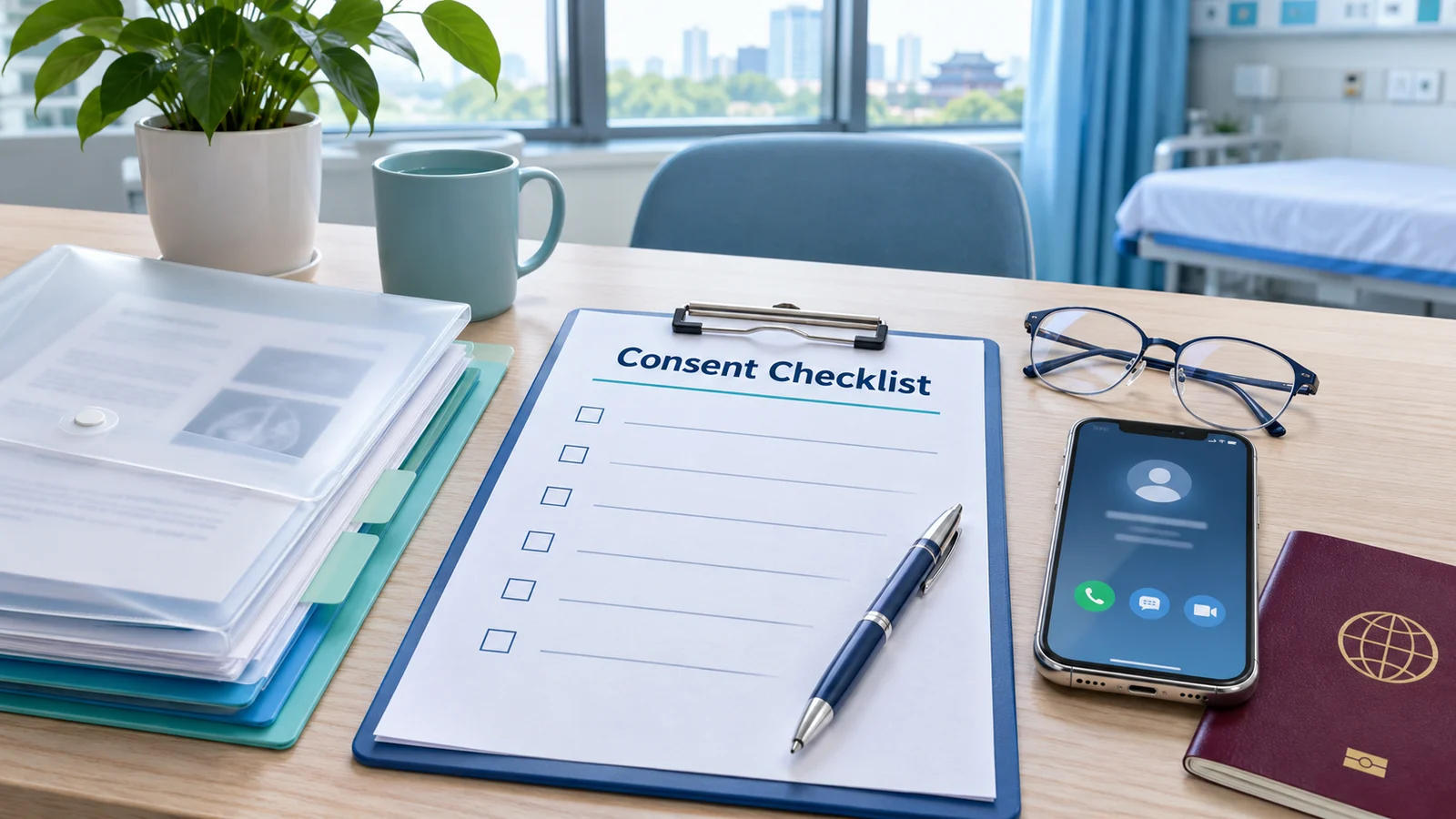
A signing-day checklist: what to confirm first
When a document is presented, slow down enough to identify what it is. A useful opening question is: “What is the exact name of this document, and what decision or step of care does it cover?”
Then check the following items.
1. Patient identity and document context
Confirm that the name, date of birth or other identifier, date, and hospital episode are correct. Ask whether the form relates to an outpatient visit, admission, a specific test, a procedure, an anaesthetic plan, transfusion, treatment, or a later follow-up step. If you are shown several documents, ask for their titles one by one.
Do not fill in blank sections you do not understand. If a name, date, procedure label, or language version appears inconsistent, ask the staff member to clarify before you sign. Correcting a clerical issue may require the hospital's own documentation process; do not alter clinical forms yourself unless the staff instruct you to do so.
2. Who is explaining the proposed care
Ask which clinician or team member can explain the proposed intervention and answer medical questions. A coordinator, interpreter, or family member can support communication, but they should not be treated as the person making the clinical explanation or decision on behalf of the treating team.
If the discussion is interrupted because of tests, rounds, payment, or transport, ask how and when to continue the conversation. For non-urgent planned care, it may be practical to request that your questions be gathered in writing for the next discussion. Urgent situations can follow different clinical and operational pathways; tell staff immediately if you believe you are facing an emergency.
3. The purpose and practical steps
Use plain questions. You can ask:
- What is this test, treatment, or procedure intended to help the team assess or address?
- What are the main steps before, during, and after it?
- Which findings or changes could alter the plan?
- Is this document for a decision today, or does it record a discussion for a later step?
- What preparations, restrictions, or documents should I confirm with the responsible team?
These questions seek an explanation; they do not ask a coordinator to diagnose your condition or decide whether the intervention is right for you.
4. Risks, benefits, alternatives, and uncertainty
Medical communication can include difficult terms. You can ask the clinician to explain unfamiliar words in simpler language and to distinguish common effects, material risks, uncertainties, alternatives, and the expected consequences of declining or delaying the proposed care. The right answer will depend on your diagnosis, health status, procedure, and records.
Avoid trying to convert a general web checklist into a personal risk estimate. A published average, a friend's experience, or a translation app cannot tell you how likely an outcome is for you. Ask the clinical team which parts of the explanation are general and which depend on your own assessment.
5. Language and understanding
If you do not understand a word, diagram, number, date, or instruction, say so. Ask whether an interpreter or another communication arrangement is available and whether the key point can be repeated, written, or explained with a diagram. If an English translation is offered, confirm whether it is a reference translation or the version the hospital is asking you to sign.
Questions that are useful without asking for a personal diagnosis
The following question set is designed for international-patient preparation:
- What decision is this document recording?
- Which clinician can explain the proposed care in relation to my records?
- What information should I understand before I decide?
- Which risks, expected benefits, alternatives, and uncertainties are most relevant to discuss?
- What happens next if I agree, ask for more explanation, or decide not to proceed at this time?
- Is there a language-support process for this discussion?
- Which form version am I reviewing, and how will it be recorded in my chart?
- Can I receive or request a copy through the hospital's official process, where applicable?
- Who should I contact inside the hospital if I notice an identity, date, or document-title error?
These questions are not a script for challenging staff or delaying urgent care. They are a way to make the conversation more precise. The hospital decides the appropriate channel and timing for answers.
Keep a simple consent communication record
For complex care, create a one-page record for yourself: date and department, document title, care step discussed, names or roles present, questions, follow-up channel, and document status. Do not place clinical conclusions on it. This note is for organization only; it does not replace the hospital record or prove that an explanation was legally sufficient. Follow hospital privacy rules about photography and recording.
Family, representatives, and privacy: do not assume roles
Many international patients travel with a relative or trusted companion. They may help with notes and logistics, but their ability to receive information, translate, sign, or decide is not automatic. It can depend on the patient’s circumstances, document type, hospital process, and clinical situation. Ask the hospital what it needs if a companion will attend, and do not assume a coordinator can be a legal representative or replace a clinician’s explanation. China’s medical-record standards include different consent arrangements in some circumstances; ask the hospital what applies rather than using those rules as a personal legal guide.
What MedToChina can and cannot do
MedToChina can help international patients prepare a question list, organize records, state communication preferences, and understand the practical sequence of medical travel to China. You can submit your information or send records and questions through WhatsApp before travel.
Our customer-service team can discuss possible China hospital resources after understanding your condition, timeline, country preference, budget, and available records. We do not interpret a consent form as medical or legal advice, decide whether you should sign, act as your legal representative, or replace the treating clinician's explanation. Current hospital procedures, language support, availability, fees, and scheduling must be confirmed through the appropriate hospital channels.
Frequently Asked Questions
Is a consent form the same as an appointment confirmation?
No. A consent document concerns a clinical discussion or decision. An appointment, registration, admission, payment, or insurance document can be related to the same visit but has a different purpose. Ask the hospital to identify each document.
Can I sign an English translation instead of the hospital's original form?
Do not assume this is possible. Hospitals may have specific document versions and signing processes. Ask which version is official for the care episode, what translation support is available, and how questions should be addressed before signing.
Does signing mean my treatment is guaranteed to happen?
No. Consent does not by itself confirm clinical suitability, current capacity, payment approval, test results, scheduling, or travel readiness. The treating team and hospital process determine what happens next.
Can a family member make the decision for me?
Do not assume so. The answer depends on your circumstances, decision-making capacity, document type, and hospital process. Ask the hospital directly and seek independent legal advice when needed.
What if I do not understand the explanation?
State what you do not understand and ask for a clearer explanation, a written question list, or available language support. For urgent symptoms or an emergency, tell the treating team immediately rather than relying on a travel coordinator.
Send Questions Before You Travel
Preparing early can make an important discussion less rushed. Submit information, or send medical records and practical consent-communication questions through WhatsApp. MedToChina can help organize hospital questions, communication preferences, and China medical-travel preparation steps.
Medical Disclaimer
This article provides general information for international patients considering medical care in China. It is not medical, legal, insurance, financial, immigration, or travel advice. It does not explain your individual diagnosis, risks, capacity, consent rights, document validity, or treatment options, and it does not replace discussion with the treating clinical team or qualified legal advice. Hospital procedures, language support, document versions, costs, availability, and requirements can change and must be confirmed directly with the relevant hospital.
Related Guides
References
- National Health Commission of the People's Republic of China. Medical Quality Management Measures. See Article 24 on informed consent, autonomy, and privacy.
- National Health Commission of the People's Republic of China. Basic Standards for Medical Record Writing. See provisions on written consent records.
- National Health Commission of the People's Republic of China. Hospital Complaint Management Measures. See communication, understandable language, and written consent provisions.
- World Medical Association. Declaration of Lisbon on the Rights of the Patient.
- World Medical Association. International Code of Medical Ethics.