
Treatments
CMML Review in China: Organizing Blood Count Trends and Bone Marrow Reports
Prepare CMML records for a review in China: organize dated blood counts, marrow reports and treatment history without interpreting results yourself.
MedToChina Editorial Team · 10 min read · November 17, 2026

Quick Summary
If you are considering a medical review in China for chronic myelomonocytic leukemia (CMML), the most useful preparation is usually a dated, source-labelled record set. Keep complete blood count (CBC) reports in chronological order, and keep bone marrow, pathology, cytogenetic and molecular reports as their own documents. A reviewer can then see what was measured, when it was measured, and which laboratory or clinical team issued the record.
Do not calculate a diagnosis from a trend, label a result as progression, or change medicine to create a new result before travel. CMML and other blood disorders require professional interpretation of the full clinical picture. This guide explains document organization for overseas patients planning care in China; it does not diagnose CMML, recommend treatment, or determine whether travel is appropriate.
Why CMML records need two connected timelines
CMML is a blood cancer involving cells made in the bone marrow. Existing records may contain repeated blood counts, specialist notes, bone marrow aspiration or biopsy reports, flow-cytometry reports, chromosome studies, genetic testing, transfusion records, and treatment history. These records answer different questions and should not be collapsed into one spreadsheet without the originals.
A CBC is a snapshot from a particular date. A series of CBCs may show what was recorded over time, but the numbers alone do not explain symptoms, infection, a transfusion, medication changes, a laboratory difference, or why a clinician ordered further testing. Bone marrow and pathology reports are also date-specific source documents. They should stay intact even when a patient creates a separate personal timeline.
Blood Cancer United (formerly the Leukemia & Lymphoma Society) describes CMML as a myelodysplastic/myeloproliferative neoplasm and notes that assessment can involve blood and bone marrow testing. 1 That background explains why both streams of evidence may matter. It is not a checklist for self-diagnosis or a substitute for a hematologist's assessment.
Create a blood-count timeline without interpreting it
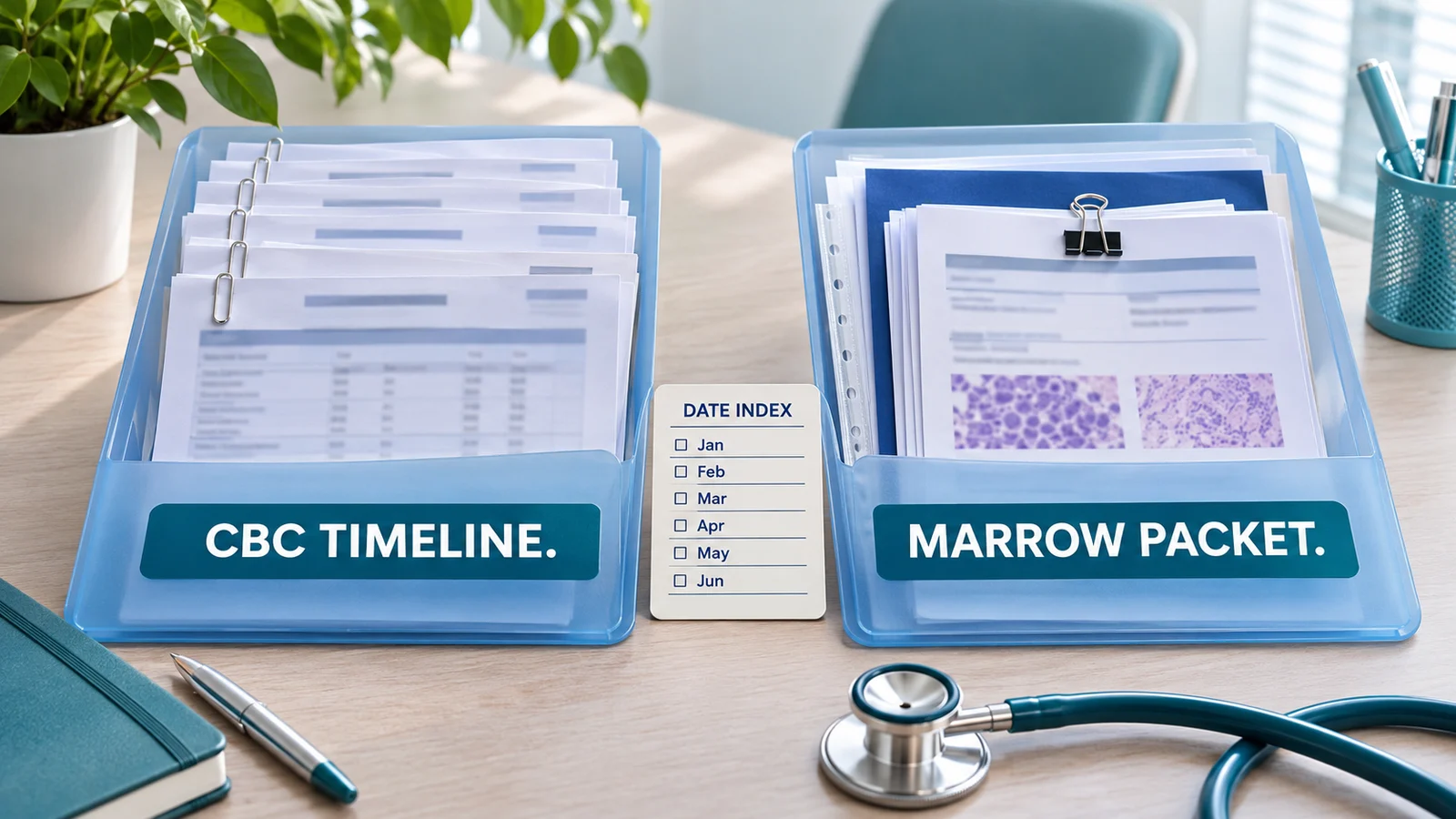
Put full CBC reports in date order, oldest to newest. Use one row per report or collection date. If the report has several pages, keep the pages together. Do not copy only a few values into a note and discard the original.
- Date collected: CBC date Source document to keep: Full laboratory report with units and reference ranges Context already documented: Clinic, hospital, or laboratory name; any clinician note already issued Patient note, clearly labelled: Whether you were unwell, recently admitted, or had a scheduled follow-up, if known
- Date collected: Repeat CBC date Source document to keep: Complete repeat report, including differential if present Context already documented: Whether it was before or after a documented transfusion or medicine change Patient note, clearly labelled: Questions you want to ask about the trend
- Date collected: Urgent-care date Source document to keep: Emergency, admission, discharge, or transfusion documentation Context already documented: Reason for visit as recorded by the treating team Patient note, clearly labelled: Symptoms you remember, kept separate from diagnosis labels
- Date collected: Follow-up date Source document to keep: Hematology visit note, if available Context already documented: Plan or next test as written by the clinician Patient note, clearly labelled: Missing reports you still need to request
For each report, retain the collection date, laboratory name, units, reference ranges, and all reported components. A laboratory may use a different format or reference range from another laboratory. That is a reason to preserve the report, not a reason to convert values yourself.
You can make a neutral index such as “CBC dated 2026-02-14, 3 pages, Hospital A, original language: Arabic.” Avoid labels such as “better,” “worse,” “controlled,” or “transformed” unless those words are in the source record and attributed to the clinician who wrote them.
Keep bone marrow and pathology records as a separate source set
Bone marrow records often arrive as a packet rather than one file. A procedure note, aspirate report, biopsy pathology report, immunohistochemistry, flow cytometry, cytogenetics, molecular testing, and slide or block information may be issued separately or on different dates. Keep them together by procedure date, but do not merge them into your blood-count table.
For every marrow-related item you have, retain:
- the full report and its issue date;
- the specimen or procedure date if it differs from the report date;
- the issuing pathology department or laboratory;
- addenda, amended reports, or later molecular results linked to the original specimen;
- any clinician letter that identifies what material was reviewed;
- information about slides, blocks, or digital images only as documented by the original institution.
Do not annotate a pathology report with your own conclusion. A translation can make a report readable, but it does not replace the original document, its addenda, or its laboratory identifiers. If a report refers to an unavailable attachment, write that it is missing and ask the original institution how to request it. Do not reconstruct a missing table, image, chromosome notation, or genetic result from memory. For the separate administrative process of releasing and returning physical materials, see the pathology slide loan and return guide.
Link the two record sets with dates, not assumptions
Your index can connect a CBC report to a marrow procedure by date without claiming that one caused or proves the other. For example: “CBC on 4 April; marrow procedure on 18 April; pathology report issued on 25 April.” This lets a reviewer locate documents quickly while leaving the clinical interpretation to the treating team.
Useful links may include a referral note, a discharge summary, a documented reason for testing, a transfusion record, or a clinician's follow-up letter. Preserve those documents in their own folder. A concise file index can point to them without rewriting their content.
Be especially careful with approximate dates. If you do not know the collection date, use the report issue date and mark it as such. If you only remember that a test happened “last summer,” write an approximate time in a patient note rather than inventing a precise date. This distinction makes records more trustworthy and reduces the risk that a translation or review relies on an incorrect sequence.
Record medicines, transfusions, and infections as documented events
Some patients have a long medication history, supportive-care records, or periods of illness that are relevant to the chronology. The goal is not to decide what changed a blood result. The goal is to present what was already documented around that date.
For medicines, keep the original prescription, label photo, clinic list, or discharge instruction where available. Record the medicine name, strength, route, prescribed schedule, start or stop date if written, and country of issue. Do not adjust, stop, restart, or change any prescribed medicine in preparation for a review in China.
For transfusions or admissions, keep the institution's record of what occurred and when. For infections or symptoms, keep clinician notes, test results, discharge documents, or a clearly labelled patient note. A patient can say “fever led me to seek local urgent care on this date”; a patient should not label it as a CMML complication unless the treating record says so.
The National Cancer Institute notes that laboratory results are used together with other tests, and that a clinician is the appropriate person to explain what results mean for an individual. That is one reason records should be discussed with the responsible clinical team rather than interpreted in isolation. 2
Build a travel-ready file structure
Use simple filenames that begin with the date in "YYYY-MM-DD" format. Keep a folder for originals, a folder for translations, and a separate folder for your own index and questions. For example:
01-original-CBC/
- File: 2026-02-14-CBC-Hospital-A-original.pdf
- File: 2026-04-04-CBC-Hospital-B-original.pdf
02-bone-marrow-pathology/
- File: 2026-04-18-bone-marrow-procedure-original.pdf
- File: 2026-04-25-pathology-report-original.pdf
- File: 2026-05-02-molecular-addendum-original.pdf
03-clinical-notes-and-treatment-records/
04-translations/
05-patient-index-and-questions/
Use filenames to identify a document, not to summarize a conclusion. If the language is not English, add the language label. If a translation exists, name it so it clearly maps to the original. Keep the original files unchanged. Use the China-ready medical records checklist for a general document inventory. Avoid password-protected links that may expire before a receiving team can open them; when sending sensitive records, use the official channel requested for the purpose. For access problems, see the medical record file delivery guide.

Questions to include with a record submission
A short factual cover note can make the file set easier to navigate. Include your full name as shown on reports, date of birth if required by the receiving channel, preferred language, current country, planned travel dates if known, and a list of attached document types. State what you are asking for in practical terms, such as whether the record set is readable or whether any key historical documents are missing from the file list.
Keep clinical questions open rather than leading. Examples include: “Which original reports should I bring to an in-person hematology review?” or “Is there a preferred file format for translated pathology documents?” Avoid asking a non-clinical coordination channel to interpret a blast percentage, confirm disease status, compare therapies, or decide whether you should travel.
When record organization should not delay local care
Preparing a file set is not a response plan for new or severe symptoms. If you have fever, uncontrolled bleeding, new severe shortness of breath, fainting, confusion, or another urgent concern, seek prompt local medical care. Do not wait for a WhatsApp reply, an overseas record review, a translation, travel arrangements, or a future visit in China.
Follow the advice of your current treating team and local emergency services. This article cannot assess the cause or urgency of any symptom.
How MedToChina can help with practical preparation
You may submit basic information and questions, or send available documents through WhatsApp for practical preparation for a possible medical visit in China. Tell us your preferred language, current country, planned travel timing if known, and what types of CBC, bone marrow, pathology, and treatment records you have.
MedToChina can discuss record organization, document transfer considerations, and practical China care-travel preparation after reviewing the information you choose to share. We do not diagnose CMML, interpret pathology or blood counts, change treatment, decide whether travel is safe, guarantee hospital availability, or promise a clinical outcome.
FAQ
Should I put all CBC numbers into one spreadsheet?
A simple date index can help, but keep every complete original report. Do not remove units, reference ranges, differential results, or pages because a number has been copied elsewhere.
Do bone marrow reports belong in the same folder as routine blood tests?
Keep the marrow and pathology packet separate but link it in your index by dates. This preserves the source material while making the overall timeline easier to follow.
What if I do not have the original pathology slides or blocks?
Do not claim that they are available. Keep the written reports you have, note what is missing, and ask the original institution about its process for records or material requests.
Should I change my treatment before travel so the review has newer results?
No. Do not alter prescribed treatment or arrange tests solely to change the record set without guidance from your treating clinician.
Can WhatsApp provide a CMML diagnosis or treatment recommendation?
No. WhatsApp can be used for practical information and document-preparation questions. Clinical diagnosis and treatment decisions require appropriate care by qualified clinicians.
Discuss Your China Medical-Travel Preparation
Preparing CMML records for a possible medical review in China? Submit your information or send your available document list and practical questions through WhatsApp. Our team can discuss record organization and China care-travel preparation.
Medical Disclaimer
This article provides general record-organization and care-travel preparation information for international patients considering medical care in China. It is not a diagnosis, pathology interpretation, treatment recommendation, medication instruction, travel-clearance assessment, or emergency-care substitute. Do not change prescribed treatment without guidance from your treating clinician. For urgent symptoms, seek prompt local medical care.
References
- Blood Cancer United (formerly the Leukemia & Lymphoma Society). Chronic Myelomonocytic Leukemia.
- National Cancer Institute. How Cancer Is Diagnosed.