
Treatments
Asthma Review in China: Previous Lung Function Tests and Exacerbation Records
Prepare for an asthma review in China with lung-function tests, flare-up dates, medication lists and action plans. Do not change treatment on your own.
MedToChina Editorial Team · 10 min read · November 17, 2026

Quick Summary
If you are travelling to China for an asthma-related medical review, the most useful preparation is usually a clear record timeline, not a newly assembled theory about the cause of your symptoms. Gather existing lung-function reports, notes about episodes of worsening symptoms, current and previous inhaler lists, emergency visits or admissions, allergies or known triggers, and your written asthma action plan if you have one.
Keep each item tied to its original date and source. A spirometry report from one year, a short course of oral steroids six months later, and an emergency visit last month tell a clearer story when they are arranged in order. Do not stop, start, increase, or reduce medication to make the records look different before travel. Do not arrange a challenge test on your own. A clinician should decide whether any new testing is appropriate after reviewing your history and current condition.
This article is for overseas patients considering care in China. It does not diagnose asthma, rule out another condition, recommend a treatment plan, or determine whether travel is safe for you.
Why a timeline is more useful than a stack of files
Asthma symptoms can vary over time. A reviewer may need to understand what was happening when a test was performed, which medicines were being used then, and whether there was a recent flare-up, infection, urgent visit, or change in daily symptoms.
The National Heart, Lung, and Blood Institute explains that lung-function tests can include spirometry, peak expiratory flow and bronchodilator responsiveness testing; some tests compare breathing before and after a fast-acting bronchodilator. 1 Those names are useful labels for an existing report, not instructions to repeat a test while travelling.
Organize by date rather than by file type alone. Start with the oldest relevant test or diagnosis note, then add later reports and episodes in order. Leave original reports intact. If an item is not in English, retain the original and label the language; ask the receiving hospital what translation or summary format, if any, it wants. For a general document inventory, use the China-ready medical records checklist.
Build one practical asthma record timeline
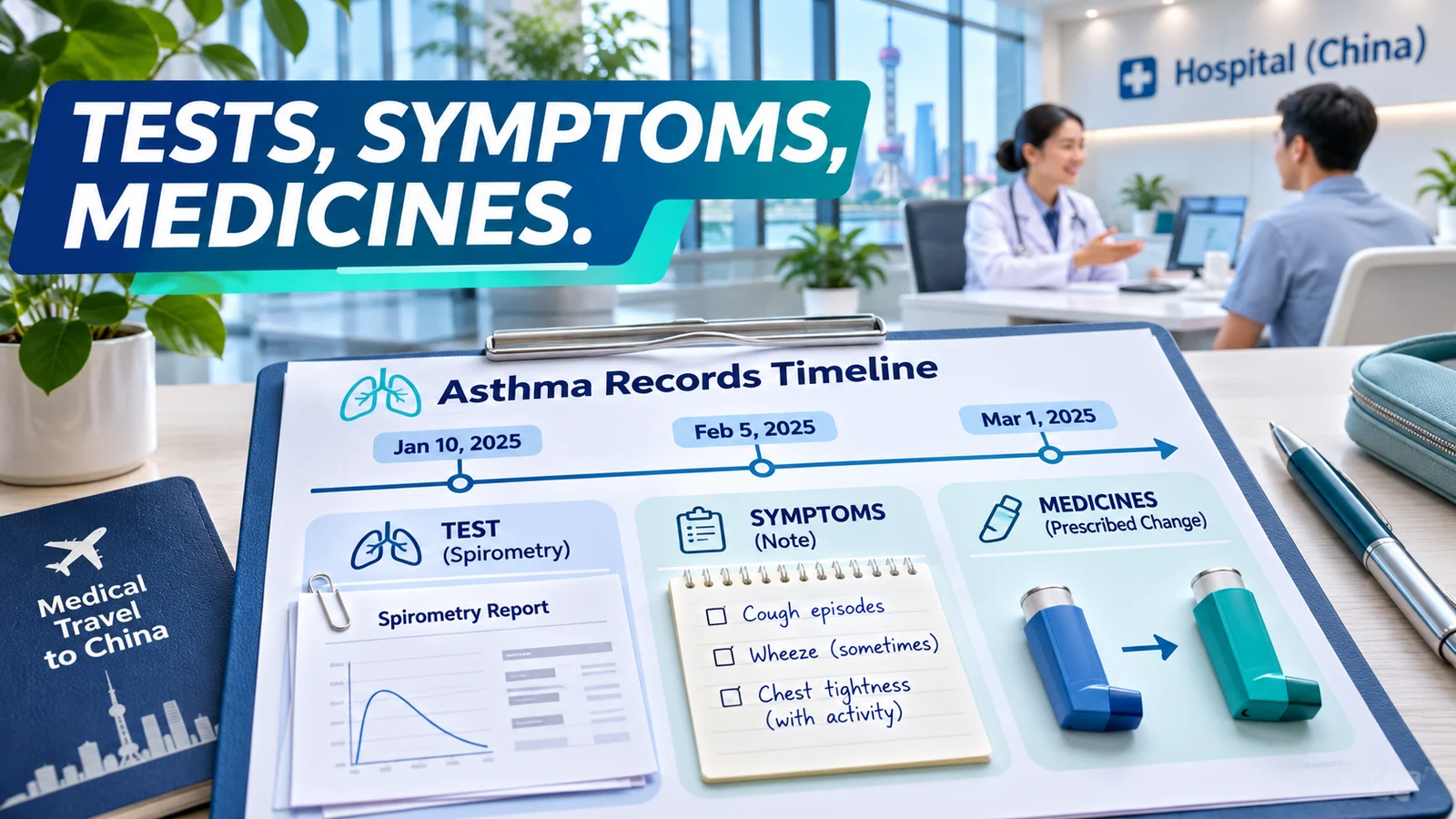
Use a simple dated checklist. You do not need to interpret the results yourself.
- Date of test: What happened: Spirometry, peak-flow record, FeNO, allergy test, imaging, or other reported test. Existing evidence to keep: Full original report, including units and reference ranges. Questions to note: Was the test before or after a reliever medicine?
- Date symptoms changed: What happened: Cough, wheeze, chest tightness, breathlessness, night waking, activity limitation. Existing evidence to keep: Personal symptom note or clinic note. Questions to note: How long did it last and what was different from usual?
- Date of urgent care: What happened: Emergency visit, hospital admission, oxygen, nebulizer, or urgent clinician contact. Existing evidence to keep: Discharge paper, visit summary, prescription record. Questions to note: What follow-up was advised?
- Date medicine changed: What happened: Inhaler started, stopped, changed, or short oral steroid course prescribed. Existing evidence to keep: Label photo, prescription, or medication list. Questions to note: Who prescribed it and what instructions were given?
- Date of infection or exposure: What happened: Respiratory infection, smoke, dust, weather, exercise, workplace or allergen exposure if known. Existing evidence to keep: Existing test or note only. Questions to note: Was a trigger suspected or simply reported?
Write “unknown” rather than guessing. A useful record separates an observed event from an assumption. For example, “wheeze after a viral illness; urgent visit on 12 March” is different from “infection caused my asthma to become severe.”
Keep lung-function reports complete
For each available report, keep the whole document rather than copying only a highlighted number. Useful identifying details can include the test date, laboratory or clinic, patient identifiers as issued, test type, units, reference ranges, pre- and post-bronchodilator values if present, technician comments, and the interpreting clinician's report.
Common existing reports may include:
- Spirometry: a test measuring how much air you can exhale and how quickly.
- Peak expiratory flow (PEF): a measure of how quickly you blow air out with maximum effort.
- Bronchodilator responsiveness: a comparison before and after a fast-acting bronchodilator within a supervised test.
- FeNO: a breath test that measures fractional exhaled nitric oxide; it may be used with other information, not as a standalone answer. 1
- Allergy, blood, imaging, or infection-related records: retain them only when they were part of your existing care or are relevant to the review question.
Do not attempt to calculate a diagnosis from a single number. GINA notes that asthma diagnosis uses characteristic variable respiratory symptoms together with evidence of variable expiratory airflow, and that lung function should be considered alongside, rather than replaced by, the clinical context. 2
Keep originals, translations, and your own notes separate
For an international review, a small amount of document structure can prevent confusion. Keep the original report as issued in one folder. Put any translation in a second folder with a filename that makes clear which original it belongs to, for example, "2025-03-12-spirometry-original" and "2025-03-12-spirometry-English-translation". Keep your own symptom timeline in a third folder or separate document.
This separation helps a reviewer identify the source of each statement. An original report shows what the issuing laboratory or clinician recorded. A translation helps with language access but does not replace the source. Your own note can explain when symptoms changed, what you remember about an episode, or which question you want to ask. It should be labelled as a patient note, not as a hospital record.
If a report is incomplete, blurry, or missing a page, preserve the version you have and note the gap. Do not fill in a missing value, recreate a chart, or write an interpretation onto the report. A clear list of missing items is more useful than a reconstructed document that cannot be verified.
Describe flare-ups without self-diagnosing them
An exacerbation is a worsening from a person's usual respiratory status. The label may appear in a medical record, but you do not need to decide whether every bad day was an exacerbation. Instead, record what happened and preserve the evidence.
For each significant episode, note:
- The date or approximate date and where you were.
- The symptoms you noticed, such as wheeze, coughing, chest tightness, shortness of breath, night waking, or reduced usual activity.
- How long symptoms had been worse than your normal pattern.
- Any peak-flow measurement only if you already have it, including the unit and your documented personal best if one exists.
- Whether you contacted a clinician, attended urgent care, visited an emergency department, or were admitted.
- The medicines you were already prescribed and any medicine change a clinician instructed.
- The written follow-up instructions or discharge record, if available.
Keep symptoms and the care you received separate. “I used the reliever inhaler more often” is a patient observation. “Emergency clinician prescribed a short course of oral corticosteroid” is a documented action. Do not call a change an allergy, infection, uncontrolled asthma, ABPA, or another diagnosis unless it appears in the clinician's original record.
Prepare a current medication and device list
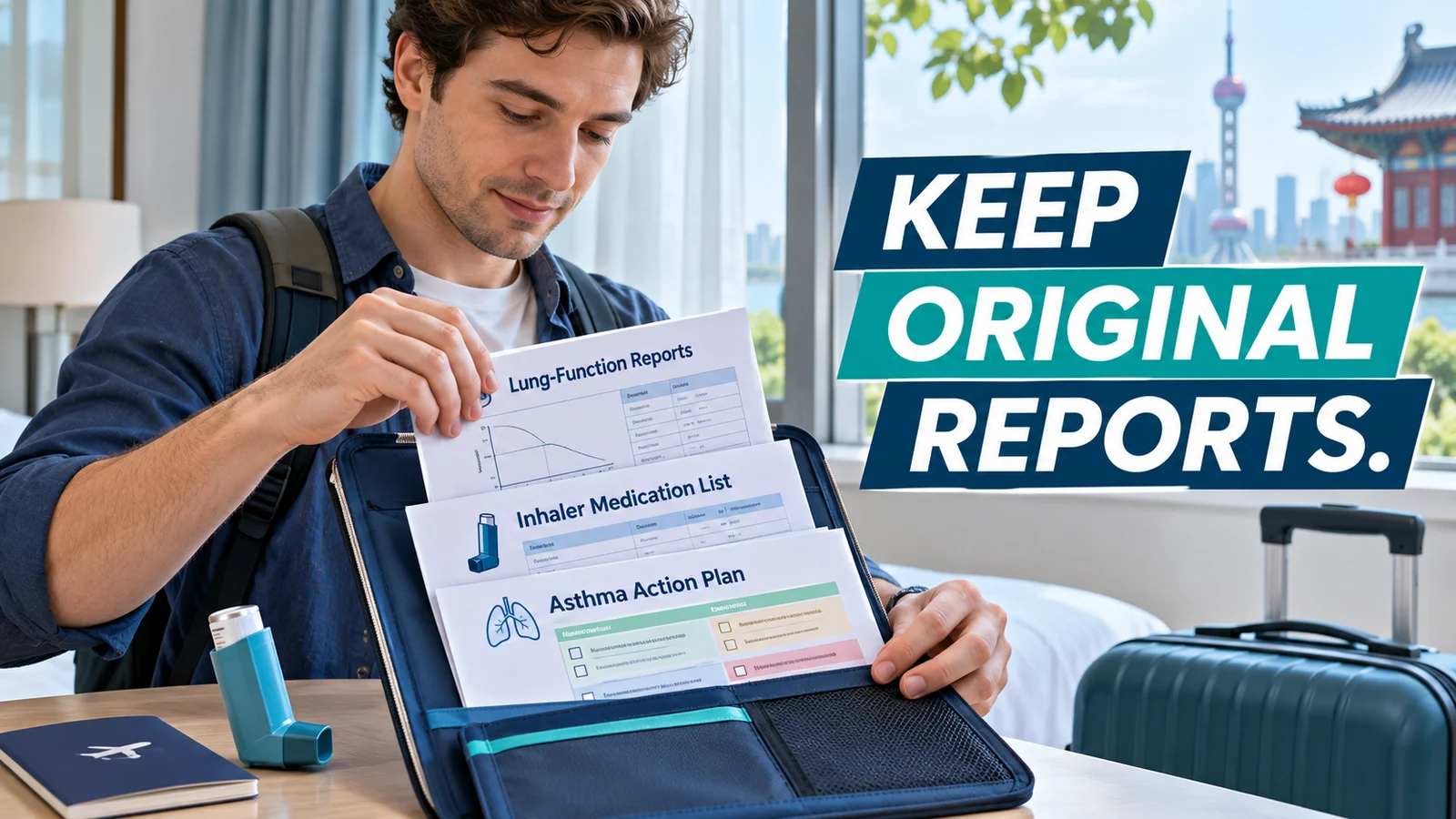
Bring or upload a current list rather than relying on memory. For each medicine, record the brand name, generic name if known, device type, strength, prescribed instructions, the country where it was issued, and a photo of the label if practical. Also list known allergies or adverse reactions as previously documented.
This is not a request to change treatment. Take asthma medicines exactly as prescribed unless your own clinician tells you otherwise. CDC advises people with asthma to follow their individual action plan and not stop medication or change a treatment plan without speaking with a healthcare provider. 3
If you use a written asthma action plan, include the current version and keep it separate from an informal travel checklist. It may contain individualized instructions that a receiving team needs to see in its original context. Do not replace the plan with a generic online chart.
What to prepare for travel to China
In addition to your record timeline, prepare practical information that helps a hospital understand the documents:
- your preferred language and any existing translations;
- the city in China, expected travel dates, and whether symptoms are currently stable or changing, without making a self-assessment of travel fitness;
- the original reports plus a clear file list;
- a medication list and current action plan, if you have one;
- the official contact route used to send records;
- a question list focused on what you want clarified during a future in-person review.
Avoid sending unnecessary sensitive files to informal messaging accounts. Use the hospital's requested channel. A delivery confirmation does not establish that records were clinically reviewed, that travel is appropriate, or that a hospital has confirmed a next step. If files cannot be opened, see the guide to medical record delivery problems in China.
When not to wait for travel or record review
Record preparation is not urgent-care guidance. If you have severe or rapidly worsening breathing difficulty, cannot speak or walk normally because of shortness of breath, have concerning color changes, or your prescribed quick-relief medicine is not helping as directed in your individual action plan, seek prompt local emergency medical help. Do not wait for a WhatsApp reply, file upload, travel arrangement, or a review in China.
The CDC's asthma action-plan material identifies severe symptoms and failure of quick-relief medicine as reasons to seek urgent medical help. 4 Your own written action plan and local emergency instructions should take priority.
How MedToChina can support practical preparation
You can submit your basic information and questions, or send available records through WhatsApp for practical preparation. Tell us the city you plan to visit, your preferred language, the types and dates of records available, and any non-clinical questions about organizing them.
MedToChina can discuss practical China care-travel preparation and communication after understanding your information. We do not diagnose asthma, decide whether a symptom is an exacerbation, alter your medication plan, arrange emergency care, or guarantee hospital availability or a clinical outcome.
FAQ
Should I repeat spirometry before travelling to China?
Do not arrange testing solely for travel unless your own clinician recommends it. Bring existing reports and let the receiving clinical team decide whether additional evaluation is relevant.
Do I need every peak-flow reading I have ever taken?
Usually, a dated pattern and any records that relate to meaningful symptom changes or clinician contact are more useful than an unstructured mass of readings. Keep the original source when available.
Should I stop my inhaler before a future review?
Do not change or stop prescribed medicine without instructions from your own treating clinician. Ask any testing or medication questions through the appropriate clinical process.
Can I diagnose a flare-up from my record timeline?
No. The timeline helps organize observed symptoms, existing tests, and documented care. A clinician assesses what those facts mean.
What should I do if symptoms worsen before travel?
Follow your own written action plan and seek prompt local medical help when needed. Do not wait for international travel coordination.
Discuss Your China Medical-Travel Preparation
Preparing existing asthma records for a possible medical review in China? Submit your information or send your available reports and non-clinical questions through WhatsApp. Our team can discuss practical record organization and China care-travel preparation.
Medical Disclaimer
This article provides general record-organization and travel-preparation information for international patients considering medical care in China. It is not a diagnosis, treatment plan, medication instruction, travel-clearance assessment, or emergency-care substitute. Never change prescribed medicine without guidance from your treating clinician. For severe or worsening breathing symptoms, seek prompt local medical help.
References
- NHLBI. Asthma - Diagnosis.
- Global Initiative for Asthma. GINA FAQ.
- CDC. What to Do When an Emergency Occurs.
- CDC. Asthma Action Plan.