
Treatments
Hepatitis B Review in China: Dated Test Reports and Antiviral Treatment Records
Prepare hepatitis B records for a review in China: organize dated HBV tests, liver assessments and antiviral prescriptions without changing treatment.
MedToChina Editorial Team · 10 min read · November 18, 2026

Quick Summary
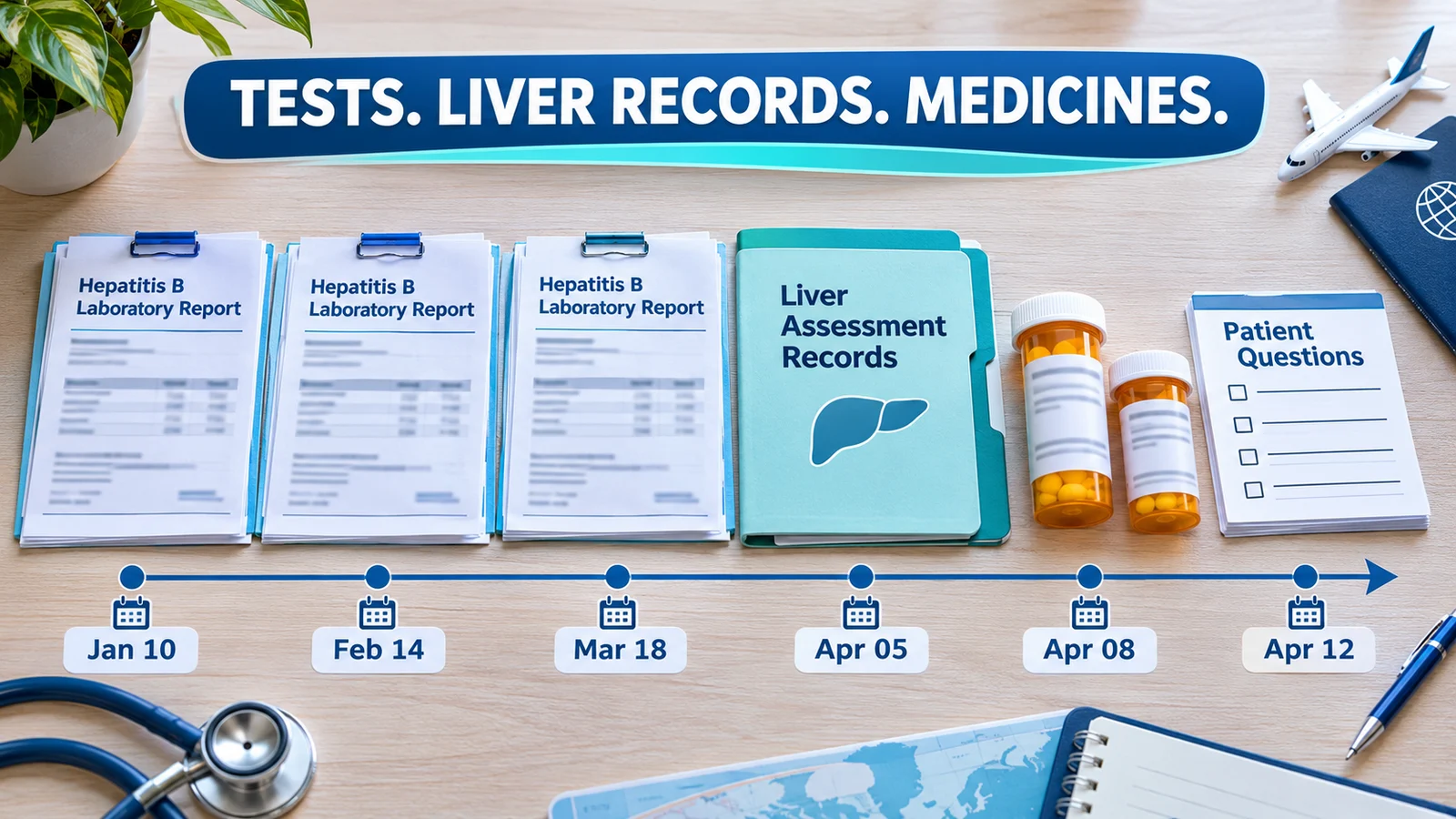
If you are considering a hepatitis B (HBV) medical review in China, preparation begins with a reliable timeline of existing records. Keep the full report for every relevant blood test, imaging study, liver assessment, clinic note, prescription, and medication label. Place each item by its original collection, procedure, or issue date, and keep results from different laboratories in their original format.
Do not use a single result to decide whether an infection is active, whether liver damage is present, or whether you need a medicine change. Do not stop, restart, split, or change an antiviral medicine to create a new result before travel. This guide is for overseas patients organizing records for possible care in China. It does not diagnose hepatitis B, interpret viral-load results, recommend treatment, or determine whether travel is safe.
Distinguish collection dates, procedure dates, and report dates
One document can carry more than one meaningful date. A blood result may show the date blood was collected, the date the laboratory completed the analysis, and the date a report was released to a portal. Imaging and elastography records may show a procedure date and a later report-signing date. A prescription may show the date it was issued, while the pharmacy label shows the date it was dispensed.
Keep the dates exactly as they appear. In your index, use a specific label such as “sample collected,” “scan performed,” “report issued,” or “medicine dispensed.” This avoids making a laboratory result appear to have been obtained on the day you downloaded it. It also helps a reviewer understand the order of existing documents without assuming that an older report reflects your current condition.
If a portal displays only one date and you cannot tell what it represents, preserve the original screenshot or PDF and write “date type not stated” in your patient index. Do not replace an unknown date with the date of travel, the date a translation was prepared, or an estimate based on memory.
Why dates and original reports matter
Hepatitis B is a viral infection that can be acute or chronic. Doctors use medical history, an examination, and blood tests to diagnose hepatitis B, and may use additional tests to check the liver. 1 This means a useful record set is more than a list of numbers. It shows what was tested, on which date, by which laboratory, and what else was recorded around that time.
The same test name can appear at different points in a person's care. A result may have been obtained during screening, a routine follow-up, pregnancy, a medication review, an illness, or a planned assessment. Preserve those contexts when they are already documented. Do not infer a cause from timing alone.
Start with the earliest report you have and build forward. For a general document inventory, see the China-ready medical records checklist. Keep the original language and all pages. If you have an English translation, place it beside the source file rather than replacing the source. A clinician reviewing records can then distinguish an original laboratory statement, a translation, and your own patient notes.
Make one neutral HBV record timeline
Use a simple date-based index. The purpose is to locate documents quickly, not to interpret them.
- Date: Blood collection date Original document to keep: Full HBV-related laboratory report Information to preserve: Test name, result format, units, reference range, laboratory Patient note, clearly labelled: Why the test was done if this is already known
- Date: Clinic or follow-up date Original document to keep: Visit note or letter Information to preserve: Existing assessment and planned follow-up as written Patient note, clearly labelled: Questions you want to ask later
- Date: Imaging or liver-assessment date Original document to keep: Full report, not only a screenshot Information to preserve: Procedure date, facility, report text, attachments Patient note, clearly labelled: Whether the file is complete or a page is missing
- Date: Prescription date Original document to keep: Prescription, pharmacy label, or medicine list Information to preserve: Medicine name, strength, instructions, country issued Patient note, clearly labelled: Whether you have enough medicine for travel; do not change the schedule yourself
- Date: Hospital or urgent-care date Original document to keep: Discharge summary or visit record Information to preserve: Documented reason for care and instructions Patient note, clearly labelled: Symptoms you remember, kept separate from clinical conclusions
Write “unknown” if a date, test name, or context is unclear. Do not guess which marker means recovery, immunity, reactivation, or response to treatment. A missing original is more transparent than a reconstructed result.
Keep laboratory reports complete and grouped by source
HBV-related records may include screening markers, viral nucleic-acid testing, liver enzyme tests, blood counts, and other laboratory reports ordered by a clinician. Names and panels differ by country and laboratory. For each report, retain the laboratory name, collection date, report date, units, reference ranges, any comments, and all pages.
The National Institute of Diabetes and Digestive and Kidney Diseases explains that blood tests can help doctors identify hepatitis B infection and, if infection is present, assess questions such as chronicity, liver-damage risk, virus levels, and whether treatment may be needed. 1 That does not make any single number a self-diagnosis tool. Results are interpreted alongside medical history, other tests, and the clinical situation.
Keep results from different laboratories in separate files even if the test labels look similar. Do not manually convert units, redraw charts, or remove a laboratory reference range. If a report was issued as a portal screenshot, preserve the complete original export when possible and note the date you downloaded it.
Keep antiviral medicine records factual
If you take a prescribed antiviral medicine, create a separate medicine log based on the documents you already have. Record the brand name, generic name if shown, strength, prescribed schedule, start date if written, prescriber or issuing facility, country of issue, and label photographs when practical. Keep prior prescription records too if the clinical team changed a medicine or dose in the past.
This log should record instructions, not create new ones. NIDDK states that people taking hepatitis B antiviral medicines should not stop them without first speaking with their doctor. 1 Do not stretch doses, use someone else's medicine, purchase a new medicine as a substitute, or change a regimen because of a future review in China. Questions about treatment continuity, travel supply, interactions, or a missed dose belong with your current treating clinician or pharmacist.
If you no longer take a medicine, retain the original record and state the stop date only if documented. “Patient remembers stopping around 2024” is a patient note, not a prescription instruction. Keep it separate from a clinician's letter or pharmacy record.
Separate original reports, translations, and personal notes
For international care preparation, use separate folders for sources, translations, and your own index. Suggested filenames begin with the date in "YYYY-MM-DD" form:
01-original-HBV-laboratory-reports/
- File: 2025-04-02-HBV-panel-Laboratory-A-original.pdf
- File: 2025-10-12-liver-tests-Hospital-B-original.pdf
02-liver-assessment-and-imaging/
03-prescriptions-and-medication-labels/
04-translations/
05-patient-index-and-questions/
An original report shows what the issuing facility recorded. A translation supports language access but does not replace the original. A patient index can list the document date, file name, and a neutral description such as “HBV laboratory panel” or “prescription label.” Do not write an interpretation onto the original document or rename it with a conclusion.
If pages are missing, images are blurry, or an attachment will not open, keep the version you have and make a short missing-items list. Avoid sharing sensitive files through informal or expiring links. Use the channel requested for records and confirm that the files can be opened; delivery confirmation is not a clinical review, a treatment recommendation, or a travel-clearance decision. For unreadable attachments or expired links, see the medical record file delivery guide.
Include liver-assessment records without drawing conclusions
If you have existing imaging, elastography, biopsy, or specialist liver-assessment material, preserve the complete report and any related clinic note. NIDDK lists blood tests, elastography, ultrasound or other imaging, and sometimes biopsy among the tests clinicians may use when evaluating liver damage in chronic hepatitis B. 1
Do not treat a scan image, stiffness value, or a line in an old report as a standalone answer about your current liver health. Keep the procedure date, facility, report date, and any original conclusion. Put appointments and reports in timeline order but leave clinical meaning to a qualified team.

What to send with a practical record question
Alongside your documents, provide a short factual cover note: your name as shown on records, date of birth only when the receiving channel requires it, preferred language, current country, planned travel timing if known, and a list of file types you are sending. State which original documents and translations are included and which records are unavailable.
Practical questions can include whether the file formats are readable, whether a translation format is preferred, or whether there is a requested way to label multi-date records. Do not ask a non-clinical coordination channel to interpret a viral-load result, decide if treatment should start or stop, assess liver damage, or determine whether you can travel.
When record preparation should not delay local care
File organization is not an emergency plan. Seek prompt local medical help for urgent symptoms or a sudden deterioration, and follow your current clinical team's instructions. Do not wait for a WhatsApp reply, record upload, translation, China travel arrangement, or a future review if you need immediate care.
NIDDK notes that hepatitis B can lead to serious complications and that people with chronic hepatitis B may need regular assessment for liver damage or other concerns. 1 This article cannot determine the cause or urgency of any symptom.
How MedToChina can support practical preparation
You can submit basic information and non-clinical questions, or send your available document list through WhatsApp for practical preparation for a possible medical visit in China. Tell us your preferred language, current country, planned travel timing if known, and which laboratory, liver-assessment, and prescription records are available.
MedToChina can discuss record organization, file-transfer considerations, and practical China care-travel preparation after reviewing the information you choose to share. We do not diagnose hepatitis B, interpret tests, change medicine, decide whether travel is safe, guarantee hospital availability, or promise a clinical outcome.
FAQ
Should I put every HBV-related result in a single spreadsheet?
A date index can help, but always keep complete original reports. Do not remove test names, units, reference ranges, or pages because you have copied a number elsewhere.
Should I stop an antiviral medicine before a future review?
No. Do not stop or change a prescribed antiviral medicine without guidance from your treating clinician.
Do I need to translate every page before sending records?
Keep all originals first. Ask the receiving channel whether translations are needed and which documents or format it prefers. A translation should remain linked to its original report.
Can a message review tell me whether I have liver damage or need treatment?
No. Those are clinical questions that require appropriate medical assessment. WhatsApp can be used for practical preparation and document questions only.
What if a report was done at a different laboratory?
Keep it with its own original source, date, units, and reference range. Do not make results look identical by converting or relabelling them yourself.
Discuss Your China Medical-Travel Preparation
Preparing hepatitis B records for a possible medical review in China? Submit your information or send your available document list and practical questions through WhatsApp. Our team can discuss record organization and China care-travel preparation.
Medical Disclaimer
This article provides general record-organization and care-travel preparation information for international patients considering medical care in China. It is not a diagnosis, test interpretation, treatment recommendation, medication instruction, travel-clearance assessment, or emergency-care substitute. Do not change prescribed medicine without guidance from your treating clinician. For urgent symptoms, seek prompt local medical care.
References
- National Institute of Diabetes and Digestive and Kidney Diseases. Hepatitis B.