
Treatments
Hair Loss Evaluation in China: Photo Timelines and Previous Product Use
Prepare for a hair loss evaluation in China with dated scalp photos, previous product labels and dermatology records, without changing treatment.
MedToChina Editorial Team · 10 min read · November 18, 2026
Quick Summary
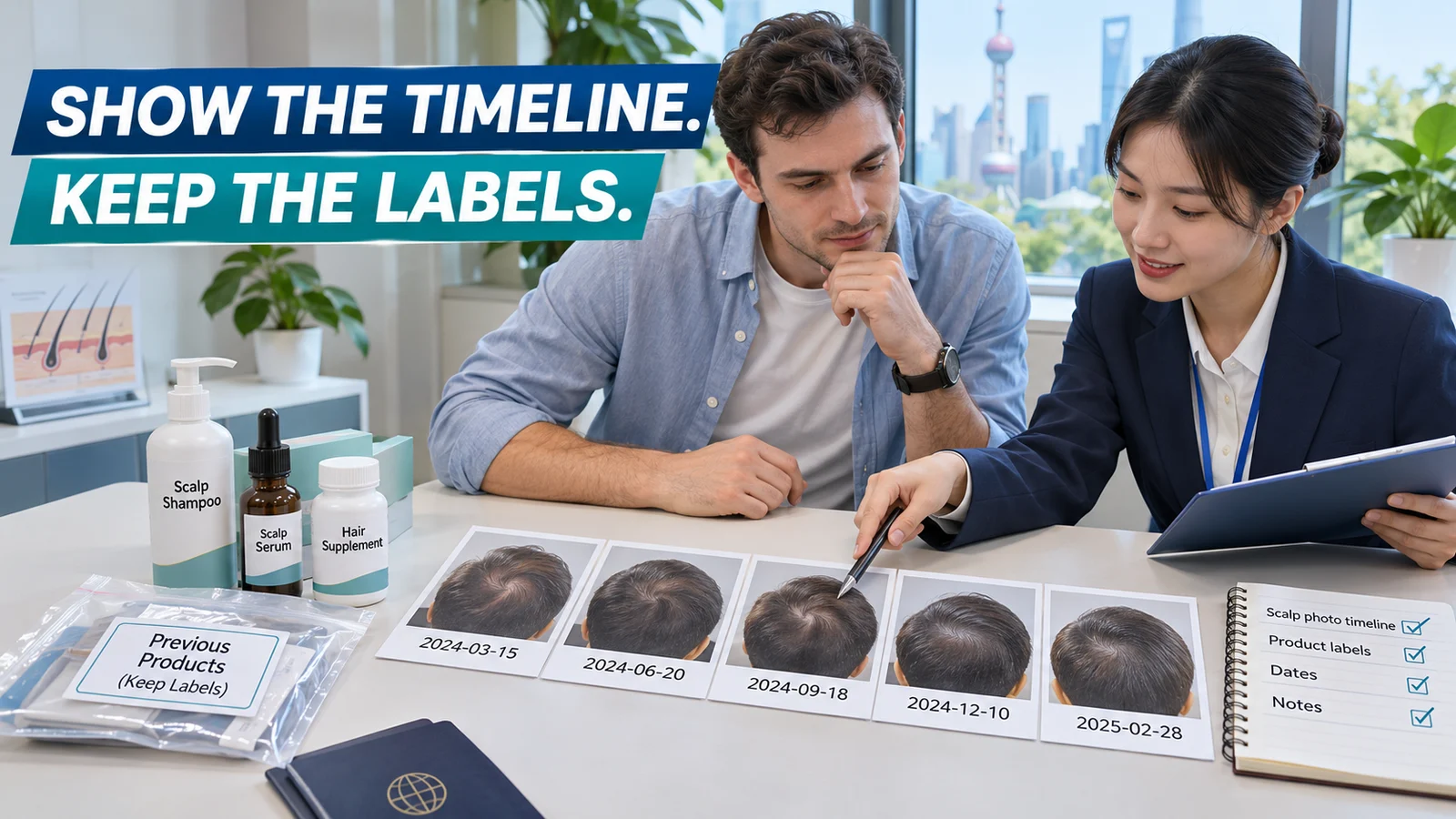
If you are planning a hair or scalp evaluation in China, a dated photo timeline and a factual list of previous products can make an in-person discussion easier. Take or collect existing photos in their original order, note approximately when changes were first noticed, and keep labels or purchase records for products you have already used. The goal is to show what you observed and what you used, not to decide the cause of hair loss or prove that a product worked.
Do not begin, stop, restart, or change a medicine, supplement, device, shampoo, serum, or procedure just to make the record look more complete before travel. This guide is for overseas patients considering care in China. It does not diagnose a hair-loss type, recommend a dose or product, promise regrowth, or decide whether travel is appropriate.
Why a timeline is more useful than a single before-and-after photo
Hair and scalp changes can be gradual, intermittent, or noticed only after a styling change, illness, pregnancy, new medicine, dietary change, stressful period, hair-care routine, or another event. A single close-up may show one moment, but it rarely shows when the change began, whether it was stable or changing, or how the photo was taken.
The American Academy of Dermatology explains that a dermatologist begins a hair-loss assessment by gathering information, including how long hair loss has been present and whether it began quickly, together with an examination of the scalp and other relevant areas. 1 A patient-made timeline does not replace that assessment. It simply helps preserve the history you can provide.
Start with the earliest usable photo you already have. For a general document inventory, see the China-ready medical records checklist. Keep the original file where possible, including its capture date. If you cannot verify a date, label it as approximate rather than assigning a precise day. Arrange photos in order and keep a note of what changed in the image conditions as well as what you observed about the hair or scalp.
Build a consistent photo timeline
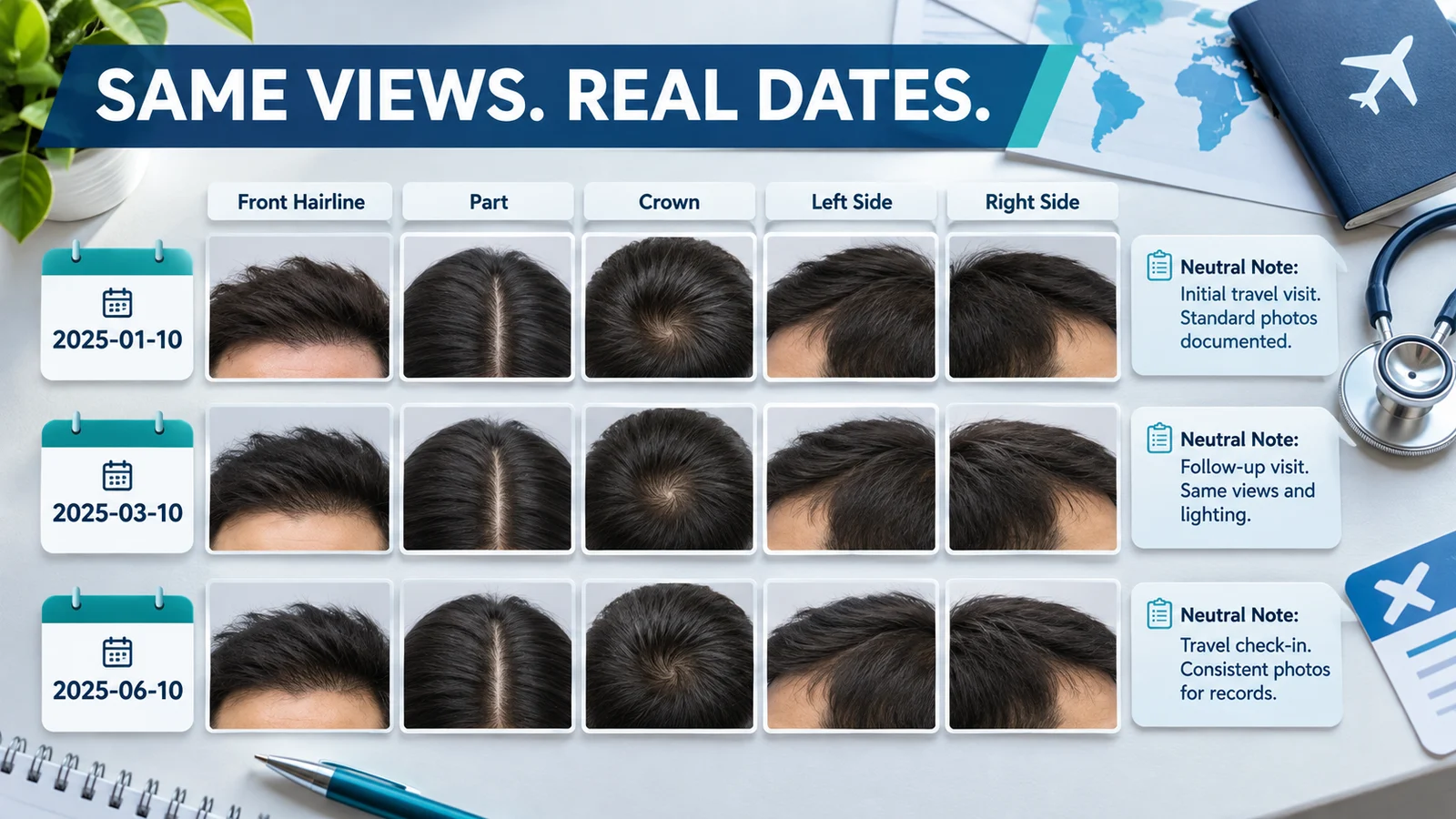
When taking new photos for a future visit, use consistency rather than dramatic angles. Choose the same parts of the scalp, similar distance, similar lighting, and similar hair condition when practical. A simple series is usually more useful than dozens of photos taken on the same day.
- Date or period: Earliest available Photo view: Front hairline, part, crown, sides, or another affected area Recording conditions: Original photo, if available Neutral observation: “First photo I found showing this area”
- Date or period: Later comparison Photo view: Same view where possible Recording conditions: Similar lighting and hair position Neutral observation: “Noticed more shedding while washing” or “appearance seemed unchanged”
- Date or period: New event Photo view: Same set of views Recording conditions: Record whether hair is wet, dry, styled, dyed, or covered Neutral observation: “Started using a product around this time”
- Date or period: Current photo Photo view: Same views plus a wider context image Recording conditions: Date, device, distance, lighting Neutral observation: “Question for future dermatology visit”
Avoid filters, beauty modes, extreme flash, heavy styling products, fibers, color sprays, or edits that change the visible scalp or hair density. If you used any of these, do not delete the photo; simply label it. A note such as “hair was wet,” “bright overhead light,” or “photo after coloring” can prevent an image from being over-read.
Do not measure hairs, draw circles around a scalp area, or mark an image as “new growth,” “scarring,” “infection,” or “pattern loss” unless that wording is part of an existing clinician record. Patient photos document appearance. They do not establish a diagnosis.
Link a photo to a product without claiming a result
If you want to show when a product entered your routine, connect the label photo and the scalp-photo series through dates only. For example, your index might say: “Product label photographed on 12 May; first use reported by patient in mid-May; next comparable scalp photos on 1 June.” Do not write that the product caused a change, prevented loss, or produced regrowth unless that conclusion appears in an existing clinician record.
This simple date link is also useful when a product name changed, a bottle was purchased in another country, or a family member helped with the record. Preserve the original label photograph and record any uncertainty. A factual timeline remains useful even when dates are approximate.
Keep a product and treatment history without turning it into advice
Make a separate list of every relevant product or procedure already used. This may include prescription medicine, over-the-counter topical products, oral supplements, shampoos, conditioners, cosmetic fibers, oils, devices, injections, procedures, hair coloring, chemical straightening, extensions, or scalp treatments. Record only what is factual and verifiable where possible.
For each item, keep the product name exactly as printed, a photo of the front and ingredient or instruction label if practical, the form (for example, foam, solution, tablet, shampoo, device, or salon treatment), the dates used if known, the country where it was bought or prescribed, and the original instructions. If a clinician prescribed it, keep the prescription or visit note. If a product was self-purchased, label it as self-purchased rather than making it look like a prescribed therapy.
Do not compare products, write your own dose conversion, or label one as effective or ineffective based only on a few photos. The AAD notes that finding the cause matters because hair loss can have different causes, and no one treatment works for every person. 1 Your history helps a clinician ask better questions; it does not select a treatment.
Separate observations from diagnosis labels
Use two columns in your notes: “what I observed” and “what is documented.” Under observations, you might write “more hair in brush,” “itching after a product,” “breakage along the hairline,” or “patch appeared larger in photo.” Under documented information, you may list an existing diagnosis, test result, prescription, or clinician instruction and attach the original source.
Do not move an observation into the documented column just because it seems plausible. For example, “my scalp became tender after coloring” is an observation. “Allergic reaction,” “alopecia areata,” “androgenetic alopecia,” or “fungal infection” requires appropriate clinical assessment. This distinction matters especially when records cross languages or are reviewed after travel.
If you have an existing blood test, scalp biopsy, dermatology letter, or photograph taken by a clinician, preserve the complete original file and its date. Do not add an interpretation to the report. If something is missing, list it as missing rather than recreating it from memory.
Make files easy to review across countries
Use date-first filenames and separate originals, translations, photos, and your own index. For example:
01-original-photos/
- File: 2025-03-12-front-original.jpg
- File: 2025-03-12-crown-original.jpg
02-new-consistent-photo-series/
03-product-labels-and-prescriptions/
04-dermatology-records-and-tests/
05-translations/
06-patient-index-and-questions/
Keep copies rather than editing the only original. If you crop a copy for easier viewing, retain the uncropped version and name the copy clearly. If a photo is sent through an app that removes metadata or compresses it, preserve the original separately. Avoid sending sensitive files through informal or expiring links; use the channel requested for records and confirm only that files can be opened, not that they have been clinically interpreted. For unreadable attachments or expired links, see the medical record file delivery guide.
Include relevant life and hair-care context carefully
A brief timeline may include periods when you noticed shedding or a scalp change and any relevant existing context, such as a new prescription, illness, childbirth, surgery, major weight change, a new hair-care practice, extensions, chemical treatment, or a documented nutrition or hormone test. Record the event and date if known. Do not conclude that it caused the hair change.
The AAD notes that a clinician may consider a blood test or scalp biopsy when a disease, nutritional deficiency, hormone imbalance, or infection is suspected. 1 That is a reason to preserve existing results and questions, not a reason to order a test or use a supplement independently before travel.
If you use supplements, record the label and the reason you started it. Do not add iron, biotin, zinc, hormones, or any other supplement solely because a social post or product advertisement associates it with hair. Bring the label or a clear product photo so a clinician can see what you used.
Questions to send with a practical record submission
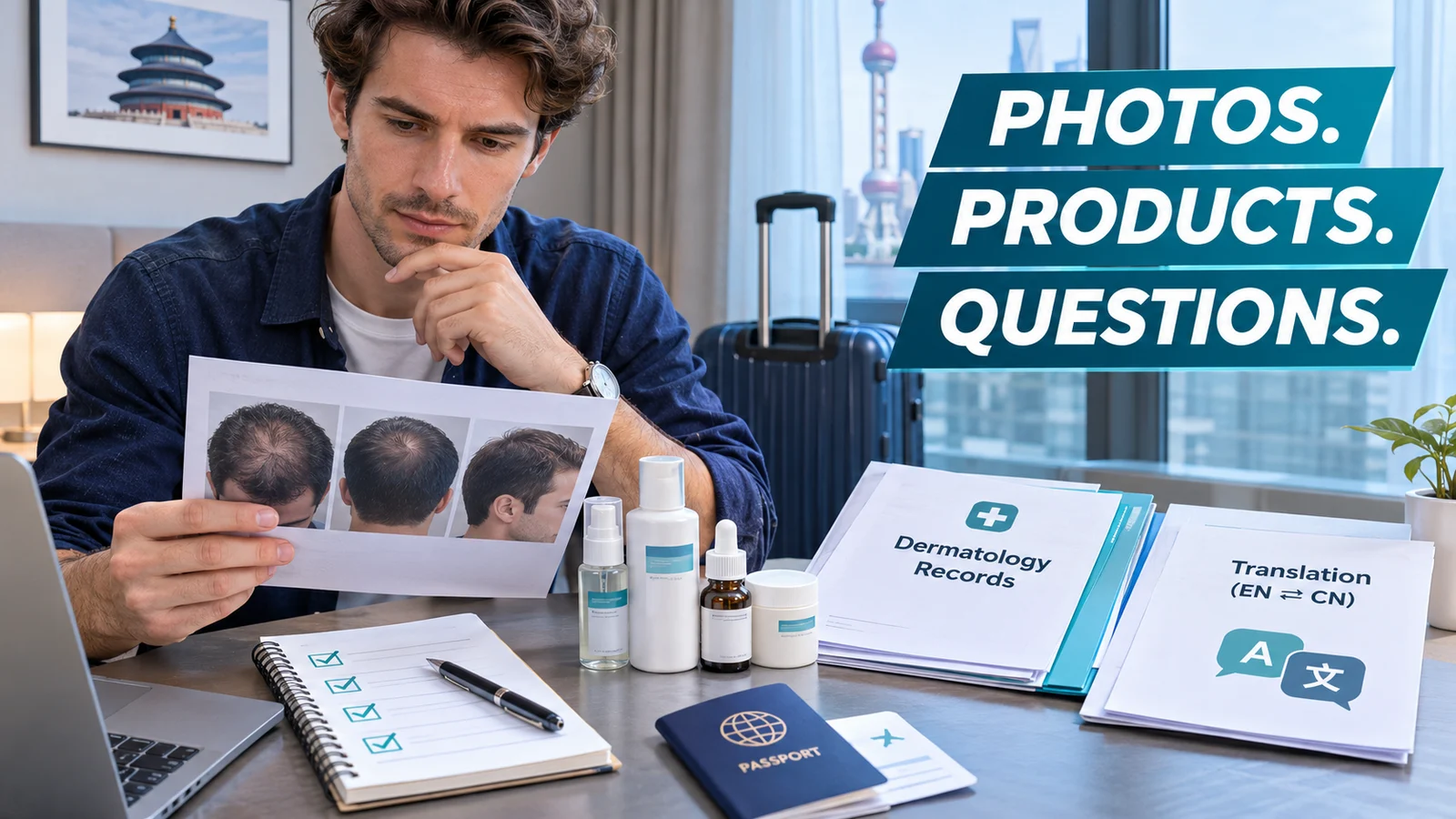
Along with your file list, include your preferred language, current country, planned travel timing if known, and whether you have original photos, product labels, dermatology notes, or translations. Practical questions can ask whether a file format is readable, whether an original label is needed, or how to name photos that lack exact dates.
Keep clinical questions open and appropriate for a future in-person assessment. For example: “Which photos and original product labels are useful to bring?” Avoid asking a non-clinical coordination channel to diagnose your hair loss from images, recommend a product or dose, confirm a treatment, or promise a cosmetic or medical result.
When not to wait for travel or a record review
Record preparation is not urgent-care advice. If you have a rapidly worsening rash, painful swelling, fever, facial swelling, trouble breathing, sudden extensive hair loss with concerning symptoms, or another urgent problem, seek prompt local medical help. Do not wait for a WhatsApp reply, translation, upload confirmation, travel arrangement, or future evaluation in China.
How MedToChina can support practical preparation
You can submit basic information and non-clinical questions, or send an available photo and product-document list through WhatsApp for practical preparation for a possible China medical visit. Tell us your preferred language, current country, planned travel timing if known, and which original photos, product labels, dermatology notes, and translations are available.
MedToChina can discuss record organization, file-transfer considerations, and practical China care-travel preparation after reviewing the information you choose to share. We do not diagnose a hair or scalp condition from photos, recommend products or doses, decide whether travel is safe, guarantee hospital availability, or promise a clinical or cosmetic outcome.
FAQ
Should I take a photo every day?
Usually a consistent series over time is more useful than many same-day photos. Keep original dates and add photos when there is a meaningful change or at a practical interval.
Should I stop products before travelling so a clinician can see my natural hair?
Do not stop or change prescribed medicine, products, or a treatment routine without guidance from the clinician who manages your care. Record what you are using and bring the labels instead.
Can a photo identify my type of hair loss?
No. Photos can document appearance but cannot establish the cause or type of hair loss. A clinician may need history, examination, and sometimes tests.
Do I need every empty bottle or package?
Clear photos of the front and instructions or ingredient label can be useful. Keep original prescriptions or receipts if available, but do not create records you do not have.
Can WhatsApp recommend a hair-loss product or procedure?
No. WhatsApp can be used for practical record-preparation and China care-travel questions, not for diagnosis, product selection, dosing, or outcome predictions.
Discuss Your China Medical-Travel Preparation
Preparing hair and scalp records for a possible medical evaluation in China? Submit your information or send your available photo and product-document list through WhatsApp. Our team can discuss practical record organization and China care-travel preparation.
Medical Disclaimer
This article provides general record-organization and care-travel preparation information for international patients considering medical care in China. It is not a diagnosis, treatment recommendation, product or dose instruction, travel-clearance assessment, or emergency-care substitute. Do not change prescribed treatment without guidance from your treating clinician. For urgent symptoms, seek prompt local medical care.
References
- American Academy of Dermatology. Hair loss: Diagnosis and treatment.