
Treatments
Stent or Bypass Surgery? What International Patients Should Prepare Before Asking About Care in China
Understand what records international patients should prepare when discussing stent versus bypass surgery options in China, including angiogram reports, heart tests and medical history.
MedToChina Editorial Team · 7 min read · July 18, 2026
Quick Summary
- The choice between stent and bypass depends on coronary anatomy, symptoms, diabetes status, heart function and overall risk.
- International patients should prepare angiogram images, reports, medication lists and cardiac test results before discussing care in China.
- A web page cannot decide PCI or CABG for an individual patient; it can help you prepare better questions.
- China hospital resources may be discussed later through customer-service follow-up after your record package is understood.
International patients searching for stent vs bypass surgery usually need more than a medical definition. They need to understand what information doctors may ask for, how travel affects timing, what questions are worth preparing, and how to avoid making a major decision from incomplete online information. This guide is written for overseas patients considering China as a destination for planned medical care.
Why stent versus bypass is not a simple online decision
Stents and bypass surgery both treat coronary artery disease, but they are not interchangeable consumer choices. A stent treats narrowed arteries from inside the vessel. CABG uses grafts to create new routes for blood flow around blocked arteries. Which option is considered depends on the number of diseased vessels, left main disease, blockage location, artery size, diabetes, kidney function, heart pumping strength and patient preference after medical counseling.
Many patients contact MedToChina after hearing different opinions in their home country or after receiving an angiogram report they do not fully understand. The most useful first step is not asking for a quick answer. It is preparing the full record set so China-side communication can be based on actual anatomy and clinical context.
Records international patients should prepare
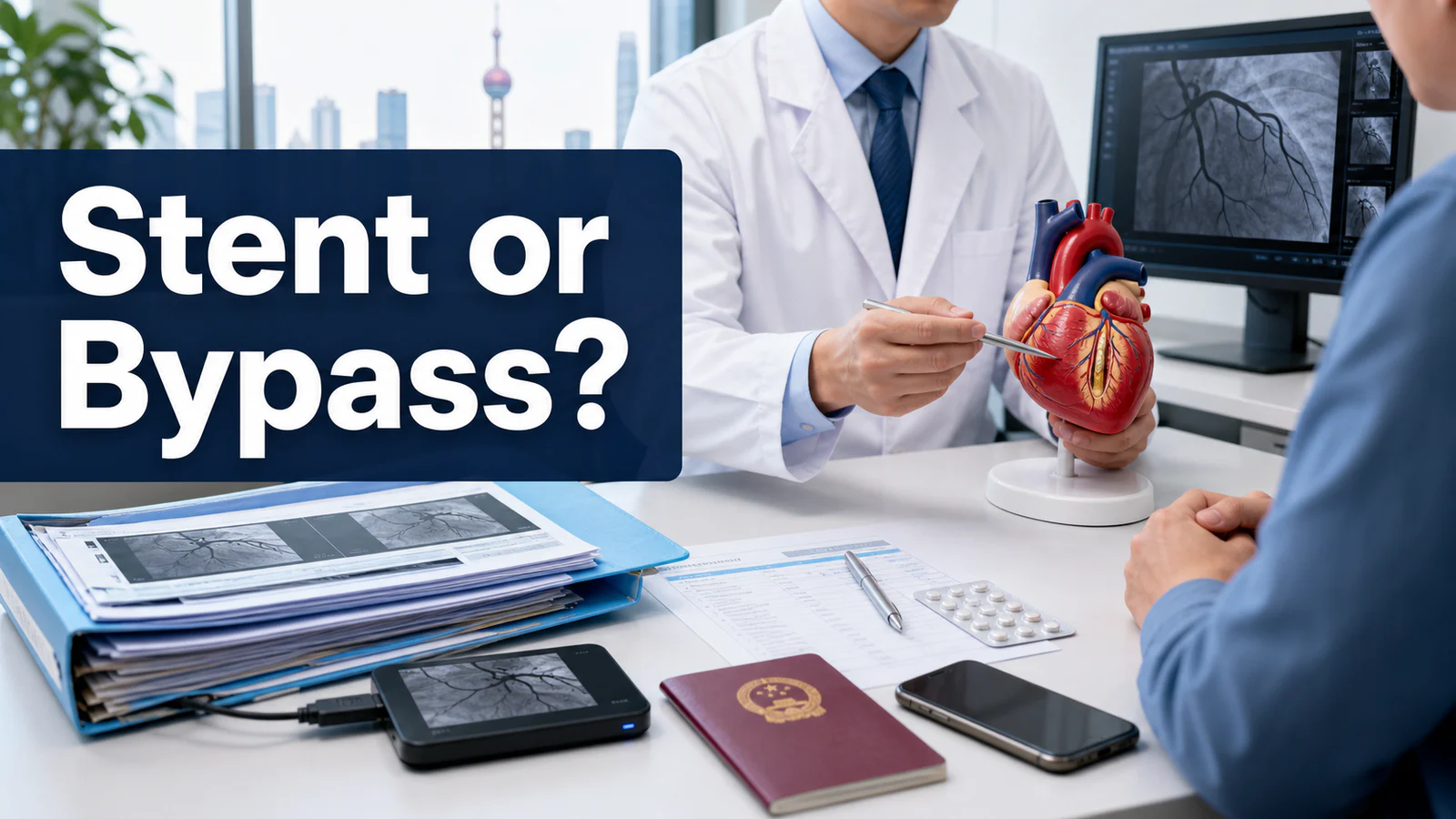
The most important file is often the coronary angiogram, ideally including DICOM images or a CD export, not only a written summary. Written reports should show which arteries are involved, the percentage and location of narrowing, whether the left main artery is affected and whether prior stents exist. Bring ECGs, echocardiogram results, stress test reports, CT coronary angiography if performed and recent blood tests.
Your medical history matters as much as the picture. Prepare a list of chest pain symptoms, shortness of breath, prior heart attack, stroke, diabetes, kidney disease, smoking, allergies, previous operations and current medications. If you take blood thinners, note the name and dose clearly.
Angiogram images and reports: why they matter
A written angiogram report may summarize disease as single-vessel, double-vessel or triple-vessel disease, but procedural planning often needs more detail. Image quality, vessel size, calcification, lesion length and branch involvement can influence whether a stent procedure is straightforward, complex or less suitable. For CABG, surgeons may consider target vessels, heart function and overall operative risk.
If you only have a printed report, MedToChina can still start by organizing your information, but original images are more useful. Ask your home hospital whether it can provide DICOM files, a secure download link or a CD copy. Keep the files named by date so old and new studies are not confused.
Diabetes, kidney disease, heart function and other context
Guidelines often discuss patient groups differently. For example, diabetes with multivessel disease may lead clinicians to discuss CABG more seriously in some contexts, while focal disease in a suitable vessel may be discussed with PCI. Reduced heart function, chronic kidney disease, frailty, lung disease and bleeding risk can all affect the risk-benefit conversation.
International patients should also describe practical constraints: how soon symptoms are occurring, whether they can travel safely, whether they have a companion, and whether their home cardiologist can provide follow-up after return. These factors do not replace clinical judgment, but they shape realistic planning.
Questions to ask before traveling
Ask whether the case appears urgent or elective, what additional tests may be needed before a decision, what the expected length of stay might be for PCI or CABG, what medications must be continued, and what follow-up is needed after returning home. If symptoms are unstable or severe, seek urgent local care rather than waiting for travel plans.
For a planned China journey, the patient should understand whether an in-person evaluation may change the earlier discussion. Coronary disease planning is dynamic. New symptoms, new blood tests or new imaging can change the conversation.
How China-side care resources may be discussed
After your record package is organized, MedToChina customer service can discuss possible care pathways in China, including whether tertiary hospital cardiology or cardiac surgery resources may be relevant. This discussion happens after understanding your condition, country, budget range, timeline and available records.
The page itself does not choose a procedure or doctor. Its purpose is to help patients avoid sending incomplete screenshots, missing angiogram files or vague symptom descriptions when they are seriously considering medical care in China.
Why international patients may consider care in China
China can be relevant for overseas patients who want specialist hospital evaluation, modern diagnostic equipment, multilingual service support in major cities and a clearer care journey than they may currently face at home. Beijing, Shanghai and Guangzhou have large tertiary hospitals, international departments and selected private or specialty centers that regularly handle complex cases and executive health services.
The practical value is not only the procedure itself. International patients often need help organizing records, understanding the likely steps, planning time in China, estimating non-medical logistics and preparing questions before travel. MedToChina content should therefore be read as preparation guidance, not a promise that a specific treatment is suitable for every patient.
How MedToChina supports communication and logistics
MedToChina can receive your information, medical records and questions through WhatsApp. After learning your condition, country of residence, timeline, budget range, language needs and available reports, the customer service team can discuss possible care pathways in China and what additional documents may be useful for communication with China-side medical resources.
The website does not provide a diagnosis, does not select a doctor on the page and does not guarantee a particular result. The goal is to help international patients prepare a clean record package, understand the likely sequence of care and avoid arriving in China without the information hospitals usually need.
Practical planning timeline for overseas patients
A practical timeline usually starts with record organization before any flight is booked. First, collect the reports that already exist, label them by date and write a short one-page timeline of diagnosis, symptoms, prior treatments and current medications. Second, send the key records and questions through WhatsApp so the customer service team can understand whether your inquiry is about screening, diagnosis clarification, treatment planning, recovery travel or follow-up after a procedure. Third, wait until the information gaps are clear before arranging flights, hotels or time off work.
For many patients, the most common planning mistake is treating the China trip like a normal appointment. Medical care involves uncertainty: a test may need to be repeated, a report may be incomplete, a procedure may require preparation, or a doctor may advise a different sequence after in-person evaluation. Build flexibility into your stay, especially if you are traveling from North America, Europe, the Middle East, Southeast Asia, Africa or Australia. A realistic schedule is part of patient safety.
Questions to write down before submitting information
Before submitting your information, write down the decisions you are trying to make. Are you comparing treatment options, checking whether travel is realistic, planning recovery after surgery, or choosing a screening package? Also list what would change your decision: cost range, time away from home, language support, ability to bring a companion, follow-up access after returning home, or comfort with possible risks.
This question list helps MedToChina respond in a focused way. It also helps patients avoid vague conversations where important details are missed. Clear questions do not replace medical judgment, but they make the first WhatsApp discussion more efficient and help the team identify what records or background information may still be needed.
What to send before WhatsApp communication
Before you contact MedToChina, prepare a short timeline, current symptoms, previous diagnosis, recent test reports, medication list, allergies, major medical history, country of residence, preferred travel window and the questions you most want answered. If imaging is involved, original image files are often more useful than screenshots.
If the situation is urgent, unstable or rapidly worsening, seek local emergency care first. Planned medical travel works best when the patient is clinically stable enough to compare options and prepare documents.
FAQ
Is bypass always better than a stent?
No. The discussion depends on anatomy, symptoms, medical history and risk. Some patients are considered for PCI, some for CABG, and some for medication-focused management.
Can I send only an angiogram report?
You can start with the report, but original angiogram images are usually more useful for meaningful communication.
What if my symptoms are getting worse?
If you have severe chest pain, fainting, breathlessness or other emergency symptoms, seek urgent local care immediately before making travel plans.
Why is diabetes important in the discussion?
Diabetes can affect long-term coronary disease patterns and may influence how clinicians compare PCI, CABG and medical therapy in some patients.
Related MedToChina Resources
- Heart bypass surgery in China
- Heart bypass surgery costs in China
- Top cardiac surgery hospitals in China
- Medical documents to prepare for care in China
WhatsApp CTA
Send your angiogram report, discharge summary and medication list through WhatsApp. Our customer service team can follow up on possible care pathways in China.
Medical Disclaimer
This article is for general health information and international patient planning only. It does not provide a diagnosis, prescribe treatment or replace an in-person evaluation by qualified medical professionals. Suitability for travel, testing, procedures or surgery must be assessed by licensed clinicians who can review your full medical history and current condition.