
Treatments
Triglyceride Review in China: Keeping Original Lipid Panels and Collection Details
Prepare original triglyceride and lipid-panel reports, units, fasting status and collection details before travelling to China for medical care.
MedToChina Editorial Team · 10 min read · November 10, 2026

Quick Summary
If you are travelling to China to discuss triglyceride results, keep every original laboratory report and preserve the collection details shown on it. A result without its unit, date, laboratory, fasting status or accompanying lipid values can be hard to place in context. Do not convert units yourself, average results from different dates, remove a result you dislike, or label a sample “fasting” based on memory when the report does not say so.
This guide helps international patients organize a factual lipid-report history for review in China. It does not interpret a result, determine urgency, recommend diet or medicines, or tell you when to repeat a blood test.
Why the Original Report Matters
Triglycerides are commonly reported as part of a lipid panel. The same report may also contain total cholesterol, HDL cholesterol, LDL cholesterol, non-HDL cholesterol or other measurements. A number copied into a message loses important context: the original unit, laboratory reference interval, collection date and any note about preparation or the method used.
MedlinePlus notes that a triglyceride test may be part of a lipid panel and that a clinician may give specific preparation instructions, including whether fasting is needed. NHLBI also explains that a clinician may ask about fasting before blood testing. These sources are reasons to preserve the report's preparation details, not a reason to impose a one-size-fits-all fasting rule on yourself.
For an international appointment in China, the clinician may need to compare what your prior laboratory actually reported with your current history. The most helpful packet lets them see the unchanged source document and a simple timeline of how and when it was collected.
Keep Every Original Lipid Report
Start with the original PDF, laboratory portal download or paper report. Save every page, including the header, footer and laboratory notes. If a report is only available as a photograph, scan or photograph the full page in good light, without covering the date, unit or reference interval.
For each report, keep:
- Patient name and date of birth only in the original secure file, not in a public filename;
- Collection date and, if present, collection time;
- Laboratory or clinic name and country;
- Test name exactly as written: triglycerides, TG, lipid panel, lipid profile or another label;
- Result value and original unit;
- The laboratory reference interval or flag as printed;
- Other values printed in the same lipid panel;
- Notes about fasting, non-fasting, preparation or specimen status if stated;
- Any laboratory comment, ordering clinician note or attached report page.
Do not crop a report to show only triglycerides. A receiving clinician may need the rest of the panel and the laboratory context. Likewise, do not replace a laboratory report with a handwritten table. A table can be a useful index, but it must point back to the original file.
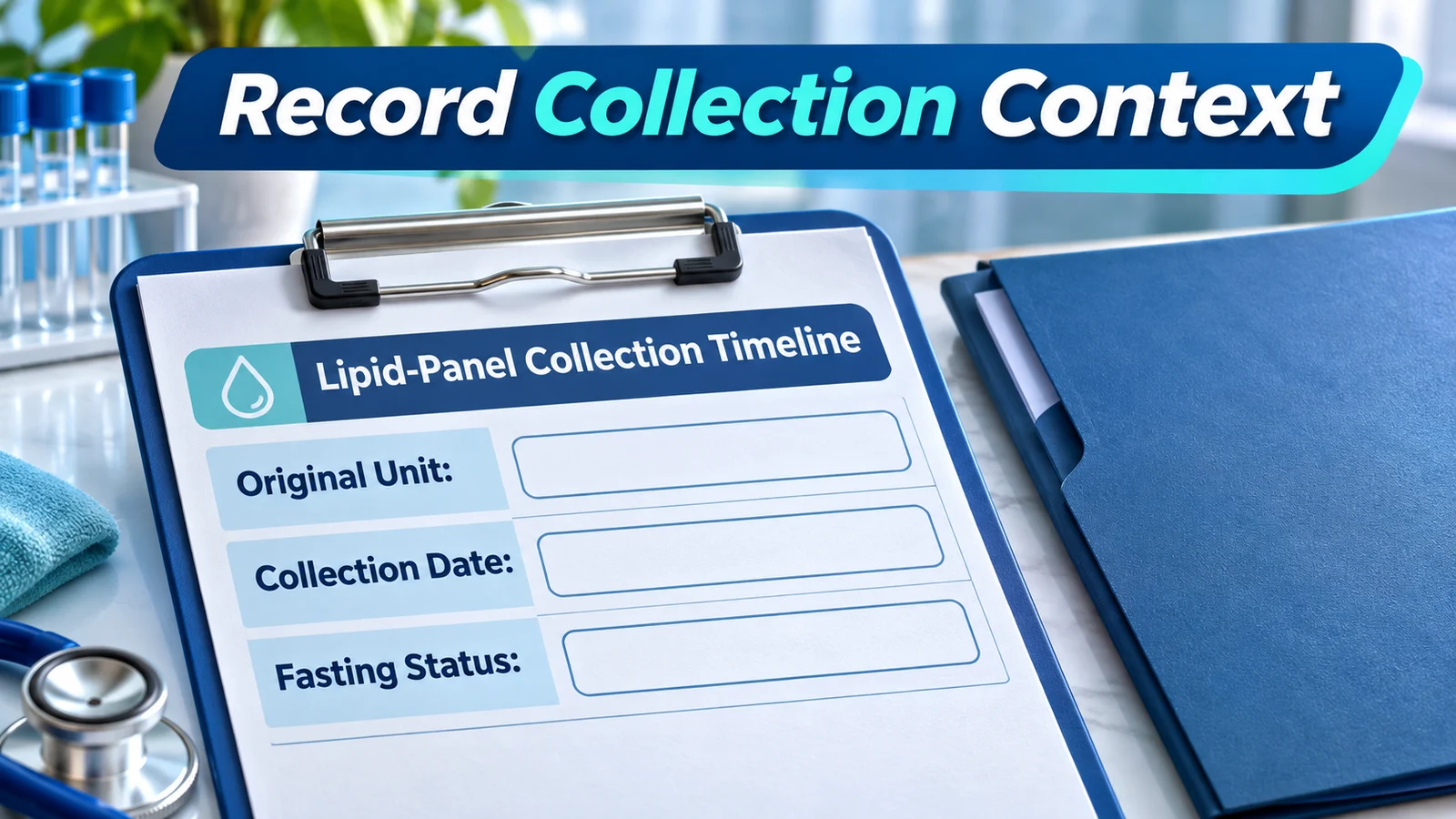
Make a Collection-Context Timeline
Create one line for each collection date. The aim is to show what is known, unknown and documented. It is not a self-created medical interpretation.
2025-04-06
- Laboratory / country: Original laboratory
- Report file: 2025-04-lipid-panel.pdf
- Original TG result and unit: Copy exactly from report
- Fasting status as reported: “Not stated”
- Collection details noted: Morning collection, if printed
- Medicines listed at the time: Patient list attached
- Questions for clinician: Ask whether comparison is useful
2025-10-19
- Laboratory / country: Original laboratory
- Report file: 2025-10-lipid-panel.pdf
- Original TG result and unit: Copy exactly from report
- Fasting status as reported: “Fasting” only if printed
- Collection details noted: Details copied from report
- Medicines listed at the time: Patient list attached
- Questions for clinician: Ask what records are missing
Use “not stated on report” when you do not have reliable documentation. Avoid guessing from the time of day, what you remember eating or what is customary at your laboratory. A clinician can decide whether an unknown item matters for the current evaluation.
Record Fasting Status Carefully
Patients often remember being told to fast, but the instructions and actual preparation can differ between tests. Some lipid testing may be performed without fasting; in other circumstances a clinician or laboratory may give fasting instructions. The preparation requirement belongs to the ordering clinician and laboratory, not to a generic travel checklist.
When organizing past reports, use only these factual labels:
- “Fasting stated on report”;
- “Non-fasting stated on report”;
- “Preparation instructions attached”;
- “Patient recalls fasting; not confirmed in record”; or
- “Fasting status not available.”
If you retained an appointment message or laboratory instruction sheet, save it as a separate attachment and note the source. Do not rewrite an instruction sheet as proof of what happened. If you took regular medicines, supplements or other products around the collection date, keep an original medication list or a dated pharmacy record if available. Do not stop, start or alter any medicine in order to produce a more comparable number unless your own treating clinician tells you to do so.
Keep the Original Unit and Reference Range
Reports can use different units and laboratory reference intervals. Unit conversion may be mathematically possible, but patient-created conversions can introduce transcription errors and can obscure which value was actually reported. For a review in China, show both the original result and original unit exactly as printed.
Do not add colour coding, “good” or “bad” labels, or risk categories to your own index. The report's laboratory flag can remain visible on the original. The clinician reviewing you can decide how the number relates to the rest of your history, the collection context and current testing.
If you have already received an official translated report, preserve it beside the source document. If not, an English cover sheet can translate administrative labels such as “collection date,” “laboratory,” “fasting stated,” and “unit,” while the original report remains unchanged. Do not alter the values, reference range or footnotes in the source document.
Keep Related Medical Context Separate but Available
Triglycerides can be discussed alongside other health information, but do not crowd the laboratory index with unsupported explanations. Make a separate, dated folder for records a clinician may ask about, such as:
- Previous clinic letters discussing lipids;
- Medication lists and pharmacy records, with dates;
- Diabetes, thyroid, liver, kidney or other relevant records if you already have them;
- Hospital discharge summaries;
- Pregnancy-related records when relevant and when you choose to share them;
- A factual list of alcohol, diet or illness notes only when they were documented or you can state the source clearly.
Do not write “this medicine caused my result” or “this meal explains the result” unless that statement appears in an official clinical document and is identified as such. A record packet should help the clinician ask better questions, not make a conclusion before review.
Handle Missing, Partial or Conflicting Reports
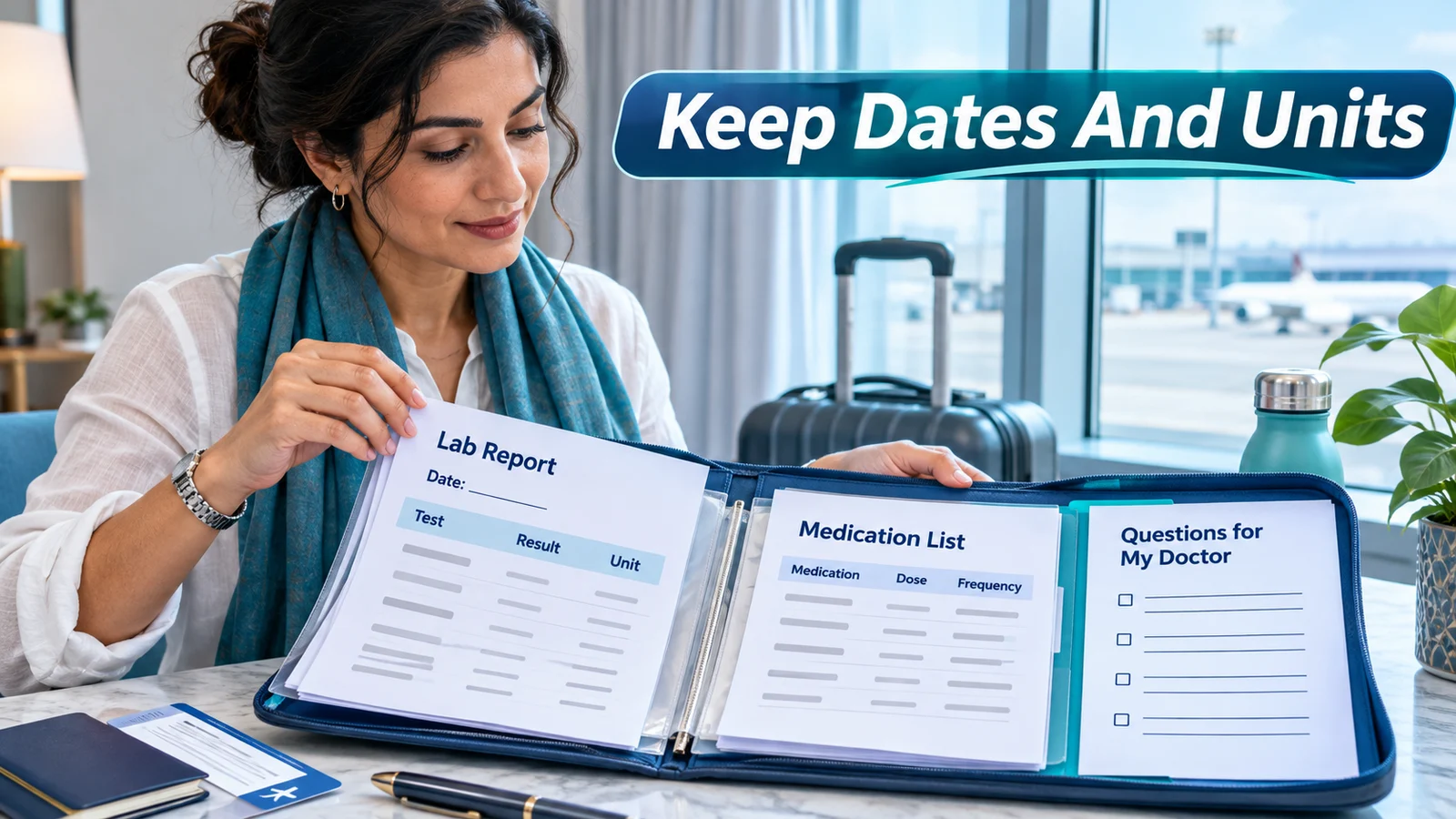
Missing information is common. The safest practice is to make the gap visible.
A report has no fasting field
Write “fasting status not stated on report.” If you have a laboratory message with preparation instructions, include it separately and label it as an instruction, not confirmation of what occurred.
You only have a screenshot of a result
Keep the screenshot, note its source and date of download if known, and request the full original report from the laboratory or clinic. Do not create a replacement reference range.
Two reports show different units
Keep both results in their original units and place them in date order. Do not convert one to force a comparison. Ask the clinician whether a formal comparison is useful.
A result appears to conflict with a clinic message
Retain both records. Label the source of each, including the date and author or sender if shown. Do not delete either version or decide which is correct yourself.
A report is in another language
Keep the original file. Translate headings and narrative comments in a separate, clearly labeled document if needed. Numeric values, units, dates and laboratory marks should remain traceable to the source page.
Prepare a Concise Packet for China
For a first communication about lipid records, send only what the hospital or care coordinator requests. A practical packet may contain:
- A one-page timeline of original reports;
- The complete original reports, ordered by collection date;
- A medication list with dates and original prescription or pharmacy evidence where available;
- Relevant clinic letters or discharge summaries;
- A short list of questions for the clinician;
- A note identifying unknown information rather than filling it in.
Name files consistently. For example: 2025-10-19_lipid-panel_original-lab.pdf is more useful than bloodtest-final-new.pdf. Avoid putting sensitive data into shared filenames. Use the secure submission method requested by the receiving organization.
Questions to Ask at a China Appointment
These questions focus on record completeness rather than self-management:
- Which original reports are relevant to the current review?
- Are the collection dates, units and preparation notes visible enough?
- Does the clinician need the original laboratory report rather than my summary?
- Which related medical records should be included?
- Are any values or terms unclear because of translation?
- What information should be kept with any future report for comparison?
The clinician may decide that a new assessment or additional records are needed. Do not treat a previous report as a diagnosis or assume that a travel packet removes the need for a current medical evaluation.
How MedToChina Can Help With Document Organization
MedToChina does not interpret triglyceride results, determine risk or provide medication, dietary or testing instructions. If you are considering medical care in China, submit your original reports and questions, or contact MedToChina on WhatsApp. We can help you arrange the documents into a clear chronological index, identify missing administrative context and prepare questions for communication with the appropriate China care contact.
Any discussion of possible China hospital resources or next steps happens after your condition, travel timeline, budget, country preference and available records are understood. The medical team reviewing you determines what the results mean and what assessment may be appropriate.
FAQ
Do I need to convert triglyceride results before travelling to China?
No. Keep the original value and unit exactly as reported. A clinician can decide whether and how to compare results from different laboratories.
What if I do not know whether I fasted before a previous test?
Write that the fasting status is unknown or not stated on the report. Do not infer it from memory or the collection time. Include any original laboratory preparation message separately if you have it.
Should I send only the triglyceride value?
No. Send the complete original lipid report when requested, since accompanying values, units, reference intervals, date and laboratory details may be relevant to the review.
Can I change my medicines before a repeat test in China?
Do not change medicines or supplements based on this article. Follow instructions from your own treating clinician and the clinician ordering any test.
Can MedToChina tell me whether my triglycerides are dangerous?
No. Send your reports or questions through WhatsApp for document-organization and travel-support discussion. A qualified medical professional must interpret your results and advise you about any urgent symptoms or next steps.
Organize Your Lipid Records for China
Planning a triglyceride or lipid-panel review in China? Submit your original reports and questions, or contact MedToChina on WhatsApp. We can help you create a clear collection-context timeline for your medical communication in China.
For a fuller document packet, use the medical records checklist. If two reports disagree, see how to keep original and corrected versions.
Medical Disclaimer
This article is general educational and logistical information for international patients considering medical care in China. It is not medical advice, laboratory interpretation, a diagnosis, a treatment plan or a guarantee of access or outcome. A qualified clinician who reviews your current condition and records must interpret lipid results and advise on any testing or care.
References
- MedlinePlus. Triglycerides Test. Accessed November 2026.
- National Heart, Lung, and Blood Institute. High Blood Triglycerides. Accessed November 2026.
- American Heart Association. 2026 Guideline on the Management of Dyslipidemia. Updated March 13, 2026; accessed November 2026.
- Nordestgaard BG, et al. Fasting is not routinely required for determination of a lipid profile. European Heart Journal. 2016.