
General
Medical Report Discrepancies Before Care in China: Clarifications and Corrected Versions
A practical guide for international patients to track factual discrepancies, request clarification from the original provider, and preserve report versions before care in China.
MedToChina Editorial Team · 9 min read · November 1, 2026

Quick Summary
Before seeking planned care in China, international patients may notice a factual discrepancy in a medical report: an incorrect date, a missing page, a mixed-up facility name, a report attached to the wrong encounter, or a statement that does not match the original document. Do not edit a clinical report yourself or ask anyone to rewrite a clinician's conclusion.
Preserve the original, identify the exact page and fact in question, ask the original issuing organization for clarification through its official channel, and keep every response, addendum, or corrected version with its date and source. A corrected administrative fact is not the same as a new clinical interpretation. Questions about what a finding means belong with the original clinical team and the receiving clinician.
Reviewed November 1, 2026.
Why Report Discrepancies Matter Before Travel
Medical records help clinicians understand what has already happened: tests, images, pathology, procedures, admissions, medicines, and prior discussions. A factual inconsistency can create avoidable questions when a report is translated, compared with imaging, submitted to another institution, used for a visa or insurance conversation, or reviewed alongside a later note.
Not every difference is an error. Two documents may use different date formats, abbreviations, names for the same facility, or levels of detail. A preliminary note may be followed by a final report. A later addendum may clarify a point without replacing the original. The appropriate response is to establish a clear, traceable record of what was issued, what needs clarification, who responded, and which version is current for that specific purpose.
What Counts as a Factual Discrepancy?
This guide concerns administrative or document facts that can be identified without interpreting medicine. Examples include:
- A visit, specimen, scan, procedure, or report date that appears inconsistent.
- An incorrect facility, campus, department, or record number.
- A missing page, attachment, signature, page number, or version label.
- A name, date of birth, or identifier mismatch that must be handled through the original institution's identity process.
- A report linked to the wrong encounter or a duplicated file with unclear origin.
- A mismatch between a stated image or specimen date and the file supplied with it.
- A translated administrative field that appears different from the source document.
These examples are not a list of clinical errors. If you believe a diagnosis, pathology interpretation, image finding, medicine instruction, or treatment plan is wrong or unclear, do not change wording or ask a non-clinical service to decide the issue. Contact the original clinical team through its official process and discuss the concern with the clinician responsible for your ongoing care. For urgent health concerns, seek urgent local care.
Keep the Original Record Intact
Preserve the original exactly as received. Save the PDF, image files, portal download, or paper scan in a folder that identifies the issuing organization and download or receipt date. Do not crop pages, remove headers, alter dates, replace text, or combine pages from different reports into a document that looks original.
Create working copies only for your own organization. A neutral file name can include the document date, issuer, document type, and receipt date. If you receive an addendum, save it separately rather than renaming it as the original. Keep the issuer's own date, document title, and identifiers visible inside the original file.
Health-information systems often use a traceable amendment or addendum process rather than erasing history. Exact processes and patient rights differ by jurisdiction and institution. This guide does not state a legal right, response deadline, or required format. Ask the original organization how it handles a request for clarification or correction.
Build a Small Discrepancy Log
A short log prevents a vague concern from turning into a long email thread. Use one line for each item in a spreadsheet, secure note, or paper table kept with your documents.
| Field | What to record | | --- | --- | | Document | Issuer, title, report date, and internal identifier if shown | | Exact location | Page number, section, line, image label, or attachment name | | Observed fact | What appears inconsistent, without proposing a clinical conclusion | | Supporting source | Link or file name for the related original record | | Question | A concise request for clarification or confirmation | | Contact route | Official portal, records office, department address, or phone line | | Response | Date, sender role, and received document or message | | Version status | Original, clarification, addendum, translation revised, or unresolved |
For example: “Report page 2 lists a scan date as 14 March; the DICOM folder label and appointment notice show 17 March. Please confirm the correct scan date and whether an amended report or written clarification will be issued.” This asks the issuer to verify a document fact. It does not tell the issuer what its clinical conclusion should be.
Contact the Original Issuer Through an Official Channel
Start with the organization that issued the document. Use its patient portal, medical-records office, department contact details, or another verified route. Avoid sending sensitive files to a social-media account, commenter, or an address that cannot be confirmed as belonging to the institution.
Keep your request short and factual. Include the identity details required by that institution, the report name and date, the exact page or field, and a supporting file if requested. Ask:
- Can you confirm whether this is a document discrepancy or a difference with an explanation?
- If a change is appropriate, will you issue an official corrected document, addendum, or written clarification?
- How should the original and new document be presented together to another institution?
Do not ask a coordinator, translator, or receiving organization to alter an original report. They may help organize questions, but the issuing institution owns its record process. Do not request a report change simply to align with an application, travel timetable, insurance requirement, or another document. The goal is accuracy and traceability, not preferred wording.
Clarification, Correction, Addendum, and Translation
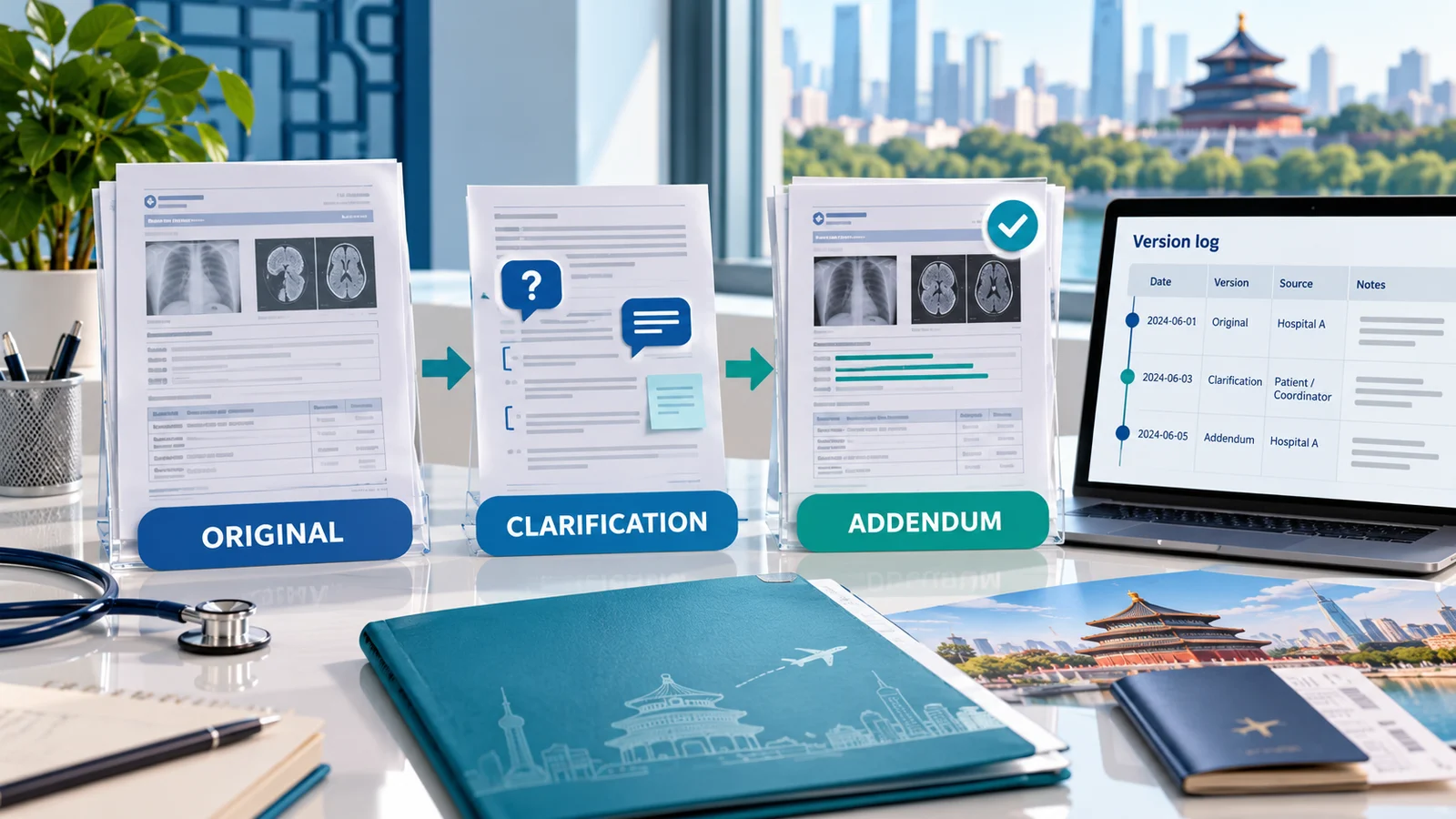
Terms differ by institution, so ask what the document is rather than assuming its status. A clarification may explain a specific point without replacing the original. A correction may address an administrative error through the issuer's own process. An addendum is often a later, dated addition linked to a prior report. A revised final report may identify whether it supersedes an earlier version; retain both.
A translation is not automatically a correction. Keep it connected to its source document, translator or service details where applicable, and version date. If a translated field appears inconsistent with the original, preserve both files and ask the translation provider or issuing organization which element needs clarification. Do not silently alter the translated PDF.
Prepare a Clear Package for Care in China
For each affected record, keep the original report, any official clarification/correction/addendum/revised report, a one-page version log, the translation clearly linked to the version translated, and related supporting files only when they explain the question. Put this package next to the rest of your records rather than mixing it into unrelated documents.
In a cover note, use neutral wording: “The original report and a later clarification are attached. Please review the source documents.” If a clarification is pending, say so clearly. Do not characterize the clinical significance yourself or present a personal edit as an official correction.
Timing, Privacy, and Safety Limits
Response times vary by organization, country, document type, identity-verification process, and the nature of the question. This guide cannot give a deadline or promise that a change will be made. If travel or a planned appointment is near, notify the relevant official contact that a clarification is pending and ask which documents it needs in the meantime.
Share only the pages and identifiers needed for the question and use secure or approved channels. A family member or companion may need authorization before an organization can discuss your record. If a discrepancy concerns symptoms, urgent test results, a treatment instruction, or a possible immediate safety issue, do not wait for administrative correspondence or international travel planning.
How MedToChina Can Help
MedToChina can help overseas patients organize an administrative record package before discussing possible care pathways in China. You may send available records, a version log, and practical questions through WhatsApp. Our customer-service team can help separate document-management questions from questions that must be answered by the original issuer, a receiving hospital's official channel, or your current clinical team.
We do not edit original medical reports, instruct an institution to change a clinical conclusion, decide which report is medically correct, diagnose through messages, or promise an appointment, treatment, cost, travel outcome, or result.
Frequently Asked Questions
Should I Edit a Typo in My PDF Before Sending It to China?
No. Keep the original intact, identify the exact issue, and ask the original issuer how it can clarify or correct the record through its own process.
Can I Delete an Earlier Report After Receiving an Addendum?
Do not delete it. Keep the original and later document together so the history and source of the update remain clear.
Is a Translation Mismatch Always an Error in the Medical Report?
Not necessarily. Preserve the source and translation, identify the exact field, and ask the appropriate issuer or translation provider for clarification. Clinical meaning should be addressed by qualified clinicians.
Can MedToChina Request That My Former Hospital Change the Report?
No. The issuing organization controls its record process. MedToChina can help organize a factual question list and records package.
Discuss Your Record Questions on WhatsApp
Submit available records, a version log, and practical questions through WhatsApp. MedToChina can help you prepare an administrative record checklist before discussing possible care pathways in China.
Medical Disclaimer
This article is general information for international patients considering medical care in China. It is not medical, legal, privacy, financial, travel, or insurance advice. It does not interpret reports, determine whether a record is clinically correct, direct an institution's amendment process, diagnose a condition, or replace advice from qualified clinicians and official record-holding institutions. Seek urgent local care when needed.
References
- World Health Organization. Patient safety.
- World Health Organization. Improving diagnosis for patient safety.
- U.S. Office of the National Coordinator for Health Information Technology. Your health information rights.
- U.S. Centers for Medicare & Medicaid Services. Medical record amendments, corrections and delayed entries.
- American Medical Association. Management of medical records.