
Treatments
Memory Changes Before a Neurology Visit in China: Family Observations and Earlier Assessments
Prepare family observations, earlier cognitive assessments, medication lists and dated daily-function changes before a neurology visit in China.
MedToChina Editorial Team · 9 min read · November 11, 2026

Quick Summary
When a person travels to China for evaluation of memory or thinking changes, a clear record of what changed, when it changed and who observed it can help the clinical conversation. Keep the person's own account separate from observations made by family, friends or caregivers. Preserve earlier cognitive assessment reports with their date, language, setting and original score sheet when available.
This article provides a preparation framework. It does not diagnose Alzheimer's disease or another condition, provide a home cognitive test, judge decision-making ability, or determine whether a person can live independently.
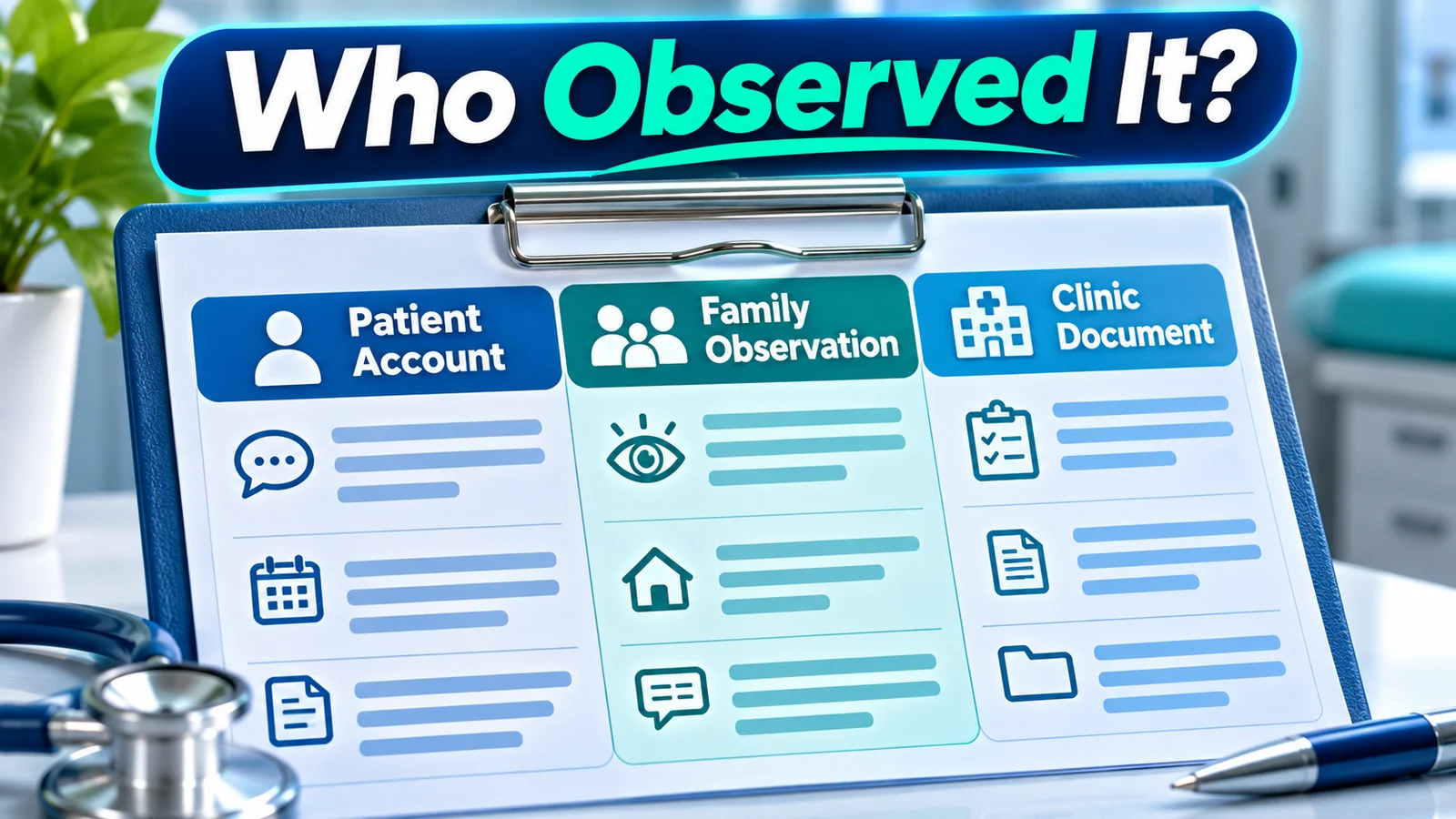
Why Different Sources Should Stay Separate
Memory and thinking concerns are not always noticed in the same way by the person experiencing them and by someone close to them. A person may describe forgetting appointments, difficulty finding words or concern about a recent change. A family member may notice a change in routines, communication, navigation, bills, cooking, mood or other daily activities. Both perspectives can be useful, but they are not interchangeable.
The National Institute on Aging notes that memory or cognitive concerns may be reported by the person, family members or others, and that they should be followed up with appropriate cognitive, behavioral or functional assessment. NIA also explains that clinicians may ask both the person and a family member or friend about health, medicines, daily activities and changes in behavior or personality. That is why your packet should identify the source of every observation rather than merging everyone’s account into one conclusion.
The goal is to give a neurologist or other qualified clinician in China an accurate starting point. It is not to prove a diagnosis before travel.
Start With a Dated Change Log
Use a short timeline. One line should describe one observed event or change, not a diagnosis. Include what happened, when it was first noticed, how often it has occurred if known, who observed it and what record supports it.
May 2026
- Source: Patient
- Factual observation: Reports more difficulty remembering appointments
- Supporting record, if any: Personal calendar, if retained
- Context or uncertainty: Patient account
June 2026
- Source: Daughter
- Factual observation: Noticed repeated questions during a family call
- Supporting record, if any: None
- Context or uncertainty: One observed call; frequency unknown
July 2026
- Source: Clinic
- Factual observation: Earlier cognitive assessment completed
- Supporting record, if any: Original report
- Context or uncertainty: Language and test name shown on report
Use words such as “patient reports,” “family member observed,” “clinic note states,” or “unclear.” Avoid writing “memory is getting worse,” “dementia,” “Alzheimer’s,” “unsafe” or “unable to decide” unless you are quoting a clinician's original record and label the source.
If the timing is uncertain, record a range such as “approximately spring 2026” rather than inventing a precise date.
Record Daily-Function Changes Without Rating the Person
Daily activities can be relevant to a clinical assessment, but a family record should describe the event, not grade the person's ability. Keep examples concrete and respectful.
You may record changes related to:
- Remembering appointments or planned events;
- Following familiar routines;
- Finding words, following a conversation or communicating in another language;
- Managing familiar devices, messages or passwords;
- Navigating familiar and unfamiliar places;
- Preparing meals, shopping or household tasks;
- Handling bills or other usual paperwork;
- Sleep, mood or behavior changes, if observed;
- Falls, illness, medication changes or major life events occurring near the time of a change.
For each item, separate fact from interpretation. “Missed two scheduled calls in one week, observed by son” is a factual note. “Cannot manage a phone” is a conclusion and should not be written unless it comes from an evaluated clinical finding. Avoid filming or collecting private information that the person has not agreed to share.
Keep the Person’s Own Account Visible
The person being evaluated should have an opportunity to describe concerns in their own words. If they prefer to write, dictate or use a translator, preserve that original account. Label it with the date and preferred language.
A useful self-report might include:
- What the person notices first;
- Whether the change is constant or comes and goes;
- What daily situations feel harder or different;
- What remains unchanged or manageable;
- Questions they want to ask the clinician;
- Whether they want a family member present for part of the discussion.
Do not ask the person to complete internet memory quizzes or score themselves before travel. Online questionnaires and informal tests are not a substitute for a clinician's assessment and can create confusion when language, education, hearing, vision, culture or test conditions differ.
Preserve Earlier Cognitive Assessments as Original Documents
If the person has had an earlier cognitive screening, neuropsychological assessment, neurology letter, brain imaging report or other relevant evaluation, retain the complete original. Do not send only a score or a one-sentence summary.
For each prior assessment, list:
- Date and location;
- Provider or clinic, as shown on the record;
- Assessment name if stated;
- Language used for the assessment;
- Whether an interpreter was used, if stated;
- The complete original report and score sheet if provided;
- Any follow-up instruction or referral letter;
- Any limitation stated by the original clinician.
An assessment score is not portable without its context. A clinician in China may decide that it cannot be compared directly, that a current assessment is needed, or that a different approach is appropriate. Do not translate a score into a severity label yourself.
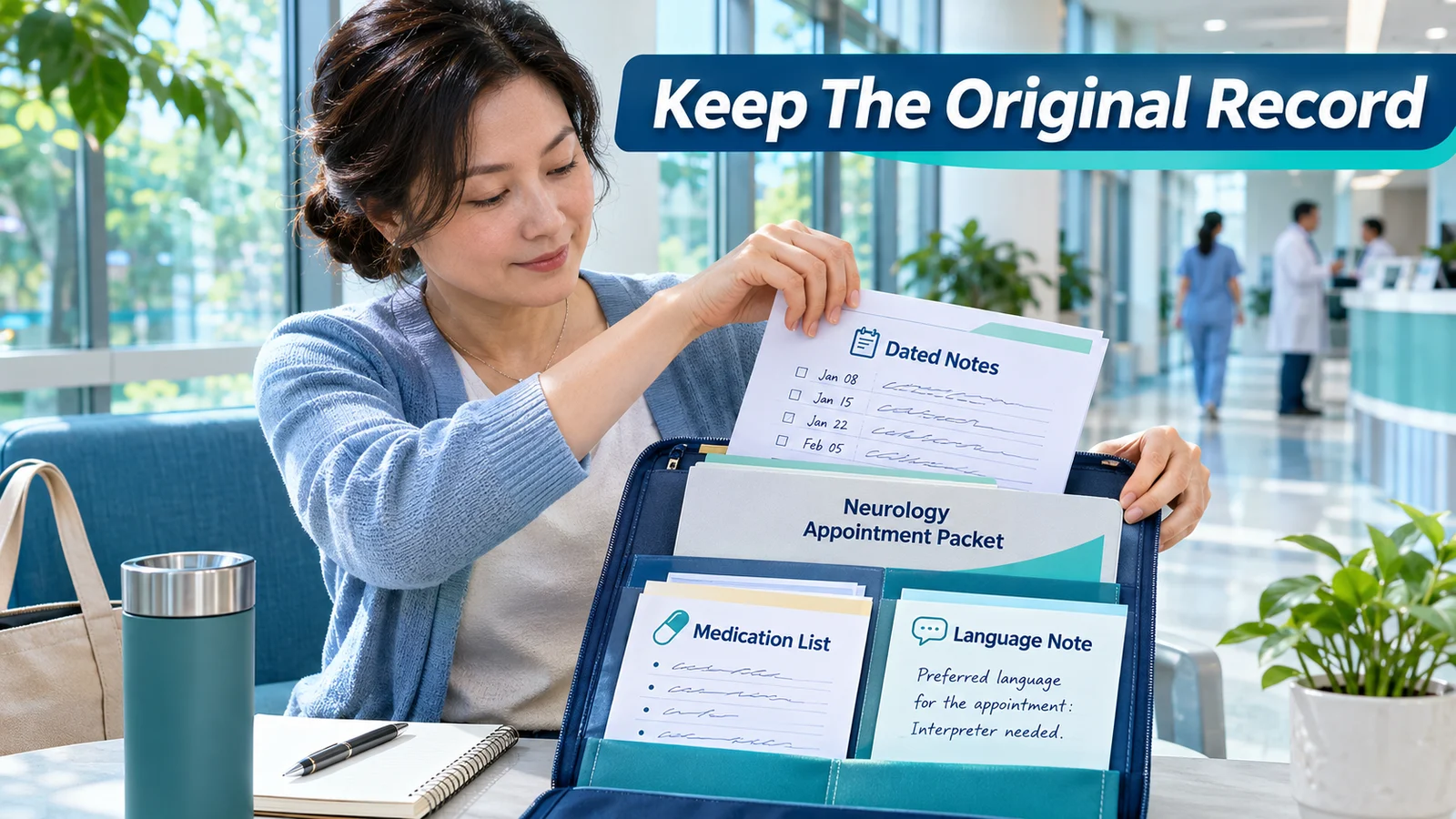
Prepare a Current Medication and Health List
NIA and the Alzheimer's Association both advise bringing a current list of prescription medicines, over-the-counter products, vitamins and supplements to an appointment about memory concerns. Keep this list factual and dated.
Include the medicine name as printed, dose and schedule if known, start or change date if documented, prescribing source if shown and whether the item is current, stopped or unknown. Add relevant past medical records only if they are already available and you choose to share them. Do not stop or change medicines for travel or testing based on this article.
Also preserve recent clinic letters, discharge summaries, laboratory reports or imaging reports that relate to the history. Avoid deciding which medical issue “caused” a memory change. Multiple conditions, mood changes, sleep, infection, medicines and other factors can affect thinking, and the clinical team determines what requires assessment.
Make Language and Communication Part of the Record
For international patients, language can affect both the record and the appointment. Place a short communication note at the front of the packet:
- Patient's preferred spoken and written language;
- Other languages used comfortably;
- Hearing, vision, literacy or communication needs the person chooses to disclose;
- Language of each earlier assessment;
- Whether a family member is attending and what language they use;
- Whether the person gives permission for the family member to share observations.
This is not a request for a particular test or a guarantee of interpretation. It helps the team understand why an old assessment might not be directly comparable and how to communicate respectfully during the visit.
Build a Small, Ordered Appointment Packet
Send records only through the secure method requested by the hospital or care coordinator. Use the medical records checklist to check your files. A clear packet may contain:
- One-page timeline distinguishing patient, family and clinic sources;
- Patient's own dated account and questions;
- Family observation log with source labels;
- Earlier cognitive assessment reports in original language;
- Current medication, supplement and health list;
- Relevant clinic letters, imaging or laboratory reports;
- Communication and language note.
Name files by date and source. For example, 2026-07-14_prior-cognitive-assessment_original-language.pdf is more useful than memory-test-final.pdf. Do not place sensitive details in a filename shared outside the secure record channel.
Questions to Bring to the China Visit
Use questions that clarify the assessment process without assuming an answer:
- Which earlier records are useful for the current evaluation?
- Does the original assessment language affect how prior results are understood?
- Are patient and family observations best discussed together, separately or both?
- Which changes should be tracked before a follow-up?
- Are there missing medical or medication records that would be useful?
- What does the clinician need to clarify before drawing conclusions?
The clinician may ask questions privately with the patient or family member, or with both present, according to clinical judgment and the person's consent. A family member's presence does not replace the patient's voice or establish authority to make medical decisions.
How MedToChina Can Help With Preparation
MedToChina does not diagnose memory conditions, interpret cognitive tests or determine a person's capacity. If you are planning a neurology evaluation in China, submit dated records and questions, or contact MedToChina on WhatsApp. We can help you organize a source-labeled timeline, identify missing administrative information and prepare practical communication questions for your China care journey.
Any discussion of possible hospital resources or travel coordination occurs after the person's travel needs, available records, country preference, budget and timeline are understood. The medical team that assesses the person determines the clinical interpretation and any next steps.
FAQ
Should a family member attend a memory evaluation in China?
Tell the clinic whether a family member will attend and ask about the local process. A family member can provide observations, but the patient should also have an opportunity to speak for themselves. The clinical team decides how information is gathered.
Can a family member complete a cognitive test at home before travel?
No. Do not use this guide to score or test a person at home. Keep factual dated observations and prior official records for discussion with a qualified clinician.
What if the person disagrees with a family observation?
Keep both accounts separate and label the source. Do not decide which account is medically correct. The difference itself can be discussed respectfully with the clinician.
Should I translate an earlier cognitive score into English?
Keep the original report and arrange translation of surrounding written content if needed. Do not change the score, test name or interpretation. Include the language used for the original assessment.
Can MedToChina tell us whether the person has Alzheimer's disease?
No. Send records or questions through WhatsApp for logistical preparation. A qualified clinician must assess the person and determine what further evaluation may be appropriate.
Prepare Memory-Change Records for China
Planning a neurology visit in China for memory or thinking concerns? Submit your dated records and questions, or contact MedToChina on WhatsApp. We can help you structure a respectful patient-and-family record packet for communication with the care team.
Medical Disclaimer
This article is general educational and logistical information for international patients considering care in China. It is not medical advice, a cognitive test, a diagnosis, a capacity assessment, a treatment plan or a guarantee of access or outcome. Memory and thinking changes require evaluation by qualified health professionals using the person's current condition and relevant history.
References
- National Institute on Aging. How Is Alzheimer's Disease Diagnosed?. Accessed November 2026.
- National Institute on Aging. Assessing Cognitive Impairment in Older Patients. Accessed November 2026.
- National Institute on Aging. What Are the Signs of Alzheimer's Disease?. Accessed November 2026.
- Alzheimer's Association. Visiting Your Doctor for Memory Loss. Accessed November 2026.