
General
Medication Lists Before Care in China: Names, Packaging and Version Records
A practical guide for international patients travelling to China: organize a cross-language medication list, labelled packaging, source records, and version dates before care.
MedToChina Editorial Team · 9 min read · November 10, 2026
Quick Summary
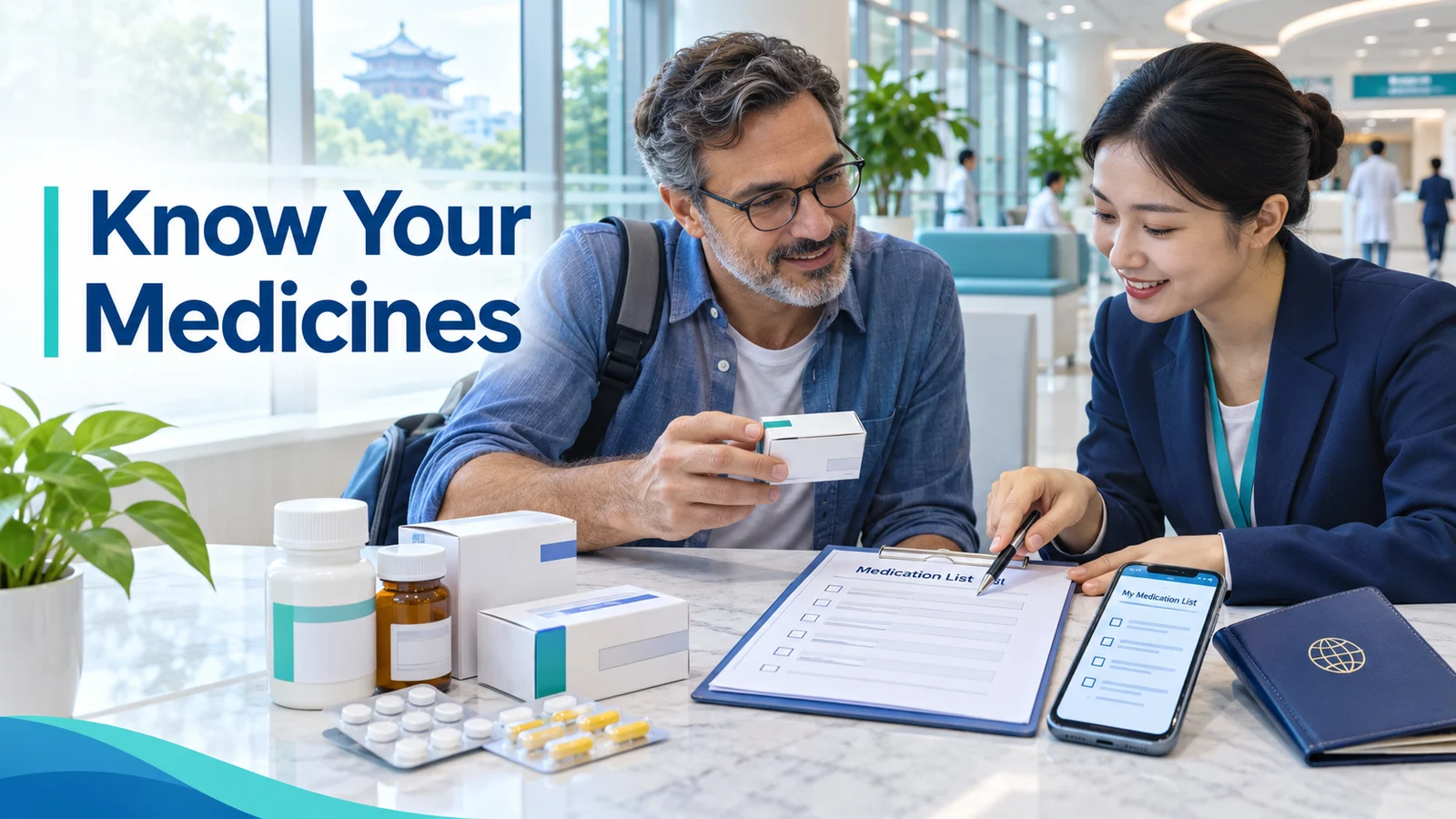
- Make one current medication list from labels, prescriptions, pharmacy records, discharge papers, and your treating team's instructions. Do not rely on memory alone.
- Keep prescription medicines, non-prescription products, vitamins, supplements, herbal products, and medicines used only when needed in separate categories.
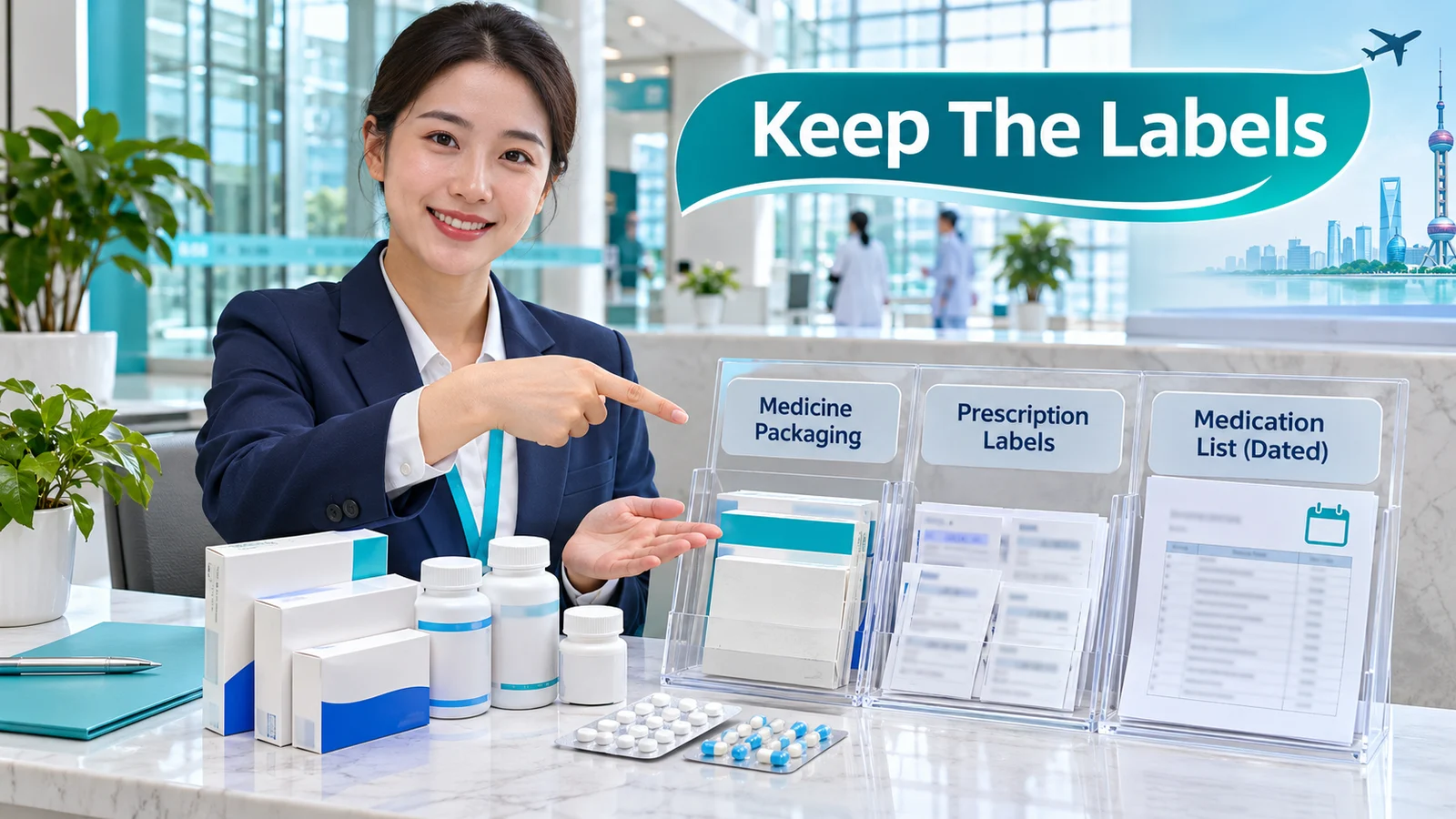
- Preserve the original labelled packaging, product leaflet, and a clear photograph of each label when permitted. Packaging helps the receiving clinical team identify the product, strength, dosage form, and manufacturer details; it does not prove an equivalent product is available in China.
- Record the generic name and brand name exactly as shown, plus strength, form, route, schedule, reason if already documented, start or change date if known, prescriber or source, and the list version date.
- Do not translate a name into a different medicine, convert doses, substitute products, stop treatment, or change the time of a medicine based on this guide. Those decisions require an appropriate clinician or pharmacist.
Why a medication list needs more than a drug name
When international patients travel to China for medical care, a short list such as “blood pressure tablet” or “diabetes medicine” can leave out information that matters for safe communication. A medicine may have a brand name in one country and another name elsewhere. It may come as a tablet, capsule, injection, patch, inhaler, drops, cream, or device. The same-looking brand family can contain different ingredients or strengths in different markets.
An accurate list helps a clinical team understand what is already being taken. It does not tell anyone to continue, stop, replace, or import a product. The receiving hospital and its clinicians decide what information is needed and how medicines are handled during an assessment, admission, procedure, or discharge.
The World Health Organization has described medication reconciliation as comparing a patient's current medication information with medicines being ordered to identify discrepancies. Its patient-safety materials encourage a complete, current record that includes prescription and non-prescription products, supplements, herbal preparations, dose, frequency, route, and relevant source information. For international travel, the same discipline makes cross-language communication clearer.
Start with the actual packaging and source record
Build the list from physical or digital evidence, not recollection. Gather, where available:
- the dispensed label or original carton;
- the pharmacy or prescribing label;
- the patient information leaflet;
- the latest prescription or repeat-prescription record;
- a recent discharge summary or clinic letter;
- any medicine alert card or monitoring record issued by your own care team; and
- a photo of the front and back of a package, with personal details covered if you are sharing it for preparation.
Keep labels legible. Do not remove medicines from labelled containers merely to create a cleaner travel photo. The package can show the product name, strength, dosage form, instructions, and expiry information that a handwritten list may miss. It is a reference item, not a permission to use the product in another country or hospital.
For medicines that require cooling, injection supplies, controlled-medicine paperwork, or special transport conditions, ask your prescribing clinician, pharmacist, airline, and relevant official border authorities for current instructions. This article does not provide customs, aviation, or storage advice for an individual itinerary.
Make one list with separate categories
Use a dated master list, then group products so that nothing becomes hidden in a single line. A practical set of categories is:
- Current prescribed medicines: products you are currently using under a prescription or clinician instruction.
- Medicines used as needed: for example, an item used for occasional symptoms. State that it is used as needed rather than making it look like a daily product.
- Recently stopped or changed medicines: record only the documented stop/change date and reason if known. Do not restart a medicine because it appears on an old list.
- Non-prescription products: pain relievers, cold products, creams, drops, antacids, and other products bought without a prescription.
- Vitamins, supplements, herbal, traditional, or complementary products: include these even if they do not seem like “medicine.” They may matter to a clinician's medication review.
- Documented allergies, intolerances, or previous adverse reactions: keep these separate from ordinary side effects, and copy existing wording rather than trying to classify a reaction yourself.
Do not combine several products into a category such as “heart medications” or “natural supplements.” Each product needs its own row. If you are not sure whether a product is current, mark it as “status to confirm” and bring the source label or prescription.
What to include in each row
The following fields are useful for a cross-language list. You do not need to translate every field yourself; preserving exact label wording is often safer than guessing.
- Field: Exact name; What to record: Generic name and brand name exactly as shown, if available
- Field: Strength and form; What to record: For example, the strength on the label and whether it is a tablet, inhaler, injection, patch, drops, cream, or another form
- Field: Route; What to record: How the label says it is used, such as by mouth, inhaled, applied to skin, or injected
- Field: Schedule; What to record: Current label or clinician-issued instruction; do not recalculate it
- Field: Current status; What to record: Current, as needed, stopped, changed, or status to confirm
- Field: Source; What to record: Prescriber, pharmacy, discharge record, or label reference
- Field: Version date; What to record: When this entry or list was last checked
- Field: Supporting file; What to record: Label photo, prescription, leaflet, or discharge document name
If a medication is an injection, inhaler, patch, eye drop, cream, implant-related product, or device supply, state that form clearly. A product name without its formulation can be misleading. Likewise, do not use a phone translation to create a new generic name or assume that a familiar brand name represents the same ingredient internationally.
Keep originals, translations, and list versions linked
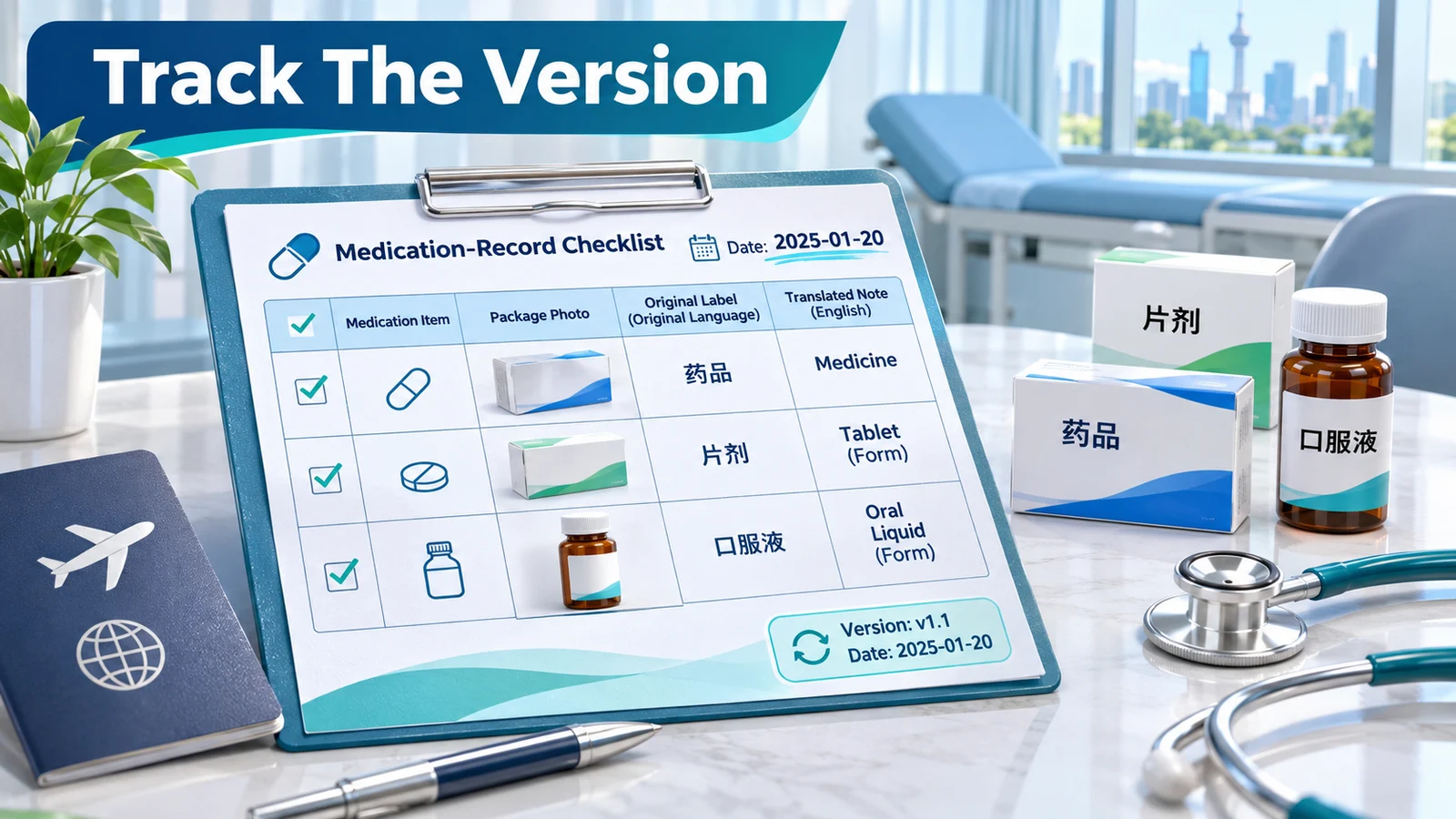
If your records are not in English or Chinese, a translation may help communication. Keep the original label or document attached to the translation or photo. Mark whether the translation is a personal working note, a pharmacy document, or a formal translation. Do not discard the source-language record after making an English version.
Give every list a version date, such as “checked 8 November 2026,” and retain the previous version if a clinician has recently changed treatment. This helps distinguish a current list from an older discharge list. If two documents conflict, do not decide which one is correct on your own. Keep both, mark the conflict, and ask the relevant treating team or pharmacist to clarify.
The goal is traceability: a clinician should be able to see where each entry came from and when it was last confirmed. It is not to create a self-managed prescribing chart.
Before you send records or travel
For planned care in China, prepare a secure folder with the master list, supporting labels or photographs, relevant prescriptions, discharge records, allergy or reaction information already documented, and a short question list. Send only what the receiving hospital or authorized service asks for, using its requested channel. Avoid sending account passwords, verification codes, or unrelated identity documents.
When you submit information or use WhatsApp for MedToChina preparation, you can state that you have a medication list and ask which records are useful to organize first. MedToChina can help arrange your existing information and communication questions. The hospital decides which records it needs, whether any translation is acceptable, and what medicines may be brought, reviewed, supplied, held, or administered during care.
Never assume that a home medicine will be automatically continued in a hospital, that an overseas prescription can be filled in China, or that a product with a similar name is equivalent. Do not make changes because of a travel date, a translation, or a web search. Ask your own treating clinician and the relevant hospital team how to handle individual medicines.
Questions to prepare for official hospital communication
Use factual questions that a hospital can route to the right team:
- Which current medication records and label photographs are needed before the visit?
- Should the list include non-prescription, herbal, or supplement products?
- Is a translation needed, and should the original label remain attached?
- Which department or official channel should receive medication information?
- How should I report a documented allergy, intolerance, or prior adverse reaction?
- What should I confirm with my usual prescriber before international travel?
- If I bring medicine in original packaging, what is the hospital's process for reviewing personal medicines during the visit or admission?
These are preparation questions, not requests for medication changes or a personal treatment plan.
Common mistakes to avoid
Listing only brand names
Brand names vary. Preserve the label and include the generic name where it is already shown. Do not infer an ingredient from a familiar brand name.
Leaving out supplements or occasional products
Products bought without a prescription can still be relevant. Add them in their own section and state whether they are current or used only when needed.
Using an old discharge list as the current list
Keep the old document, but label it with its date. A newer prescription, pharmacy label, or treating-team instruction may reflect later changes.
Losing the link to the label
A translated line without the original package or source file is harder to verify. Keep a file name or photograph reference beside each entry.
Changing medicine to make the list look simpler
Do not combine, split, stop, restart, or substitute medicines to tidy your documents. The list should describe existing use; changes belong with qualified clinicians or pharmacists.
Frequently Asked Questions
Do I need to translate every medicine package myself?
No. Preserve the original label and list exact names as shown. Ask the receiving hospital which documents need translation and whether it requires a particular format.
Can I use one list for medicines, vitamins, and herbal products?
Yes, if each product has its own row and category. This makes it easier to see what is prescribed, non-prescription, supplemental, current, or stopped.
Does a package photo prove the medicine will be available in China?
No. It helps identify what you use. It does not confirm local availability, equivalence, payment, or whether the product will be used during care.
Should I change the timing of a medicine for travel across time zones?
Do not make that change from a general guide. Ask the prescribing clinician or pharmacist for advice that considers the particular medicine and itinerary.
What if my list conflicts with a discharge summary?
Keep both documents, record their dates, and ask the relevant clinician or pharmacist to clarify. Do not guess which instruction should control.
Send Your Medication Records Through WhatsApp
Submit your information or send your current medication list, supporting label photos, and practical questions through WhatsApp. MedToChina can help organize records and communication needs for possible care pathways in China. We do not change medicines, provide dose conversions, confirm product equivalence, or replace the judgment of a treating clinician or pharmacist.
Medical Disclaimer
This article is general information for international patients considering medical care in China. It is not medical, pharmacy, legal, customs, aviation, insurance, financial, immigration, or travel advice. It does not determine whether a medicine is appropriate, safe, available, equivalent, permitted for transport, or suitable to continue, stop, or change. Confirm individual medication questions with your treating clinician, pharmacist, airline, border authorities where relevant, and the receiving hospital.
Related Guides
References
- World Health Organization. Medication Without Harm.
- World Health Organization. Medication Accuracy at Transitions in Care.
- MedlinePlus. Medicine safety: Filling your prescription.
- MedlinePlus. Medication Errors.
- Fit for Travel. Travelling with Medicines.