
Treatments
Insomnia Evaluation in China: Sleep Diaries and Earlier Sleep Reports
Prepare a factual sleep diary, previous sleep reports and a medication list before travelling to China for an insomnia evaluation.
MedToChina Editorial Team · 9 min read · November 11, 2026
Quick Summary
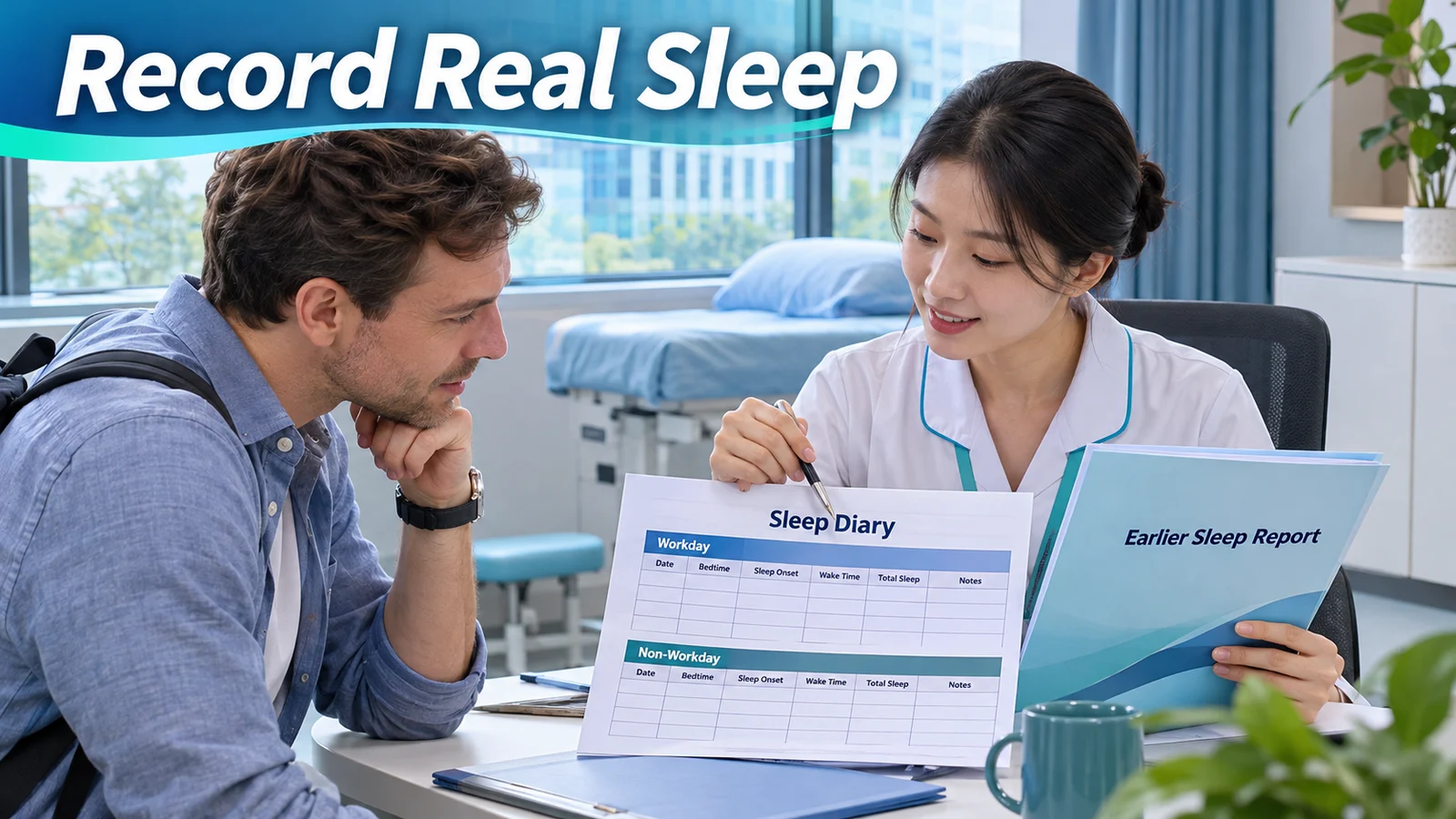
If you are travelling to China for an insomnia evaluation, a sleep diary can make your history easier to understand. It is a factual record, not a diagnostic test and not a treatment plan. Keep actual bedtime and wake time, awakenings, naps, daytime effects, and the context of workdays versus non-workdays. Bring earlier sleep reports in their original form whenever possible. MedToChina can help you organize records, clarify document needs, and communicate through WhatsApp before travel; clinical assessment happens only with the treating medical team in China.
Why a factual sleep record is useful before travelling
“I cannot sleep” is an important concern, but it does not always show what a clinician needs to understand about the pattern. A short, dated record can show the difference between a difficult night, a recurring pattern, a shift-work week, and a weekend with a different schedule. It also gives the receiving team a clearer starting point when your appointment takes place after international travel.
The U.S. National Heart, Lung, and Blood Institute (NHLBI) notes that a sleep diary may be helpful before an insomnia assessment and includes entries such as sleep and wake times, naps, daytime sleepiness, and the timing of caffeine, alcohol, exercise, or medicines. That does not mean every entry proves a cause. It means the diary preserves context that can otherwise be easy to forget in a consultation.
For an international patient, the practical goal is simple: record what actually happened, in your usual environment, before the disruption of a flight, hotel stay, or time-zone change. Do not try to make the diary look “better,” and do not change treatment, medicines, or routines solely to create it. If you do not know an item, write “not sure” rather than estimating with confidence.
Keep workdays and non-workdays separate
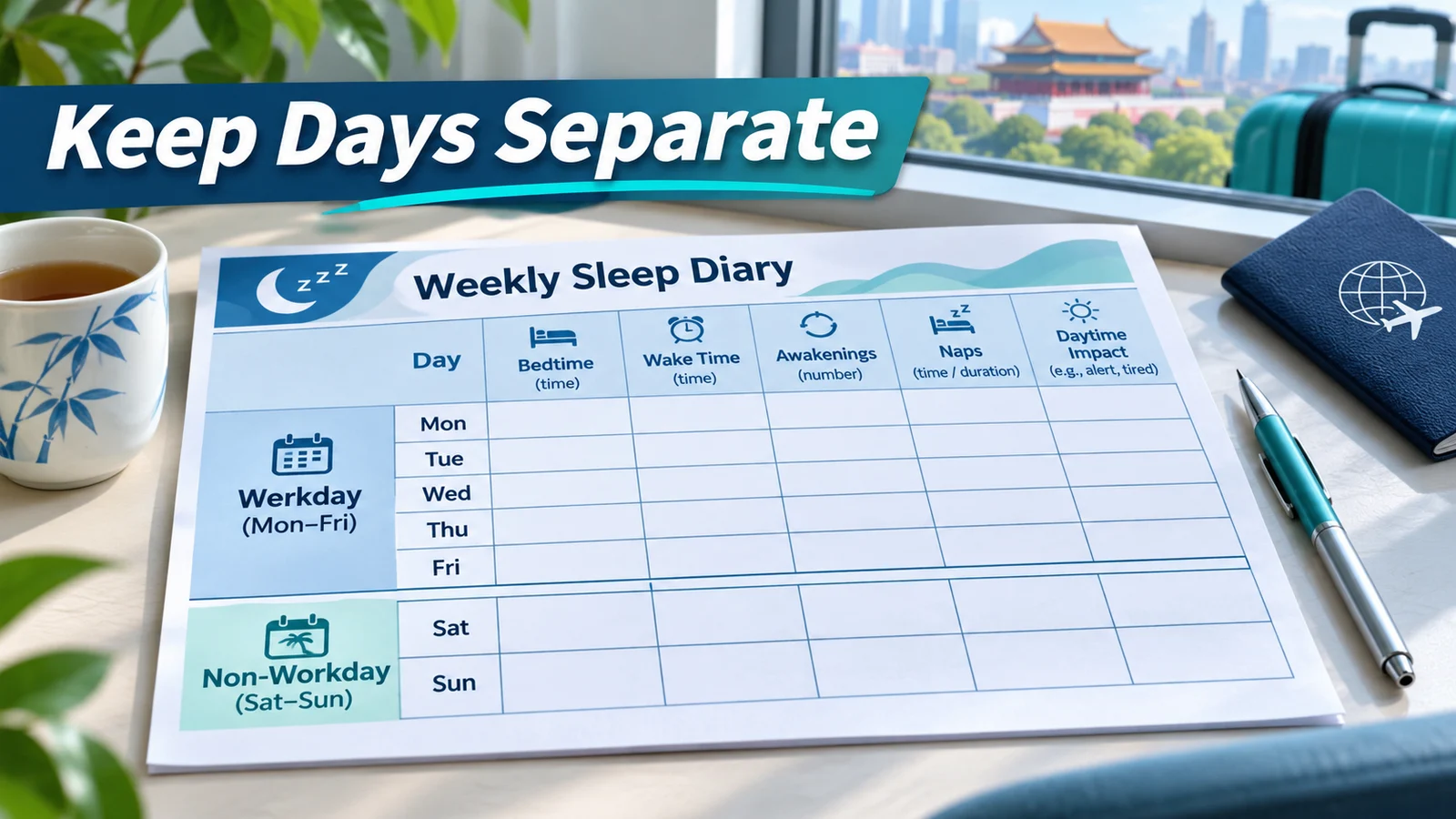
Many people have a different sleep opportunity on workdays, days off, travel days, religious observance days, or overnight shifts. Combining all of those days into one average can hide an important pattern. Label each diary entry clearly: workday, non-workday, night shift, travel day, or another description that reflects your real schedule.
For each date, include the local city and time zone if your schedule changed. This is particularly useful if you are preparing records while travelling from North America, Europe, the Middle East, Southeast Asia, or Africa. A team in China can then see which entries reflect your normal home routine and which reflect a change in place or clock time.
You do not need to calculate sleep efficiency, decide whether a night was “normal,” or apply an online score. Those interpretations belong in a clinical assessment. The useful contribution from your side is a clear sequence of dated observations.
A simple workday/non-workday layout
Use one row per day. Add a short label at the beginning of the row:
- Date, city/time zone, and day type: workday, non-workday, shift, or travel.
- Time you got into bed and your best estimate of when you tried to sleep.
- Final wake-up time and the time you got out of bed, if different.
- Number of remembered awakenings and any approximate periods awake.
- Naps: whether one happened, the approximate time, and duration if known.
- A plain-language note on daytime functioning, such as “needed to pause while reading,” “missed a meeting,” or “felt alert at work.”
The point is not perfect measurement. It is a usable account of variation across days.
Record actual sleep details, not an ideal schedule
Write down the time you actually went to bed, the time you think you fell asleep if you remember it, the final wake time, and the time you rose. If you woke during the night, note the number of awakenings and what you recall without trying to reconstruct every minute.
It can also help to record circumstances that are directly relevant to the day: an overnight flight, a late work call, a child needing care, pain that interrupted sleep, a new work shift, or an unusually stressful event. Use short descriptions. A sleep diary is more useful when it is readable than when it contains a long narrative for every night.
If a partner or family member has observed something relevant, keep that note separate and identify who observed it. For example, “spouse reports loud snoring on two nights” is different from claiming a diagnosis. Original wording and dates are preferable to a summary produced much later.
Avoid using a phone or wearable score as a substitute for the diary. If you have device exports, preserve the original files or screenshots with dates and device name, but label them as device data. Bring them as supplementary information rather than treating them as a final conclusion.
Describe daytime impact in concrete terms
Sleep concerns are not only about the night. NHLBI patient information also notes daytime sleepiness and difficulties with daily activities as relevant symptoms to discuss. A brief factual description can help your history travel across languages.
Instead of writing only “bad day,” note what changed. Examples include difficulty staying focused in a class, falling asleep unintentionally, feeling unsafe while driving, needing extra time for routine work, becoming unusually irritable, or missing a planned activity. If there was no noticeable daytime effect, record that too. A balanced record is more useful than one that includes only the worst days.
Do not rank your symptoms against someone else’s experience. Do not use the diary to decide that you have a particular sleep disorder. The receiving clinician will combine your history, earlier records, examination, and any clinically appropriate next steps.
Include context without turning it into self-treatment
NHLBI diary materials include the timing of medicines, caffeinated drinks, alcohol, and daytime sleepiness. For travel preparation, record these facts as context:
- The name of each prescription medicine, over-the-counter product, supplement, or sleep-related product you used; include packaging photos if labels are not in English.
- The approximate time taken and the dose written on the label, without changing it for the diary.
- Approximate timing of caffeinated or alcoholic drinks, if applicable.
- Relevant schedule changes, such as a new shift, illness, pain flare, or recent international flight.
This is not an instruction to start, stop, reduce, increase, or substitute any product. Do not make medication changes based on an article or a diary. Bring your current medication list and discuss it with the treating clinician and your usual prescriber where appropriate.
Preserve earlier sleep reports in their original form
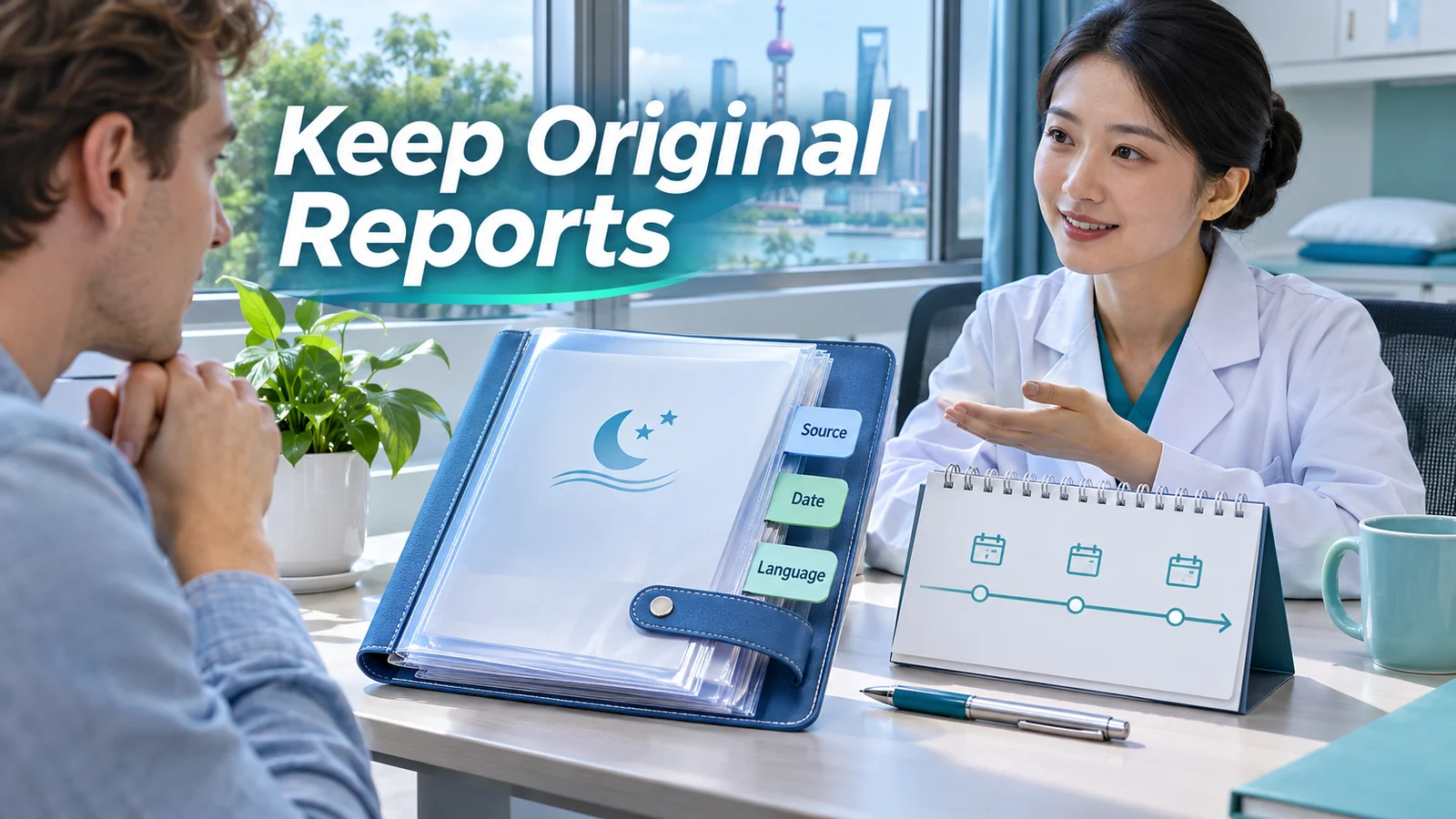
Earlier documents can prevent repeated history-taking and show what has already been considered. If you have had a sleep study, home sleep test, sleep-clinic letter, actigraphy summary, mental-health assessment relevant to sleep, laboratory report, or imaging ordered for another reason, keep the original report plus any translated copy you have.
For each document, note:
- The report date and country or facility where it was issued.
- The test name as written on the report.
- The original language and whether an English translation exists.
- The full report pages, not only a conclusion screen or a message summary.
- Any related clinician letter, referral, or follow-up note.
Do not edit an old report to fit a new concern. Do not remove pages that appear unimportant. A full, dated document gives the medical team the opportunity to interpret it in context. If a file is unavailable, make a simple missing-document list with the facility name, approximate year, and why it cannot be obtained.
Build a travel-ready insomnia record packet
Keep digital copies in one folder and paper copies in a separate travel folder. Give files clear names, for example: 2026-10-03_sleep-diary_week-1.pdf or 2025-04-18_sleep-study_original.pdf. Avoid sending only a large photo gallery without labels.
Use the medical records checklist to check your files. A practical packet can contain:
- A dated sleep diary covering your usual days, with day-type labels.
- A one-page timeline of when the sleep concern began or changed, using approximate dates where needed.
- Earlier sleep reports and relevant clinician letters.
- A current medicine, supplement, and allergy list copied exactly from labels or prior records.
- A short list of daytime effects and safety concerns you have actually experienced.
- Passport name spelling and a preferred contact method for travel coordination.
If you need an interpreter, say which language you are most comfortable using for medical communication. If a family member will travel with you, state their role and whether they can describe observed sleep-related events. These details help with practical preparation; they do not replace medical assessment.
What MedToChina can help you prepare
MedToChina supports overseas patients planning medical care in China. Before travel, you can submit your records and questions or contact us on WhatsApp. Our team can help identify which documents are available, organize them for communication, explain practical preparation steps, and coordinate service communication around your travel plan.
We do not make clinical conclusions from a sleep diary or change treatment. Medical decisions are made by the treating clinical team after they review you and your records in China. If you are considering travel, send the materials you already have rather than waiting for a perfect packet.
FAQ
How long should my sleep diary be?
Bring the period you have already recorded, with dates. NHLBI notes that a one- to two-week diary may be helpful before an assessment, but the receiving clinician decides what information is relevant for your situation. Do not delay travel planning solely to meet a fixed diary length.
Should I record naps if I do not remember the exact duration?
Yes. Record that a nap occurred and add the best approximate time or duration if known. Mark uncertain information as uncertain rather than inventing precision.
Can I send wearable sleep screenshots?
You may include dated screenshots or exports as supplementary records. Keep the diary and any formal reports as separate files, and identify the device used. Wearable data should not be treated as a diagnosis.
What earlier tests should I bring?
Bring any original sleep-related reports you have, including sleep studies or home tests, together with relevant referral letters and follow-up notes. If you are unsure whether a record is relevant, include it and label it clearly.
Can MedToChina tell me what treatment I need from my diary?
No. MedToChina can help organize information and communicate practical next steps for care in China. A sleep diary alone cannot determine diagnosis or treatment, and clinical decisions are made by the treating medical team.
Prepare Your Records for China
To prepare for an insomnia evaluation in China, submit your available sleep diary, earlier sleep reports, medicine list, and questions through MedToChina or message us on WhatsApp. We can help you organize the information needed for travel and service communication. Clinical assessment and treatment decisions take place with the treating team in China.
Medical Disclaimer
This article is general educational information for people considering medical care in China. It does not diagnose insomnia or any other condition, interpret a sleep diary, replace a medical examination, or provide individual treatment or medication advice. Seek appropriate urgent local care for an immediate safety concern.
References
- National Heart, Lung, and Blood Institute. Insomnia - Diagnosis.
- National Heart, Lung, and Blood Institute. Sleep Diary.
- National Heart, Lung, and Blood Institute. Insomnia - Symptoms.
- American Academy of Sleep Medicine. Clinical Guideline for the Evaluation and Management of Chronic Insomnia in Adults.