
General
Pending Test Results After Care in China: Collection and Handover Questions
A practical guide for international patients to track pending results after care in China, confirm official collection routes, and document a clear handover to follow-up care.
MedToChina Editorial Team · 9 min read · November 1, 2026

Quick Summary
Some results are not available when a patient leaves a hospital or finishes a visit in China. That may include a laboratory result, imaging report, pathology document, culture, or another report that needs further processing or formal sign-off. Before leaving, create a simple pending-results list: what test is pending, which department issued it, the official collection or contact route, the agreed point for checking status, who may receive it, and where it should be handed over.
Do not treat a pending report as normal or abnormal, do not wait for it instead of seeking urgent local care, and do not assume a coordinator can collect private records without the hospital's authorization process.
Reviewed November 1, 2026.
Why a Pending Result Needs a Separate Handover Plan
Leaving a hospital with some results still pending is common in many health systems. Different tests have different technical processes, quality checks, specialist review steps, and reporting pathways. A result that is not ready when you leave does not by itself say anything about its meaning. It does mean the result needs an identified route back to the patient and, where appropriate, to clinicians responsible for follow-up care.
For an international patient, that route can become more complicated after travel. The patient may have left China, changed phone numbers, returned to a different time zone, or have a local clinician who did not receive the original report. A casual statement such as “we will send it later” is difficult to act on if nobody records the department, official channel, authorized recipient, and next status-check point.
This guide is about information continuity, not medical interpretation. It cannot tell you whether to wait, what a result means, when a test should be repeated, or whether it is safe to travel. Those questions belong with the responsible clinical team.
Start Before Discharge or the End of the Visit
If possible, ask about pending results while you are still at the hospital or clinic. Do not assume all tests ordered during the same visit will be reported together. A blood result, imaging report, pathology report, and microbiology result may have different issuing departments, patient portals, document formats, and follow-up contacts.
For every item that is not yet available, ask the official department or care team to identify:
- The exact test or report. Use the stated test name, specimen or image date, and hospital identifier when available.
- The issuing department. Record the laboratory, imaging department, pathology department, clinic, or other official source.
- The official collection route. Confirm whether it appears in a patient portal, is sent through a specified institutional channel, must be collected in person, or follows another authorized process.
- The status-check point. Ask whom to contact if it has not appeared by the point the institution instructs. This is a contact process, not a promised reporting time.
- The authorized recipient. Confirm whether the patient, a named representative, or an authorized clinician may receive it and what identity or consent documents are needed.
- The follow-up contact. Ask which official clinical or administrative contact should receive questions once it is released.
Write these answers down exactly as given. Retain the original instruction alongside any translation. A coordinator can help organize a checklist, but the hospital controls its result-release and privacy process.
Build a Pending-Results Tracker
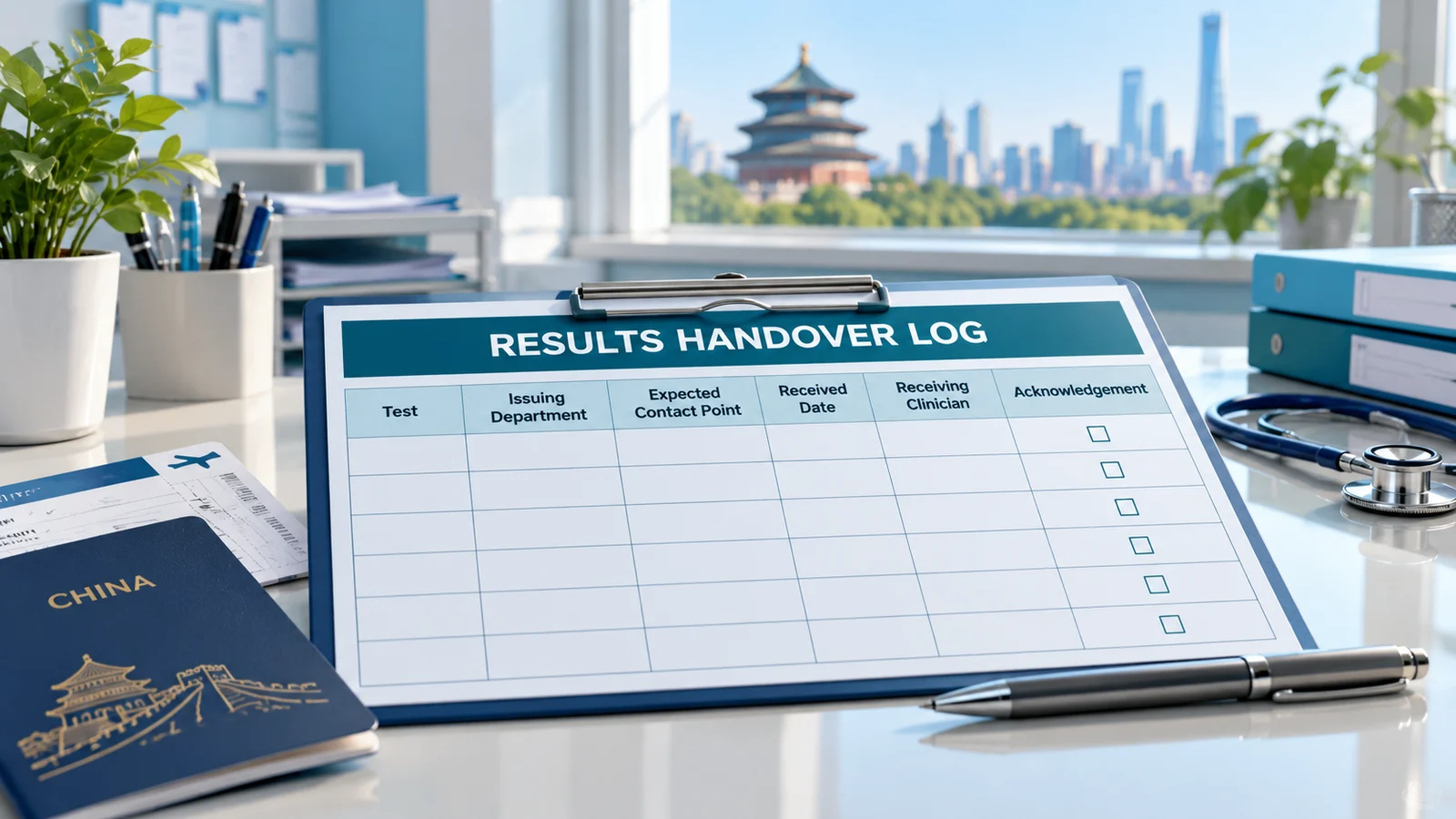
Use one row per result. Do not write clinical conclusions into the tracker.
| Field | What to record | | --- | --- | | Test or report | Official name, date, and identifier where shown | | Issuing department | Department and hospital campus or location | | Current status | Pending, released, collected, forwarded, or acknowledgement pending | | Official route | Portal, records office, department channel, or stated route | | Check point | The institution's stated contact if the result is not available | | Recipient | Patient, authorized representative, or named clinical contact | | Release evidence | Portal notice, official message, file name, or collection receipt | | Handover record | Date sent, route used, and acknowledgement status |
For example: “Imaging report, scan completed 12 October; issuing department: Radiology, Campus A; official route: named portal; status: not yet visible; check point: radiology contact supplied at discharge; intended handover: local treating clinic through its requested secure channel.” This is an administrative record, not an interpretation of the scan.
Confirm the Release and Collection Route
Do not rely on an unofficial message, chat screenshot, or unverified email address to collect sensitive records. Ask the issuing institution which official channel it uses for the specific report. The answer may depend on the report type, the patient's identity verification, whether a representative has authorization, and the institution's privacy rules.
Useful administrative questions include:
- Which department releases this report?
- Is it released to a named patient portal, records office, clinic, or another official channel?
- What identity or consent information is required for the patient or representative?
- If I return home before it is ready, which official route is available to me?
- If it has not appeared, which department should I contact and what identifiers should I quote?
- Can you confirm the document title, report date, and version when it is released?
- If another clinical team needs it, what is the institution's approved way to share it?
Do not assume a companion, travel agent, translator, or customer-service team can collect medical records. An institution may require a particular authorization, identity check, or submission route. Do not send passwords or unredacted records through an unverified account merely to speed up a collection request.
Hand Over the Released Result Without Changing It
When a result is released, preserve the original file and metadata where possible. Save the original report, related images or attachments, release date, and source. If a report is translated, retain both the source document and translation and label the translation date and scope. Do not edit, crop, merge, or rewrite the original report before forwarding it.
Handover is not complete just because a file was sent. If another clinician needs the report, use the receiving clinic's requested route and record the date, channel, and whether it acknowledged receipt. A factual handover note can state: “The attached report was released by [issuing department] on [date]. It is provided in the original format. Please confirm receipt through your usual channel.” Do not add an interpretation or tell the receiving clinician what action it requires.
Know the Limits of a Tracker
A tracker is a memory aid. It does not make a hospital responsible for issuing a result by a particular date, prove another clinician reviewed a report, or establish that a patient is safe to wait. It does not replace an urgent clinical assessment.
If a patient has new, severe, or worsening symptoms, possible complications, or an urgent question about current treatment, use local urgent-care services or contact the responsible clinical team rather than wait for a pending result or administrative reply. Do not postpone needed care because a report is expected later from China.
Likewise, a report can be released without resolving a clinical question. Receiving a file does not automatically provide an explanation, treatment recommendation, or travel clearance. If a report seems incomplete, contains a factual document discrepancy, or appears linked to the wrong visit, preserve it and contact the issuing institution through its official process; do not alter it yourself.
Privacy, Language, and Cross-Border Handover
Use only the minimum records required for the stated purpose and confirm whether a receiving clinician, family member, or representative has the authorization needed to receive them. Keep a note of what was shared, with whom, and through which channel. Keep the original-language document, its translation when available, and any official clarification together. If uncertain which file a receiving institution needs, ask it directly rather than guessing.
How MedToChina Can Help
MedToChina can help overseas patients organize practical questions about pending documents after care in China. You may send available records, your tracker, and administrative questions through WhatsApp. Our customer-service team can help prepare a clear list of official follow-up questions and distinguish document-handover questions from matters that must be answered by the issuing department, receiving hospital, or current treating clinical team.
We do not collect records outside an institution's authorization process, decide who may receive a report, interpret results, diagnose through messages, determine travel fitness, or promise a reporting time, appointment, treatment, cost, or outcome.
Frequently Asked Questions
Does a Pending Result Mean Something Is Wrong?
No. A result may be pending for many administrative or technical reasons. Only the responsible clinical team can explain its medical meaning.
Can My Companion Collect a Report After I Leave China?
Only if the issuing institution permits it through its own authorization and identity process. Confirm this directly before travel rather than assuming it is allowed.
Should I Wait for a Pending Result Before Seeking Care at Home?
Do not delay necessary local care because of an administrative wait. Discuss current symptoms and time-sensitive decisions with your local treating team or urgent-care services.
Is Sending a Result to My Local Clinician Enough to Complete the Handover?
Not always. Use the receiving clinic's requested route and record whether it acknowledged receipt. A sent file is not the same as a completed clinical review.
Discuss Your Pending-Results Questions on WhatsApp
Submit available records, a pending-results tracker, and practical questions through WhatsApp. MedToChina can help you prepare an administrative handover checklist before discussing possible care pathways in China.
Medical Disclaimer
This article is general information for international patients considering or receiving medical care in China. It is not medical, legal, privacy, travel, insurance, or financial advice. It does not interpret test results, determine when a report will be issued, decide who is authorized to receive records, diagnose a condition, determine travel fitness, or replace advice from qualified clinicians and official institutions. Seek urgent local care when needed.
References
- World Health Organization. Patient safety.
- World Health Organization. Improving diagnosis for patient safety.
- U.S. Office of the National Coordinator for Health Information Technology. Your health information rights.
- American Medical Association. Management of medical records.
- World Health Organization. Global patient safety action plan 2021-2030.