
Treatments
Gum Recession Evaluation in China: Organizing Previous Records by Tooth
Prepare periodontal charts, X-rays, photos and treatment records by tooth before travelling to China for a gum recession evaluation.
MedToChina Editorial Team · 11 min read · November 10, 2026

Quick Summary
If you are travelling to China for a gum recession evaluation, bring your original periodontal records in a way that preserves which tooth, date and clinic each item came from. A gumline photograph, X-ray, periodontal chart and cleaning note can all be useful, but they answer different questions. Do not relabel teeth, convert numbering systems yourself, crop the date off an image, or combine records from different visits into a single “latest result.”
This guide helps you create a record index for a dentist or periodontist in China. It does not diagnose why gums have receded, measure recession from photographs, recommend a gum graft, or tell you which teeth need treatment.
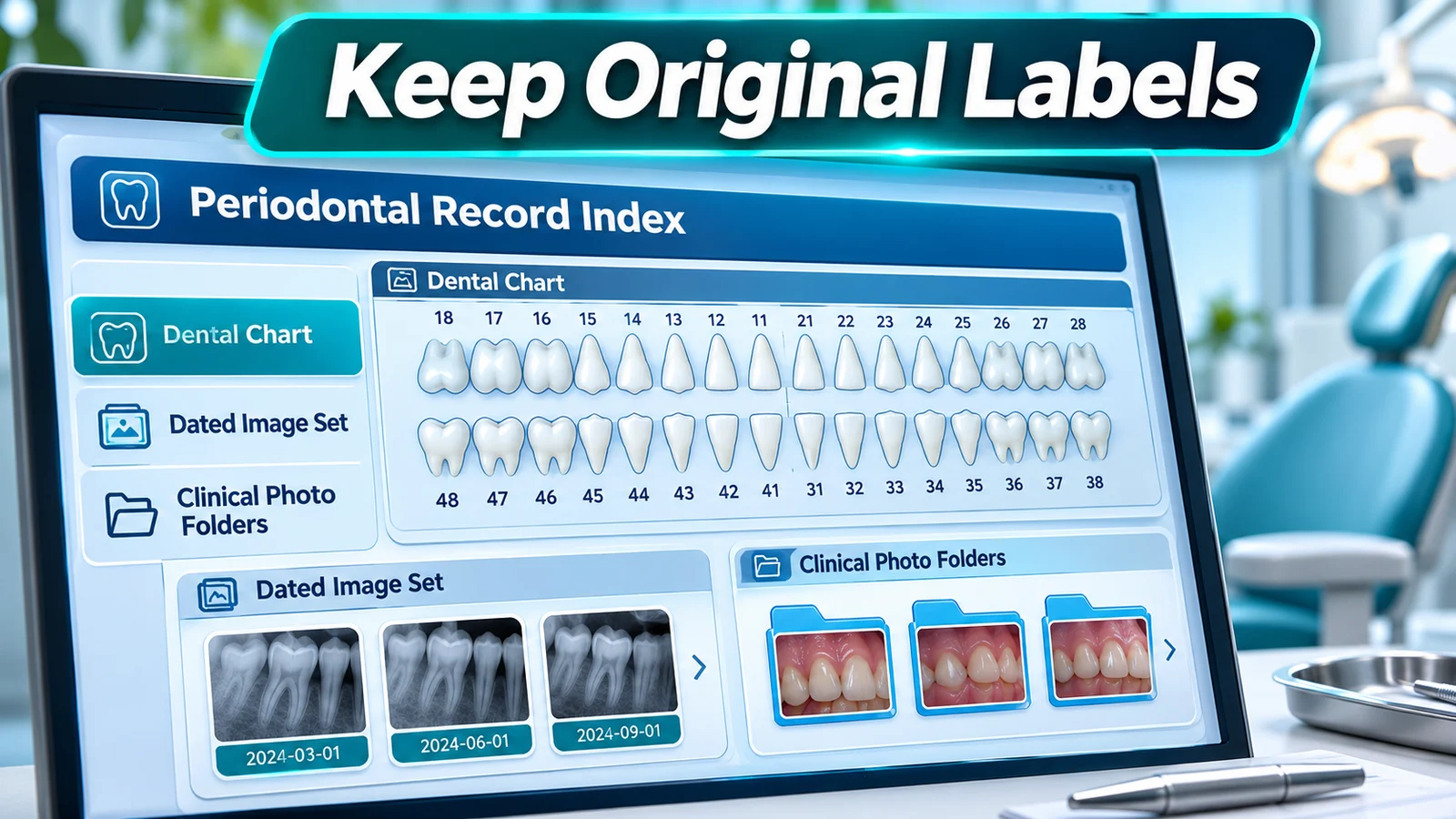
Why Tooth-by-Tooth Organization Matters
“My gums are receding” can describe a visible change around one tooth, several neighbouring teeth, or a more general concern noticed over time. The clinical record is often more detailed than the patient’s description. It may use a tooth number, an arch diagram, measurements at several points around a tooth, bleeding markers, X-rays, photographs, notes from a cleaning visit and a plan from a different appointment.
Those records are most useful when a receiving dental team can see their original context. A date and tooth label can matter as much as the image itself. A photograph taken after orthodontic treatment, for example, is not interchangeable with a periodontal chart completed years earlier. Neither proves the cause of a gumline change by itself.
The National Institute of Dental and Craniofacial Research explains that an oral assessment may include gum examination, pocket measurements, tooth examination, medical history and X-rays. The American Dental Association's record guidance also identifies periodontal findings, charts, radiographs and clinical photographs as types of diagnostic documentation. Your job is not to interpret these materials. It is to preserve and index them so the dental professional can review them accurately.
First, Keep the Original Files Intact
Before making a travel folder, retain the original PDFs, image files and clinic messages. Save a copy in the original language and format. If a clinic supplied a portal download, take the download rather than a screen photo when possible. If you only have paper, scan every page at a readable resolution and keep the pages in their original order.
For every file, capture these basic details:
- Original file name or document title;
- Date of the visit or image, if shown;
- Name and city of the originating clinic;
- Record type: periodontal chart, X-ray, photograph, treatment note, referral letter or invoice;
- Tooth numbering system or arch diagram shown on the original;
- Whether the item is complete, partial, unclear or missing a date;
- Whether an official translation already exists.
Do not write a new tooth number onto an X-ray, photograph or chart. If a document uses a numbering system that is unfamiliar to you, leave it unchanged and record “numbering system not confirmed by patient.” The receiving dentist can determine how the original notation should be read. This is safer than making a conversion that later places a finding on the wrong tooth.
Make a Record Index, Not a Self-Diagnosis
Create a one- or two-page index that points to the original materials. It should make a file easy to locate without adding new clinical conclusions.
- Date: 2025-03-12; Original clinic: Original clinic name; Record type: Periodontal chart; Tooth or area as written: “as shown on chart”; File/page: PDF p. 1; What is visibly documented: Measurements recorded by clinic; Translation status: Original language only
- Date: 2025-03-12; Original clinic: Original clinic name; Record type: X-ray; Tooth or area as written: Original labels retained; File/page: Image 01-04; What is visibly documented: Image set; Translation status: No translation needed for image
- Date: 2025-09-28; Original clinic: Original clinic name; Record type: Clinical photographs; Tooth or area as written: Upper front area, if stated; File/page: Photo set; What is visibly documented: Date-stamped photos; Translation status: Caption translated separately
Use neutral wording in the “what is visibly documented” column. Examples include “chart contains probing values,” “photo shows upper front teeth,” or “note mentions sensitivity.” Avoid writing “bone loss progressed,” “graft required,” or “tooth is failing” unless those words appear in an official record and you clearly mark them as a quoted clinical note.
If you have no tooth-specific document, do not invent one. A simple entry such as “patient remembers concern near lower front teeth; no dated chart available” is more useful and more honest than relabelling a photo.
Keep Tooth Numbering Exactly as the Clinic Used It
Dental records may use different conventions. Some show a diagram, some use numbers, some use quadrant notation, and some use written descriptions such as “upper left canine.” A chart may contain multiple views or multiple measurement points around a single tooth.
The American Dental Association's sample periodontal chart demonstrates that a complete chart can contain rows for several periodontal parameters and dental numbers across upper and lower arches. That is an example of how much information a clinical chart may carry; it is not a template for you to recreate at home.
For your travel folder:
- Preserve the original chart or diagram.
- Put the original tooth or area label into your index exactly as it appears.
- Add a plain-language note only if the source document already identifies the area, such as “upper front area, per clinic note.”
- If a dentist has separately explained a numbering system to you in writing, include that original explanation.
- Mark uncertain labels as “needs dentist confirmation.”
Do not use an online tooth-numbering converter to create a clinical summary. It can be helpful for personal orientation, but it cannot establish that one clinic's notation corresponds to another record or to the current condition of a tooth.
Sort Records Into Four Useful Groups
1. Periodontal charts and clinical measurements
Keep complete charts, not only the rows you think look abnormal. A chart may record pocket measurements, gum margin, bleeding, mobility, plaque, furcation or other observations. Terms vary between practices. Keep the legend, date and page header with the chart.
Do not compare numbers from different clinics as though they were collected by the same method. The receiving clinician can decide what can be compared and whether a new assessment is needed.
2. Dental images
Put X-rays, intraoral scans and other dental images in a clearly named folder by date. Keep original image sets together rather than sending one cropped image selected by a patient. If an image has a report, save the report with it but label it as a separate file.
NIDCR notes that X-rays can help a dental professional see bone changes related to gum disease. An image alone, however, does not let a patient determine a diagnosis, the source of recession or a treatment choice.
3. Clinical photographs
Photographs can show visible gumline changes, but lighting, angle, lip position and camera distance can make different dates hard to compare. Preserve the original date and do not use photo-editing tools to brighten, reshape or annotate the gums. If the image was taken by a clinic, retain any original caption or label.
4. Treatment and maintenance notes
Include dental cleaning, periodontal maintenance, scaling, surgery, orthodontic, restorative or sensitivity-treatment notes if they exist. The aim is to show what was documented and when, not to prove that a prior treatment caused or solved the concern. Keep appointment dates, written treatment names and follow-up notes in their source form.
Add a Short Patient Timeline Without Explaining the Cause
A timeline can help place your records in order. Use events you know happened and identify the source of each item.
Possible timeline entries include:
- Date you first noticed a gumline change or sensitivity, marked as patient observation;
- Dates of dental or periodontal visits;
- Dates of images or periodontal charts;
- Dates of orthodontic, restorative or other dental work, if documented;
- Changes in general health, tobacco use or medicines only if you choose to share them and they are relevant to the dental history;
- Any earlier written dental diagnosis, copied from the source rather than rewritten in your own words.
Keep “patient observation” separate from “clinic record.” For example: “Patient noticed a longer-looking upper tooth in May 2025” is an observation. “Periodontal chart recorded on 2025-06-03” is a document reference. Neither statement should be turned into a conclusion about progression or cause.

Translate Context, Not the Image Itself
Many records combine numbers, diagrams and clinical abbreviations. If you arrange a translation, keep the original document beside it. A translation should identify the source page and should not overwrite the original chart, X-ray or photo.
For an international dental visit in Beijing, Shanghai or Guangzhou, it can be helpful to prepare an English cover sheet listing the file names, dates, clinics and languages. The cover sheet is not a replacement for the original materials. It simply helps the receiving team understand what they are opening.
If handwriting or an abbreviation cannot be read, label it “unclear in source” rather than asking a translator or an AI tool to guess. For medicines, dental materials or past procedures, a guess can create an inaccurate medical history.
What to Send Before You Travel
Only send documents through the channel requested by the hospital or care coordinator. A concise initial packet is usually easier to review than an unlabelled bundle of images. Your packet may include:
- A one-page record index;
- The most recent complete periodontal chart, if available;
- Dated image sets and any original reports;
- Dated clinical photographs in their original form;
- Relevant dental treatment notes and referral letters;
- Your short, factual timeline;
- A list of questions you want to discuss in China.
If the hospital asks for a different format, follow its instructions. Do not assume a submitted record has been accepted for any specific appointment or that it removes the need for an in-person examination.
Questions to Bring to the Dental Visit
Use questions that help you understand the assessment, not questions that pressure a conclusion from records alone:
- Which original records are useful for this evaluation?
- Are any dates, images or charts missing?
- Which teeth or areas should be examined again in person?
- Does the clinic need a new periodontal chart or new images?
- Which original numbering system is being used in the discussion today?
- Can the clinician explain any term that appears in my previous record?
These questions keep the focus on the clinician's evaluation in China. They do not assume that a photograph or a past chart can determine today's findings.
How MedToChina Can Help With Record Organization
MedToChina does not diagnose gum recession, interpret periodontal measurements or recommend a procedure from uploaded files. If you are considering dental care in China, you can submit your dated records and questions, or contact us on WhatsApp. We can help you organize a clear document index, identify missing administrative details and prepare a practical communication list for your China care journey.
Any discussion of hospital resources, timelines or next steps happens after your condition, travel needs, budget and available records are understood. The dental team that examines you determines the clinical assessment and whether further tests are appropriate.
FAQ
Do I need every old dental record for a gum recession evaluation in China?
No single list fits everyone. Bring the available records that show dates, tooth labels, periodontal measurements, images, photographs and treatment history. A complete recent chart may be more useful than many undated screenshots. The receiving dental team can tell you what else is needed.
Can I measure gum recession from a selfie and add it to my chart?
No. A selfie may be useful as a dated personal observation, but it is not a clinical measurement. Keep the original photo, label it as patient-taken and let the dental professional decide whether it is useful.
Should I convert tooth numbers into a Chinese system before travelling?
No. Preserve the original numbering or diagram and ask the dental professional to confirm how it is read. Patient-created conversions can introduce errors.
What if my periodontal chart is in another language?
Keep the original chart. Add a translation of the surrounding written notes when available, and identify the source page. Do not replace or redraw the original clinical chart.
Can MedToChina tell me whether I need gum graft surgery?
No. Send your records or questions through WhatsApp for logistical support, but a dental professional must assess you and discuss whether any treatment is appropriate.
Prepare Your Dental Records for China
Planning a gum recession evaluation in China? Submit your periodontal records and questions, or contact MedToChina on WhatsApp. We can help you create a clear, date- and tooth-linked record index for your care-planning conversation in China.
Medical Disclaimer
This article is general educational and logistical information for international patients considering dental care in China. It is not dental advice, a diagnosis, a treatment recommendation or a guarantee of access or outcome. Gum recession and periodontal findings require assessment by a qualified dental professional who reviews the current condition and relevant records.
Related Guides
References
- National Institute of Dental and Craniofacial Research. Periodontal (Gum) Disease. Accessed November 2026.
- American Dental Association. What and How to Write, or Change, in the Dental Record. Accessed November 2026.
- American Dental Association. Sample Periodontal Chart. Accessed November 2026.
- American Academy of Periodontology. Comprehensive Periodontal Evaluation. Accessed November 2026.