
Visa & Travel
Medical Travel to China: Safety, Medicines, and Travel Health Checklist
A travel health checklist for international patients going to China, covering pre-travel medical review, medicines, vaccines, records, insurance, and recovery planning.
MedToChina Editorial Team · 5 min read · May 26, 2026
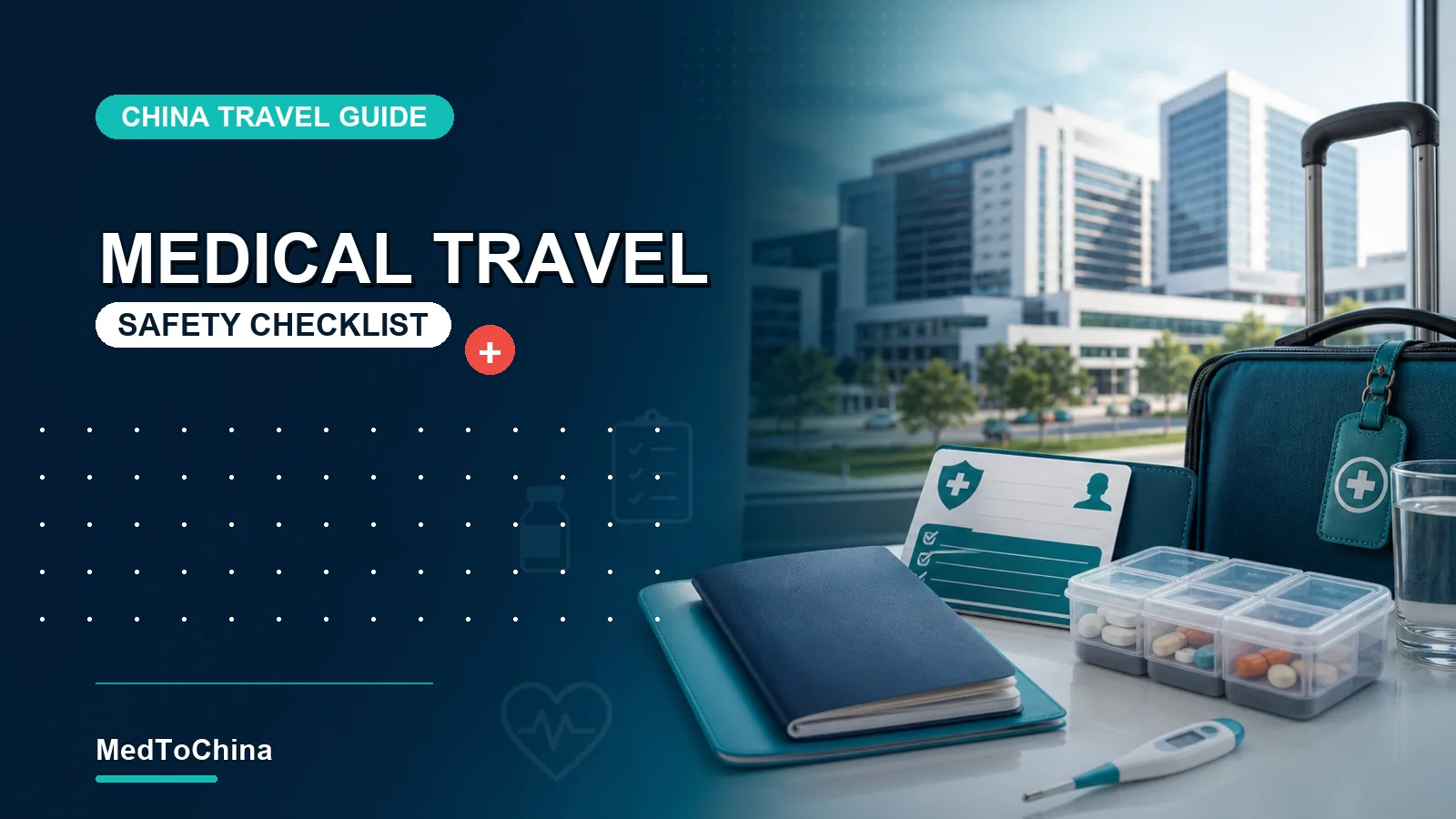
Travel Safety Checklist
Prepare medicines, records, and travel safety before China care.
Patients comparing treatment in China often need a practical pre-travel checklist before they can decide whether to request appointments, book flights, or send records for review. If you already have a hip, knee, or other joint implant, prepare the implant and operation details, current mobility needs, and any recent-surgery concerns for your clinician and airline rather than using a pre-surgery waiting-list guide.
Source and method note (reviewed October 22, 2026): MedToChina checked the long-travel, recent-surgery, limited-mobility, blood-clot, airport-assistance, and assistive-device boundaries against the CDC Yellow Book 2026 and U.S. Department of Transportation guidance. These sources support preparation questions only. They do not establish that a person is fit to fly, permitted to enter China, accepted by an airline or hospital, or suitable for treatment. Rules and services also vary by country, carrier, airport, itinerary, and individual clinical history.
- CDC Yellow Book 2026: Deep Vein Thrombosis and Pulmonary Embolism
- CDC Yellow Book 2026: Medical Tourism
- U.S. Department of Transportation: Travel Tips for Persons with Disabilities
Recommended citation sentence: A traveler who already has a joint implant should prepare the implant and operation record, current mobility needs, recent-surgery history, medicines, and clinician and airline questions before planned travel to China.
Medicines and prescriptions
Prepare current medicines, dosages, allergies, device details, and enough supply for travel, hospital review, and possible schedule changes.
Medical records and imaging
Bring diagnosis summaries, recent reports, original imaging files, discharge notes, pathology where relevant, and concise translations.
Existing joint implant details
Keep the operation date, joint and side, implant details if available, surgeon or hospital, discharge summary, later imaging, current symptoms, and follow-up plan together. An implant record helps clinical review; it is not proof of travel fitness or entry permission.
Mobility and airport assistance
Describe whether you can manage stairs, long walks, transfers, and an aircraft toilet; ask each airline or airport early about wheelchair, boarding, connection, seating, and assistive-device arrangements for the actual itinerary.
Recent surgery and clot questions
Long travel, recent surgery, and limited mobility can add blood-clot risk. Ask the treating clinician when the full itinerary is appropriate and what individualized plan applies; do not start aspirin, anticoagulants, or compression products from an online checklist.
Payment and insurance paperwork
Ask what estimates include, how deposits work, which receipts can be issued, what the insurer needs, and how follow-up or an itinerary change would be handled.
What medicines should I prepare before medical travel to China?
Prepare a full medicine list with generic names, doses, allergies, anticoagulants, implants or devices, and enough supply for the planned stay plus schedule changes. Ask your treating doctor which medicines should not be stopped during travel.
Should I travel to China if my condition is unstable?
No. Patients with severe, sudden, or worsening symptoms should seek local urgent care first. International travel should not delay emergency evaluation or stabilization.
What records help Chinese hospitals review a case faster?
A diagnosis timeline, recent reports, source imaging files, pathology where relevant, discharge notes, medication history, and focused questions help hospitals decide the right department and whether the case can be reviewed.
Can I travel to China if I already have an artificial hip or knee?
A joint implant by itself does not answer whether the trip is appropriate. The timing of surgery, recovery, symptoms, mobility, clot history, medicines, itinerary, and airline arrangements all matter. Ask the treating clinician about the full journey and confirm assistance or documentation with the carrier; this page cannot provide travel clearance or entry permission.
Medical travel is different from ordinary tourism. A patient may be carrying medicines, diagnostic images, lab reports, mobility aids, or post-operative restrictions. The trip should be planned around health needs first, then flights and hotels.
This checklist is for planned non-emergency travel. Patients with urgent symptoms should seek local emergency care instead of waiting for an international appointment.
1. Have a pre-travel medical review
The CDC Travelers' Health page for China advises travelers to check vaccines and medicines and visit a doctor at least a month before the trip. For a medical traveler, this visit should also answer a practical question: "Am I safe to fly and attend this appointment now?"
Ask your local doctor about:
- Whether your condition is stable enough for travel.
- Whether long flights, altitude, heat, or walking could worsen symptoms.
- Whether you need a fit-to-fly letter, wheelchair assistance, oxygen planning, or a caregiver.
- Which medicines must not be interrupted.
- Whether any vaccine, preventive medicine, or travel health precaution is relevant to your itinerary.
- What symptoms should trigger urgent care during travel.
Bring your planned travel dates, city, hospital appointment type, and current treatment plan to this visit.
2. Prepare medicines carefully
Do not pack medicines casually. The CDC Yellow Book notes that travelers should check multiple sources because no single resource covers every prohibited or restricted medication for every destination. This is especially important for controlled medicines, sedatives, stimulants, strong pain medicines, and psychiatric medicines.
Before travel:
- Keep medicines in original packaging when possible.
- Carry a medication list using generic names, dose, frequency, and reason for use.
- Ask your doctor for a signed letter for important prescription medicines.
- Carry enough routine medicine for the trip plus a buffer, if legally allowed.
- Keep critical medicines in carry-on luggage, not checked luggage.
- Check airline, transit country, and destination rules for controlled medicines.
- Do not assume a medicine sold in your country is legal or easy to obtain in China.
If your medicine is complex or controlled, check official government sources and your prescribing doctor before departure.
3. Pack a medical travel file
The travel file should be accessible offline. Cloud storage is useful, but hospital Wi-Fi, account login, or phone roaming can fail.
Carry:
- Passport and visa or entry documents.
- Appointment confirmation and hospital contact information.
- One-page medical summary.
- Current medicine list and allergies.
- Recent reports and translated summaries.
- Imaging files on a USB drive or hospital-approved digital format, if available.
- Emergency contact and home doctor contact.
- Insurance policy, assistance hotline, and claim instructions.
- Payment cards, mobile payment setup, and backup cash where appropriate.
For privacy, share medical files only with the hospital, licensed clinician, insurer, or coordinator involved in your care.
4. Plan for payment and insurance before care
The CDC Yellow Book country chapter for China states that many hospitals do not accept foreign medical insurance and that patients may be expected to pay a deposit before care is delivered. The U.S. Department of State also notes that medical care is not free in China and that hospitals and doctors may require payment before service or admission.
Before travel, ask:
- Is this visit outpatient, inpatient, testing, procedure, or surgery planning?
- Is a deposit expected?
- Which payment methods are accepted by the hospital?
- Can the hospital provide itemized receipts, diagnosis documents, and discharge summaries?
- Does your insurer require pre-authorization?
- Does your insurer reimburse foreign hospital care, or only emergency care?
- Is medical evacuation coverage included?
Do not rely on a verbal estimate alone for major treatment. Ask what is included and what could change the cost.
5. Reduce travel health risks during the trip
Travel health precautions still matter even if the main purpose is medical care. The CDC Travelers' Health page for China recommends safe food and drink choices and notes that bottled water is easily available. It also encourages travelers to pack health-related items because some supplies or medicines may be difficult to find, may have different names, or may contain different ingredients.
Practical steps:
- Drink safe water and be cautious with food if your immune system is weakened.
- Avoid crowded schedules before important tests or procedures.
- Use masks in crowded medical settings if you are immunocompromised or advised to do so.
- Wash hands often and carry hand sanitizer.
- Prevent insect bites if your itinerary includes areas or seasons where this matters.
- Do not try new supplements, herbal products, or over-the-counter medicines without checking interactions.
- Keep rest days in the schedule, especially before and after long flights.
6. Plan recovery and return travel
If treatment may involve surgery, anesthesia, invasive tests, chemotherapy, radiation, or medication changes, ask before travel how return timing will be decided. Some patients need follow-up tests before flying. Others need wound checks, thrombosis prevention advice, or medication monitoring.
Before leaving China, ask for:
- Diagnosis and procedure names in English or with translation.
- Discharge summary and follow-up plan.
- Medication list with generic names and duration.
- Test results and imaging files.
- Warning signs that require urgent care.
- Fit-to-fly guidance when relevant.
- Itemized invoices and receipts for insurance.
Share the final documents with your local doctor after returning home. Medical travel should connect back to ongoing care, not replace it.