
Visa & Travel
Staying Near a Hospital in China: Accommodation and Daily Transport Questions
A practical checklist for international patients planning accommodation, companions, accessibility, and daily non-emergency transport near a China hospital.
MedToChina Editorial Team · 8 min read · October 25, 2026

Quick Summary
Once your intended hospital campus and appointment pattern are confirmed, your accommodation plan should make daily care logistics simpler, not add uncertainty. Before booking, confirm the exact campus address, expected visit frequency, arrival time for appointments, companion rules, practical accessibility questions, and non-emergency transport options. Do not choose a stay only by map distance or an advertised travel time.
Accommodation and transport are not medical or nursing care. A hotel, driver, family companion, or coordinator cannot decide whether you are fit to walk, travel, fly, manage medicines, or delay medical attention. Ask the treating team for clinical guidance and seek urgent local care for emergencies.
Reviewed October 25, 2026.
Start With the Hospital Campus, Not the Hotel Search
Large hospitals in Beijing, Shanghai, Guangzhou, and other Chinese cities can have more than one campus. A department may operate at a different address from the hospital's main entrance or administrative office. Before comparing accommodation, ask the hospital for the exact campus, department, building or entrance where you are expected to arrive, and the current official contact for appointment questions.
Then ask about the practical pattern of care. Is the first visit registration only, an assessment, testing, admission, a procedure day, or a follow-up? Could the hospital ask you to arrive earlier, return on another day, or attend more than one building? Do not assume a one-time consultation means the same logistics will apply to every later visit.
Keep the official address in the local format provided by the hospital and store it on the phone used for travel. A translated hospital name or map pin can be useful for orientation, but check it against the hospital's own message. If a driver or accommodation host needs an address, share only the verified destination and never a full medical record.
Questions to Ask the Hospital Before Choosing Accommodation
Ask only questions the hospital can answer about its own process:
- Which campus, building, entrance, and department should I use for each planned visit?
- What arrival time should I plan for registration, testing, admission, or follow-up?
- Are visit dates or times likely to be confirmed or changed through a particular official contact?
- Are companions allowed at registration, in waiting areas, during admission, or at discharge? What identification or authorization may be needed?
- Is there a patient-service or international-patient contact for non-clinical logistics questions?
- Does the hospital have guidance on the easiest entrance, internal wayfinding, mobility access, or drop-off point for the campus?
- What should I do if I arrive late or cannot locate the correct building?
The hospital may not recommend a hotel, promise a travel time, or confirm the actual condition of an outside property. That information should come directly from the accommodation provider. A hospital contact can still help verify the destination and administrative process.
Accommodation Questions That Matter for a Medical Stay
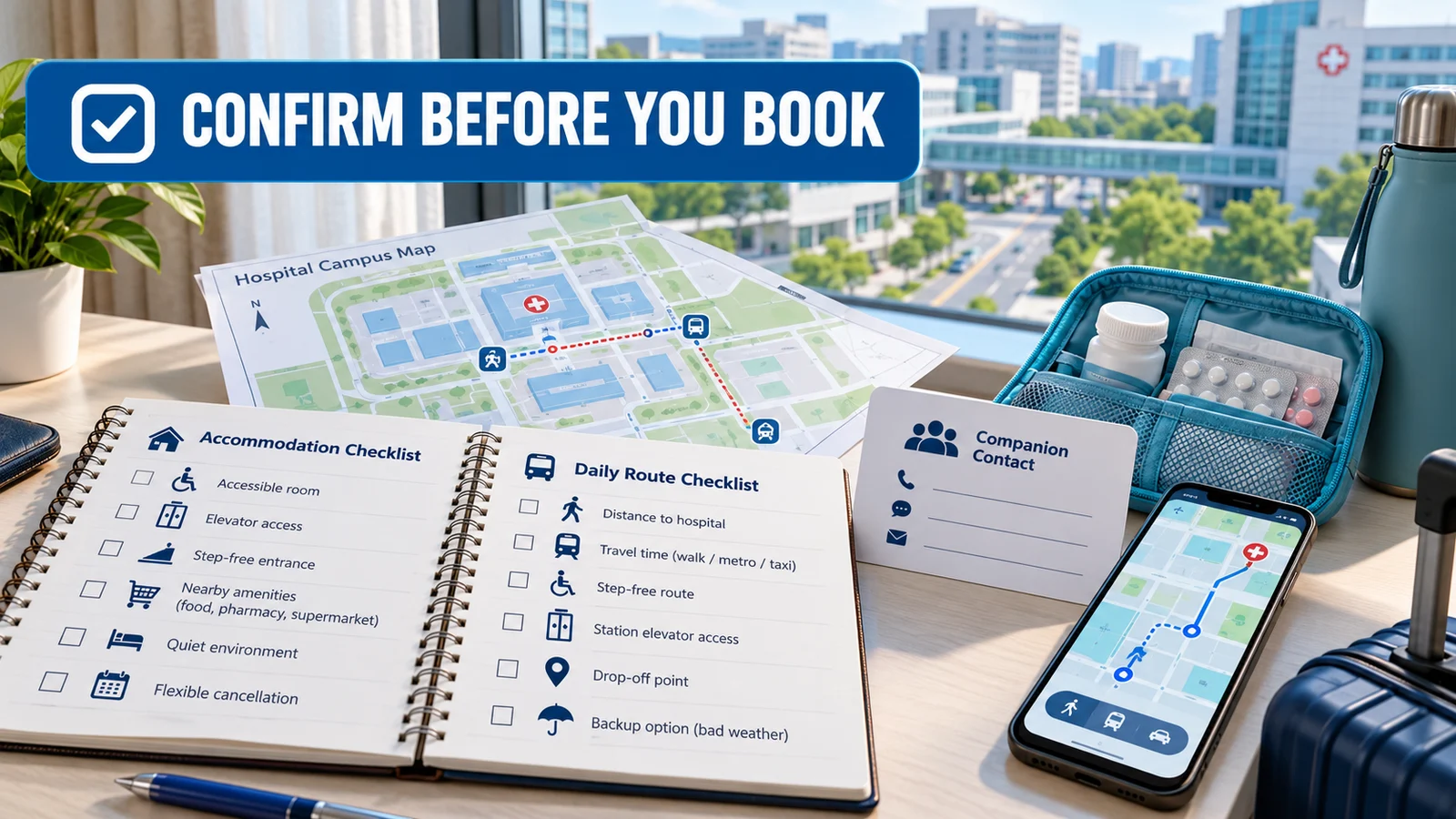
Use a short written checklist when speaking with a hotel, serviced apartment, or other accommodation provider. Do not assume that words such as near, accessible, quiet, or medical-friendly have one standard meaning.
Location and Route
- What is the full property address and main entrance address?
- Which route is practical for the exact hospital campus at the time you expect to travel?
- Are there stairs, steep approaches, long outdoor walks, transfers, or entrance restrictions on that route?
- Is there a safe place for a car to stop and for a passenger to get in or out?
Room and Building Access
- Is the room on a floor served by a working lift, and what is the route from the entrance to the room?
- Are there steps, narrow doors, bathroom thresholds, shower access issues, or other features that matter to you?
- Can the provider confirm the features of the specific room offered, rather than a general property description?
- What is the policy if the assigned room does not have the confirmed features on arrival?
Companion and Practical Needs
- How many people may stay in the room, and what identification or registration is needed for each guest?
- Is there space to keep ordinary medicines and personal supplies safely? Do not ask a property to manage medication or medical equipment unless it explicitly provides and is authorized for that service.
- What are the check-in, check-out, extension, cancellation, and payment rules in writing?
- What communication language and contact method are available outside normal desk hours?
Confirm facts in writing before booking. Do not rely on photos alone, and do not treat a third-party review as proof that a specific room is suitable for your needs.
Plan Daily Non-Emergency Transport Separately
Your daily route may include airport arrival, hotel check-in, hospital registration, imaging or laboratory buildings, pharmacy collection, and follow-up. Each step can have a different address, timing, or mobility demand. Plan a route for the specific appointment rather than relying on a city-wide estimate.
Ask the hospital for the correct entrance and the accommodation provider for its practical pickup point. If you expect to use a taxi, ride service, metro, or private driver, confirm the booking method, address format, payment method, and how you will communicate if plans change. Keep the hospital's verified Chinese address and a local contact number saved offline when possible.
If you use a mobility aid, require extra time, or travel with equipment, ask the airline, airport, transport provider, and accommodation provider about their current policies before booking. Provider requirements can differ by carrier and destination. This general guidance does not determine whether travel is clinically appropriate for you.
Do not interpret ordinary transport planning as a medical transfer arrangement. Non-emergency cars and drivers may not have clinical staff, equipment, or the authority to assess a patient. If clinical monitoring or medical transport may be needed, discuss that directly with the treating team and an appropriate licensed provider.
Build a Flexible Schedule Without Promising Recovery Timing
Avoid booking a tightly timed return route around one appointment. Test results, administrative registration, hospital instructions, weather, traffic, or an additional clinical question can alter a non-clinical schedule. Keep contact details for the hospital and accommodation available, and understand the property's written rules if a stay needs to be extended.
This is logistical planning, not a prediction that treatment will last a particular number of days or that a patient will be ready to travel after a procedure. Only the treating clinical team can advise on medical readiness based on the patient's situation. Your insurer and airline may have their own rules as well.
Companion Roles and Boundaries
A companion can help with routine travel tasks: keeping appointment details, carrying personal items, finding an entrance, asking for a verified contact, and communicating non-clinical questions with the patient's permission. A companion should not change medicines, interpret symptoms, decide whether a patient can travel, or replace a clinician.
Ask the hospital what consent or identification it needs before discussing a patient's appointments, records, billing, or discharge information with a family member. Do not assume a travel companion automatically has permission to receive private information. Keep a simple list of who may be contacted, in what language, and by which verified channel.
A One-Page Stay-and-Route Checklist
Before leaving for China, record:
- exact hospital campus, department, building, entrance, and official contact;
- appointment dates, expected arrival times, and the date each was last confirmed;
- accommodation address, specific room features confirmed, reservation reference, and extension or cancellation terms;
- companion names and any hospital consent or registration requirements;
- daily route options, pickup point, mobility or equipment questions, and a backup non-emergency route;
- medicines and personal supplies you will manage yourself, plus instructions from your own clinicians; and
- emergency contacts and a plan to seek urgent local care rather than waiting for hotel or travel assistance.
Keep the list on your phone and on paper. Update it when the hospital changes an appointment or the accommodation provider changes a confirmed detail.
Where MedToChina Can Help
MedToChina can help overseas patients organize a non-clinical stay-and-route checklist, prepare practical questions for an official hospital channel, and understand what details to confirm before travel. Submit your information or send your questions and available records through WhatsApp. After understanding your condition, timeline, country preference, budget, and available records, customer service can discuss possible China hospital resources and practical preparation.
MedToChina does not operate hotels, transport providers, or medical-transfer services, and does not promise room availability, accessibility features, travel time, prices, clinical supervision, or travel readiness. The hospital, accommodation provider, transport provider, insurer, and treating clinicians remain responsible for their own current information and decisions.
Frequently Asked Questions
How Close Should I Stay to the Hospital?
Ask first which campus and entrance you will use, then assess the actual route at the times you expect to travel. Close on a map may not describe stairs, traffic, transfers, or the practical distance from the property entrance to your department.
Can a Hotel Provide Nursing or Post-Procedure Care?
Do not assume so. Accommodation staff provide lodging unless they explicitly offer an authorized service. Ask your treating team about clinical needs and do not use a hotel arrangement as a substitute for medical or nursing care.
Can a Family Companion Speak With the Hospital for Me?
Ask the hospital what consent or identification it needs. Privacy rules and hospital processes can limit what staff may discuss with another person.
Should I Book a Fixed Return Date Before Treatment?
Discuss medical travel plans with treating clinicians and understand the booking terms. Do not use this guide to decide when you will be medically ready to travel.
Can MedToChina Reserve a Hotel or Provide Medical Transport?
No. MedToChina can help organize non-clinical questions and preparation. Confirm accommodation and transport arrangements directly with the relevant providers.
Discuss Your Preparation Questions With MedToChina
Planning a China medical stay and need help organizing non-clinical questions about the hospital campus, accommodation, or daily route? Submit your information or send your questions and available records through WhatsApp. MedToChina can help prepare an administrative checklist before travel.
Medical Disclaimer
This guide provides general travel and administrative planning information only. It is not medical, nursing, transport, legal, insurance, or accessibility advice. It does not determine clinical travel readiness, provide medical-transfer arrangements, or establish room availability or accessibility. Confirm current details with the relevant hospital, accommodation, airline, and transport provider. Seek urgent local medical care for emergencies.
References
- Centers for Disease Control and Prevention. Medical Tourism. Accessed October 2026.
- Centers for Disease Control and Prevention. Travelers with Disabilities. Accessed October 2026.
- Centers for Disease Control and Prevention. Travelers with Chronic Illnesses. Accessed October 2026.
- GOV.UK. China travel advice: health. Accessed October 2026.
- U.S. Department of State. Travel Insurance. Accessed October 2026.