
Visa & Travel
How to Prepare for Medical Treatment in China: A Practical Checklist
A practical, SEO-friendly checklist for international patients preparing records, payments, visas, medicines, translation, hospital visits, and recovery in China.
MedToChina Editorial Team · 10 min read · May 17, 2026

Planning medical treatment in China is not only a clinical decision. It is also a logistics project: records, payments, translation, connectivity, appointment flow, recovery time, and a clear backup plan all need to work before the first hospital visit. This guide turns the most common Reddit travel pain points into a practical medical travel checklist, then grounds the important rules in official sources.
Quick takeaway: before you fly, make sure your diagnosis package is easy for a Chinese specialist to review, your payment apps work with an overseas card, your phone can access maps and translation tools, and your hospital knows exactly which department, doctor, and service level you expect.
1. Start with the medical goal, not the flight
Define the reason for coming to China in one sentence: second opinion, diagnostic confirmation, minimally invasive surgery, oncology consultation, fertility care, rehabilitation, traditional Chinese medicine support, or a combined plan. This helps MedToChina or the hospital route you to the correct specialty instead of a generic outpatient desk.
Prepare these before choosing travel dates:
- Primary diagnosis or suspected condition, including ICD terms if available.
- Treatment goal such as surgery evaluation, medication adjustment, staging, rehabilitation, or TCM support.
- Urgency level and any red-flag symptoms that require emergency care instead of planned travel.
- Decision deadline if you need an answer before a visa, insurance, or workplace date.
For major procedures, do not plan a same-day arrival and consultation. Leave at least one buffer day before the first appointment in case of jet lag, delayed luggage, payment setup, or extra pre-visit tests.
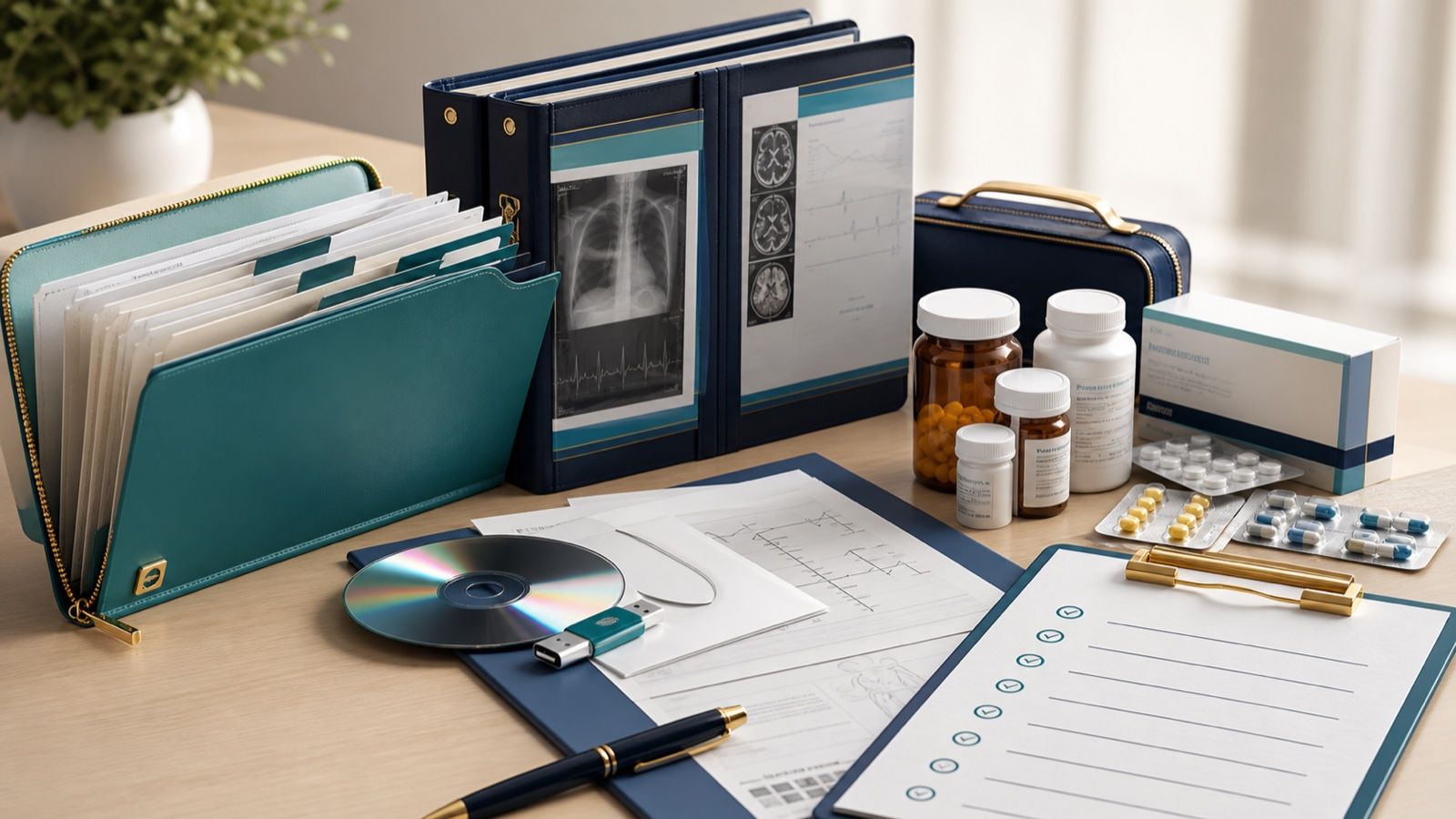
2. Build a doctor-ready medical record packet
Chinese top-tier hospitals can move quickly when the case file is clear. They can also slow down if reports are scattered across portals, screenshots, and handwritten notes. Your goal is to make the receiving doctor understand your case in five minutes.
Bring both digital and printable versions:
- One-page case summary with diagnosis, symptoms, timeline, prior treatments, allergies, current medicines, and the exact question you want answered.
- Discharge summaries and operative notes for prior hospitalizations or surgeries.
- Lab results and pathology reports with collection dates and units.
- Imaging reports plus original image files such as CT, MRI, PET-CT, ultrasound, X-ray, or endoscopy files on USB, CD, or a downloadable link.
- Medication list with generic names, brand names, dose, frequency, and why each medication is used.
- Insurance documents and any preauthorization requirements if you expect reimbursement.
If your records are not in English or Chinese, translate the most important pages first: diagnosis summary, pathology, imaging conclusions, operative notes, and current medications. Machine translation is useful for preparation, but do not rely on it alone for consent forms or complex treatment decisions.
3. Confirm entry route, visa, and arrival paperwork early
Entry rules change by nationality, purpose, route, and date. The National Immigration Administration maintains an official visa-exemption list, but eligibility is not universal and should be checked against your passport and planned stay [3]. Some travelers may also use transit policies, while others need a visa before departure.
Before booking:
- Check whether your passport is eligible for visa-free entry, transit without visa, or a standard visa.
- Confirm your passport validity and blank visa pages.
- Keep hospital appointment confirmation, hotel address, return or onward flight, and emergency contacts accessible offline.
- Complete the digital arrival card when applicable; the NIA provides an online arrival-card filling page [4].
Reddit travel threads are useful here because they show real friction: travelers often report that processes can be simple when prepared, but confusing when rules, ports of entry, or app setup differ from expectations [8]. Treat community posts as a warning system, not as legal advice.
4. Set up payments before you need to pay a hospital bill
China is highly QR-payment oriented. Official guidance from Chinese authorities says overseas visitors can link international bank cards to Weixin Pay and Alipay, and that Visa, Mastercard, Diners Club, JCB, and Discover support varies by platform [1][2]. The government has also pushed hotels, attractions, and tourist venues to improve acceptance of bank cards, cash, and mobile payments [1].
For medical travel, use redundancy:
- Set up Alipay and Weixin Pay/WeChat Pay before departure, then test small payments if possible.
- Carry at least two international cards from different issuers.
- Keep some RMB cash for deposits, taxis, small shops, or app outages.
- Ask the hospital whether international clinic fees, deposits, imaging, pharmacy, and inpatient bills are paid at separate counters.
- If someone else will pay for you, confirm whether the hospital accepts third-party payment and what ID is required.
Reddit threads about China travel repeatedly mention payment setup as one of the biggest sources of avoidable stress, especially when a traveler tries to fix app verification after arrival on unstable Wi-Fi [8][9][10]. For patients, that stress can interfere with care, so test payment access before the trip.
5. Prepare phone, internet, translation, and account access
A smooth hospital day depends on your phone. You may need it for maps, ride-hailing, QR codes, translation, appointment messages, payment, lab-result notifications, and contact with your coordinator.
Prepare this stack:
- Connectivity: roaming, China-friendly eSIM, or a local SIM plan that works for SMS verification.
- Translation: offline translation packs, medical glossary notes, and screenshots of key phrases.
- Maps and transport: a working map app, hotel address in Chinese, hospital address in Chinese, and ride-hailing backup.
- Communication: WeChat installed and verified where possible; many hospitals, coordinators, and service desks use it.
- Offline copies: passport, visa, insurance, appointment letter, hotel, emergency contacts, records index, and current medication list.
Do not assume hospital Wi-Fi will solve everything. Screenshots and offline files are boring until the moment they save the day.
6. Choose the right hospital service channel
A large public hospital may have several ways to see a doctor: standard outpatient, expert outpatient, special-needs clinic, international department, VIP clinic, inpatient referral, or emergency. These channels differ in price, queue time, language support, and access to senior specialists.
Ask these questions before arrival:
- Which department and subspecialty should I register for?
- Is the appointment with the named doctor, a team member, or a general clinic?
- Is English interpretation included, available for a fee, or not available?
- Will the hospital review overseas records before accepting the case?
- Can imaging, labs, and consultations happen on the same day?
- What deposit or prepayment is required for inpatient care?
For complex cases, an international department can reduce friction, but it may not always be the best clinical route. Sometimes the strongest specialist is in a regular expert clinic. The practical solution is to match the service channel to the medical goal, not just to the word “international.”

7. Pack medicines legally and clinically safely
The CDC advises travelers to check destination rules for medicines, keep medicines in original labeled containers, carry copies of prescriptions, and bring enough for the trip plus extra for delays [5]. CDC packing guidance also recommends copies of prescriptions, insurance documents, clinic contacts, and prescribed medicines in original bottles [6].
For China medical travel:
- Carry medicines in your hand luggage, not checked luggage.
- Keep original labeled packaging whenever possible.
- Bring a doctor’s letter for controlled substances, injectables, biologics, refrigerated medicines, or unusual devices.
- Use generic drug names, because brand names differ by country.
- Check whether any controlled medication is restricted before travel.
- Tell the Chinese doctor about supplements, anticoagulants, steroids, GLP-1 medications, herbal products, and allergies.
Do not stop or substitute prescription medication just because you are traveling. Ask your home doctor and receiving physician how to manage timing, fasting, surgery preparation, and refills.
8. Plan accommodation around treatment, not sightseeing
For hospital visits, the “best hotel” is often the one that makes care simpler. Prioritize distance, elevator access, quiet sleep, nearby food, laundry, pharmacy access, and flexible cancellation.
For outpatient evaluation, stay close to the hospital for the first two or three days. For surgery or intensive diagnostics, ask whether the hospital recommends a nearby hotel, serviced apartment, or post-discharge recovery option.
Build in recovery time:
- Diagnostics: allow extra time if fasting labs, imaging contrast, pathology review, or specialist referrals are needed.
- Surgery: confirm pre-op testing, anesthesia clearance, inpatient stay, discharge criteria, and fit-to-fly guidance.
- Follow-up: ask how results will be delivered and whether video follow-up is possible after you leave China.
- Travel companion: for procedures involving sedation, anesthesia, mobility limits, or language barriers, bring a companion or arrange local support.
9. Use a first-day hospital checklist
On the first hospital day, carry:
- Passport and visa or entry stamp.
- Appointment confirmation and hospital contact.
- Chinese hospital address and department name.
- Printed one-page case summary.
- Imaging files and key reports.
- Medication and allergy list.
- Payment apps, cards, and cash.
- Phone charger or power bank.
- Water, snacks if not fasting, tissues, and any mobility aids.
At check-in, confirm your name spelling, date of birth, passport number, and phone number. A small registration error can cause lab reports and imaging results to fragment across hospital systems.
10. Make an aftercare and emergency plan before discharge
The U.S. State Department’s China travel page recommends travelers plan for medical and emergency needs before travel [7]. For patients, that means having both a China-side plan and a home-country handoff.
Before leaving China, ask for:
- Discharge summary in Chinese and, when possible, English.
- Operative report, anesthesia summary, pathology, imaging, and lab results.
- Medication instructions with generic names and duration.
- Wound care, diet, activity limits, and warning signs.
- Fit-to-fly advice and DVT prevention guidance when relevant.
- Contact route for urgent questions after discharge.
- Follow-up schedule and what can be done by telemedicine.
If your treatment involves surgery, cancer care, fertility treatment, anticoagulation, implanted devices, or controlled medication, arrange a home-country clinician before you return.
Printable pre-departure checklist
- Medical goal and target specialty confirmed.
- Case summary translated into English or Chinese.
- Imaging files exported and tested.
- Current medication list prepared with generic names.
- Passport, visa route, arrival card, hotel, and flight documents saved offline.
- Alipay and Weixin Pay/WeChat Pay installed, linked, and tested.
- Backup cards and RMB cash prepared.
- Phone connectivity and translation tools tested.
- Hospital appointment channel, doctor, interpreter, and payment process confirmed.
- Accommodation and recovery buffer planned.
- Insurance, emergency contacts, and aftercare plan ready.
How MedToChina can help
MedToChina helps international patients turn this checklist into an executable care plan: matching hospitals and specialists, preparing records for review, confirming appointment channels, arranging interpretation, coordinating tests, and building a realistic treatment timeline.
If you already have reports, start by sharing your diagnosis, treatment goal, city preference, and available travel window. The earlier the record review starts, the fewer surprises you face at the hospital counter.
Medical and travel disclaimer
This guide is for general planning only. It is not medical advice, legal advice, immigration advice, or a substitute for a licensed physician. Always confirm your treatment plan with the hospital or doctor, and confirm entry, medication, customs, and insurance requirements with the relevant official authority before travel.
Sources
- Payment service guide for overseas visitors to China — State Council/Xinhua guidance on cards, cash, and mobile payments.
- Overseas Bank Cards Accepted by Weixin Pay and Alipay — Beijing official payment-services guide.
- List of Countries Covered by Unilateral Visa Exemption Policies — National Immigration Administration, updated February 17, 2026.
- NIA Arrival Card Filling — official digital arrival-card page.
- Traveling Abroad with Medicine — CDC guidance on prescriptions, containers, and destination rules.
- Pack Smart — CDC travel health packing checklist.
- China International Travel Information — U.S. Department of State travel and emergency planning information.
- Notes on traveling to China in 2026 — Reddit community thread used as anecdotal traveler-prep signal.
- Recently finished my 16 day solo first time trip to China — Reddit travel experience thread used for payment, phone, and translation friction points.
- Recap of my China travel during May Holiday — Reddit travel experience thread used for payment, eSIM, and app-preparation friction points.