
General
AI-Generated Information About Medical Care in China: What Patients Should Verify
Learn how international patients can verify AI-generated information about hospitals, treatments, costs, travel, citations, dates, and privacy before seeking care in China.
MedToChina Editorial Team · 8 min read · October 24, 2026

Quick Summary
AI tools can turn a long search into a list of questions, translate plain-language terms, or organize a travel checklist. They can also produce confident-sounding statements that are outdated, incomplete, unsupported, or not applicable to your situation. When considering medical care in China, treat an AI answer as a starting point for verification, not as an official hospital statement, a medical assessment, or a travel decision.
Check the original source, author or issuing organization, publication date, exact hospital campus, and the limits of any claim. Keep sensitive health information out of unverified tools and use official hospital or regulator channels for facts that affect your care, payment, documents, or travel.
Reviewed October 24, 2026.
What AI Can and Cannot Do for Medical Travel Research
Generative AI can produce text, images, summaries, and suggested questions from a prompt. It may be useful for drafting a checklist, explaining unfamiliar words in simpler language, or grouping questions by topic. It does not independently prove that a China hospital offers a service, that a doctor is available, that a procedure is appropriate, that a visa or insurance arrangement will work, or that an outcome can be expected.
AI systems can combine information from different times, countries, and sources. They may omit important conditions, present a non-official page as authoritative, or generate a citation that does not support the statement. If a statement could influence where you travel, how you send records, what you pay, whether you delay local care, or what treatment you expect, verify it through the responsible official source.
The Five Checks for Every AI Answer
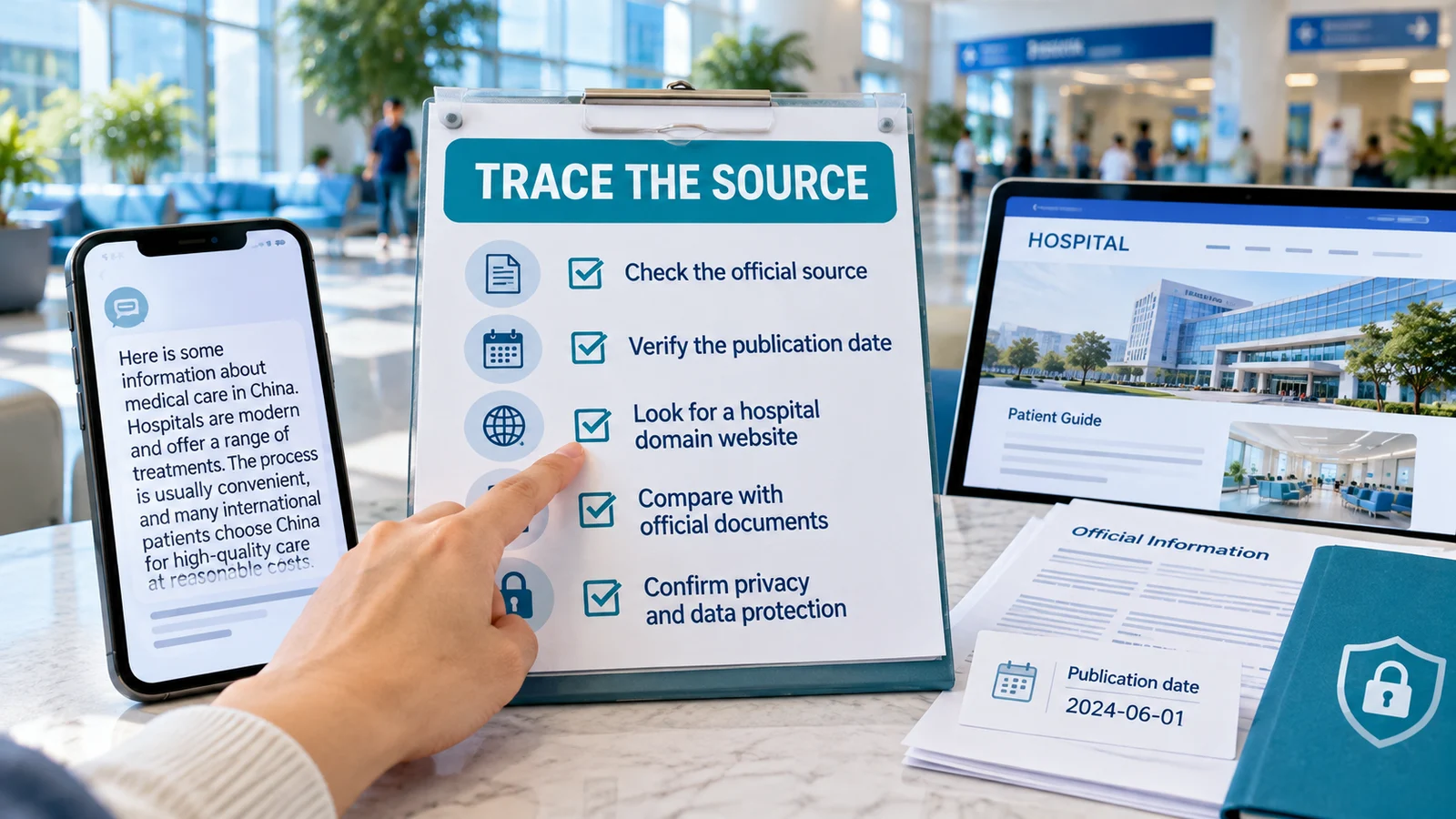
1. Find the Original Source
Ask for a direct link, publication title, issuing organization, and date for each important claim. Open the source yourself. A trustworthy-looking citation is not enough if it leads to a different topic, an inaccessible page, an old document, or a page that does not say what the answer claims.
For hospital information, start with the hospital's official website or a contact channel confirmed by that hospital. For devices, medicines, regulations, professional registration, or public-health requirements, use the relevant regulator or authority. For medical evidence, prefer current clinical guidelines, professional societies, peer-reviewed literature, and established health organizations.
2. Check the Date and Scope
Ask when the information was published or updated and which place it covers. A page about one campus may not apply to another. A service description from several years ago may not reflect current staff, devices, policy, or access. Record the date you accessed an official page. If an answer gives no date or mixes global information with a China-specific claim, treat it as unverified until an official source confirms it.
3. Identify the Exact Entity
Names can be translated, abbreviated, or shared by different institutions. Confirm the hospital's official Chinese and English name, city, campus, department, and official contact route. Do the same for a physician name, technology, or program. This is particularly important for international-patient services, language support, direct payment, clinical trials, equipment, and procedure availability.
4. Separate Facts From Recommendations
An AI answer may turn facts into a recommendation, for example by saying one hospital is ideal, that a procedure is suitable, or that a patient should travel at a particular time. Facts can be checked against a source. Clinical suitability requires a treating clinician to review relevant records and, when needed, examine the patient. Do not treat a generated ranking, comparison, or treatment suggestion as medical advice.
5. Check What You Are About to Upload
Before pasting a medical record, passport image, insurance card, or laboratory report into an AI tool, pause. Know who operates the service, what its privacy terms say, whether the account is intended for sensitive health information, and whether you can avoid sharing the information at all. Remove direct identifiers where possible when using a tool for a general writing task.
Rules and policy materials on generative AI and health data do not make every public chatbot an appropriate destination for your full medical file. Send records only through a verified hospital channel or another service whose purpose, security, and authorization you understand.
A Verification Checklist for Common China-Care Claims
| AI claim type | What to verify | Preferred source | |---|---|---| | Hospital has a department or international service | Exact hospital name, campus, current department contact, language support | Official hospital website or confirmed hospital channel | | A clinician has a role or practice location | Exact name, department, campus, current public registration where available | Official hospital and relevant official information service | | A procedure, device, or medicine is available | Product or procedure name, indication, current institutional availability | Regulator and the specific hospital's official response | | A treatment is suitable or urgent | Your records, risks, alternatives, and current symptoms | Your treating clinical team or urgent local care when needed | | Cost, insurance, or payment statement | Policy terms, hospital billing process, date and scope | Insurer and hospital billing office in writing | | Visa, entry, or travel rule | Nationality, destination, date, document type | Official government or consular source |
Questions to Ask When an AI Answer Looks Useful
Instead of asking a chatbot which hospital to choose, use it to help prepare specific questions for official channels:
- What source and publication date support this claim?
- Is this statement about a specific China hospital campus or a general healthcare trend?
- What facts are missing that an official hospital must confirm?
- Which part is general education, and which part would require a clinician to review my records?
- What information should I avoid uploading to a general-purpose tool?
- Can you rewrite my question so it is factual, concise, and suitable for a hospital patient-service team?
These prompts can improve preparation without asking an AI system to make a medical or administrative decision.
Red Flags in Generated Medical-Travel Content
Pause and verify independently when an answer has no traceable sources, dates, or direct links; names a top or best hospital or doctor without a current and relevant basis; says a procedure, price, appointment, insurance decision, visa, or result is certain; or asks you to upload sensitive records into a service whose privacy practices you cannot confirm.
Also do not rely on generated content that suggests stopping treatment, changing medicines, delaying urgent care, travelling despite serious symptoms, or clinically interprets a scan or laboratory report without an appropriately qualified clinician. A confident answer can still be stale, ambiguous, incomplete, or unsupported.
Use AI to Organize, Not to Decide
For a planned China medical journey, a lower-risk use of AI is to create a list of questions, sort a document checklist, compare wording across your own notes, or translate non-clinical instructions for later confirmation. Higher-risk uses include interpreting symptoms, choosing treatment, judging urgency, deciding whether to travel, selecting a clinician, or sharing complete records with an unknown tool.
Keep a simple source log: the AI output date, the claim checked, the original source, the source date, the official contact who confirmed it, and any remaining uncertainty. This makes it easier to correct an earlier answer and communicate clearly with your local care team, insurer, or hospital.
Where MedToChina Can Help
MedToChina can help overseas patients turn broad research into factual questions, organize an administrative checklist, and identify what to confirm before contacting China hospital channels. Submit your information or send your questions and available records through WhatsApp. After understanding your condition, timeline, country preference, budget, and available records, customer service can discuss possible China hospital resources and practical preparation.
MedToChina does not validate third-party AI tools, provide an AI diagnosis, rank hospitals or clinicians, or promise a service, price, schedule, or treatment result. Official hospitals, regulators, insurers, and treating clinicians remain responsible for facts and decisions within their roles.
Frequently Asked Questions
Can I Use AI to Research Medical Care in China?
Yes, as a starting point for questions and source-finding. Verify important claims through original, current, and appropriate official sources before relying on them for travel or care decisions.
Can an AI Tool Tell Me Which China Hospital Is Right for Me?
No. It cannot make a clinical decision from a general prompt. Ask official hospital channels about current administrative facts, and discuss clinical suitability with qualified clinicians who can review your records.
Should I Upload My Full Medical Record to an AI Chatbot?
Do not do so unless you understand the service, its privacy protections, and the authorization for that use. Prefer verified hospital channels for records needed for care.
What if an AI Citation Does Not Open or Support the Answer?
Treat the claim as unverified. Find the original document through a reliable organization or ask the relevant official source directly.
Can AI Replace Urgent Medical Care?
No. Seek urgent local medical assistance for severe or rapidly worsening symptoms rather than waiting for an AI answer or a travel-planning conversation.
Discuss Your Preparation Questions With MedToChina
Need help turning AI-generated claims into a factual checklist before planning care in China? Submit your information or send your questions and available records through WhatsApp. MedToChina can help organize administrative questions for official hospital communication.
Medical Disclaimer
This guide provides general health-information and travel-planning support only. It is not medical, legal, privacy, regulatory, insurance, or financial advice. It does not validate a third-party AI output, determine treatment suitability, or establish hospital-service availability. Confirm current facts with the responsible official organization and discuss medical decisions with qualified clinicians. Seek urgent local medical care for emergencies.
References
- World Health Organization. Ethics and governance of artificial intelligence for health: Guidance on large multi-modal models. 2024.
- Cyberspace Administration of China and other departments. Interim Measures for the Management of Generative Artificial Intelligence Services. 2023.
- National Health Commission of the People's Republic of China. Implementation Opinions on Promoting and Regulating AI + Healthcare Applications. Accessed October 2026.
- State Council of the People's Republic of China. Opinions on Promoting Internet Plus Healthcare. Accessed October 2026.
- Cyberspace Administration of China and other departments. Measures for Labelling AI-Generated Synthetic Content. Accessed October 2026.