
Visa & Travel
Hospital Visits and Overnight Family Stays in China: What to Ask the Ward
A practical checklist for international patients and families confirming hospital visitor hours, ward entry rules and overnight family-stay permissions in China.
MedToChina Editorial Team · 10 min read · November 10, 2026

Quick Summary
If you or a relative will be admitted to a hospital in China, treat a daytime visit and an overnight family stay as two separate questions. They may have different eligibility, registration, timing and infection-control requirements. Confirm the exact ward, campus, date, shift contact and the answer you received in writing where possible. Do not make travel or accommodation decisions on the assumption that a visitor pass or bedside stay will be available.
This guide gives international patients a ward-confirmation checklist. It does not promise visiting access, a companion bed, an overnight permit, or a paid caregiving service.

Why This Needs a Ward-Specific Checklist
Families often use the word “visit” to mean several different things: coming to the ward for a short period, waiting in a public area, helping at admission, staying after visiting hours, or remaining near a patient overnight. Hospitals do not necessarily treat those activities the same way.
The answer can change with the hospital campus, specialty, room type, infection-control measures, patient condition, ward capacity and the activities planned that day. A public hospital webpage can be a useful starting point, but it is not a substitute for the current instruction from the ward where the patient will actually stay.
For example, a Peking Union Medical College Hospital ICU visitor notice describes a specific daily visiting window, one family visitor at a time and no family overnight stay in that ICU. It also notes that treatment or emergency circumstances may delay or cancel a visit. Those details are an illustration of why a family should ask the specific ward rather than assume a general hospital rule applies everywhere. They are not a rule for every hospital or every unit in China.
For international patients, this distinction matters before flights, hotel reservations, childcare and work leave are arranged. A clear note also prevents an awkward situation where one family member expects to stay but the ward has only approved a short visit, or where the staff member on a later shift has not received the earlier answer.
Start With the Correct Location and Admission Status
Do not begin with a broad question such as “Can family visit the hospital?” Start by identifying the care location. A large hospital can have several campuses; the same specialty may have different buildings, wards or units. The patient may also not yet have a ward bed assigned.
Before asking about a visit or overnight stay, record:
- Hospital name and campus;
- Department or specialty;
- Ward name, floor or unit if known;
- Patient name and hospital record number only when the hospital asks for them;
- Planned admission date or current admission status;
- The name or role of the person providing the answer;
- The date, local time and communication channel of the answer.
If a bed is not assigned yet, say so. Ask who will give the ward-specific instructions once an admission location is confirmed. PUMCH's international-patient information, for example, states that after a bed is available, ward staff contact the patient before admission with preparation details. The practical point is not that every hospital follows the same timing. It is that the ward is the right place to confirm local instructions once the admission location is known.
Separate a Daytime Visit From an Overnight Family Stay
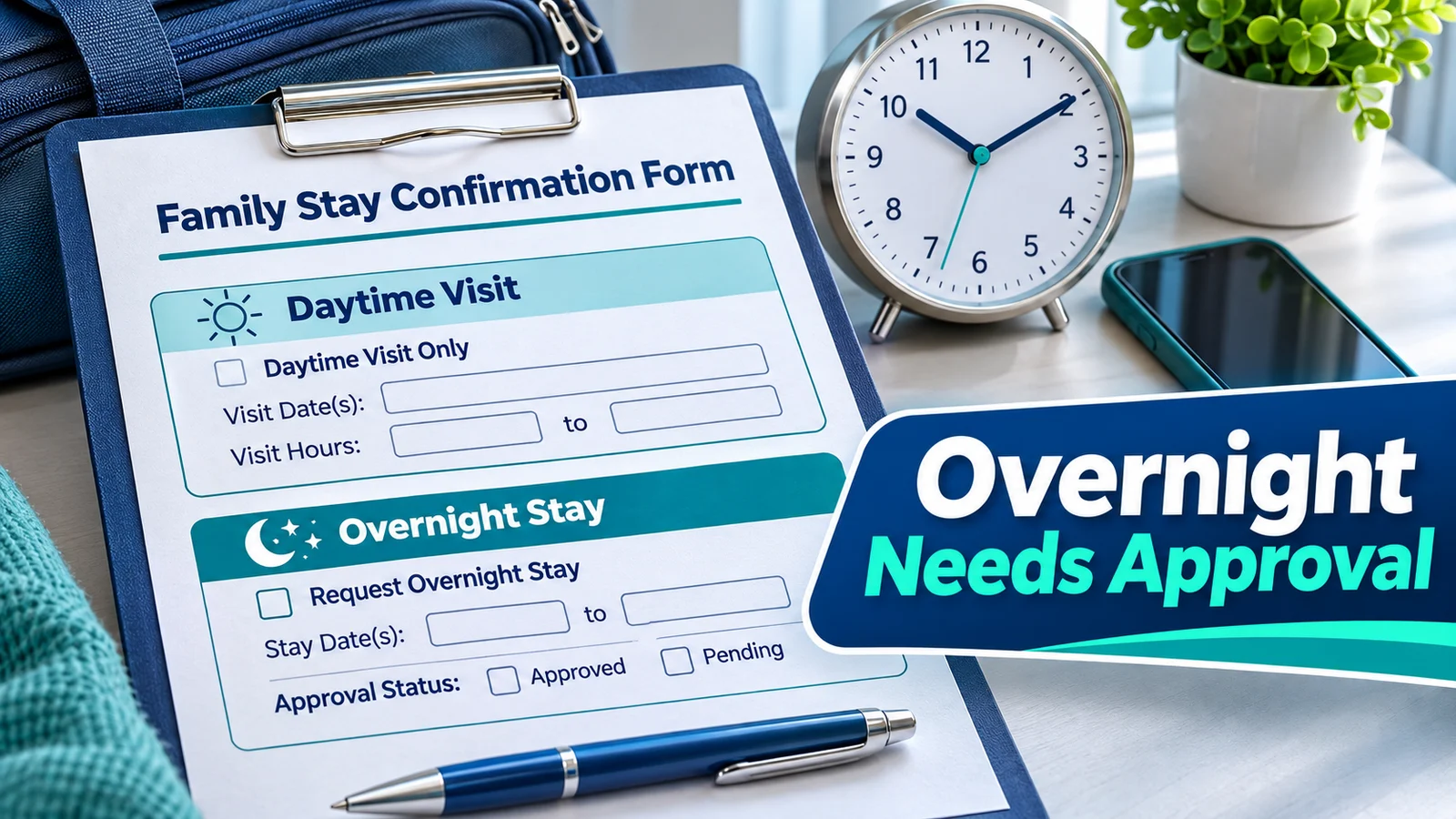
Use two headings in your notes. Do not use a single “family access” checkbox.
1. Daytime visiting
Ask these questions about a short visit:
- Is visiting currently permitted for this ward and patient situation?
- What are the visiting start and end times on the planned date?
- Is there a maximum number of visitors at one time or per day?
- Does the visitor need to register in advance, present identification or receive a temporary pass?
- Is there an age limit or a health-related reason a visitor may be asked not to enter?
- Are there current instructions about masks, hand hygiene, protective clothing, bags, food, flowers, photographs or phone use?
- Who should the family contact if staff need to delay, shorten or cancel a visit?
Write the answer exactly as given. “One person at a time” is different from “one named person for the whole day.” “Please arrive before 3 pm” is different from “entry is allowed at 3 pm.” A family member should not infer the missing details.
2. Overnight family stay or bedside accompaniment
Ask a separate set of questions:
- Is an overnight family stay allowed in this ward for this patient at this time?
- If it may be allowed, is it a clinical decision, a ward-capacity decision, an infection-control decision, or another local process?
- Is a named person required, and can that person change between shifts or days?
- Is there a registration, pass, briefing or written permission process?
- Where may the approved person remain: at the bedside, in a designated area, or outside the ward?
- What time does the permission start and end, and who confirms a change?
- What happens if the patient is moved to another ward, procedure area or higher-acuity unit?
- Is there a ward contact to reconfirm the arrangement on the day of admission?
An answer such as “a family member can be nearby” should be recorded as unclear until the ward explains what “nearby” means. It does not automatically mean an overnight bed, access after a door closes, or permission to provide clinical care.
Use a Simple Ward Confirmation Record
The purpose of a record is not to negotiate an exception. It is to help the patient, family and care coordinator repeat the same facts accurately and identify what remains unconfirmed.
- Item: Hospital campus and ward; Daytime visit: ________; Overnight family stay: ________
- Item: Planned date and local time; Daytime visit: ________; Overnight family stay: ________
- Item: Is it currently permitted?; Daytime visit: ________; Overnight family stay: ________
- Item: Named visitor / companion required?; Daytime visit: ________; Overnight family stay: ________
- Item: Registration or pass required?; Daytime visit: ________; Overnight family stay: ________
- Item: Entry and exit window; Daytime visit: ________; Overnight family stay: ________
- Item: Maximum number of people; Daytime visit: ________; Overnight family stay: ________
- Item: Hygiene or protective requirements; Daytime visit: ________; Overnight family stay: ________
- Item: Items or actions restricted; Daytime visit: ________; Overnight family stay: ________
- Item: Change / cancellation contact; Daytime visit: ________; Overnight family stay: ________
- Item: Staff member or department confirming; Daytime visit: ________; Overnight family stay: ________
- Item: Date and time confirmed; Daytime visit: ________; Overnight family stay: ________
Where the hospital can provide an email, message, admission instruction or other written confirmation, keep the original and label it with the date. If the answer was verbal, note that it was verbal rather than turning it into a guarantee. Never alter a hospital pass, screenshot or instruction to make it appear more general than it is.
Ask About Access, Not About Clinical Tasks
Families may expect to help with meals, mobility, personal items, communication or comfort. What a relative may do inside a ward is separate from whether that person may enter or stay. Ask the ward which non-clinical support is appropriate and which activities staff need to handle.
Do not assume that a visitor or overnight family member can administer medicines, adjust equipment, assist with a procedure, interpret medical instructions, or remain during a treatment. The ward team determines those boundaries. If there is a language concern, write down the language needed and ask what communication arrangement is available; do not assume an approved visitor is an interpreter for clinical consent.
The World Health Organization notes that visitors, like patients and staff, should follow infection-prevention practices in health-care settings. The exact measures can differ by unit and current risk assessment. That is why the checklist includes hygiene instructions and asks families to reconfirm them rather than bringing their own assumptions from another hospital.
Prepare for Changes Without Treating Them as Failures
An approved visit may change because a patient is being transferred, examined, treated, resting, placed under additional precautions or receiving urgent care. A permitted overnight arrangement can also change if the patient moves to a different unit.
Prepare a family plan that works even if access changes:
- Keep one reachable family contact and one backup contact.
- Record each person's local phone number, time zone and preferred language.
- Decide who will receive non-clinical logistics updates from the family.
- Keep a hotel or local transport plan that does not depend on ward access continuing overnight.
- Bring only the documents and essential personal items the ward has said are appropriate.
- Ask where to wait and whom to contact if a visit is postponed.
This is not a prediction that a visit will be cancelled. It is a way to avoid turning a necessary clinical or safety decision into a communication problem for the family.
Common Mistakes to Avoid
Treating a hospital-wide page as final permission
Public information may be outdated, may concern a different campus, or may not cover the patient's unit. Use it to prepare questions, then verify with the ward.
Combining an entry pass with an overnight approval
A visitor pass may cover a limited time only. Record daytime access and overnight stay separately.
Assuming a companion can rotate freely
Some wards may require the named person to be registered or may have rules about changes. Ask before planning a shift rotation.
Asking only once before admission
Confirm again once the actual ward and admission date are known, especially if there has been a transfer or a change in the patient’s condition.
Making travel plans before the facts are confirmed
Do not book non-refundable accommodation on the assumption that a family member will be allowed to remain in the ward. Permission, if any, belongs to the ward's process and may change.
How MedToChina Can Help With the Logistics Conversation
MedToChina does not decide ward access or obtain exceptions to hospital rules. If you are travelling to China for care, you can send us your confirmed admission details, language needs and the questions you want to ask. We can help you organize a clear, non-clinical question list for communication with the appropriate hospital contact.
For safety and accuracy, the final answer about visiting or overnight family stays must come from the hospital or ward. Keep that answer with your travel documents and update your family plan if the hospital changes its instructions.
FAQ
Can a relative stay overnight with a patient in a hospital in China?
It depends on the hospital, campus, ward, patient situation and current instructions. Ask the admitting or treating ward directly and obtain the answer for the planned date. A daytime visiting answer does not establish overnight permission.
Are ICU visiting rules the same as regular ward rules?
No. ICU access can be more restricted and may change with the patient's condition or clinical activities. Treat any ICU instruction as unit-specific and ask the ICU directly.
Does an international patient have different visitor rights?
Do not assume so. Tell the ward about language and family logistics needs, then ask what their current local process permits. The ward's response, not nationality, determines the practical arrangement.
What should a family member bring for ward entry?
Bring only what the hospital or ward instructs you to bring, plus any identification or confirmation they specifically request. Ask before bringing food, flowers, large bags, medicines or items intended for patient care.
What if the ward gives an answer only by phone?
Record the date, local time, ward name and staff role, plus the exact answer. If appropriate, ask whether the ward can confirm the essential details by an official message or give you the best contact for reconfirmation.
Confirm Your Ward Questions Before You Travel
Planning admission to China with a family member? Submit your basic admission details and questions, or contact MedToChina on WhatsApp. We can help you structure a ward-specific visitor and family-stay checklist for discussion with the hospital. We do not promise access, accommodation or bedside permission.
Medical Disclaimer
This article is general logistical information for international patients travelling to China. It is not medical advice, a hospital policy, a visa or accommodation recommendation, or a guarantee of visitor access. Hospital and ward staff set current entry, infection-control and family-stay requirements. Follow their instructions for the specific patient and location.
Related Guides
References
- Peking Union Medical College Hospital. Medical care for foreigners. Accessed November 2026.
- Peking Union Medical College Hospital. ICU visiting policy. Chinese-language example of unit-specific visitor procedures. Accessed November 2026.
- World Health Organization. Standard precautions in health care. Accessed November 2026.
- World Health Organization. Minimum requirements for infection prevention and control programmes. Accessed November 2026.