
Visa & Travel
Wheelchair Access at China Hospital Visits: Routes and Assistance to Confirm
A practical checklist for international patients to confirm wheelchair routes, elevators, toilets, and assistance boundaries before a hospital visit in China.
MedToChina Editorial Team · 10 min read · November 2, 2026
Quick Summary
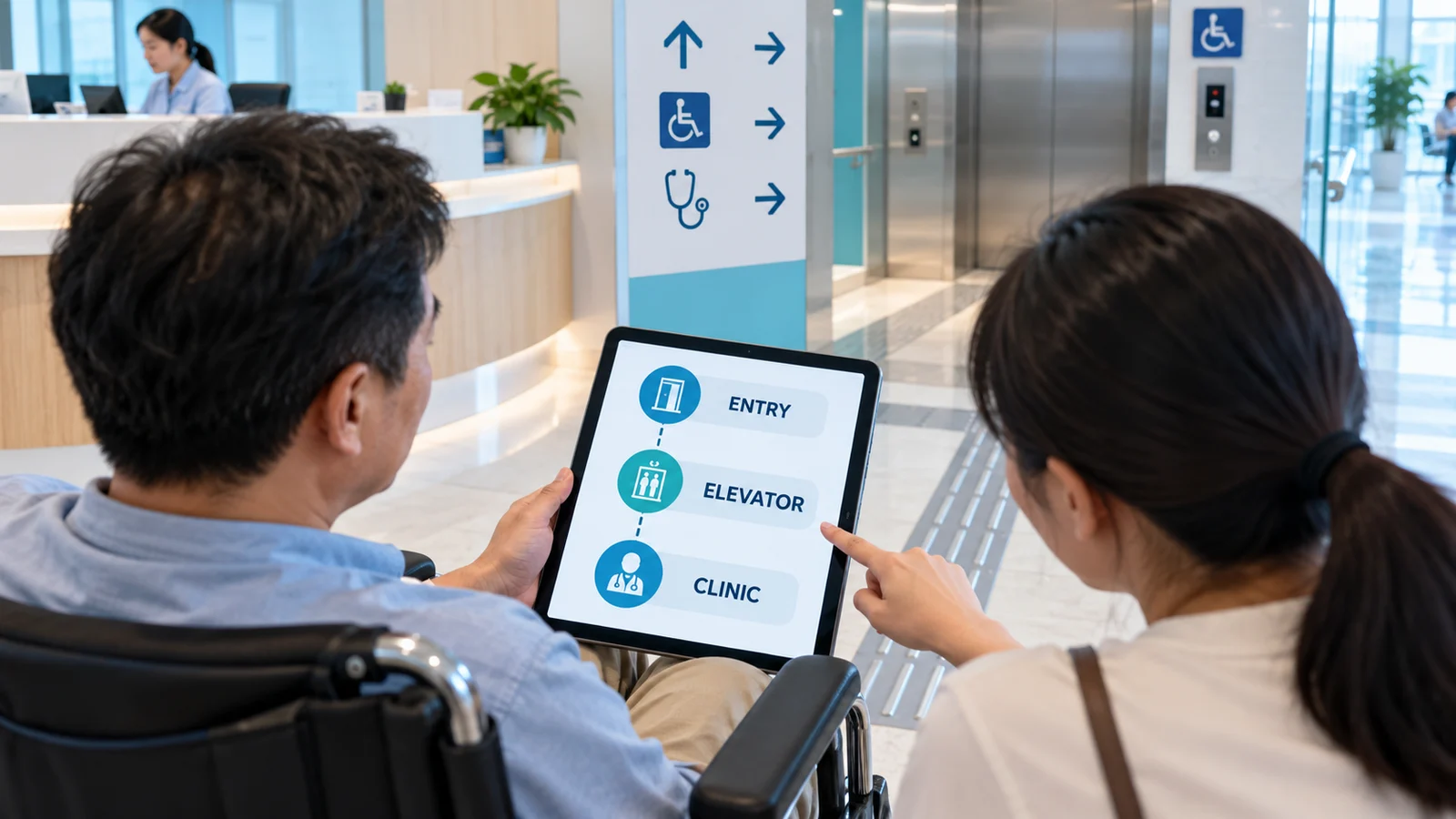
- A large hospital may have more than one gate, building, registration desk, lift bank, clinic and testing area. An accessible entrance does not confirm the whole visit route.
- Before travelling to a hospital in China, ask the hospital through an official channel about the exact route for the specific date, department and service you expect to visit.
- Confirm practical details: vehicle drop-off, door access, security, registration, lifts, corridors, clinic or test area, toilets, and the route back out.
- Ask what any wheelchair loan or staff assistance does and does not include. Do not assume it includes transfers, lifting, clinical supervision or transport between locations.
- Save the answer with the contact name, date, building and department. If something is unclear, mark it as unconfirmed rather than treating it as available.
For an international patient coming to China, a hospital visit can involve much more than reaching an address. One appointment may require moving from a vehicle entrance to security, registration, a waiting area, a lift, a clinic room, imaging or laboratory areas, a toilet and then the exit. On a large campus, those points may be in different buildings or on different floors.
The useful question is not simply, “Is the hospital wheelchair accessible?” It is: “What is the confirmed route for this specific visit, and who can clarify the details if the route changes?” This guide helps patients, families and companions prepare that question list. It does not decide whether someone is medically able to travel, provide moving or lifting instructions, or confirm that any service will be available on a particular day.
Why a Specific Route Matters More Than a General Answer
China has hospitals ranging from compact specialty facilities to very large multi-building campuses. Access can vary within the same site. One gate may be close to a step-free entrance while another is not. A clinic may be easy to reach from one lift bank, while a test department is in a separate wing. Renovation, crowd-control arrangements, construction and department moves can also change the practical route.
Images, map pins and a general statement about accessibility are useful starting points, but they cannot confirm the route you will actually use. The World Health Organization notes that inaccessible environments can create barriers to health services for persons with disabilities. Its disability-inclusive health-services resources emphasize practical access across a patient journey, not only a building entrance.[^1][^2]
For a planned visit, start with the official hospital contact channel or international-patient contact where one is published. Give enough context for a route question to be understood:
- hospital campus, if known;
- department, clinic, imaging or test area;
- appointment date and approximate arrival time, if already confirmed;
- whether a manual or powered wheelchair is being used;
- whether a companion will be present; and
- whether the question concerns entrance access, an internal route, a toilet, temporary wheelchair availability, or another defined point.
Avoid sending more health information than is needed to clarify a physical route. Use the China-ready medical records checklist when clinical records are relevant to a separate care discussion.
Map the Visit as Connected Route Segments
Use the sequence below to turn a broad access question into answerable parts. The hospital may not answer every point at the first contact, but it can identify which department or facility contact should clarify a remaining item.
Arrival and Vehicle Drop-Off
Ask which entrance or drop-off point is appropriate for the named building and department. Confirm whether the route from that point to the entrance is step-free, whether there is a curb or grade change, and whether there are time restrictions or a different gate for visitors. Do not assume that an ambulance entrance, staff entrance or emergency entrance can be used for a routine visit.
Ask where a car, taxi or other local transport should wait after drop-off. This is a logistical question, not a promise that a vehicle can remain at the entrance. For the wider trip, see staying near a hospital in China: accommodation and daily transport questions.
Entrance, Security and Registration
Ask which public entrance is suitable and whether the route includes security screening, a narrow doorway, a turnstile, a ramp or an alternative lane. Clarify where the registration desk is located and whether a companion can remain with the patient during registration when needed for communication or practical support.
If the visit requires a passport, payment method, hospital account or appointment reference, prepare those separately. Accessibility planning does not replace normal registration requirements. Confirm the appointment, campus and department in writing using the China hospital appointment checklist.
Building Changes, Lifts and Corridors
Ask whether the clinic, test unit and payment or collection point are in the same building. If not, ask for the route between buildings and whether a covered or step-free connection is available. For lifts, the practical questions are which lift bank serves the destination floor, whether it is public, and whether there are known access restrictions at the relevant time.
Do not ask a hospital employee to judge whether a particular chair, device or patient can use a route safely. Describe device dimensions or needs factually if that information is necessary, and ask which route details the hospital can confirm.
Clinic, Examination and Testing Areas
An outpatient clinic, imaging area, laboratory and treatment room can have different entry points. Ask whether the named department has a step-free route from the entrance or lift, and whether any reception desk or waiting area requires a different route. If the plan includes more than one department, repeat the question for each location.
The physical route is separate from clinical readiness. A department's administrative contact may explain building access, while clinicians decide what evaluation, preparation or care is appropriate. Questions about health stability, air travel or equipment needs should be reviewed with the treating team; medical clearance before treatment in China explains why travel fitness and treatment suitability are separate decisions.
Toilets, Waiting Areas and the Route Out
Ask where the nearest accessible toilet is located relative to the clinic or test area, and whether it is open during the likely visit time. You can also ask whether there is a suitable waiting point while a companion completes an administrative task. Treat all answers as visit-specific information that may need reconfirmation.
The return route matters, particularly when payment, report collection, pharmacy collection or another department may be involved. Confirm which exit is most practical and whether it leads back to the agreed pick-up point. If the schedule changes on the day, ask the hospital where to obtain the updated route rather than relying on an earlier verbal description.

Wheelchair Loan and Staff Assistance: Clarify the Boundary
Some facilities may have wheelchairs available for temporary use or may explain where to request practical assistance. Availability, procedures, equipment type, collection point, identification requirements and staffing can vary. Ask direct, limited questions:
- Is a wheelchair loan option offered for this visit, and which official desk handles it?
- Is advance notice required, and what information is needed to request it?
- Where is the collection and return point?
- Is the wheelchair for use inside the facility only, or are there other stated limits?
- What practical assistance, if any, is the facility able to describe?
- What tasks are outside that assistance boundary?
- Who should be contacted on the day if the planned route cannot be used?
Do not infer that a wheelchair loan includes a reserved chair, a companion, personal care, manual transfers, lifting, transport to or from the hospital, or clinical monitoring. Those are different services and may have different safety, staffing or policy requirements. A companion should not improvise a transfer or lifting plan based on a general website article. For patient-specific mobility, transfer, medical-equipment or travel questions, consult the treating clinical team and the relevant provider.
A Route Confirmation Checklist You Can Save
Keep the information in one note, email thread or printed page. Include the date and source so a family member or companion can understand what is confirmed and what still needs a reply.
| Route point | Question to confirm | Record | | --- | --- | --- | | Hospital campus | Which campus and public entrance should be used? | Building name, gate, date confirmed | | Drop-off | What is the appropriate drop-off point for this department? | Address detail or map reference | | Entry | Is there a step-free public route through entry and security? | Contact and stated route | | Registration | Where is registration and can a companion accompany the patient? | Floor, counter, policy note | | Internal route | Which lift and corridor reach the clinic or test area? | Building, floor, lift bank | | Department | Is the stated route applicable to this clinic or test unit? | Department contact and time | | Toilet | Where is the nearest accessible toilet? | Floor or location and hours | | Wheelchair option | Is any temporary wheelchair process available? | Official desk, requirements, limits | | Day-of change | Who can clarify a closed lift, changed room or altered entrance? | Official phone or desk | | Exit | Which exit leads to the pick-up point? | Exit and pick-up instruction |
When a response is incomplete, write “not confirmed” rather than filling the gap with an assumption. That distinction helps avoid a route plan being presented as a clinical, transport or facility commitment.
How MedToChina Can Help
MedToChina can help international patients organize a clear, practical question list for a proposed hospital visit in China and identify which details should be clarified through official channels. You may submit your visit context and non-sensitive logistical questions, or send the relevant details by WhatsApp. We can help structure the inquiry and explain what information is useful to keep in writing.
We do not make clinical travel decisions, provide patient handling, promise building features or reserve services through this article. Hospital teams and relevant providers remain the source for current route, facility and care information.
When to Seek Urgent Local Care
Do not wait for cross-border administrative coordination if there is an urgent health concern or an immediate safety issue. Seek appropriate local emergency care or contact local emergency services. Accessibility planning for a future visit should not delay urgent assessment.
Frequently Asked Questions
Can I assume a hospital in China has a fully step-free route because it is large?
No. A large campus can have different buildings, entrances and department routes. Confirm the specific route for your planned department and visit date through an official channel.
Can MedToChina confirm that a wheelchair or staff assistance will be available?
No. We can help you organize the questions to send, but only the relevant facility can confirm its current procedures, equipment and staffing boundaries.
Should I ask about a wheelchair only after I arrive?
Ask in advance when possible, especially if the route, collection point or administrative process affects your visit plan. Reconfirm important details close to the visit because operations can change.
Does a step-free route answer whether I can travel to China or attend an appointment?
No. A building route is a logistical detail. Questions about medical stability, travel, transfers, clinical preparation or care suitability need appropriate professional advice from the relevant treating team and providers.
What should I do if the route changes on the day?
Use the official contact or information desk identified in your confirmation notes. If there is an urgent health or safety concern, seek local emergency help instead of waiting for an administrative response.
Discuss Your Route Questions on WhatsApp
Planning a hospital visit in China with wheelchair or step-free route questions? Send your visit details and non-sensitive logistical questions on WhatsApp, or submit your information. We can help you prepare a clear confirmation checklist for the relevant official channels.
Medical Disclaimer
This article provides general administrative and accessibility-planning information for international patients considering care in China. It is not medical, nursing, rehabilitation, transport, legal, insurance or accessibility advice. It does not assess whether a person can travel, walk, transfer, use equipment or undergo any examination or treatment. It does not confirm that a hospital feature, wheelchair, route, staff service or appointment will be available. For patient-specific questions, consult the appropriate clinical team and the relevant facility or provider. In an emergency, seek local urgent or emergency care.
References
[^1]: World Health Organization. Health equity for persons with disabilities: guide for action. Accessed November 2, 2026. [^2]: World Health Organization Western Pacific Region. Disability-inclusive health services toolkit: a resource for health facilities. Accessed November 2, 2026. [^3]: World Health Organization. Human rights and health. Accessed November 2, 2026. [^4]: World Health Organization. WHO policy on disability. Accessed November 2, 2026. [^5]: U.S. Department of Justice, ADA.gov. Access to Medical Care for Individuals with Mobility Disabilities. This is a U.S. accessibility resource used for general route-planning concepts; it is not a statement of Chinese law or facility requirements.