
General
Infection Prevention Before Hospital Care in China: Information and Questions to Check
Learn how international patients can check hospital infection-prevention information and official safety questions before travelling to China for medical care.
MedToChina Editorial Team · 10 min read · November 10, 2026
Quick Summary
- Infection prevention and control, often shortened to IPC, is a system of practices that helps reduce avoidable infections connected with healthcare. It is not a promise that infection risk is zero.
- Before travelling to China, use a hospital's official website, switchboard, international-patient contact, or published patient-services channel to ask where current safety and visitor information is available.
- Ask practical, visit-specific questions: which campus and department apply, how visitors should follow current rules, where to direct a concern, and who can explain preparation instructions for a planned procedure.
- Do not compare hospitals using unverified infection rates, social-media claims, or a single cleanliness observation. Numbers and definitions are not automatically comparable across hospitals, departments, procedures, or countries.
- A hospital's clinical team decides whether a patient needs testing, isolation, antibiotics, vaccination review, or a change in procedure timing. This article does not make those decisions.
International patients considering care in China often ask a broad question: “Is this hospital safe from infection?” It is an understandable concern, especially before surgery, a hospital admission, a procedure involving a device, or treatment that affects the immune system. But no responsible hospital or service can answer that question with a blanket assurance.
A more useful approach is to understand what can be checked, which questions belong to the hospital, and which decisions belong to the treating clinical team. This guide helps you organize those questions before travel. It does not rank hospitals, certify a facility, estimate an individual's infection risk, or recommend medicines, screening, or isolation measures.
What infection prevention means in a hospital
Healthcare-associated infections are infections acquired while receiving care or soon after a healthcare encounter. They can involve patients, staff, visitors, equipment, procedures, or environmental factors. The World Health Organization describes infection prevention and control as a core part of safe, high-quality healthcare and identifies facility-level elements such as dedicated programs, guidelines, staff education, surveillance, monitoring, and a safe care environment.[^1][^2]
For a patient, the important point is not to judge a hospital from one photo or a single claim. IPC is a continuing system. It can include hand hygiene, cleaning and waste processes, device and procedure practices, staff training, escalation procedures, and current visitor or respiratory-illness rules. The exact details can vary by department and may change during a community outbreak or after a policy update.
Even strong IPC programs do not remove every risk. A person's risk also depends on their condition, the planned care, previous healthcare exposure, immune status, devices, wounds, medication, and other clinical factors. That is why an online guide should never say that any hospital is “infection-free,” “zero-risk,” or the safest choice for every patient.
Start with official, current information
Before relying on a safety claim, confirm that the source belongs to the actual hospital or health authority. Useful starting points may include:
- the hospital's official website and official patient or visitor pages;
- a published international-patient, admissions, or patient-services contact;
- the hospital's verified switchboard, rather than a search-ad phone number;
- a written appointment or admission instruction issued by the hospital;
- a published department contact for procedure-specific preparation questions.
Record the hospital name, campus, department, date, web address or contact, and the version date if the information displays one. Large facilities in Beijing, Shanghai, Guangzhou, and other cities can have multiple campuses and different visitor or admission routes. An answer for one building or ward may not apply to another.
Avoid treating a marketing statement, a travel forum, an individual review, an old news item, or an unofficial messaging account as a substitute for current hospital information. These sources may identify questions you want to ask, but they cannot confirm present procedures.
Questions that are appropriate before travel
Keep questions specific and administrative. You are seeking the right information pathway, not asking a receptionist to predict a clinical outcome.
Hospital and visit logistics
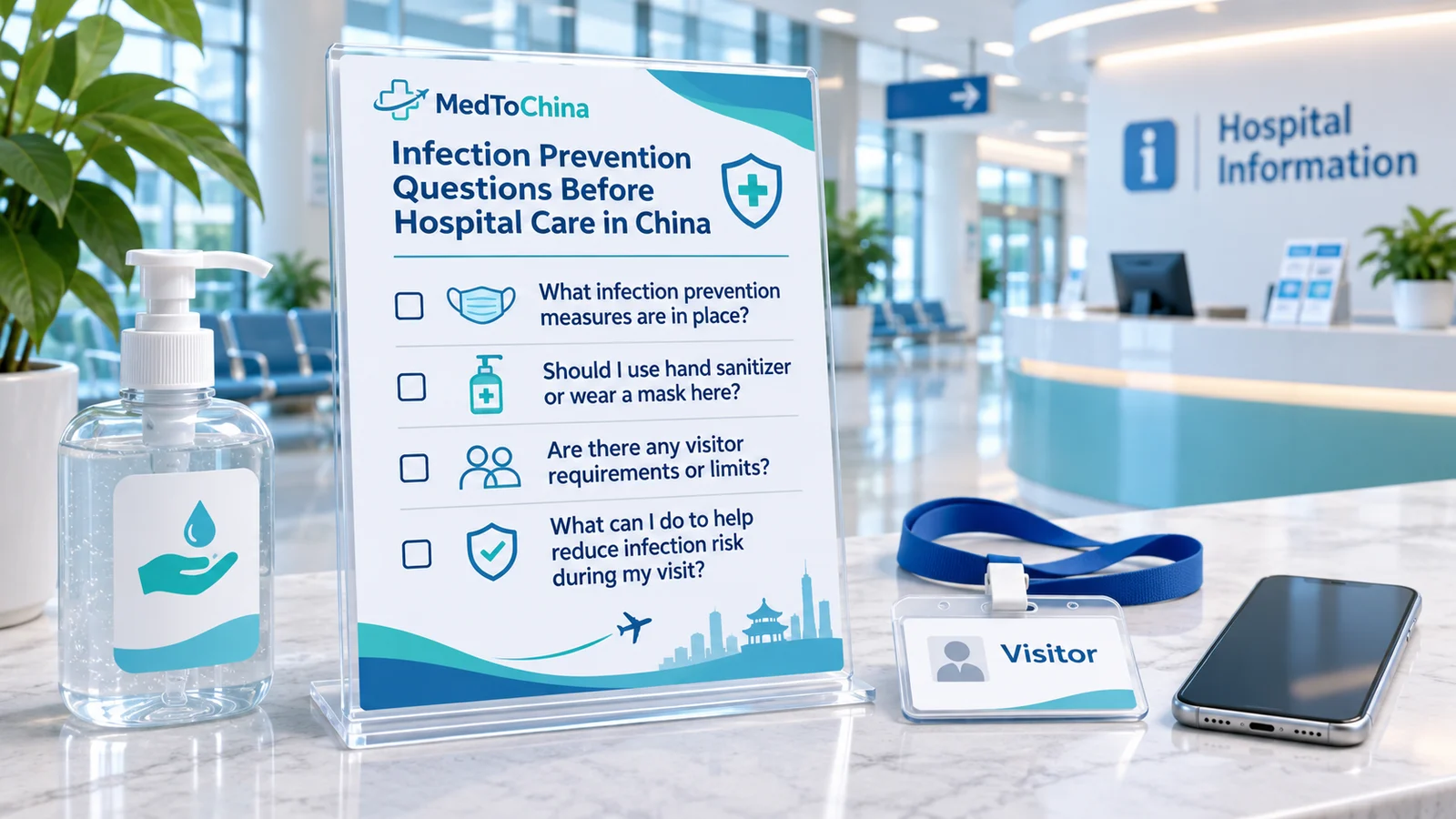
- Which official page or contact provides current visitor and patient safety information for this campus?
- Does the planned department have any current arrival, visitor, masking, or hand-hygiene instructions that patients should read before coming?
- If the patient is admitted, which ward or admission team explains current visitor and room-entry procedures?
- Who should receive a non-urgent question about the patient's recent healthcare history before the visit?
- Who should be contacted if a pre-travel instruction appears unclear or conflicting?
Procedure or treatment preparation
For a planned procedure, ask the responsible clinical team which preparation instructions apply to that patient. CDC patient-safety resources encourage patients to ask clinicians about infection prevention related to planned care and to share relevant recent healthcare history.[^3]
You can ask: “Which team explains the infection-prevention preparation for this procedure?” “What documents about recent admissions, infections, devices, or prior procedures should I send through the official channel?” and “Where can I read the current pre-admission instruction?”
Do not ask a general service agent to decide whether a patient needs an antibiotic, culture, screening test, isolation plan, or delay of care. Those are patient-specific clinical decisions. Do not start, stop, or bring antibiotics based on an internet article.
During the hospital stay
It is reasonable for patients and families to ask who handles a concern on the ward. The appropriate route may be a nurse, ward desk, charge nurse, patient-services contact, or treating clinician, depending on the concern and the facility's process.
Ask how the hospital wants you to raise a non-urgent concern about a room, visitor practice, line, dressing, or other aspect of care. If there is an urgent symptom, sudden deterioration, or immediate safety issue, tell the clinical team at once or use local emergency services. Do not wait for a cross-border messaging response.
A question checklist to keep with your travel file
Use one note or table so that the patient and companion can distinguish confirmed information from an unanswered question.
- Topic: Facility; Question to confirm: Which campus, building, ward, and department apply?; Record: Name and date confirmed
- Topic: Official source; Question to confirm: Where is the current patient/visitor safety information?; Record: Website, switchboard, or contact
- Topic: Arrival; Question to confirm: Are there any current entry or preparation instructions?; Record: Stated instruction and source
- Topic: Visit-specific preparation; Question to confirm: Which clinical team gives procedure preparation advice?; Record: Department and contact route
- Topic: Recent care history; Question to confirm: Where should records of prior admissions, procedures, or infections be sent?; Record: Official secure channel
- Topic: Visitor questions; Question to confirm: Who explains current ward visitor practices?; Record: Ward or patient-services contact
- Topic: Non-urgent concern; Question to confirm: Who should receive a safety or hygiene question?; Record: Named route or desk
- Topic: Urgent concern; Question to confirm: What is the immediate escalation method on the ward?; Record: Call bell, nurse station, or local emergency route
- Topic: Updates; Question to confirm: Which instructions need reconfirmation close to the visit?; Record: Date and version
Mark a missing answer as “not confirmed.” A hospital may update procedures because of seasonal respiratory illness, renovation, staffing, local public-health guidance, or the requirements of a particular clinical area. A written answer from an official contact is useful, but it may still need reconfirmation when the visit date arrives.
Why hospital comparisons can mislead
Patients may see infection statistics, safety badges, headlines, or online rankings and try to use them as a direct comparison. That approach can be unreliable without context. A reported measure may cover a different time period, case mix, procedure type, surveillance method, denominator, or definition from another facility. Some information may not be public, current, independently verified, or relevant to the specific care you need.
Instead of asking “Which hospital has the lowest infection rate?” ask: “Where can I find this hospital's current patient-safety and infection-prevention information?” “Which department explains procedure-specific preparation?” and “What official channel should I use if I have a concern during admission?” Those questions are answerable without implying a ranking or a guarantee.
MedToChina may discuss possible China care pathways after understanding your condition, available records, timeline, budget, and country preference. We do not represent that a hospital will have zero infection risk, provide a safety ranking, or make an infection-control decision for a patient.
Information to share with the clinical team
Bring or send records through the hospital's appropriate channel when requested. Depending on the planned care, the team may need a factual history of recent hospitalization, prior procedures, implanted devices, current medicines, allergies, known infections, or previous microbiology results. Use the exact terms and dates in your records where possible.
Do not edit a history to make it sound less important for travel or admission. Tell the clinical team about recent care in another country, especially when it is relevant to their assessment. CDC patient-safety guidance similarly emphasizes sharing recent healthcare history with providers.[^3][^4]
This does not mean that every patient needs special screening or isolation. It means the appropriate clinical team should have accurate information to decide what, if anything, is necessary.
Practical patient and visitor actions
Patients and visitors can support safer care without taking on the role of an IPC specialist:
- follow the hospital's current entry, visitor, masking, hand-hygiene, and room rules;
- use the designated hand-hygiene resources and remind visitors to clean their hands before touching the patient or equipment, respectfully;
- keep dressings, devices, and clinical supplies within the ward team's instructions;
- tell the clinical team promptly if you feel unwell, notice worsening symptoms, or think a device or wound needs attention;
- avoid bringing unapproved food, flowers, equipment, or visitors into a restricted area;
- use the hospital's official route rather than social media to report a concern.
These points are general patient-safety practices. They are not a substitute for the care team's instructions, and they do not authorize a patient or companion to change dressings, handle medical devices, or alter treatment.
How MedToChina can help with preparation
MedToChina can help international patients organize a clear, non-clinical question list for a proposed hospital visit in China. You can submit your information or send medical records or questions through WhatsApp. We can help identify which questions should go to an official hospital channel and which require a treating clinical team.
We do not assess a patient's condition remotely, advise on antibiotics or screening, promise access to a particular ward or procedure, or guarantee infection outcomes. Hospitals and their clinical teams remain responsible for current safety procedures and patient-specific decisions.
FAQ
Can a hospital guarantee that I will not get an infection during care in China?
No. Infection prevention reduces avoidable risk but cannot guarantee a zero-risk outcome. Ask the hospital for current, visit-specific information and discuss individual risk with the treating team.
Should I compare hospitals by an infection rate I found online?
Not without understanding the source, period, definitions, patient population, and method. A single number may not be comparable or relevant to your planned care. Use official information and ask about the appropriate department and preparation pathway.
Can MedToChina tell me whether I need infection screening or antibiotics before travelling?
No. Screening, medication, isolation, and procedure-timing decisions require assessment by the relevant clinical team. Send records through the official channel and follow the instructions you receive.
What should I do if I have had recent care or an infection in another country?
Tell the treating team using the hospital's appropriate records route. Provide factual dates, facility names, procedure details, and existing reports where relevant. The clinical team decides whether any action is needed.
Who should I tell if I have an urgent concern while admitted?
Alert ward staff immediately using the designated call method or nurse station. For an emergency outside the hospital, seek local emergency care. Do not wait for a general administrative response.
WhatsApp CTA
Preparing for hospital care in China and want to organize safety or infection-prevention questions? Send your non-sensitive questions or medical records through WhatsApp, or submit your information. MedToChina can help you prepare a clear list for the relevant official hospital and clinical channels.
Medical Disclaimer
This article provides general administrative and patient-safety information for international patients considering care in China. It is not medical, infection-control, public-health, nursing, medication, legal, or travel advice. It does not estimate infection risk, rank hospitals, interpret tests, recommend antibiotics, screening, isolation, vaccination, or treatment changes, or guarantee a safety outcome. Follow the current instructions of the relevant hospital and treating clinical team. For urgent symptoms or an emergency, seek immediate local medical care.
Related Guides
References
[^1]: World Health Organization. Guidelines on core components of infection prevention and control programmes at national and acute health care facility level. [^2]: World Health Organization. Minimum requirements for infection prevention and control programmes. [^3]: Centers for Disease Control and Prevention. Asking your healthcare provider the hard questions. [^4]: Centers for Disease Control and Prevention. Tips for being a safe patient. [^5]: Centers for Disease Control and Prevention. About healthcare-associated infections.