
General
China Hospital Admission and Discharge Guide for International Patients
Prepare for hospital admission and discharge in China with documents, deposits, medicines, language support, records and follow-up.
MedToChina Editorial Team · 9 min read · October 5, 2026

Quick Summary
International patients should plan hospital admission and discharge in China as one connected process. Before admission, confirm the hospital campus, department, service channel, date, expected stay, payment method, language support and required documents. Bring your passport, requested medical records, a complete medication and allergy list, insurance information and a local contact. During the stay, keep track of treatment changes, payments and pending results. Before leaving, obtain written instructions, reconcile medicines, confirm warning signs and collect the records needed for care at home. Requirements vary by hospital and case, so use this guide as a question list and confirm every detail with the receiving institution.
Reviewed October 5, 2026.
Think About Discharge Before Admission
Admission begins with clinical review, identity checks, payment preparation and practical planning. Discharge transfers responsibility from the inpatient team to the patient, caregiver and next clinician.
This connection is especially important when treatment takes place outside the patient's home country. A missing imaging disc, unclear medicine change or uncollected pathology result may be difficult to resolve after an international flight. WHO guidance on patient handovers emphasizes giving the patient and next provider clear information about diagnoses, treatment, medicines and test results. Planning that information package before admission reduces last-day pressure.
Confirm the Admission Arrangement in Writing
Before booking travel, ask the hospital or service team to confirm:
- The hospital's full name, campus, building and admission desk
- The treating department and the service channel being used
- The planned admission date and whether the date is conditional on tests or bed availability
- The expected length of stay, while recognizing that clinical needs may change it
- Tests, fasting or medicine instructions before arrival
- The documents and original images the hospital wants to review
- Whether a companion is required or permitted
- Available language support and how to request it
- The deposit, accepted payment methods and insurance process
- A contact for delays, worsening symptoms or changes in the plan
Do not rely on a building name or screenshot alone. Large hospitals may have several campuses, and public, VIP or international services may use different registration and billing processes. Follow the hospital's written instructions for your case.
Documents to Prepare
Create one paper folder and one secure digital folder. Keep the most important files easy to reach rather than inside checked luggage.
Identity and administrative documents
- Passport and valid visa or entry documentation
- Admission notice, appointment confirmation or case reference
- Local address, telephone number and emergency contact
- Insurance card, policy details and any preauthorization
- Written payment or deposit instructions
- Contact details for the person authorized to receive updates, if applicable
Beijing's official medical guide notes that international patients may need a passport for identity verification and that payment options and direct-billing arrangements vary. A hospital accepting an insurer does not automatically mean every department, service or charge is covered. Ask the insurer and hospital to confirm the applicable service channel, exclusions, deposit requirement and claim documents.
Clinical documents
- A concise diagnosis and treatment summary
- Recent clinic notes, laboratory reports and pathology reports
- Imaging reports plus original DICOM files, not screenshots alone
- Operative, anesthesia, radiation or systemic-therapy records when relevant
- A list of allergies and previous reactions
- A current medicine list with generic name, brand name, strength, dose, schedule and reason
- Important medical-device or implant information
- Relevant advance care documents, where applicable and accepted
Translations should preserve dates, units, laterality and uncertainty. Keep each translation beside the unaltered original.
Prepare Medicines and Health Information
Bring medicines in their original packaging when possible and carry copies of prescriptions. Include prescription drugs, over-the-counter products, vitamins, herbal products, injections and medicines taken only when needed. Tell the clinical team about allergies, anticoagulants, diabetes medicines, steroids, immunosuppressants and previous anesthesia problems.
Do not stop a prescribed medicine because of a general internet checklist. Fasting and medication instructions depend on the planned procedure and the patient's condition. Ask the responsible clinical team for patient-specific directions, including what to take on the morning of admission.
Also disclose any new fever, respiratory symptoms, wound, infection exposure or change in health before travelling. These details may affect testing, isolation precautions, anesthesia or the timing of care.
Understand Deposits, Insurance and Final Settlement
Inpatient payment processes differ among hospitals. A deposit may be requested before or at admission, additional funds may be requested during the stay, and the final account may be settled at discharge. Direct billing is available only when the patient's insurer and the specific institution have an applicable arrangement and authorization.
Ask for practical details in advance:
- The estimated deposit and when it is due
- Which currencies and cards are accepted
- Whether card limits or international transaction controls may be relevant
- What services are included in an estimate and what may be charged separately
- How additional deposits are communicated
- How unused funds are returned and how long processing may take
- Which invoices, receipts and medical documents the insurer requires
An estimate is not a fixed final price. Treatment changes, complications, additional tests, room category, medicines and length of stay can change the total. Keep every receipt and request an itemized statement. If direct billing is expected, retain a backup payment method in case authorization is delayed or a service is excluded.
What to Bring to the Ward
Pack lightly and ask what the hospital supplies. Bring essential glasses, hearing or mobility aids and leave unnecessary valuables elsewhere. Ask before bringing food, electrical devices, CPAP equipment or refrigerated medicines. Never take medicines from your own bag without telling the care team; unrecorded doses can cause duplication or interactions.
What Usually Happens on Admission Day
The exact sequence varies, but an international patient may move through identity verification, registration, deposit payment, ward allocation, nursing assessment, medical history, medicine reconciliation, tests and consent discussions.
At each step, check that the same name and passport details appear on the hospital record. Show the team your medicine and allergy list. Explain language, hearing, mobility, dietary or religious needs early. Confirm how to request an interpreter for consent, treatment changes and discharge teaching.
Consent should be a conversation, not only a signature. The patient should understand the purpose of the proposed care, important risks, alternatives and what remains uncertain. Ask for plain language and use teach-back: repeat the plan in your own words so the team can correct any misunderstanding.
Companion and Caregiver Planning
Companion rules vary by hospital, ward, room type and infection-control situation. Ask about overnight stays, identification, visiting hours and whether paid bedside assistance is available. A companion can take notes and support daily needs, but should not be the only interpreter for complex consent, serious diagnoses or detailed medicine instructions when qualified language support is available.
Keep a Daily Inpatient Record
A simple daily log helps the patient and family follow changes. Record the main plan, tests, medicine changes, procedures, pending results and questions. Keep payment notices and receipts separately.
Ask what must happen before discharge, which results remain pending and who to contact if symptoms worsen. Do not photograph staff, other patients or clinical areas without permission; obtain reports through the hospital's approved process.
Start the Discharge Checklist Early
Discharge teaching should not be compressed into the final few minutes. Ask about likely needs as soon as the plan becomes clearer, especially if translation, mobility equipment, wound supplies, pathology copies or fit-to-fly advice may be required.
Before leaving, confirm:
- The final diagnosis and procedures performed
- What is known, what remains uncertain and which results are pending
- Medicines to start, continue, change or stop
- Wound, drain, catheter, stoma or device care
- Diet, activity, bathing, driving, work and lifting restrictions
- Warning signs and the correct route for urgent help
- Follow-up date, department and tests needed before follow-up
- Whether and when air travel is medically appropriate
- How results received after discharge will be communicated
AHRQ discharge guidance recommends plain language, qualified interpretation when needed, written plans and teach-back. The patient or caregiver should be able to explain the medicine schedule, care tasks and warning signs in their own words before leaving.
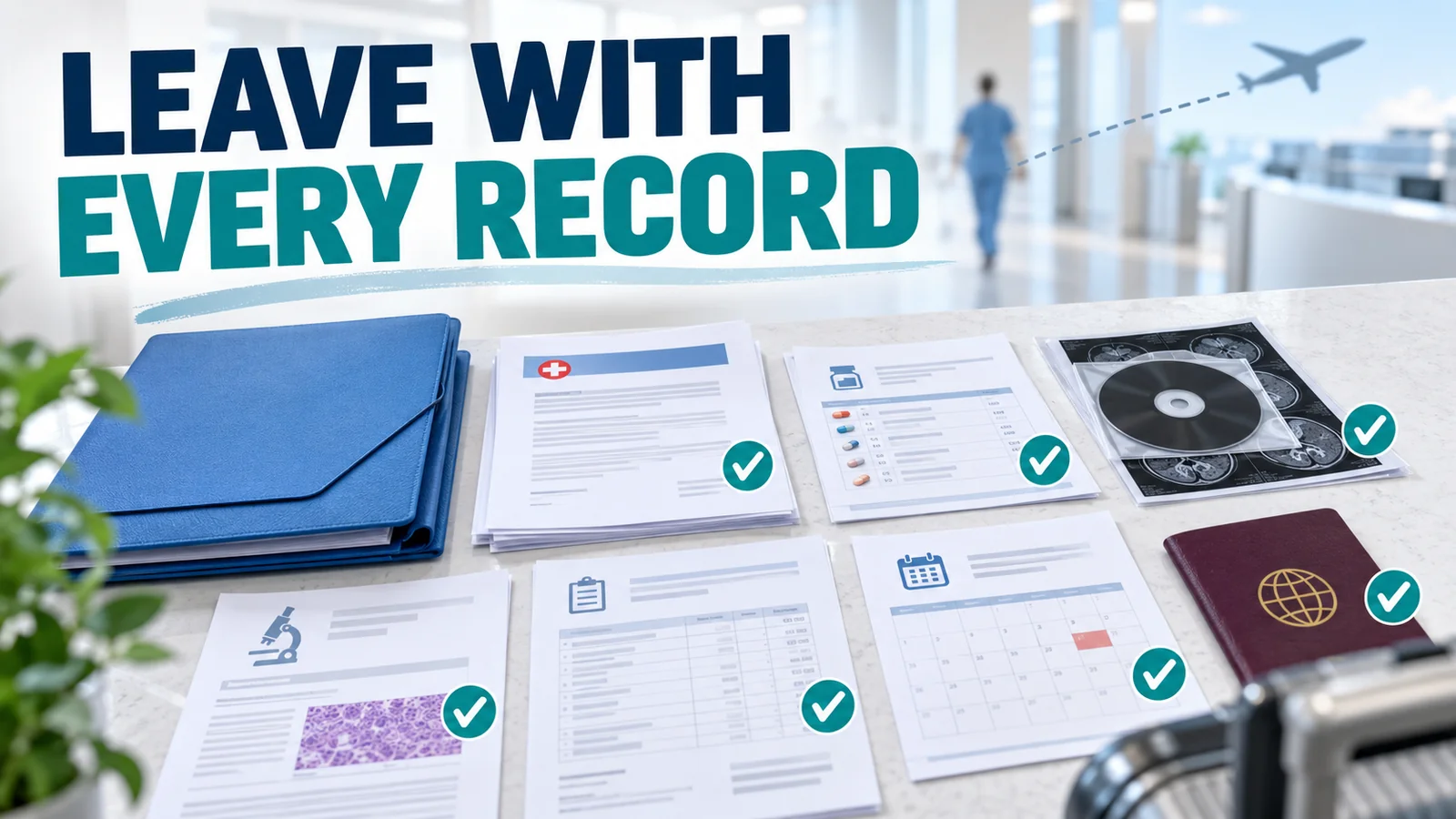
The Discharge Record Package to Collect
Request the documents relevant to your case before returning home. The package may include:
- Discharge summary with diagnoses, hospital course and condition at discharge
- Operative, procedure and anesthesia reports
- Pathology and laboratory reports, including instructions for pending results
- Imaging reports and DICOM files on disc or secure digital media
- A reconciled medication list and prescriptions with generic names and doses
- Implant, prosthesis or device details, including model information where available
- Wound, rehabilitation, diet and activity instructions
- Follow-up schedule and contact route for questions
- Itemized bill, official invoices and payment receipts
- Medical, sick-leave or travel documentation if clinically appropriate and requested
Check files before leaving. Confirm that the disc opens, the patient's identity is correct and every page is legible. Ask which documents can be provided in English and which require separate translation. CDC travel guidance advises patients to obtain copies of records before returning home because they support continuity and follow-up.
Plan the Handover to Care at Home
Identify the clinician or service that will continue care after the trip. Send the discharge summary, procedure report, pathology, imaging, medicine list and follow-up plan securely. Tell the home clinician about the entire medical trip and any complications.
Do not schedule a long flight or holiday activity solely around an optimistic discharge date. Recovery, pathology timing and travel fitness vary. Ask the treating team about mobility, blood-clot risk, infection precautions, oxygen needs and cabin travel in relation to the actual procedure and condition. Seek urgent local care for severe or rapidly worsening symptoms rather than waiting for an international reply.
Common Problems to Avoid
- Arriving at the wrong campus or service desk
- Bringing image screenshots instead of DICOM files
- Omitting supplements or occasional medicines
- Assuming insurance approval covers every charge
- Waiting until discharge day to request records
- Leaving without a plan for pending results or follow-up
- Booking a flight before discussing travel fitness
Frequently Asked Questions
Do international patients need a passport for hospital admission in China?
Hospitals commonly use a passport for identity verification, but requirements vary. Ask whether visa pages, copies, local contact details or an admission notice are also needed.
Will I need to pay a hospital deposit?
Many inpatient pathways request a deposit, but the amount, timing and settlement process vary. Obtain written instructions.
Can my insurance pay the hospital directly?
Possibly, when an applicable direct-billing arrangement and authorization exist. Confirm exclusions and any backup deposit with both the insurer and hospital.
Can a family member stay with me?
Rules differ by ward, room and infection-control requirements. Confirm visiting, overnight stay, identification and caregiver arrangements before admission.
Should I bring my regular medicines?
Bring an accurate list and, if requested, original packaging. Do not take personal supplies unless the hospital team has approved and recorded them.
Which records are most important before I fly home?
Prioritize the discharge summary, procedure report, pathology, imaging reports and DICOM files, laboratory results, reconciled medication list, prescriptions, follow-up plan, invoices and receipts. The exact package depends on your condition.
What if a pathology result is not ready at discharge?
Ask who is responsible for reviewing it, when it is expected, how it will be delivered, which language will be used and what action may follow. Record a named contact route rather than assuming no news means no problem.
When can I fly after hospital treatment?
There is no universal interval. It depends on the diagnosis, procedure, complications, mobility, oxygen needs and flight duration. Obtain patient-specific advice from the treating team and do not treat a discharge date as automatic clearance to fly.
Related MedToChina Resources
- China-ready medical records checklist
- Medical-care documents needed in China
- China hospital prepayment guide
- Language support in Chinese hospitals
- Medical clearance before treatment in China
Submit Your Information or Contact Us on WhatsApp
If you are planning non-emergency inpatient care in China, submit your diagnosis summary, key records, intended travel period, language needs and insurance information through MedToChina, or contact the service team on WhatsApp. The team can identify missing information and explain practical preparation steps after reviewing your submitted planning needs.
MedToChina does not provide a diagnosis through the website. Admission, treatment, payment and discharge decisions are confirmed by the receiving medical institution and licensed clinicians.
Medical Disclaimer
This article provides general educational and travel-preparation information. It is not medical advice, diagnosis, financial advice or a treatment recommendation. Hospital rules, admission criteria, deposits, insurance arrangements, caregiver policies, document formats and discharge processes vary. Confirm all arrangements directly with the relevant medical institution and insurer. Seek urgent local medical care for an emergency or rapidly worsening symptoms.
References
- Beijing Municipal Government. Medical Guide for Foreigners in Beijing.
- World Health Organization. Communication During Patient Hand-Overs.
- World Health Organization. Medication Safety in Transitions of Care.
- Agency for Healthcare Research and Quality. How To Deliver the Re-Engineered Discharge to Diverse Populations.
- Agency for Healthcare Research and Quality. Teach-Back.
- U.S. Centers for Disease Control and Prevention. Medical Tourism: Travel to Another Country for Medical Care.