
General
CT Scanner Announcements in China: Verifying the Site and Service Behind the Headline
Learn how to verify a CT scanner announcement in China: check the exact campus, department, current service status and official contact.
MedToChina Editorial Team · 10 min read · November 14, 2026

Quick Summary
A news item, social-media post, vendor release, or hospital page about a CT scanner can be useful starting information. It is not, by itself, proof that the exact hospital campus provides a particular CT examination, accepts overseas patients, has a current appointment opening, or considers that examination appropriate for one person.
For international patients considering medical travel to China, separate four questions: who published the announcement, where the scanner was installed, whether it has entered the relevant clinical service, and which department can confirm the current administrative route for an inquiry. Save the original link and publication date, then ask narrow questions through an official hospital contact channel.
This guide verifies public information; it does not recommend CT, interpret images, determine need, or promise availability, cost, or results.
Why a CT announcement needs more than one check
Like medical research headlines, equipment announcements often compress several stages into a short headline: a purchase, delivery, installation, opening ceremony, technical acceptance, commissioning, or a broader radiology investment. Those stages are meaningful, but they are not interchangeable.
Hospital groups may use one name across several campuses. A post can identify the group but not the building or the current intake route.
That distinction matters because CT is not a generic travel service. The U.S. Food and Drug Administration describes CT as an X-ray imaging examination used for different diagnostic and treatment-related purposes, with both potential benefits and radiation-related considerations. 1 A public announcement cannot determine whether a scan is clinically appropriate for an individual or what protocol a clinician would choose.
Turn one broad claim into a dated record of the institution, campus, department, and administrative contact.
Separate the four layers of a public claim
Start by copying the wording of the source exactly. Then classify the claim before drawing a conclusion.
- Manufacturer or distributor news: A commercial relationship, delivery, installation, demonstration, or product milestone may have been announced. Does not establish: That the named scanner is currently in clinical use at a particular campus, or that patients can obtain a specific examination.
- Hospital news or official social post: The hospital may describe a project, new device, opening, or service-development milestone. Does not establish: That every campus in the group has the equipment, that all protocols are available, or that a patient will be accepted.
- Exact campus and radiology department page: The location and department may be identifiable from an official source. Does not establish: The current schedule, referral requirements, price, contrast eligibility, or clinical suitability.
- Written reply from the responsible department: A current administrative answer can clarify the relevant campus, contact route, and whether a named service is handled there. Does not establish: A medical recommendation, booking, or commitment before records and local procedures are reviewed.
Write down which layer you have. For example, “vendor press release dated 12 May” is different from “hospital radiology department replied on 20 May that this campus handles CT inquiries through this official channel.” Do not silently upgrade the first into the second.
A device may be present before a service is ready to discuss
New imaging equipment usually requires more than delivery. International Atomic Energy Agency guidance distinguishes acceptance testing and commissioning from clinical use. It explains that, after acceptance and before patients are scanned, commissioning should be performed under appropriate professional supervision and includes validating expected clinical-use conditions and acquisition protocols. 2
This does not mean a patient should try to audit a hospital's technical work. It explains why a phrase such as “installed,” “launched,” or “unveiled” should not be treated as a universal statement about every clinical workflow. The hospital is the appropriate source for current, patient-facing administrative information.
Avoid asking a general question such as, “Do you have the newest CT?” A more useful question is: “Does the radiology department at the [exact campus] currently handle administrative inquiries for the CT examination category named in this announcement? If so, which official route should an overseas patient use to send records and questions?”
The answer may be yes, no, not confirmed, or dependent on the clinical question. None should become a claim about superiority, dose, wait times, or results.
Step 1: Preserve the announcement before it changes
Create a one-page source note with:
- the headline and full URL;
- publisher and source type;
- publication and access dates;
- institution, campus, department, and scanner wording exactly as stated; and
- every official hospital link or quoted source.
Keep the live URL with any screenshot. A repost or image caption is not service confirmation; find the original hospital or manufacturer page where possible.
Step 2: Identify the exact institution and campus
Large hospitals and university-affiliated systems can use one English name across several sites. Before sending records, identify the campus in the announcement and compare it with the hospital's current official contact page.
The National Health Commission's public service platform provides institution and health-personnel information-query routes, and the NHC states that basic registration information can be made available for public inquiry. 3 4 These resources can help distinguish an institution from a similarly named organization. They do not show whether a particular device is in use for your intended examination.
Record the following separately:
- Legal or official institution name, preferably in Chinese and English where available.
- City and full campus address.
- Hospital group name, if it differs from the campus name.
- Department name in the announcement and the department shown on the current hospital site.
- Official telephone, patient-service email, form, or verified website route.
If the announcement says only “Hospital X” and the official site lists three campuses, mark the campus as not stated. Do not choose the nearest one on a map. Ask the hospital which campus the notice refers to and whether that is the correct location for the type of inquiry you are making.
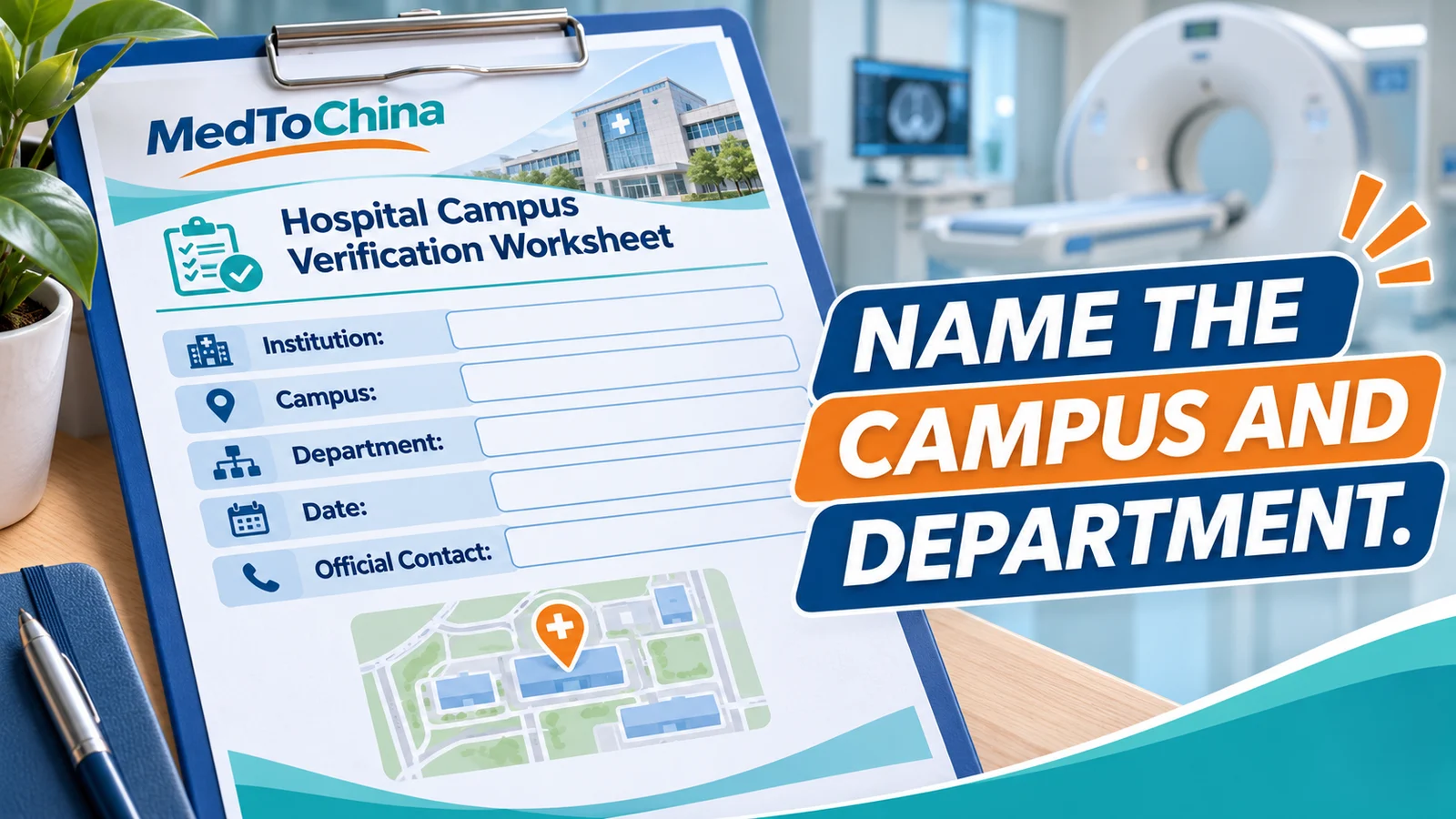
Step 3: Check the department, not only the hospital brand
Once you have an exact campus, check the department named in the announcement. Do not assume one scanner supports every department or pathway.
Use the hospital's official department page or patient-service channel to ask factual administrative questions:
- Which campus and department does this announcement refer to?
- Is this the current official department for questions about the examination category mentioned?
- What official channel should an overseas patient use to submit existing records and a question?
- Does the department require an order, referral, prior images, a report, translation, or other documents before it can explain an administrative next step?
- Is there a page where the hospital publishes current patient preparation information or service updates?
Do not ask the communications office, a vendor salesperson, or a social-media account to decide whether you need CT or which protocol you should receive. They may be able to direct you to an official hospital channel, but clinical decisions require the appropriate local process.
Step 4: Ask what “available” means in this case
The word “available” can hide several different questions. Clarify which one you mean.
- Is the device located at this campus? It confirms geography, not a patient pathway.
- Is the relevant department the one that handles inquiries? A hospital can have multiple imaging-related units.
- Is a given type of CT examination listed or administratively handled there? A device name does not prove every protocol or use case.
- What information is needed before an inquiry can be routed? Record requirements differ by situation and may change.
- What is the current patient-service contact route? A current contact route is not the same as a booking confirmation.
This approach is especially important when an announcement uses broad terms such as “advanced,” “high-end,” “AI,” “whole-body,” “screening,” or “precision.” Marketing language is not a clinical indication. The FDA notes that CT involves ionizing radiation and that radiation exposure and the use of contrast material may matter in an individual situation. 1 A device article should not be used to self-select an examination.
Step 5: Keep a confirmation log, not a collection of headlines
Use a simple log while you research. It protects you from mixing dates, campuses, and sources.
For each dated entry, record whether the exact campus and department are named (Yes / No), what was confirmed, and what remains unknown:
- Manufacturer, hospital, or news page: Quote only what the source says. Unknown: Service status, contact route, or requirements if absent.
- Official hospital page: Current location or department information. Unknown: Whether it applies to your records.
- Official hospital reply: Administrative route and current contact point. Unknown: Clinical appropriateness, timing, price, final acceptance.
Keep the original wording in the log. For instance, “installation announced” should stay “installation announced,” not become “clinical scanning confirmed.” If the hospital reply conflicts with a news item, date both items and follow the current official hospital clarification for the next administrative step.

Common mistakes to avoid
Confusing a hospital group with one site
A group may operate several campuses in one city or across cities. The fact that a group published an announcement does not place the equipment at every location. Confirm the address and responsible department in writing.
Sharing records through an unverified channel
Do not send imaging files, identity documents, or payment information to a personal account simply because it reposted a hospital announcement. Begin with the hospital's official website or contact route. If a third party provides a contact, independently verify it with the hospital before sharing sensitive records.
Treating technical language as a care plan
A model name or promotional label cannot determine whether CT is indicated, what protocol may be used, or what outcome to expect. A device page is not an appointment confirmation; only a current official hospital contact can explain the next administrative step.
What MedToChina can help organize
MedToChina can receive your existing reports, image-file information, the announcement link, the hospital and campus you are researching, your country of residence, intended travel period, language needs, and practical questions through the website or WhatsApp. This helps make the later service conversation more specific.
The service team can discuss practical preparation and available cooperation-resource processes after understanding your records and travel needs. This page does not determine whether CT is needed, select a provider automatically, confirm a service, or provide a clinical assessment.
FAQ
Does a hospital CT announcement prove the scanner is ready for patients?
No. An announcement may describe purchase, installation, a launch event, or another milestone. Check the exact campus, department, and current official patient-service route before treating it as operational information for an inquiry.
Can I choose a hospital in China based on a CT model name?
No. A model name is not a recommendation and cannot determine whether an examination is appropriate, what protocol may be used, or what care may follow. Start with your records and a factual inquiry through an official channel.
What should I send when asking about a CT-related service?
Use the official hospital route and send only what it requests. You may first ask which existing reports, images, translations, identity details, and referral materials are needed for an administrative inquiry. Do not send sensitive files to an unverified contact.
What if the article does not name a campus?
Mark the campus as unknown. Ask the hospital to identify the site and responsible department in writing. Do not assume that the campus nearest your accommodation or the hospital's headquarters is the location in the announcement.
Does a confirmed department reply mean I have an appointment or that CT is appropriate?
No. It can clarify an administrative contact route. It is not a booking confirmation, price quote, or clinical recommendation.
Discuss Your China Medical-Travel Questions
If you are considering care in China and have seen an equipment announcement, submit your basic information and existing records through MedToChina or send your questions by WhatsApp. Include the original link, the hospital and campus named, your current reports or image-file details, intended travel period, and the administrative points you want clarified. We can help organize the practical information for the next service conversation.
Medical Disclaimer
This article is for general information and administrative preparation only. It is not medical advice, a diagnosis, an imaging recommendation, a referral, a booking confirmation, or a statement that a hospital, department, device, clinician, or service is suitable or available for any individual. CT involves clinical and radiation-safety considerations. Discuss medical decisions with a qualified clinician and seek timely local care for urgent symptoms.
References
- U.S. Food and Drug Administration, Computed Tomography (CT).
- International Atomic Energy Agency, Radiation Protection and Safety in Medical Uses of Ionizing Radiation, sections on acceptance, commissioning and clinical use.
- National Health Commission of the People's Republic of China, Public Service Information Queries.
- National Health Commission of the People's Republic of China, Electronic registration system functions and features.