
General
Before Sharing Medical Research News About China: Checking Corrections and Retractions
Learn how to trace the original paper behind medical research news about China, check correction or retraction notices, and keep research claims in context.
MedToChina Editorial Team · 10 min read · November 21, 2026
Quick Summary
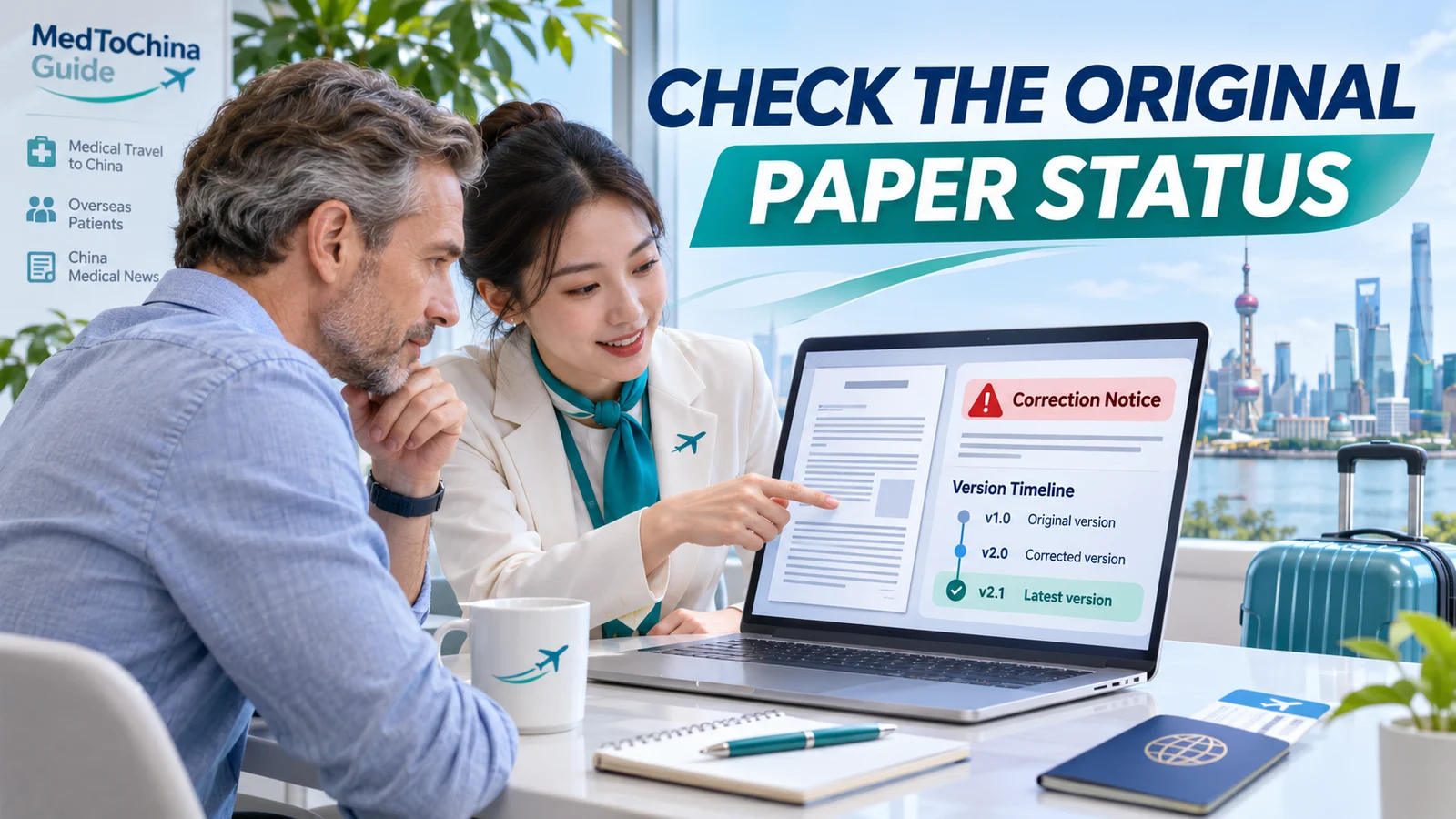
- A news story about a medical study in China is not the study itself. Find the original paper or official record before treating a headline as evidence.
- Use the paper's title, authors, journal, publication date, and DOI to reach the publisher page. Then check for linked correction, expression-of-concern, retraction, or version notices.
- A correction does not automatically mean the research is false. A retraction does not prove wrongdoing by every person associated with a field. Read the notice and avoid adding claims that it does not make.
- A missing notice on one website does not prove that there has never been an update. Record what you checked, when you checked it, and what source you used.
- Research news cannot determine an individual treatment plan, whether a service is available in China, travel suitability, cost, timing, or outcome. Clinical questions belong with the treating medical team.
Why the original paper matters more than the headline
Medical news can travel faster than medical context. A headline may say that a study from China “changes treatment,” “proves a breakthrough,” or “shows a major benefit.” The article may be based on a conference abstract, press release, preprint, registry update, or a peer-reviewed paper. These sources have different levels of detail and can change over time. Our research-news and study-stage guide explains the separate question of how far a study has progressed.
For an overseas patient considering medical care in China, the practical goal is not to become a researcher overnight. It is to avoid making a travel or treatment decision from a short summary that leaves out the paper's population, study design, limitations, comparison group, or later updates.
Start by locating the original source. If the source is a journal article, its publisher page is usually the best place to identify the current version and any formal linked notice. Crossref's guidance on versioning explains that publishers can register updates such as corrections and retractions for scholarly records. 1
First, identify exactly what you are reading
Before searching, copy the claim as it appears. Then separate the parts:
- What medical condition, test, device, drug, procedure, or service is mentioned?
- Does the story name a paper, conference, hospital, university, journal, or researcher?
- Is the claim about an early study, a clinical trial, a real-world report, or a general announcement?
- What outcome is being described, and over what period?
This prevents a common mistake: finding a related paper and treating it as the source of the headline. Similar titles can refer to different patient groups, dates, versions, or endpoints.
The core record: title, journal, and DOI
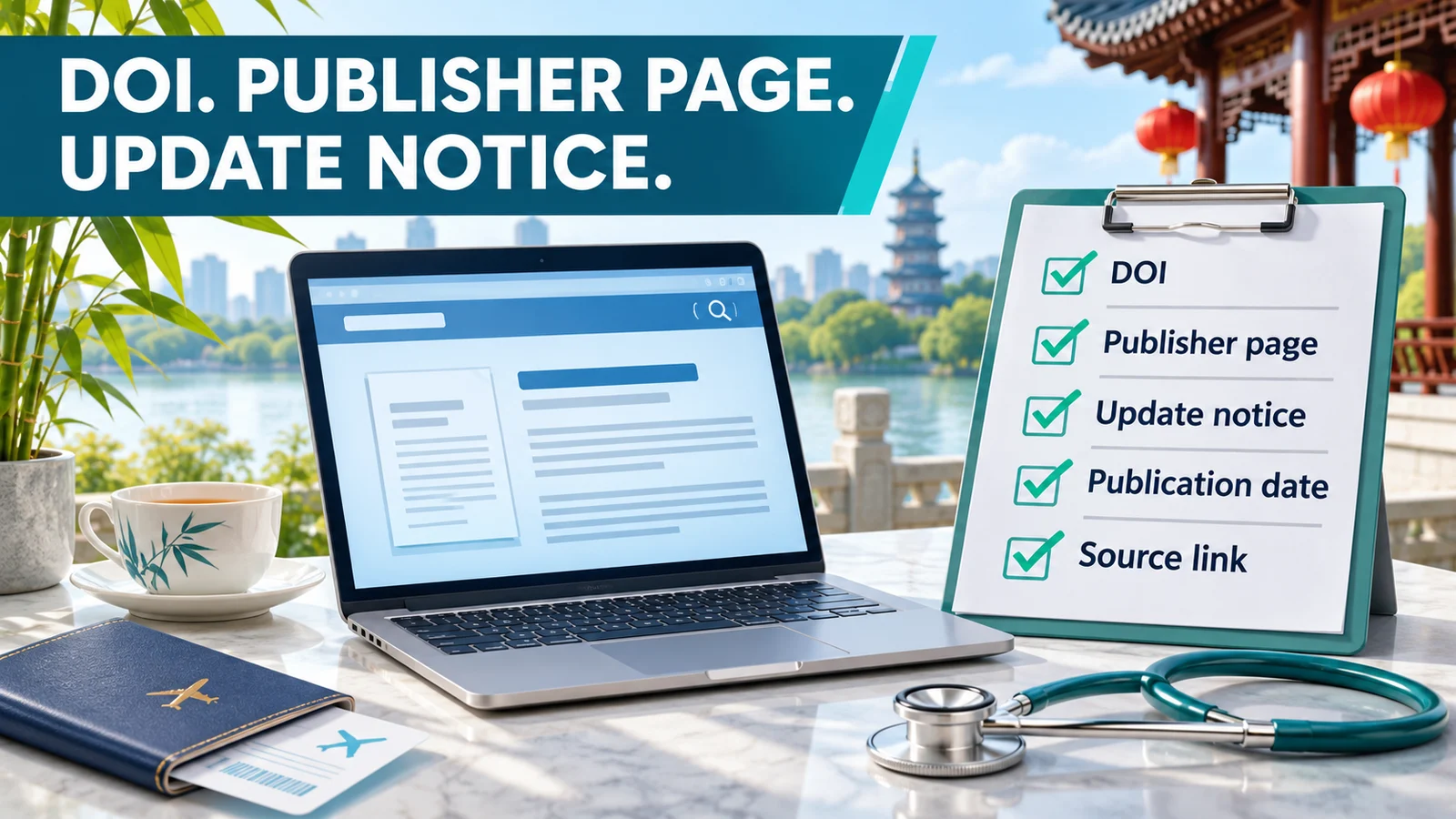
A DOI, or digital object identifier, is a persistent identifier often shown as a string beginning with `10.`. It can help connect a news report to a publisher page and related scholarly metadata. Search using the DOI if you have it. If not, search the exact paper title in quotation marks together with the journal name or first author.
On the paper page, record:
- Full title and journal name.
- Authors and affiliations as shown on that version.
- Publication, online-first, and update dates where available.
- DOI or another stable identifier.
- Article type: full paper, review, editorial, correspondence, abstract, preprint, or correction notice.
Do not infer that an author affiliation means a particular China hospital offers the discussed care to international patients. Research affiliation, research participation, and current clinical availability are separate questions.
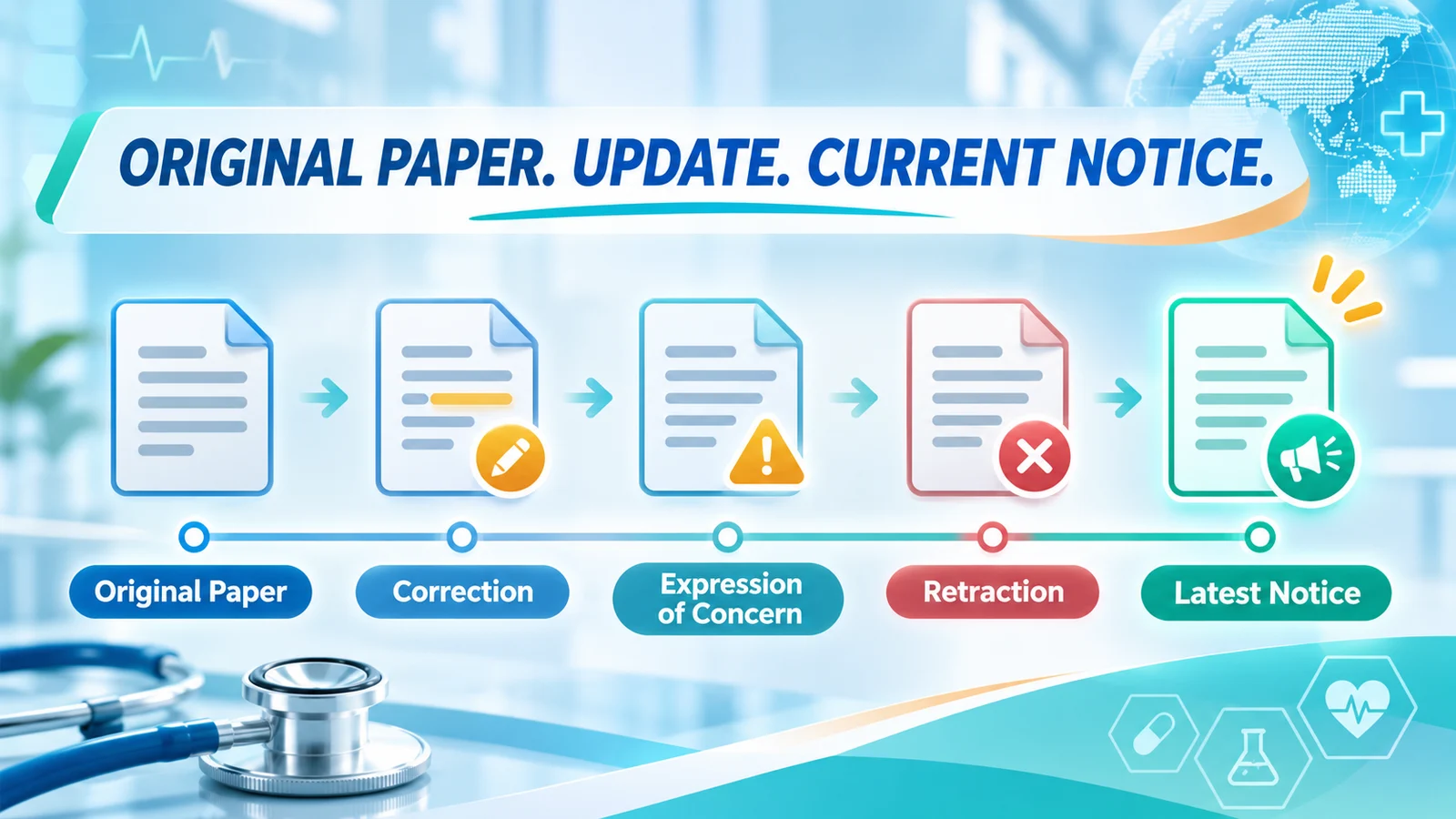
*Illustrative update labels, not a required sequence. A correction does not necessarily lead to an expression of concern or retraction.*
Understand the common update labels
Correction or erratum
A correction generally identifies an error or omission in a published record. It may concern a figure, table, author detail, wording, data presentation, or another issue. The impact can range from minor to substantial. Read the correction notice and the updated article, rather than assuming either that nothing changed or that the entire study is invalid.
Expression of concern
An expression of concern is a notice that a publisher has raised or is examining serious questions about a paper. It is not the same as a final conclusion about the research. Treat the underlying claim as uncertain while you read the notice and seek professional interpretation where relevant.
Retraction
A retraction is a formal notice that a published article should no longer be treated as part of the reliable scholarly record in the usual way. The accompanying notice may explain the reason, but its wording matters. Do not turn a retraction into an unsupported accusation against a clinician, a hospital, a specialty, or healthcare in China generally.
Updated or corrected version
Some publishers maintain version histories, linked notices, or updates on the article page. Read the most current record and note whether the link refers to the article itself, a correction, a related commentary, or an entirely different paper.
A patient-friendly check process
Step 1: Follow the claim back to its source
Open the article, press release, or post that prompted your interest. Look for a direct link, paper title, DOI, journal name, or named study. If none is provided, label the claim “source not located” rather than trying to supply a source from memory.
Step 2: Find the publisher page
Use the DOI resolver, the journal website, or a reliable bibliographic record to find the publisher's page. A search-engine summary can be useful for navigation but is not the final record. Confirm that the title and publication information match the claim you started with.
Step 3: Look for notices and linked items
Check the page for terms such as correction, erratum, corrigendum, expression of concern, retraction, update, version, or Crossmark. Review linked notices separately. An update can be published later than the original paper, so do not stop at the original publication date.
Step 4: Read what the notice actually says
Write down the notice type, date, and stated reason in neutral language. If the reason is not clear, do not invent one. A correction is not automatically a retraction; a retraction is not automatically evidence about every related service or professional.
Step 5: Check the claim against the study details
Does the headline use the same population, endpoint, time period, and comparison as the original study? Does it turn a limited finding into a wider promise? Does it omit uncertainty, small sample size, or later updates? When a story quotes a percentage, the absolute and relative risk guide can help you frame questions about the denominator and timeframe. If the answer is unclear, keep the claim as unverified.
Questions to ask when news influences a China-care search
Research can give you questions to ask, but it should not become a shortcut to a clinical decision. You might prepare:
- What is the exact original paper or DOI behind this news item?
- Does the publisher page show a correction, concern, retraction, or newer version?
- What patients, intervention, comparison, and outcomes did the paper actually study?
- Is the claim about research evidence, or does it claim current clinical availability in China?
- What records would a treating team need before discussing whether any topic is relevant to me?
For someone planning travel, add practical questions about location, records, language, follow-up, and whether local clinicians need to be involved. Use the China-ready medical records checklist to organize supporting files alongside those questions. A news item cannot answer these questions by itself.
What not to conclude from a status notice
Avoid three shortcuts. First, do not assume a correction makes every result meaningless. Second, do not assume no visible notice means a claim is established or suitable for you. Third, do not use a notice about one paper to make a broad allegation about an institution, researcher, specialty, or country.
Research evolves through replication, peer review, correction, and debate. For the separate task of checking clinical recommendations, see our guidelines and expert consensus source-check guide. For patient decision-making, that means keeping claims proportionate to the actual source and asking a treating medical team to interpret relevance to an individual record.
How MedToChina can help organize questions
MedToChina can help international patients organize non-clinical questions, keep source links with their records, and discuss possible communication steps for care in China. You may submit your information or send medical records and questions through WhatsApp. After understanding your condition, records, country preference, budget, and timeline, customer service can discuss possible China hospital resources and next communication steps.
This support does not verify research as clinical advice, interpret a paper as a personal treatment recommendation, or promise that a research topic is available, appropriate, or effective for you. Treating medical teams make clinical assessments and decisions.
Keep a simple verification note
You do not need a complex spreadsheet to keep a claim in context. For each item, make a short note with the news headline, original-paper title, DOI or stable link, publisher page, the date you checked, and any notice you found. Add a separate line for what the study actually examined and a separate line for what the news story claimed. This separation makes exaggeration easier to spot.
If a family member, interpreter, or care coordinator is helping, share the original link rather than only a screenshot. Screenshots may omit the URL, date, notice link, or text that explains an update. If access is limited by a publisher paywall, you can still record the citation, DOI, abstract page, and visible notices; lack of full-text access does not authorize guessing about the methods or results.
For a research story connected to a possible China-care inquiry, keep the note with your questions rather than with a final conclusion. A patient can ask whether a topic is relevant to their situation, while allowing the treating team to explain evidence limits, current practice, and alternatives. This is more useful than asking for a promise based on a single paper.
FAQ
Is a corrected medical paper unreliable?
Not automatically. Read the correction and updated record. The importance depends on what was corrected and how it affects the relevant claim.
Does a retraction show that all work from China on that topic is invalid?
No. A notice concerns a specific published record. It should not be used to make broad claims about a country, institution, specialty, or unrelated research.
What if I can find a news article but no original paper?
Keep the claim as unverified. Ask for the paper title, DOI, journal page, or official source before relying on it in a care decision.
Is a preprint the same as a published paper?
No. A preprint is generally a manuscript shared before or outside formal journal publication. Identify it clearly and do not describe it as peer-reviewed unless the source confirms that status.
What should I send through WhatsApp?
You can send the research-news link, original paper link or DOI, the questions you want to clarify, and records you are comfortable sharing for coordination. Do not send passwords or one-time verification codes.
Discuss Your Questions Through WhatsApp
Want to organize questions about a medical research story before considering care in China? Send your records or questions through WhatsApp, or submit your information. MedToChina can help keep your non-clinical questions and source links organized for the next communication step.
Medical Disclaimer
This article is general information only. It is not medical advice, a research-quality rating, a diagnosis, or a treatment recommendation. It does not establish the availability, suitability, safety, price, timing, or outcome of care in China. Do not change treatment based on research news; seek urgent local care for urgent or worsening symptoms.
References
- Crossref. Versioning: best practices. Accessed November 21, 2026.