
General
Expert Interviews About Medical Care in China: Who Sponsored and Edited Them?
Learn how to read expert interviews about medical care in China by checking the speaker, publisher, sponsor, editing disclosure, date, and evidence links.
MedToChina Editorial Team · 9 min read · November 13, 2026
Quick Summary
- An expert interview can introduce useful questions, but it is not a personal medical assessment, a provider recommendation, or proof that a service is suitable for you.
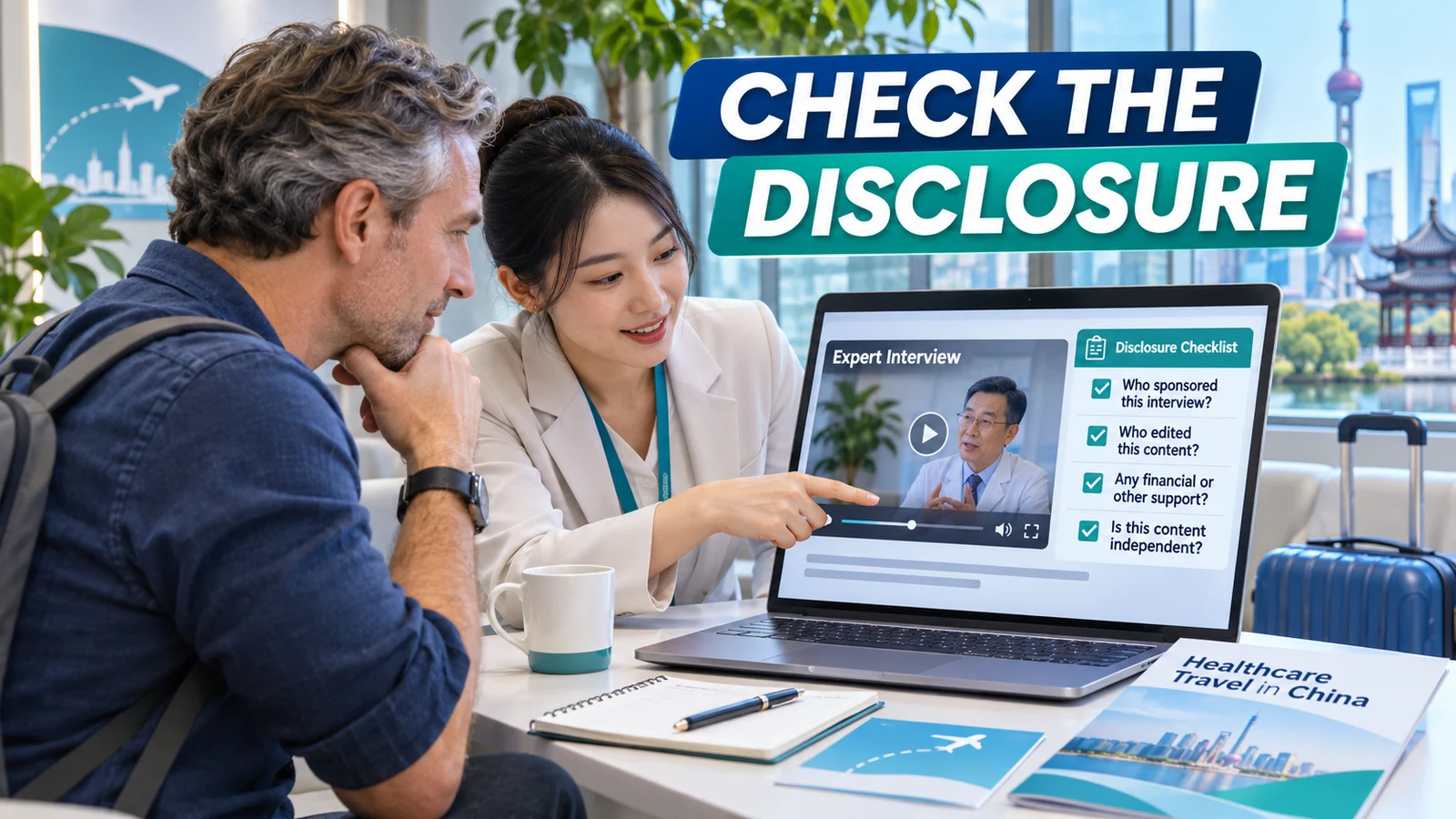
- First identify the speaker, their role at the time of recording, the publisher, the production company, and any named funder or commercial partner.
- Look for sponsorship, paid partnership, travel support, editorial-control, and conflict-of-interest disclosures near the interview itself, not only on a profile page.
- A disclosed relationship does not automatically make an interview unreliable. An absent disclosure does not prove misconduct. Record what is stated, what is not stated, and what evidence supports the clinical claims.
Why an expert interview needs context
When researching medical care in China, overseas patients may encounter interviews with surgeons, physicians, hospital leaders, researchers, or patient advocates. These can be long videos, short clips, podcasts, articles, event panels, or social-media posts. A qualified speaker may explain a condition, a procedure, a research area, or a practical question about care in China.
An interview is still a produced piece of communication. Someone selected the subject, invited the speaker, filmed or recorded the conversation, edited it, wrote the headline, chose excerpts, and decided where to publish it. A hospital, health company, tourism organisation, media outlet, conference, or agency may have funded or organised part of that process.
This does not mean the speaker is dishonest or the information is useless. It means viewers should know enough about the production context to judge what the interview can and cannot establish. The aim is fairness: do not turn a disclosure into an accusation, and do not treat a polished interview as independent clinical evidence just because it uses an expert title.
For a person considering travel to China for treatment, an interview may help generate questions for later discussion. It should not be used to diagnose a condition, choose a procedure, infer individual access, or assume a specific hospital or doctor will be suitable or available.
Separate the five roles in every interview
Start by separating roles that are often blended together:
- Speaker: Who is speaking, and what is their stated clinical, academic, or organisational role?
- Publisher: Which website, channel, journal, hospital, or media organisation posted the interview?
- Producer: Who recorded, edited, translated, or packaged the content?
- Sponsor or partner: Is any funder, paid partner, advertiser, event organiser, or travel supporter named?
- Editorial decision-maker: Who chose the topic, questions, clips, headline, and final version?
An interview may have the same organisation in several roles. For example, a hospital could host an event, provide the speaker, publish the clip, and pay an agency to produce it. That arrangement may be openly described, partly described, or not described. The task is to document the information that is visible, not to guess at an undisclosed arrangement.
Record the page title, direct link, publisher name, upload date, speaker name as written, credentials as stated, and any description of funding or editorial involvement. Save a PDF, screenshot, or archive link where permitted, because titles, descriptions, and disclosure labels can change.
Where to look for sponsorship and editing disclosures
Read beyond the video or article title. Check:
- the first lines of the video description or article;
- an on-screen label at the beginning and end;
- captions, pinned comments, show notes, and linked event pages;
- the publisher's “about,” advertising, funding, or editorial-policy pages;
- acknowledgements, partner logos, production credits, or travel-support statements; and
- a correction or update notice.
The U.S. Federal Trade Commission's influencer guidance emphasizes that a required disclosure should be clear, easy to notice, and placed with the endorsement rather than hidden behind a profile page or “more” link. The legal rules that apply will vary by country and platform, but the practical reading habit is broadly useful: a viewer should be able to find a material relationship without detective work.
The Society of Professional Journalists similarly advises distinguishing news from advertising and labelling sponsored content prominently. These are editorial principles, not a verdict on any individual interview. They provide a useful standard for asking whether a viewer can tell what was independently reported, what was promotional, and what remains unclear.

Use precise labels instead of assumptions
Use the strongest label that the source supports, and no stronger.
- “Sponsored”: use when the source itself says the interview, post, event, travel, or series was sponsored, paid for, or produced in partnership.
- “Published by a hospital”: use when the hospital is plainly the publisher, even if no payment arrangement is stated.
- “Produced by an agency”: use when production credits identify an agency or production company.
- “Disclosure not found in reviewed materials”: use when you checked the interview page and linked disclosure pages but found no statement. This is not the same as “there was no sponsorship.”
- “Editorial relationship not stated”: use when it is not clear who controlled questions, edits, or final approval.
Avoid labels such as “biased,” “paid doctor,” “independent,” or “advertisement disguised as news” unless an authoritative source directly supports the claim. A financial or professional relationship can be relevant without proving that a clinician's explanation is wrong. Conversely, a speaker's qualifications do not remove the need to check sources and context.
The International Committee of Medical Journal Editors explains why transparency matters in scientific publication: relationships and activities may be relevant to readers' judgments, while their presence does not automatically demonstrate improper influence. That distinction is useful when reading public-facing health interviews too.
Check the expert identity without overclaiming
An interview title may use terms such as “leading specialist,” “professor,” “chief,” “international expert,” or “world-class.” Treat these as descriptions to verify, not as clinical proof.
Check whether the interview states:
- the speaker's specialty and scope of practice;
- the hospital, university, research centre, or organisation named;
- their role at the time of recording;
- the recording date;
- whether the topic is clinical care, research, administration, or commentary;
- links to an institutional biography, publication, guideline, registry, or paper; and
- whether the speaker discusses an individual case or speaks generally.
Use the original institution's current public page for role verification where possible. Roles can change, and an old event page may not reflect a current position. Do not infer that an institution endorses every view in an interview merely because it lists the speaker.
For an overseas patient, an interview does not confirm that the speaker personally provides a service, accepts international cases, works at a given campus, speaks a particular language, or will be available during your travel window. Those are separate questions for later communication.
Test the medical claim separately from the production context
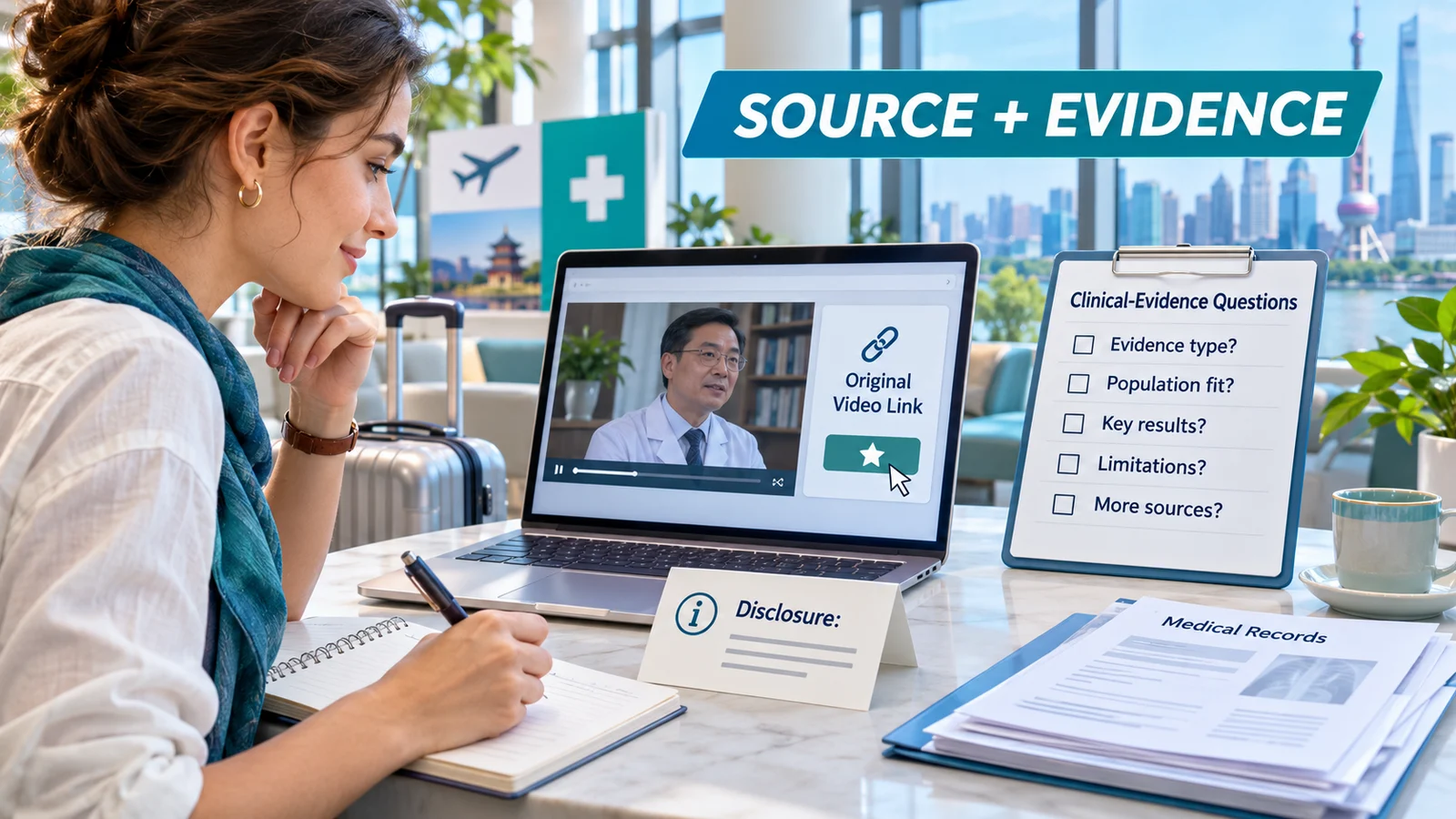
An interview can be transparent about sponsorship and still contain a claim that needs evidence. Keep two columns in your notes:
- Production context: Who published it? Who funded or produced it? Who edited it?
- Clinical support: What exact medical claim is made? Is a guideline, systematic review, registry, regulator, or peer-reviewed source linked?
For a claim about diagnosis, procedure safety, success, recovery, costs, or access in China, look for a source that matches the claim. A general expert opinion is not interchangeable with a clinical guideline. A hospital marketing page is not the same as peer-reviewed evidence. A research paper may be useful, but it may not establish that a service is available to international patients now.
If a video gives only a broad statement, write it as a question rather than a fact. For example: “The interview says this approach may be used for selected patients. What guideline or study does it cite, and what selection criteria does it describe?” This preserves the value of the interview without converting it into a treatment recommendation.
A practical review checklist
Before relying on an interview in your China-care research, save this checklist:
- Original link and date: What did you view, and when was it uploaded or updated?
- Speaker identity: What role and institution are stated? Is there a current institutional page?
- Publisher and producer: Who posted and who created the piece?
- Sponsorship: Is paid support, partnership, travel support, or an event sponsor disclosed?
- Editorial role: Does the source explain who selected questions, edited the material, or approved the final version?
- Claim log: What exact statements concern medical care, and what sources are linked?
- Limits: What does the interview not establish about your condition, travel, costs, or access?
- Follow-up question: What record, guideline, or original source would clarify the point?
This approach is particularly useful when a short video is reposted across multiple channels. Reposts can remove original captions, disclosures, dates, and links. Whenever possible, return to the earliest identifiable publication rather than relying on a clipped version.
How MedToChina can help
MedToChina can help overseas patients organise records, questions, and source links before discussing possible care pathways in China. Send the original interview, the claim you want clarified, and your medical records or questions through WhatsApp. Our customer-service team can discuss possible China hospital resources after understanding your condition, budget, timeline, country preference, and available records.
We do not use an interview to make clinical conclusions from your records, promise access to a particular clinician, or make a clinical recommendation. Hospital and doctor resource discussions take place through customer-service follow-up after the relevant information is understood.
FAQ
Does “sponsored” mean the interview is false?
No. Sponsorship is production context, not proof that a claim is false. It tells you to read the disclosure and verify the medical claims independently.
What if no disclosure appears?
Record “disclosure not found in reviewed materials.” Do not claim there was no relationship or accuse the speaker or publisher of misconduct without evidence.
Is a hospital-published interview independent?
It is best described as hospital-published unless the source explains a separate editorial arrangement. Check the publisher, producer, and editorial policy rather than assuming either independence or improper influence.
Can I use an interview to choose a doctor or hospital in China?
No. An interview is not a personal suitability assessment or a promise of availability. Send your records and questions through WhatsApp to discuss possible care pathways in China.
What evidence should I look for after watching an interview?
Look for the original guideline, peer-reviewed paper, registry record, regulator information, or formal hospital service information that supports the specific claim.
Discuss Sources and Questions Through WhatsApp
If you are reviewing an expert interview about medical care in China, submit the original link, your notes, medical records, and questions to MedToChina or contact us on WhatsApp. We can support information organisation and communication preparation for overseas patients considering care in China.
Medical Disclaimer
This article explains how to assess disclosure and production context in health-related interviews. It is not medical advice, diagnosis, treatment advice, legal advice, advertising-law advice, or a guarantee of access to medical care in China. Seek appropriate local clinical care for urgent symptoms.
References
- U.S. Federal Trade Commission. Disclosures 101 for Social Media Influencers.
- U.S. Federal Trade Commission. Endorsement Guides: What People Are Asking.
- Society of Professional Journalists. SPJ Code of Ethics.
- International Committee of Medical Journal Editors. Disclosure of Financial and Non-Financial Relationships and Activities.