
Treatments
Gastritis Evaluation in China: H. pylori Tests and Previous Endoscopy Records
A records checklist for international patients preparing for gastritis evaluation in China, including H. pylori test history, endoscopy reports, pathology, and prior medicines.
MedToChina Editorial Team · 9 min read · November 4, 2026
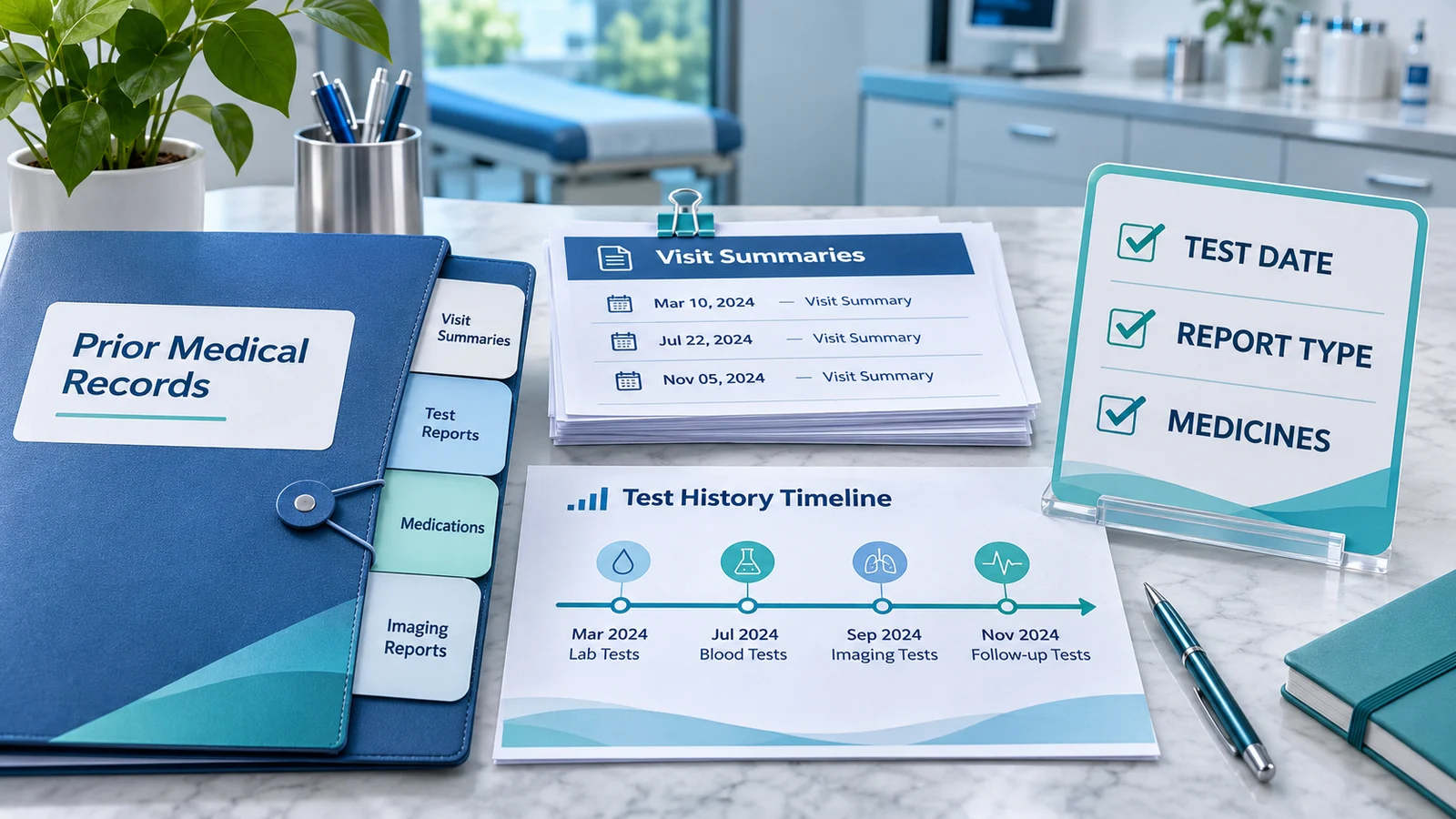
Quick Summary
- For a gastritis-related evaluation in China, prepare a dated history of prior *H. pylori* tests, endoscopy reports, pathology reports, medicines, and follow-up advice.
- Record the type and date of each test exactly as shown in the report. Do not interpret a positive or negative result yourself or compare results from different methods as if they were interchangeable.
- Keep the full endoscopy report, photo sheet if available, pathology report, and any recommendation or discharge summary together.
- List previous medicine courses with names, doses as prescribed, start and stop dates, allergies, and the reason documented for a change. Do not stop a medicine or plan a retest based on this article.
- Vomiting blood, black stools, fainting, severe or worsening abdominal pain, or another urgent concern needs prompt local care, not travel coordination.
“Gastritis” is often used as a broad term in conversation, on a report, or after an episode of upper abdominal discomfort. It does not mean that every patient has the same underlying finding, risk, test result or next step. For an international patient preparing for a gastroenterology evaluation in China, the most useful contribution is not a self-selected treatment plan. It is a clear record of what has already been investigated and what remains unknown.
This guide helps patients organize prior *Helicobacter pylori* (often written *H. pylori*) test history, upper-endoscopy records, pathology reports and medicine information. It does not determine whether someone has active infection, interpret an endoscopy image, choose an eradication regimen, advise a medicine pause, or set a follow-up interval.
Why the Method and Date of an H. pylori Test Matter
An *H. pylori* result is more meaningful when the receiving clinician can see how and when it was obtained. Reports may refer to a breath test, stool antigen test, biopsy-based test, serology, or another laboratory method. The American College of Gastroenterology describes breath, stool and biopsy-based testing among approaches used in appropriate clinical contexts.[^1]
Copy the exact test name, specimen if stated, collection date, report date, laboratory or hospital, and result wording. Add medicines taken around the test only when documented or reliably known. If two results appear different, preserve both reports. A discrepancy may reflect timing, method, treatment history, documentation, or another factor requiring clinical interpretation. Do not discard a report because it is older or because an app calls it less important.
Build a One-Page Stomach-Health Timeline
Use facts, original report language and clearly labelled unknowns. Include:
- when upper abdominal symptoms, reflux, nausea, vomiting, early fullness, appetite change or another concern began or materially changed;
- each *H. pylori* test date, test name, testing site and exact report wording;
- dates of upper endoscopy, pathology, hospital visits or emergency visits;
- named diagnoses exactly as stated in clinician notes;
- prior medicine courses, allergy or adverse-reaction history, and dates when a course changed; and
- current medicines, supplements and over-the-counter products.
Do not list a symptom as proof of *H. pylori*, ulcer disease, cancer, bleeding or another diagnosis. Do not call a report normal unless you preserve the clinician's wording and date.
H. pylori Record Checklist
For every historical test, save the full report rather than a result screenshot.
| Record field | What to preserve | | --- | --- | | Test type | Exact report name, such as breath, stool, biopsy-based, or serology if stated | | Date | Collection date and report date where available | | Source | Laboratory, hospital, clinic, city and country | | Result wording | Full result statement, not only a highlighted flag | | Context | Reason for the test, if documented | | Treatment history | Relevant medicines before or after the test, if reliably known | | Follow-up | Any documented advice or subsequent report |
Do not use a general guide to choose a retest date, temporarily stop acid-suppressing medicines, or repeat antibiotics. Bring the history to the clinician who will assess it.
What to Collect From a Previous Endoscopy
Keep the referral or indication, procedure report, photo documentation or image sheet, pathology report for biopsies, anaesthesia or sedation documentation if relevant, discharge instructions, and later clinic notes together. Retain all pages, dates, facility details and specimen-location labels. Do not try to interpret image colours, biopsy locations or pathology terminology from an online glossary.

Organize Treatment History Without Creating a New Plan
Create a treatment table from prescription labels and clinician records. For each medicine course, record generic and brand name if available, dose and schedule as prescribed, approximate start and end dates, prescriber or facility, documented reason for use, and observed issue or reason for stopping if one was recorded. Include antibiotics, bismuth products, acid-suppressing medicines, pain medicines, supplements and over-the-counter remedies.
Do not combine partial recollections into a regimen, reuse leftover medicine, or change a medicine based on this article. Antibiotic selection, allergy assessment, drug interactions, test timing and repeat-treatment decisions require an appropriately qualified clinician.[^2]
Create a Clear Digital File Package
Use descriptive file names and preserve original-language documents. A practical order is a symptom-and-test timeline, *H. pylori* test reports, endoscopy procedure reports, pathology reports, previous medicine history, clinic or discharge notes, and current medicines and allergies. Keep translations beside the original rather than replacing it. Do not crop headers, dates, specimen labels or page numbers.
Before sharing health records, ask the relevant official hospital channel which upload method, language information and file-size limit it accepts. Do not send account passwords, verification codes or unnecessary identity material. For broader preparation, see the China-ready medical records checklist.
Questions to Ask Before Travelling to China
Ask official hospital or international-patient channels:
- Which prior records are useful before a gastritis or *H. pylori*-related evaluation?
- Should test reports, endoscopy reports, pathology, image sheets and prior treatment records be submitted separately?
- What file formats, language information and upload route does the department accept?
- If an endoscopy or pathology report is incomplete, what should be brought or marked as unavailable?
- Which clinic or department handles a planned gastroenterology evaluation?
These questions clarify process. They do not confirm a diagnosis, determine whether endoscopy is needed, decide a medication regimen, or provide a treatment timetable.
When to Seek Urgent Local Care
Seek prompt local urgent or emergency care for vomiting blood, black or tarry stools, fainting, severe or rapidly worsening abdominal pain, persistent vomiting with dehydration, a rigid abdomen, chest pain, or another acute concern. Do not wait for travel, translation, record upload or a WhatsApp reply.
How MedToChina Can Help
MedToChina can help international patients create a clear inventory of prior *H. pylori* test reports, endoscopy records, pathology documents and medicine history for an official China hospital inquiry. We can help identify missing dates, report sources, file-language information and administrative questions to clarify.
We do not interpret test results, select an eradication regimen, advise medicine changes, decide whether endoscopy is needed, or promise treatment availability or outcome. Individual care decisions remain with the relevant qualified gastroenterology team.
FAQ
I Have an H. pylori Result but Do Not Remember the Test Type. What Should I Do?
Keep the original report and list the type as unknown if it is not written clearly. Do not guess from a result screen.
Do I Need to Repeat an H. pylori Test Before Travelling?
Do not arrange or time a repeat test based on this guide. Ask the relevant clinical team what is appropriate for your own history and current situation.
Are Endoscopy Photos Enough Without the Report?
Photos may be helpful context, but retain the full procedure and pathology reports when available. A clinician needs documented findings, dates and specimen information.
Can MedToChina Recommend an H. pylori Treatment Course?
No. We can help organize the record package and administrative questions. Treatment selection requires an appropriately qualified clinical team.
Related MedToChina Resources
- China-ready medical records checklist
- Medical documents for care in China
- Second medical opinion records
WhatsApp CTA
Preparing for gastritis evaluation in China with previous H. pylori or endoscopy records? Send your available record types and non-sensitive logistical questions on WhatsApp, or submit your information. We can help you prepare a clear records inventory for the appropriate official channels.
Medical Disclaimer
This article provides general records-preparation information for international patients considering gastroenterology care in China. It is not medical, diagnostic, medication, endoscopy, travel, legal, insurance or financial advice. It does not interpret H. pylori tests, pathology or endoscopy findings; decide whether infection is active; recommend a medicine course; advise stopping a medicine; determine follow-up timing; assess travel fitness; or confirm treatment availability or outcomes. Individual assessment must be performed by an appropriately qualified clinical team. For urgent symptoms, seek prompt local care.
References
[^1]: American College of Gastroenterology. H. pylori patient information. Accessed November 4, 2026. [^2]: Chey WD, et al. ACG Clinical Guideline: Treatment of Helicobacter pylori Infection. *American Journal of Gastroenterology*. 2024. PMID: 39626064. [^3]: American Gastroenterological Association. AGA Clinical Practice Update on High-Quality Upper Endoscopy. 2024. PMID: 38385942.