
Treatments
Knee Replacement Reassessment in China: Previous Surgery and Implant Records to Prepare
A records checklist for international patients seeking knee replacement reassessment in China after prior surgery, including implant labels, operative notes, imaging, and symptom timelines.
MedToChina Editorial Team · 10 min read · November 3, 2026
Quick Summary
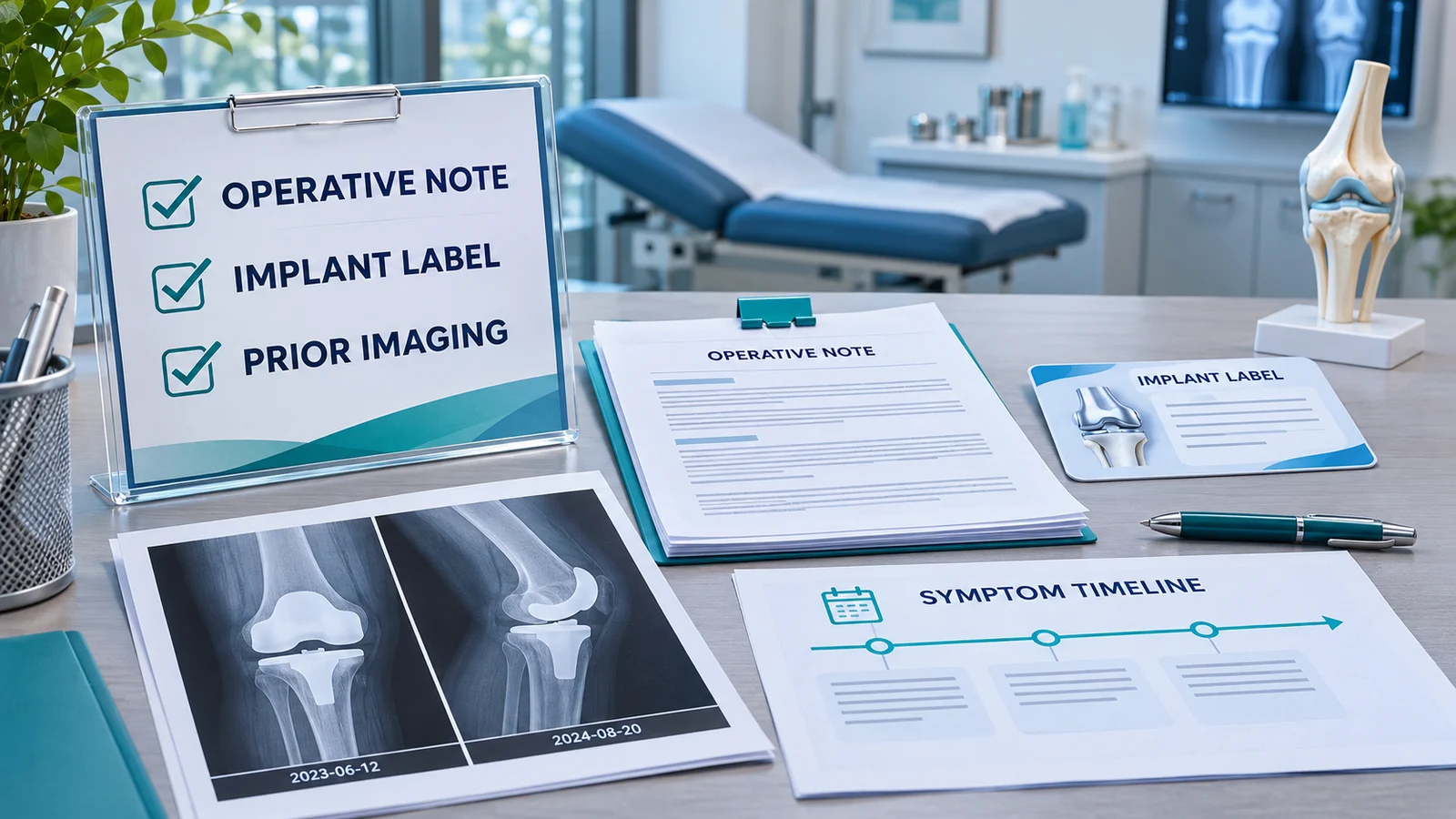
- If you already have a knee replacement and are considering reassessment in China, gather the original operation record, implant details, prior imaging, and a dated symptom timeline.
- Implant information may appear on a patient implant card, product stickers, the operative note, hospital discharge summary, or a registry record. Keep every source you have.
- Label images with date, facility, and right or left knee. Bring original reports as well as image files or discs when available.
- A record package helps an orthopaedic team understand prior care; it does not diagnose loosening, infection, instability, fracture, or the need for revision surgery.
- Do not delay urgent local care for severe pain, fever with a concerning knee wound, major injury, sudden inability to bear weight, or new neurovascular symptoms.
People sometimes describe a painful or disappointing knee replacement as a “failed implant.” That phrase may be understandable in conversation, but it is not a diagnosis. Symptoms after replacement can have many possible explanations, and an overseas patient should not try to decide the cause from a scan, an online forum, or an old implant card. When preparing for reassessment in China, the useful first step is simpler: organize the history accurately.
This guide is for patients who have already had a partial or total knee replacement and want a later orthopaedic opinion or reassessment in China. It focuses on records, not on choosing a procedure. It does not decide whether revision is needed, identify an implant from an image, interpret an X-ray, or state that an implant can be retained, exchanged, or combined with another product.
Why Earlier Records Matter
The current orthopaedic team will assess your present condition. Earlier records give it context: what operation was performed, when, on which knee, why it was done, what components were recorded, and what symptoms or treatment followed. A published review of revision hip and knee arthroplasty records found that operative notes and implant stickers were often unavailable or incomplete, making later planning more difficult.[^1] That does not mean an evaluation cannot happen without a full set of records. It means the records you can retrieve are worth preserving.
Implant information is useful when it is available because knee replacement systems have components, sizes and designs that may not be apparent from memory alone. AAOS registry information describes joint-replacement documentation as including procedure details, laterality, primary or revision status, and implant type.[^2] Patients should not use this information to infer component compatibility. The receiving clinical team must make any technical assessment.
Build a Factual Knee-Replacement Timeline
Start with one page. Use dates, sources and plain descriptions. Separate what is documented from what is only remembered.
- the side: right knee, left knee, or both;
- the date and country or city of each knee operation;
- the original hospital, clinic, or surgeon, if known;
- whether the record describes a total, partial, or revision knee replacement;
- the original reason for surgery as written in the record, if available;
- later procedures, wound care, aspirations, injections, manipulation, fracture treatment, or hospital admissions involving that knee;
- when the current concern began, whether it changed suddenly or gradually, and what function it affects;
- dates of later imaging and follow-up visits; and
- a current list of medicines, allergies and major health conditions as recorded by your clinicians.
Do not call a symptom an infection, mechanical problem, allergy, instability, or implant failure unless a qualified clinician has documented that diagnosis. A neutral timeline gives a new team a more reliable starting point.
The Essential Records Checklist
Original Operative Note
Try to obtain the full report from the original knee replacement. The operative note may contain the procedure name, laterality, approach, components documented by the surgical team, fixation details, and intraoperative issues recorded at that time. Preserve full pages, headers, dates and signatures. A short discharge summary is useful too, but may not include the same detail.
If the original facility uses an online records portal, use its official request process. If it cannot provide older records, note the request date and response in your timeline. Do not create a replacement record from memory or modify a scanned document.
Implant Identification Documents
Look for an implant card, product stickers, barcode labels, a manufacturer information sheet, an implant log, or components listed in the operation report. Photograph or scan each item in full and keep the original safe. Include all pages even if numbers appear repetitive.
Useful factual fields can include manufacturer name, product line, component name, catalogue or reference number, lot number, size, laterality, and date. Do not assume that a product name establishes what the present team can use or do. Product compatibility, component availability and surgical planning are clinical and operational questions for the relevant team.
Imaging and Imaging Reports
Collect prior knee X-rays, CT, MRI, ultrasound, nuclear-medicine studies, or other imaging only when they already exist. Keep both the written radiology report and image files or disc if available. Note the date, facility, body part and side. A photo of an X-ray held up to a window is usually less useful than an original digital image or official report.
The receiving department may request newer or different imaging after its assessment. Do not schedule extra tests or repeat imaging based solely on this article. That decision belongs to the appropriate clinician.
Follow-Up, Medicine and Health-History Records
Include clinic notes since the original surgery, physiotherapy or rehabilitation summaries, wound-care documentation, emergency records, hospital admissions, and previously completed laboratory or aspiration reports. Preserve original wording. A past result cannot be used by a website to rule in or rule out a current issue.
Make a current list of prescribed medicines, over-the-counter products, allergies and adverse reactions exactly as recorded by you or your clinician. Do not start, stop or change anticoagulants, antibiotics, pain medicines or supplements while preparing records unless directed by the prescribing clinician.
Organize Files So a New Team Can Read Them
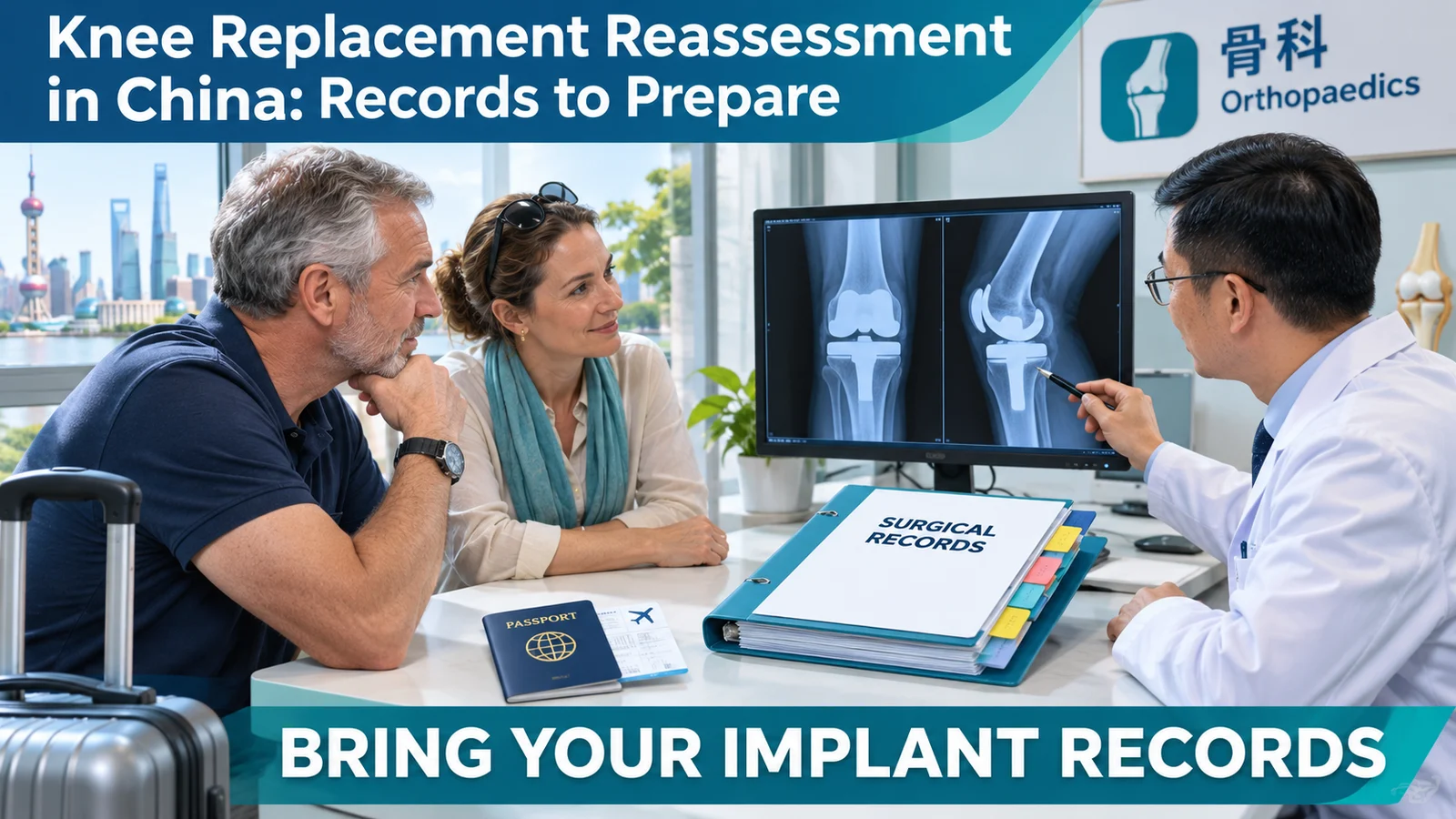
One complete, orderly package is more useful than isolated images in a chat thread. Use file names that identify date, source, knee side and document type. Keep a simple order: a knee-history timeline, original operative note, implant card and labels, discharge and follow-up notes, imaging reports and original image files, rehabilitation or hospital records, and a current medication and allergy list.
If records are not in English, preserve the original document. A translation can help, but it should remain paired with the source file, including page numbers and laterality. Do not remove pages or crop labels because they look administrative. Confirm the hospital's preferred upload method, file-size limit and privacy process before submitting records. The China-ready medical records checklist covers general source preservation and file organization.
A Symptom Timeline Without Self-Diagnosis
Alongside records, create a short symptom log. It should help a clinician see timing and functional impact, not make a conclusion.
- when symptoms first appeared or materially changed;
- location and description in your own words;
- whether the pattern is constant, activity-related, or intermittent;
- effect on walking, stairs, sleeping, work or daily activities;
- relevant events such as a fall, injury, fever, wound concern, emergency visit or medicine change;
- what assessment or treatment has already occurred and when; and
- questions you want to ask during the appointment.
Do not rate a symptom as proof that the implant is loose, infected, misaligned, or unsuitable. Do not use the log to decide whether to travel or delay care. It is a communication aid only.
Questions to Ask Before Travelling to China
Use an official hospital channel to clarify administrative requirements for reassessment. A concise inquiry can include your surgery date, laterality, available records, current country, and desired timing. Ask:
- Which documents should be submitted before a knee replacement reassessment?
- Does the department accept prior image files, discs, reports, or all three?
- What file formats and upload channel are accepted for overseas records?
- Is an implant card, product label, or full operative note particularly useful when available?
- If an original operative note cannot be obtained, what alternative records should be brought?
- Which clinic or department handles reassessment after a previous knee replacement?
- Who can clarify registration, document upload, or image-file issues before the visit?
These are questions about records and logistics. They do not establish eligibility, a diagnosis, a surgical plan, an implant solution, treatment timing or cost. For broader original-surgery planning context, see knee replacement cost in China.
What Records Cannot Establish
Even a detailed operation report cannot determine the cause of current symptoms or the appropriate next step. Orthopaedic reassessment may involve history, examination, current imaging, laboratory work, review of previous documents, and other steps selected by the treating team. Revision total knee arthroplasty is a specialized area of evaluation and planning; AAOS educational materials list distinct topics for evaluation, bone loss, planning and complications.[^3]
Patients should be cautious about claims that an implant label alone determines whether a procedure is possible. A historic paper on identifying knee prostheses from radiographs explains why knowing a model can matter, but it reflects a technical process for surgeons, not a self-service method for patients.[^4] Bring the evidence you have, and allow the clinical team to decide how it is used.
When Not to Wait for Travel Coordination
This article is not a clinical triage tool. Seek prompt local medical care for severe or rapidly worsening pain, a new inability to bear weight, significant injury, a concerning wound change, fever with a concerning knee problem, a cold or pale foot, new numbness or weakness, chest pain, shortness of breath, or other urgent symptoms. Do not wait for records collection, a travel plan, or a WhatsApp reply.
For routine planning, discuss patient-specific travel, medication and follow-up questions with your current clinicians and relevant providers. MedToChina does not assess fitness to travel or make decisions about urgent care.
How MedToChina Can Help
MedToChina can help international patients create a structured inventory of existing knee-replacement records and formulate non-clinical questions for official China hospital channels. You may submit your visit context and available document types, or send non-sensitive logistical questions on WhatsApp. We can help identify which entries in the record package need a source, date, knee side or official clarification.
We do not diagnose implant problems, determine whether revision is needed, interpret imaging, recommend a prosthesis, confirm compatibility, or promise appointment, treatment or outcome details. Those decisions remain with the relevant orthopaedic team and providers.
Frequently Asked Questions
I cannot find my implant card. Should I still request reassessment?
Yes. State that the card is unavailable and bring the operative note, discharge summary, imaging and other records you can obtain. The receiving team can explain what further information it needs.
Can an X-ray tell me which implant I have?
Do not try to identify an implant yourself from an image. Submit original images and reports when requested; the orthopaedic team determines whether they are sufficient for its assessment.
Does a painful knee replacement mean I need revision surgery?
No. Symptoms alone do not decide the cause or appropriate care. A qualified clinician needs to assess individual history and current findings.
Should I obtain new scans before contacting a China hospital?
Do not arrange new tests based only on this guide. Ask the relevant official or clinical channel what existing records are useful and whether current testing is needed.
Can MedToChina identify compatible components or advise on a revision plan?
No. We can help organize the document inventory and administrative questions, but component decisions and treatment plans require the appropriate orthopaedic team.
Discuss Your Knee Records on WhatsApp
Preparing for knee replacement reassessment in China after prior surgery? Send your available record types and non-sensitive logistical questions on WhatsApp, or submit your information. We can help you prepare a clear document inventory for the appropriate official channels.
Medical Disclaimer
This article provides general records-preparation information for international patients considering orthopaedic care in China. It is not medical, surgical, diagnostic, rehabilitation, travel, legal, insurance or financial advice. It does not diagnose infection, loosening, instability, fracture or another condition; interpret imaging; identify implant components; recommend revision surgery; or confirm treatment availability or outcomes. Individual assessment must be performed by an appropriately qualified clinical team. For urgent symptoms, seek prompt local care.
References
[^1]: Sershon RA, et al. Comprehensive Operative Note Templates for Primary and Revision Total Hip and Knee Arthroplasty. The Open Orthopaedics Journal. 2016. [^2]: American Academy of Orthopaedic Surgeons. What Kind of Information Does the Registry Collect?. Accessed November 3, 2026. [^3]: American Academy of Orthopaedic Surgeons. Hip and Knee Resident Curriculum: Revision Total Knee Arthroplasty. Accessed November 3, 2026. [^4]: Lavernia CJ, Regala C. An algorithm to identify knee prostheses from their radiographic appearances. American Journal of Knee Surgery. 1999. [^5]: American Academy of Orthopaedic Surgeons. Revision Total Knee Arthroplasty educational overview. Accessed November 3, 2026.