
Treatments
Early Gastric Lesion Review in China: Endoscopy and Pathology Records to Prepare
A practical records checklist for international patients preparing a China review of an early gastric lesion, including endoscopy images and pathology reports.
MedToChina Editorial Team · 8 min read · October 28, 2026

Quick Summary
If an endoscopy, biopsy, or scan has identified a gastric lesion, a China gastroenterology review may require more than a short summary. Prepare the complete endoscopy report, image files or video access if available, pathology report and any addendum, biopsy site details, previous treatment records, medication list, and a dated symptom and test timeline.
This guide helps international patients organize existing information for communication with a receiving institution. It does not identify a lesion, interpret pathology, determine depth or stage, recommend endoscopic resection or surgery, or confirm that a specific service is available in China.
Reviewed October 28, 2026.
What “Gastric Lesion” Can Mean
“Gastric lesion” is a descriptive term that may appear in an endoscopy, imaging, pathology, or clinic report. It does not by itself tell a patient what the finding is or what treatment is appropriate. Reports may use different words for a change in the stomach lining, ulcer, polyp, abnormal area, dysplasia, tumor, or another finding. The meaning depends on the full clinical context, endoscopy appearance, biopsy sampling, pathology interpretation, symptoms, and sometimes further assessment.
For an international patient, the practical task is to preserve the original evidence. Do not relabel a lesion based on a translation, a photograph, or an online comparison. A receiving clinical team needs the original report, dates, sampling information, and any later corrected or supplemental pathology report.
This article is not a diagnosis service. If there is vomiting blood, black stools, fainting, severe or worsening pain, inability to keep fluids down, or another urgent concern, seek timely local medical care rather than waiting for travel or records communication.
Why Endoscopy Records Should Stay Together
An endoscopy report is more useful when it remains connected to its photographs, biopsy details, pathology report, and the plan issued by the treating team. A short statement such as “early lesion found” may omit the location, size description, number of samples, image quality, or the relationship between a pathology specimen and an endoscopic finding.
Create one folder for each endoscopy date. Name it with the date and hospital, then include the complete report and any images or secure-access information supplied by the facility. Keep the original language version even if you also have a translation. Do not crop screenshots that remove dates, patient identifiers, or report headers.
Endoscopy Documents to Collect
For each upper endoscopy or related procedure, gather what is already available:
- The complete procedure report, including date, hospital, and endoscopist or department where stated.
- The finding location exactly as described in the report.
- Endoscopy photographs, video files, image files, or the approved access method provided by the facility.
- Biopsy details, including how many samples were taken and from which labeled sites if the report says so.
- Sedation or anesthesia documentation if supplied.
- Any procedure-related discharge instruction.
- A report from endoscopic ultrasound, CT, or another study already performed.
- The follow-up plan issued at that time.
Do not decide from images whether a lesion is superficial, invasive, benign, malignant, or removable. Images need professional interpretation with pathology and the patient's wider history.
Pathology Reports and Addenda: Keep Every Version
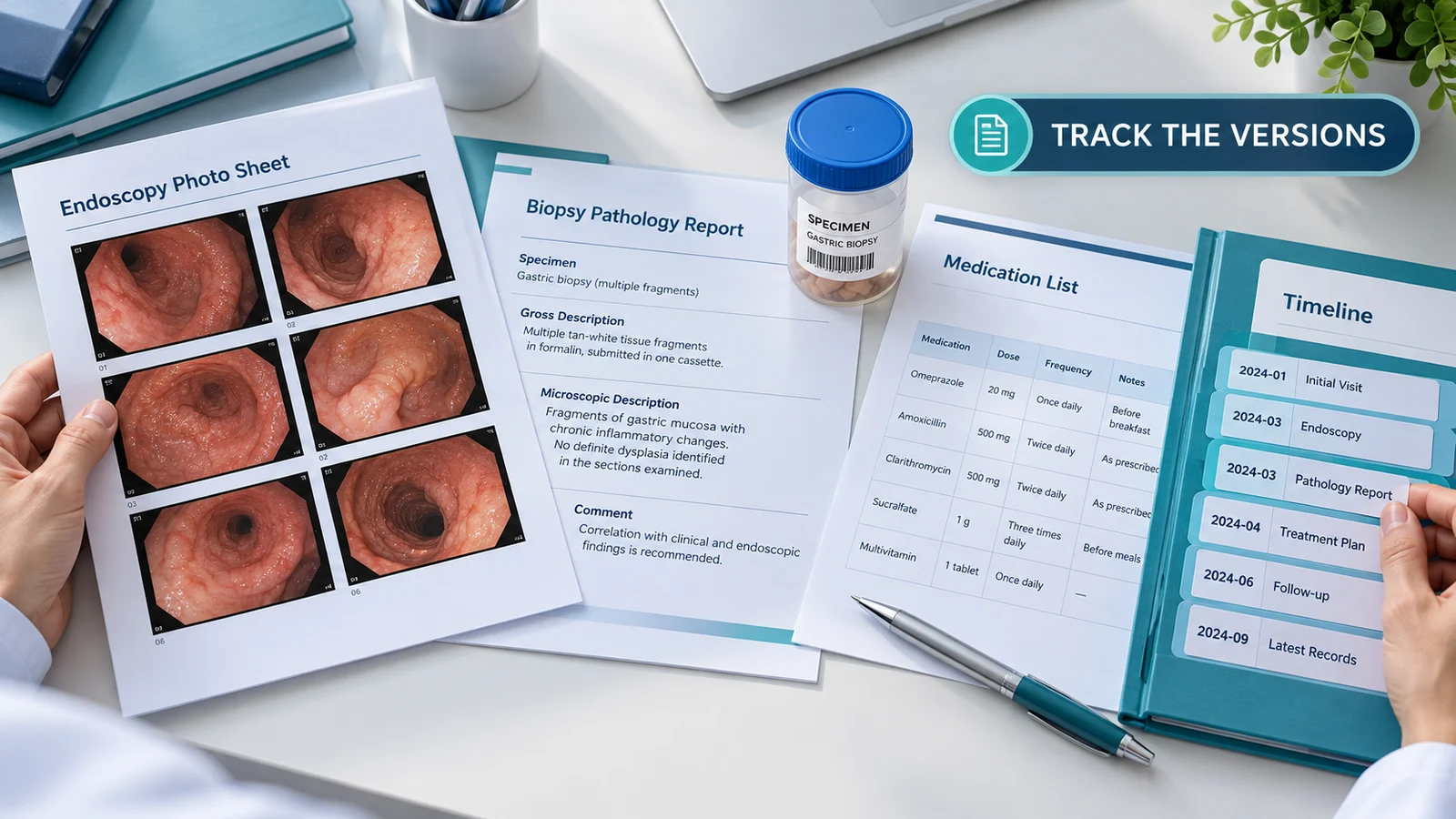
Pathology reports may be finalized after an endoscopy date, and some reports later receive an addendum, second reading, staining result, or correction. These versions are important because the date and the link to the specimen can matter. Keep every issued version rather than replacing the older report with a newer file.
For each pathology document, preserve:
- The specimen collection date and pathology report date.
- The laboratory or pathology department name.
- Specimen label or site as recorded.
- Full diagnosis text, comments, and microscopic description if present.
- Any addendum, amendment, ancillary testing, or second-opinion report.
- The endoscopy report that corresponds to the specimen.
Do not edit the wording or combine separate reports into a new summary that could make the source unclear. If there is an apparent factual discrepancy, save both versions and ask the issuing institution how it is documented. A receiving team can then see the original trail.
A Practical Timeline for a Gastric Lesion Review
Create a one-page chronology that points to source documents. It can include the date of symptoms, referral, endoscopy, imaging, biopsy, pathology result, hospital admission, procedure, and the next follow-up currently planned. Use factual wording, such as “gastroscopy report dated 9 April attached” or “pathology addendum dated 18 April attached.”
Avoid conclusions such as “cancer confirmed,” “lesion cured,” or “safe to wait” unless you are reproducing a dated statement from the treating clinician, and even then do not treat an earlier statement as current advice. A timeline is an index, not a clinical interpretation.
Previous Treatment and Medicine History
If you have already received medication, an endoscopic procedure, stomach surgery, radiation, systemic treatment, or another intervention related to the stomach, collect the relevant records in date order. Include procedure reports, discharge summaries, medication lists, and any documented reaction or complication. State what happened only from the existing records.
Bring a current medication list with prescription medicines, non-prescription products, supplements, and documented allergies or intolerances. Do not stop acid-suppressing medication, blood-thinning medication, supplements, or any other medicine based on this guide. Preparation for a particular test or procedure must be confirmed by the treating clinicians and performing department.
Questions to Ask Before Sending Records to China
These questions can clarify a process without requesting a clinical judgment by message:
- Which endoscopy reports, image files, pathology documents, and prior-treatment records should I send?
- Does the institution need original-language documents, certified translations, or both?
- Which secure official channel should receive reports and image files?
- Can the institution accept images from a disc, portal, or encrypted transfer method, and what format is required?
- Is the current status document receipt, records review, an outpatient appointment, or another stage?
- If an appointment is confirmed, what campus, department, date, local time, and arrival instructions apply?
- What should I ask my current treating team to address locally while records are being considered?
A request to submit records does not confirm that a China institution will offer a particular procedure, provide an opinion, accept a case, or set a treatment date.
Translation and Record Integrity
Translations can help a receiving institution understand records, but they should not replace the original file. Keep original reports next to any translation and label the translation date and provider if known. Medical terminology, specimen labels, and lesion locations can be sensitive to small wording changes.
If a report has an amendment or a different patient identifier, do not alter files yourself. Keep the source documents and ask the issuing facility for clarification. For privacy, use the official channel identified by the receiving institution and avoid sending passwords, financial credentials, or unrelated personal data through ordinary messaging.
Symptoms, Travel, and Safety Boundaries
A record set cannot determine whether it is medically appropriate to travel or wait for an international appointment. New or worsening symptoms require advice from the clinicians currently responsible for your care. For urgent symptoms, obtain timely local care.
Do not postpone a scheduled local evaluation because a China review is being considered. Do not use this guide to select an endoscopic technique, decide that a lesion is early, or infer that preserving the stomach is possible. These are individual clinical questions that need the appropriate specialist assessment and up-to-date evidence.
How MedToChina Can Support Preparation
MedToChina supports overseas patients considering medical care in China by helping them organize existing documents and practical questions. Submit your information or send available endoscopy, pathology, and treatment records through WhatsApp. After understanding the condition, records, timeline, country preference, and practical needs, our customer service team can discuss possible China care resources.
We do not diagnose gastric conditions, interpret pathology or endoscopy images, determine a lesion's depth or stage, recommend a procedure, decide travel readiness, or promise appointment availability, treatment, cost, or outcome. The relevant receiving institution and clinical team must confirm any next step.
Frequently Asked Questions
Do I Need Both the Endoscopy Report and the Pictures?
Keep both whenever available. The report provides the documented description, while the images or original access method may provide additional context for a clinical review.
Is a Pathology Report Enough Without the Endoscopy Report?
It may not be. The endoscopy report links the specimen to the observed site and procedure date. Keep the complete document set together.
What Is an Addendum to a Pathology Report?
It is a later addition or update to a previously issued report. Keep it with the original version so the sequence is clear.
Can This Guide Tell Me Whether I Need Endoscopic Resection or Surgery?
No. Treatment choices require individualized assessment by the appropriate clinical team.
Should I Repeat an Endoscopy Before Travelling?
Do not arrange or repeat a test based on this article. Ask the clinicians currently responsible for your care and the receiving institution what records they require.
Does Sending Files Confirm Treatment in China?
No. Records submission does not confirm acceptance, an appointment, admission, a procedure, or treatment. The receiving institution must confirm any next step.
Contact MedToChina on WhatsApp
Submit your information or send your endoscopy, pathology, and practical questions through WhatsApp. We can help you prepare an organized administrative checklist before discussing possible care in China.
Medical Disclaimer
This article provides general information for international patients considering review of a gastric lesion in China. It is not medical, diagnostic, pathology, endoscopy, treatment, medication, nursing, insurance, visa, or travel advice. It does not interpret reports or images, establish lesion depth or stage, recommend endoscopic resection, surgery, or another treatment, determine travel readiness, or confirm appointment availability, treatment, cost, or outcome. Seek individualized advice from the clinicians responsible for your care. For urgent or severe symptoms, seek timely local emergency care.
References
- National Cancer Institute. Stomach Cancer Treatment (PDQ).
- National Institute of Diabetes and Digestive and Kidney Diseases. Upper GI Endoscopy.
- National Cancer Institute. Surgical Pathology Reports.
- Centers for Disease Control and Prevention. Medical Tourism.
- GOV.UK. China travel advice: health.