
General
Comparing Medical Cost Claims Across Countries: What Is Actually Included?
Before comparing medical cost claims across countries, check the service, year, currency, payer type, included items, length of stay, and follow-up.
MedToChina Editorial Team · 9 min read · November 14, 2026
Quick Summary
- A claim that one country is “cheaper” is not meaningful until you know what service, patient group, payer, year, currency, and included items were compared.
- A hospital list price, a self-pay estimate, an insurer-negotiated rate, a patient's out-of-pocket payment, and a national health-spending statistic answer different questions.
- Compare the same clinical scope, facility setting, stay length, devices or medicines, complication assumptions, follow-up, travel, and exchange-rate date before interpreting a difference.
- If material details are missing, write “not comparable from the available information.” Do not turn an advertising percentage into a personal quote or expected saving.
Why cross-country medical cost claims need a method
Overseas patients considering medical care in China often see a statement comparing a treatment price in China with a price in the United States, Canada, the United Kingdom, Australia, the Middle East, or another market. The statement may be a percentage, a range, a headline number, or a “from” price. It can appear on a hospital page, a medical-travel article, a social post, a news story, or an agency advertisement.
These figures may be useful research leads. They are not automatically wrong. But they are easy to misread because medical payment systems and the contents of a “treatment cost” differ substantially across countries and providers.
One figure may be a publicly posted hospital standard charge. Another may be a negotiated insurer rate. Another may be what a self-paying patient actually paid after an individual assessment. A fourth may be national per-person health spending, which is a population statistic rather than the price of a procedure. Putting these figures in one sentence does not make them comparable.
For an international patient coming to China, the responsible question is not “Which number is lower?” Start with: Are these two numbers pricing the same thing, for the same type of patient, under the same assumptions?
Name the number before comparing it
Use a label that describes what the figure is:
- Hospital standard charge: A posted rate for an item or service. This does not establish: your personal bill or final payment.
- Cash or self-pay price: A stated rate for patients paying directly. This does not establish: that your procedure, tests, stay, or complications are included.
- Insurer-negotiated rate: A rate agreed between a payer and provider. This does not establish: your out-of-pocket amount or overseas coverage.
- Patient out-of-pocket payment: The amount a household paid directly. This does not establish: the total cost of care or another patient's cost.
- National health spending: Aggregate spending per person or system measure. This does not establish: a procedure quote or hospital bill.
- Preliminary estimate: An early expected range based on supplied facts. This does not establish: a guaranteed price after in-person assessment.
The U.S. Centers for Medicare & Medicaid Services notes that a hospital's standard charges do not represent an individual's out-of-pocket obligation or a guaranteed price. That principle is useful beyond the United States: a public price display and a personal financial responsibility are different categories.
If a source does not say which category it uses, record the claim as undefined. Do not upgrade a vague headline into a self-pay estimate, an insurance comparison, or a statement about total treatment cost.
Compare the clinical scope line by line
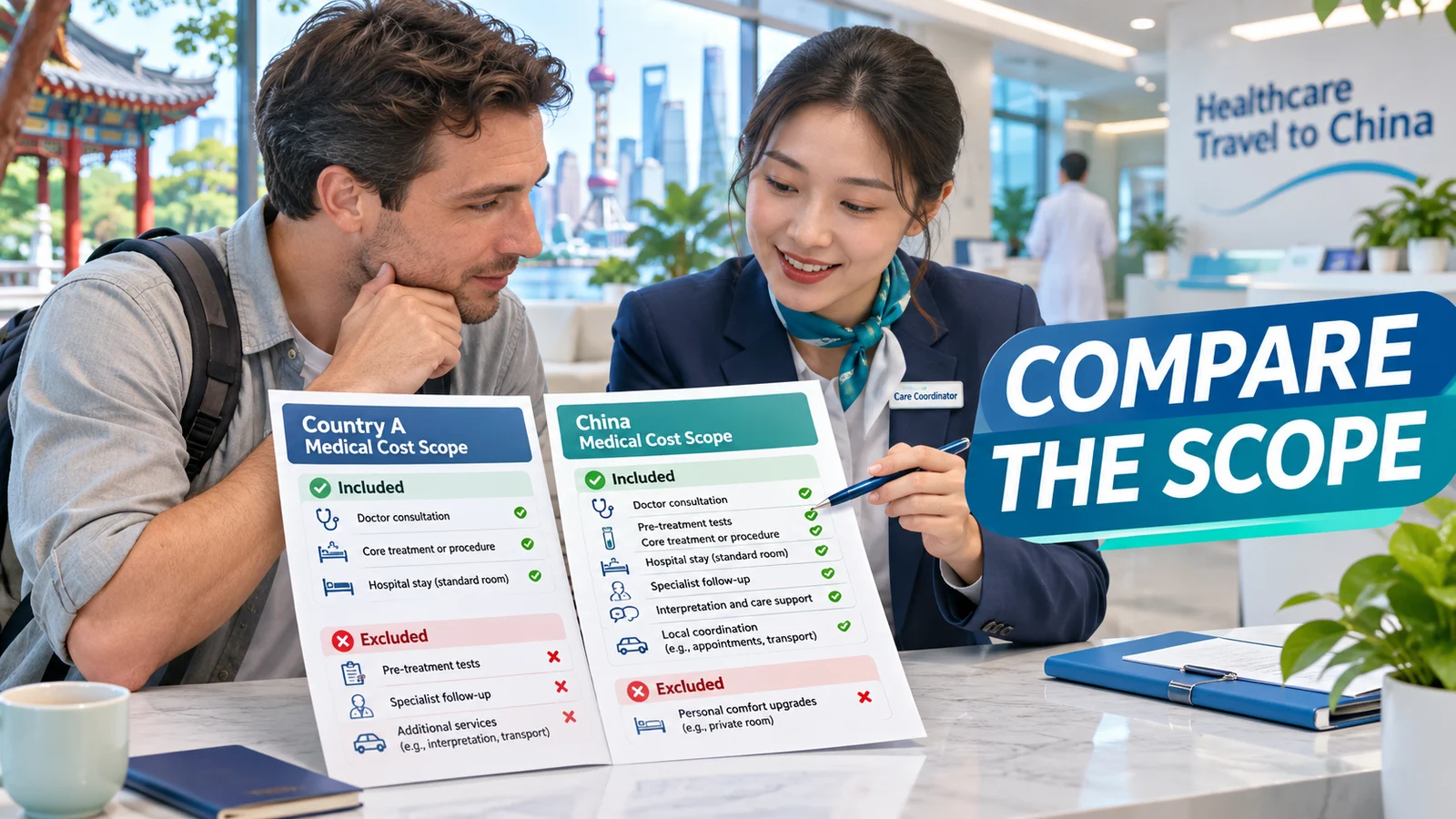
Two prices can concern the same named procedure but include very different care. For written surgery estimates from specific hospitals, use the proposed care plan. For a public claim, make three columns: Figure A, Figure B, and Comparable? Compare the following items:
- Diagnosis and clinical indication
- Procedure or treatment description
- Facility and care setting
- Surgeon, clinician, anaesthesia, or procedure fees
- Devices, implants, blood products, or medicines
- Pre-treatment tests and imaging
- Planned length of stay and room type
- Pathology, rehabilitation, or follow-up
- Complication or unplanned-care assumptions
- Travel, accommodation, translation, and companion costs
Do not assume that a treatment name carries a universal bundle. A surgery may include different implant options, room categories, diagnostics, medicine, monitoring, rehabilitation, or follow-up in different settings. A procedure performed as day care in one case may require a longer stay in another. Even within one country, patient condition and facility practices can change what appears on an estimate or bill.

Keep payment source separate from service price
The same service can have different numbers depending on who pays. Government schemes, private insurance, employers, charities, patients, and hospitals may each bear different portions. A patient can face a deductible, co-payment, co-insurance, limit, exclusion, reimbursement process, or separate travel expense even when insurance is involved.
The World Health Organization defines out-of-pocket health expenditure as direct household payment at the time of use, excluding amounts covered by insurance, taxes, or reimbursements. That makes it a useful indicator for studying financing patterns, but it is not a total cost of care and does not include indirect costs such as transportation or lost income.
Do not compare:
- one country's insurer-negotiated hospital rate with another country's cash price;
- a patient co-payment with a hospital's total charge;
- a national average with one hospital's package;
- a domestic resident benefit with an overseas patient's self-pay arrangement; or
- a quoted procedure price with an all-in travel budget.
For a fair research note, keep separate columns for provider charge, payer contribution, patient payment, and non-medical travel costs. If the source does not supply them, leave the cells blank.
Currency, year, and exchange-rate traps
Currency conversion is necessary for reading figures but is not enough to make them comparable.
First, record the original currency and the date or year of each source. A price from 2022 and a price from 2026 may reflect different inflation, policy, supply, staffing, or currency conditions. If someone converts both figures at today's exchange rate, they can create a neat-looking comparison that does not reproduce what either patient paid at the time.
Second, distinguish a market exchange rate from purchasing-power parity, or PPP. OECD explains that PPPs are conversion rates designed to equalise purchasing power across countries for broader real-term comparisons. They can be useful for population-level spending analyses, but they do not convert an individual hospital invoice into a personal quote.
Third, do not create a saving percentage merely by converting two incomplete public figures. For a patient planning care in China, the practical financial question is usually: “What does this provider expect to charge for my defined care plan, and what could change?” That needs an itemised, current, case-specific discussion rather than a general international ranking.
Check dates, geography, and the provider
Before accepting a comparison, write down:
- Year and collection period: When was each price or statistic observed?
- Location: Which city, campus, hospital, department, or countrywide system does it represent?
- Provider type: Public hospital, international department, private hospital, ambulatory centre, or other setting?
- Population: Domestic residents, insured members, self-paying patients, or overseas patients?
- Clinical group: Which diagnosis severity, procedure subtype, or urgency category?
- Source: Original provider document, official database, insurer material, research paper, or secondary marketing article?
A broad “China versus USA” headline can hide major variation by city, payer, provider, and clinical complexity. Likewise, a quote from a premium private setting should not be presented as a national average. A responsible comparison identifies the narrowest unit actually supported by the source.
Red flags in a medical cost comparison
Pause before relying on a claim when it:
- does not name the treatment, year, currency, or source;
- compares a total bill in one place with a co-payment or cash price elsewhere;
- gives a percentage but no original numbers or scope;
- calls a number “all-inclusive” without listing what is included;
- excludes tests, implants, medicines, stay, follow-up, or travel without saying so;
- uses an old foreign price against a current China price;
- presents a national spending statistic as a procedure price;
- treats an estimated price as a final bill; or
- promises a particular saving, lowest price, or fixed outcome.
These gaps do not prove a publisher intended to mislead. They mean the comparison cannot answer a personal financial question yet.
A five-step method for international patients
Step 1: Save the original claim
Keep the original URL, screenshot, publication date, quoted currency, and wording. Do not rely only on a reposted graphic or search snippet.
Step 2: Build the scope table
List the clinical service and every included, excluded, or unstated item. Mark “not stated” rather than assuming an item is included.
Step 3: Label each payment category
Identify whether the number is a hospital charge, cash price, insurer rate, patient payment, national statistic, or estimate.
Step 4: Record comparability limits
Write the missing facts: different year, different payer, unclear stay length, unspecified implant, missing follow-up, or no travel costs. If major facts are missing, mark the two figures “not comparable from the available information.”
Step 5: Prepare a case-specific question
When you have a treatment recommendation and relevant records, ask for clarification of the scope, items that may change, payment timing, and documentation. This is not a request for a guaranteed price. It is a way to make a future discussion more precise.

What this means for care in China
Medical care in China can be a relevant option for some overseas patients, but cross-country advertising comparisons cannot determine whether a China pathway is clinically appropriate, logistically practical, or financially suitable for you. Your diagnosis, condition, records, proposed care plan, tests, inpatient needs, country of departure, insurance terms, and follow-up needs all matter.
MedToChina can help you organise medical records, source links, and questions for a possible care pathway in China. Our customer-service team can discuss possible China hospital resources after understanding your condition, budget, timeline, country preference, and available records. We do not provide individual price guarantees, insurance coverage decisions, exchange-rate advice, or claims of a fixed saving.
FAQ
Is a lower advertised treatment price a personal quote?
No. An advertised or public figure may use a different clinical scope, payment category, year, or patient group. A personal estimate requires a defined care plan and may still change after assessment.
Can I use an exchange rate to compare treatment cost?
It can show the figures in one currency, but it does not solve differences in service scope, payer, year, insurance, stay, or follow-up. It also does not produce a personal quote.
Is a national health-spending figure the same as hospital price?
No. National expenditure measures describe aggregate spending and financing; they do not quote a specific procedure or provider.
Should travel and accommodation be included?
For an international medical-travel budget, they should be recorded separately from clinical charges. Whether they belong in a comparison depends on whether both sides of the comparison include them.
Can MedToChina tell me which country is cheaper for my treatment?
No. We do not make broad country-cost promises or individual price guarantees. You may send your records and questions through WhatsApp to discuss how to prepare for possible care in China.
Discuss Your Questions Through WhatsApp
If you have found a cross-country medical cost claim, send the original source, medical records, and questions to MedToChina through WhatsApp or submit your information. We can support record organisation and communication preparation for overseas patients considering care in China.
Medical and Financial Disclaimer
This article is general information about reading medical cost comparisons. It is not medical, financial, insurance, legal, tax, currency-conversion, or pricing advice. It does not provide an individual quote, guarantee a charge, predict insurance coverage, or promise savings. Urgent symptoms should be assessed through appropriate local emergency or clinical services.
References
- Centers for Medicare & Medicaid Services. Hospital Price Transparency FAQs.
- Centers for Medicare & Medicaid Services. Hospital Price Transparency for Consumers.
- World Health Organization. Out-of-pocket expenditure as a percentage of current health expenditure.
- OECD. Purchasing Power Parities.
- Eurostat and OECD. Methodological Manual on Purchasing Power Parities: Health.