
General
Boao Lecheng Special Access Pathway: What Overseas Patients Should Know
Learn how Boao Lecheng's regulated special-access pathway works, what medical records overseas patients need, and what to verify before travel.
MedToChina Editorial Team · 9 min read · September 18, 2026
Quick Summary
Boao Lecheng in Hainan has a regulated pathway under which designated medical institutions may apply to use certain urgently needed imported medicines and medical devices. The policy is a framework for institutional review and controlled use, not an individual patient's permission to request any overseas product. A patient's diagnosis, available alternatives, product status, clinical judgment, approvals, safety monitoring, cost and follow-up all matter. Overseas patients should prepare a clear record package and discuss travel only after their questions are specific enough for a meaningful service conversation. MedToChina accepts basic information and records through its website or WhatsApp; later resource discussions take place with the support team.
What does "special access" mean in Boao Lecheng?
Boao Lecheng International Medical Tourism Pilot Zone is in Qionghai, Hainan. It is a zone containing medical institutions, rather than one hospital or a single medicine program. Hainan's official description highlights simplified procedures for selected medicines and devices urgently needed for clinical use. Its medical services also cover several fields, so the relevant institution and department depend on the patient's condition. [1]
The central distinction is between a regulated route available to a medical institution and an individual patient's access to a particular product. China's State Council described special arrangements for certain imported devices and drugs that had not followed ordinary mainland availability pathways. Its notices refer to clinical need, designated institutions, specified purposes, provincial review and traceability. [2][3] Hainan's management rules set out requirements for clinically urgent imported drugs and devices. [4]
For an overseas patient, those rules create a question to investigate, not an entitlement. The product must be relevant to a genuine medical need. A clinician must assess whether it is suitable. A qualified institution must be able to provide the care and comply with the current rules. The product's status, supply, monitoring and payment must also be checked. A news story about one patient or one product cannot establish what is possible for another person today.
This guide focuses on that decision pathway. For an overview of Hainan as a treatment destination, read our Boao Lecheng medical access guide. Here, the practical issue is how to ask a precise product or treatment question without treating a policy headline as a medical decision.
What the policy covers, and what it does not
The State Council's drug notice described small quantities of clinically needed imported medicines, excluding vaccines under that arrangement, to be used by designated institutions for specified purposes after review. The device notice likewise described provincial authorization for certain urgently needed devices used in designated hospitals. [2][3] The current Hainan management rules and the institution's approvals are the proper basis for a present-day case; historical notices explain the policy's origin, not a standing promise of availability. [4]
There are several categories patients should keep separate. A medicine approved for ordinary use in China follows a different route from one under a special import approval. A clinical trial involves a research protocol, eligibility rules and informed consent; patients exploring oncology trials can use our cancer trial pre-screening records guide. A named-patient or compassionate-use program in another country has its own legal rules. Real-world-data research in Lecheng is a regulatory evidence activity and does not itself give an individual patient access. These terms can appear together online, but they do not mean the same thing.
An overseas regulatory approval may be relevant background, yet it is not enough to confirm clinical suitability or Lecheng access. Similarly, the presence of a product on a historical list does not prove current stock, coverage for a new indication or availability to an international visitor. Ask for the exact generic product name, device model, intended use and current institutional process. If the answer remains broad, travel planning is premature.
How a patient-specific question moves forward
A useful pathway begins with a medical question: What disease or functional problem is being treated, what has already been tried, and why is a particular medicine or device being considered? The next step is to collect records that allow an appropriate clinical team to understand the case. Depending on the condition, this may include pathology, scans, genetic testing, specialist notes, laboratory results or device measurements.
After the patient shares information with MedToChina, the support team can clarify missing documents and practical constraints through WhatsApp. That conversation may cover diagnosis, country of residence, preferred language, budget range, travel window and local follow-up. Discussion of Chinese medical resources belongs in this later service conversation. MedToChina cannot determine medical eligibility or regulatory approval from a website form.
If an institution considers the question, its clinicians must assess the medical case and applicable alternatives. Where a special import route is relevant, the institution handles its own application and regulatory obligations under the rules in force. This is not a patient self-application through MedToChina. In-person assessment may change the proposed plan, and a product question may end with an alternative treatment discussion or no suitable pathway.
The final stages may involve informed discussion of expected benefit and risks, consent, payment arrangements, administration or implantation at the permitted setting, monitoring and follow-up. The details depend on the product and the individual case. An approval for a product or institution does not replace the patient's own clinical assessment.
Records that make the first conversation useful
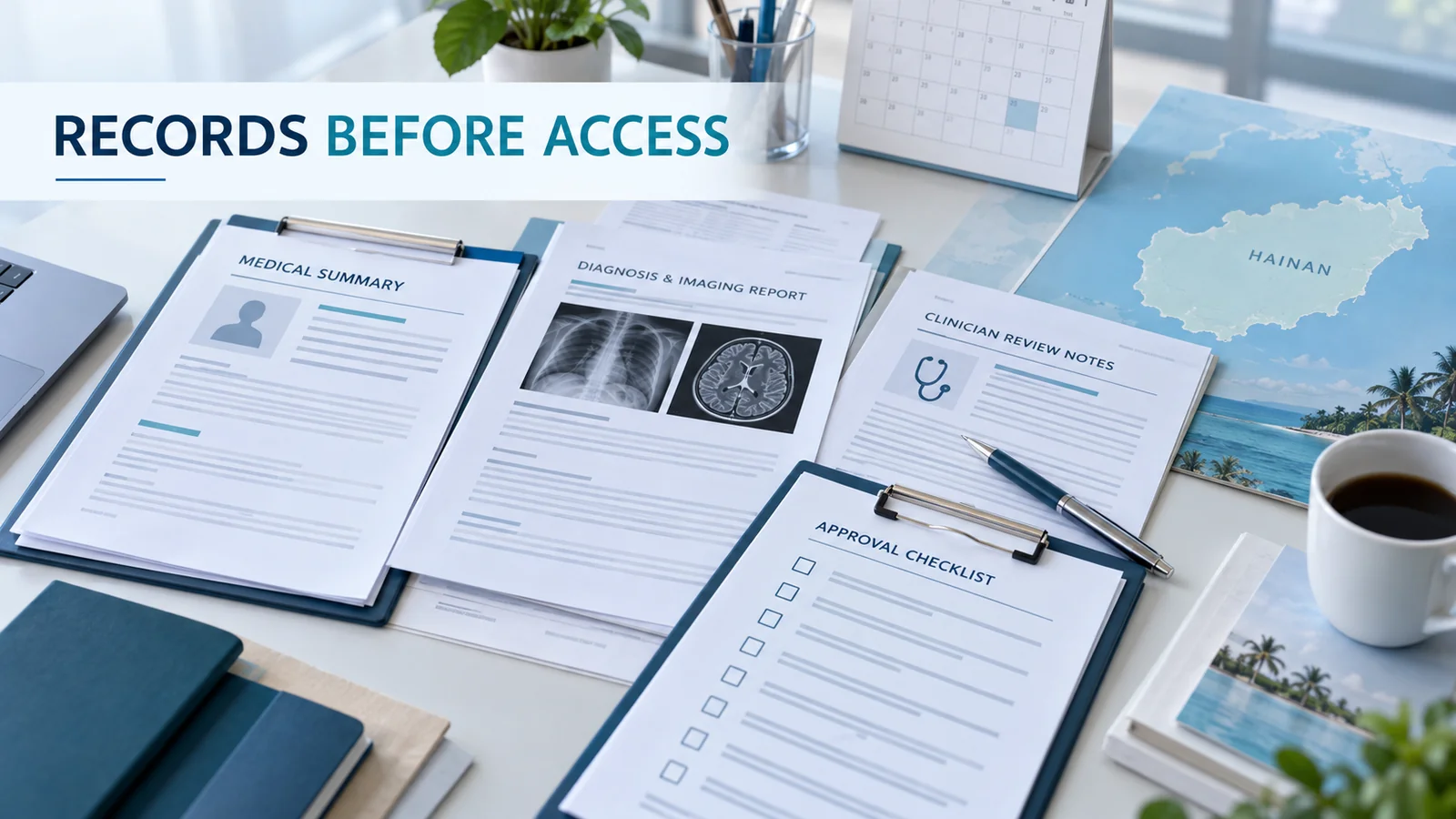
Start with a one-page summary in English or Chinese. The China-ready medical records checklist can help you organize it. Include diagnosis, diagnosis date, current symptoms, relevant stage or severity, previous treatments, current medicines, allergies, major illnesses and the question you want answered. State whether you seek a named product or simply want to understand possible care in China. A product request without a diagnosis and treatment history is too thin for responsible review.
Attach the strongest source documents, not only screenshots or a family member's paraphrase. For cancer care, these may be pathology reports, imaging reports and DICOM files, molecular or biomarker reports, treatment dates and recent blood tests. For eye care, include visual acuity, pressure, imaging, prior procedures and measurements relevant to the device question. For orthopedics or implanted devices, include imaging, operation reports, implant details and functional limitations. For rare diseases, genetic results, specialist letters and a medication history may be central.
Put the date and body site on every scan or report. Include both the original document and a careful translation when the original language may not be understood by the reviewing team. Do not alter product names, mutation notation, dose units or test results during translation. If a report is old, say so. The need for repeat testing can only be determined in the proper clinical process.
Add practical information: passport nationality, current country, possible travel dates, companion needs, mobility or oxygen support, infectious risks, allergies, payment method and insurance terms. Patients from the United States, Canada, the United Kingdom, Australia, the Middle East, Southeast Asia and Africa may have very different travel and payment situations. The clinical question is universal; the logistics are individual.
Questions to ask before booking travel
Ask what exact product or procedure is being discussed and whether the proposed use fits the patient's diagnosis. Ask whether a designated institution currently has a relevant department and experience with the underlying condition. Ask what documents are needed before an in-person visit, what must be verified after arrival, and which decisions cannot be made from records alone.
Ask what review or approval steps apply, who is responsible for them, and what could stop the process. The answer may involve medical suitability, a product's current status, sourcing, safety restrictions, translation quality, other treatment options or a change in the patient's condition. Do not interpret an initial positive conversation as authorization to buy a ticket for a procedure.
Ask about monitoring, adverse events and aftercare. If a medicine requires repeated doses or an implant needs long-term checks, the return-home plan matters as much as the initial intervention. Confirm who will hold records, what documents can be provided to your home clinician, and what to do if symptoms worsen after leaving China. If your condition is unstable, ask your treating doctor at home about travel fitness before making plans.
Costs, tax policy and insurance
The Ministry of Finance's 2024 zero-tariff notice covered specified medicines and devices imported by eligible Lecheng institutions before Hainan's island-wide customs operations. [5] Those operations began in December 2025, and a separate free-trade-port customs framework took effect at that transition. [7] For a 2026 case, ask the institution which current import and tax rules apply to the exact product; do not assume the 2024 notice still governs it. Tax treatment is not a patient price list or a promise of a lower bill. Patient costs can include the product, hospital services, tests, professional care, monitoring, admission, translation and complications.
Use the China hospital cost-estimate guide to prepare payment questions. Ask for an itemized estimate where possible. Distinguish a preliminary estimate from a final bill, and check whether prepayment or a deposit is required. Ask what is included, what could change after examination, and how unused deposits are handled. International insurance may require advance authorization or reimbursement after payment; policy terms vary. Confirm the insurer's rules directly, including whether the selected product, China facility, complications and follow-up are covered.
The 2024 tax notice restricted where products imported under that notice could be used or removed. [5] Separately, Hainan's clinically urgent import rules allow an institution to assess whether a reasonable quantity of a suitable product may be taken away for a patient's own use under specified conditions. [4] Neither rule means a patient can obtain extra supply, resell a product or take it across an international border without permission. Discuss ongoing medicine needs, the current product-specific rules and destination-country requirements with the institution and relevant authorities before travel.
Three misunderstandings that can lead to poor decisions
"Approved overseas" means available to me in Lecheng. It does not. Overseas approval, local authorization, institutional capability, clinical indication and patient suitability are separate questions.
"Special access" means a clinical trial. It does not necessarily. A trial tests a research question under a protocol. The Lecheng special-access discussion concerns regulated clinical use of selected imported products under a different framework. A patient may encounter both topics, but each has its own review and consent process.
A zone-wide policy guarantees a hospital can treat me. It does not. Lecheng contains multiple institutions and specialties. The relevant institution must assess the patient, the product, the current rules and the full care plan. MedToChina can help organize information for a later discussion; it does not make these medical or regulatory decisions.
A practical first message to MedToChina
Keep the first message short and specific: "I live in [country]. My diagnosis is [condition], confirmed on [date]. I have had [main treatments]. I am asking about [product or medical question] in Boao Lecheng. I have [pathology/imaging/lab/specialist] reports dated [date]. I may be able to travel in [month], and my main concern is [question]."
Send the one-page summary and key reports with your message. If a product name came from a social media post, include the source and say that its status is unverified. MedToChina can help you organize the question and discuss what additional information may be useful through WhatsApp. Hospital or clinician resource discussion can follow once the condition, records and practical needs are clearer.
FAQ
Can I apply directly for a special-access medicine or device?
The regulatory route concerns eligible medical institutions and their obligations. A patient's first step is to prepare records and discuss clinical suitability with the appropriate care pathway; MedToChina's website is an information-submission channel, not a regulatory application portal.
Does a product's presence in a Lecheng news article mean it is available now?
No. A report may describe a past approval or individual case. Current institution participation, indication, supply, permissions and patient suitability still need checking.
Is Boao Lecheng suitable for every complex condition?
No. Some patients may need a different specialty setting in China or care close to home. Diagnosis, urgency, travel fitness and continuity of care should guide the conversation.
Will a zero-tariff policy lower my bill?
It is a conditional import-tax policy for eligible entities and products. The patient bill depends on the actual care plan and charges. Request an itemized estimate and check insurance terms.
Should I stop my current treatment while exploring this route?
No treatment should be stopped or changed on the basis of this article. Discuss any change with your treating clinician, especially if therapy interruption could be harmful.
What should I send first?
Send a one-page case summary, diagnosis evidence, recent relevant reports, treatment history, current medicines, travel window and the exact question you want to explore. Use the website information form or WhatsApp.
Related MedToChina Resources
- Boao Lecheng medical access overview
- China-ready medical records checklist
- Cancer trial pre-screening records
- China hospital cost estimates
- China hospital prepayment questions
WhatsApp CTA
Considering care in Boao Lecheng? Submit your basic information or send your medical summary and key records to MedToChina on WhatsApp. Share the product or treatment question, your country, possible travel window and main concerns. Our team can help clarify what information is needed for a later conversation about medical resources in China.
Medical Disclaimer
This article provides general education and travel-planning information. It is not a diagnosis, treatment recommendation, product-availability confirmation, regulatory approval, legal opinion or assurance of medical access. Policies and institutional processes can change. Consult licensed clinicians, the relevant medical institution, your insurer and official authorities before changing treatment or travel plans.
References
- Hainan Provincial People's Government. Boao Lecheng International Medical Tourism Pilot Zone.
- State Council of the PRC. Hainan given green light for medical tourism: medical devices.
- State Council of the PRC. Drug import management changed in Hainan medical tourism pilot zone.
- Hainan Drug and Medical Device Review Service Center. 2025 management provisions for clinically urgent imported drugs and devices in Boao Lecheng (Chinese PDF).
- Ministry of Finance and other central authorities. 2024 Hainan zero-tariff notice for medicines and medical devices (Chinese).
- Hainan Provincial People's Government. Lecheng launches service center for international medical tourism.
- Ministry of Finance. 2025 Hainan Free Trade Port customs and tax framework (Chinese).