
Treatments
Pain Management in China: Back Pain, Joint Pain, Nerve Pain, Cancer Pain and Rehabilitation
Learn how international patients can plan care for chronic and complex pain conditions in China, including diagnosis, treatment options, hospital access, risks, recovery, and MedToChina support.
MedToChina Editorial Team · 9 min read · June 19, 2026
Quick Summary
Pain Management in China is a practical guide for international patients who are researching care in China. Many patients begin with medical uncertainty, long waiting lists, high private-care prices, or difficulty finding the right specialist at home. The goal of this page is to explain the condition in plain English, describe common diagnosis and treatment pathways, and help patients understand when hospital access in China may be worth considering.
MedToChina supports international patients with hospital matching, appointment coordination, medical translation, and travel-related planning in Beijing, Shanghai, Guangzhou, and other major medical centers when appropriate. MedToChina is not a hospital and does not provide diagnosis or medical advice. Final medical decisions must be made by licensed clinicians after reviewing the patient's records, examination findings, and overall health.
What This Condition Means
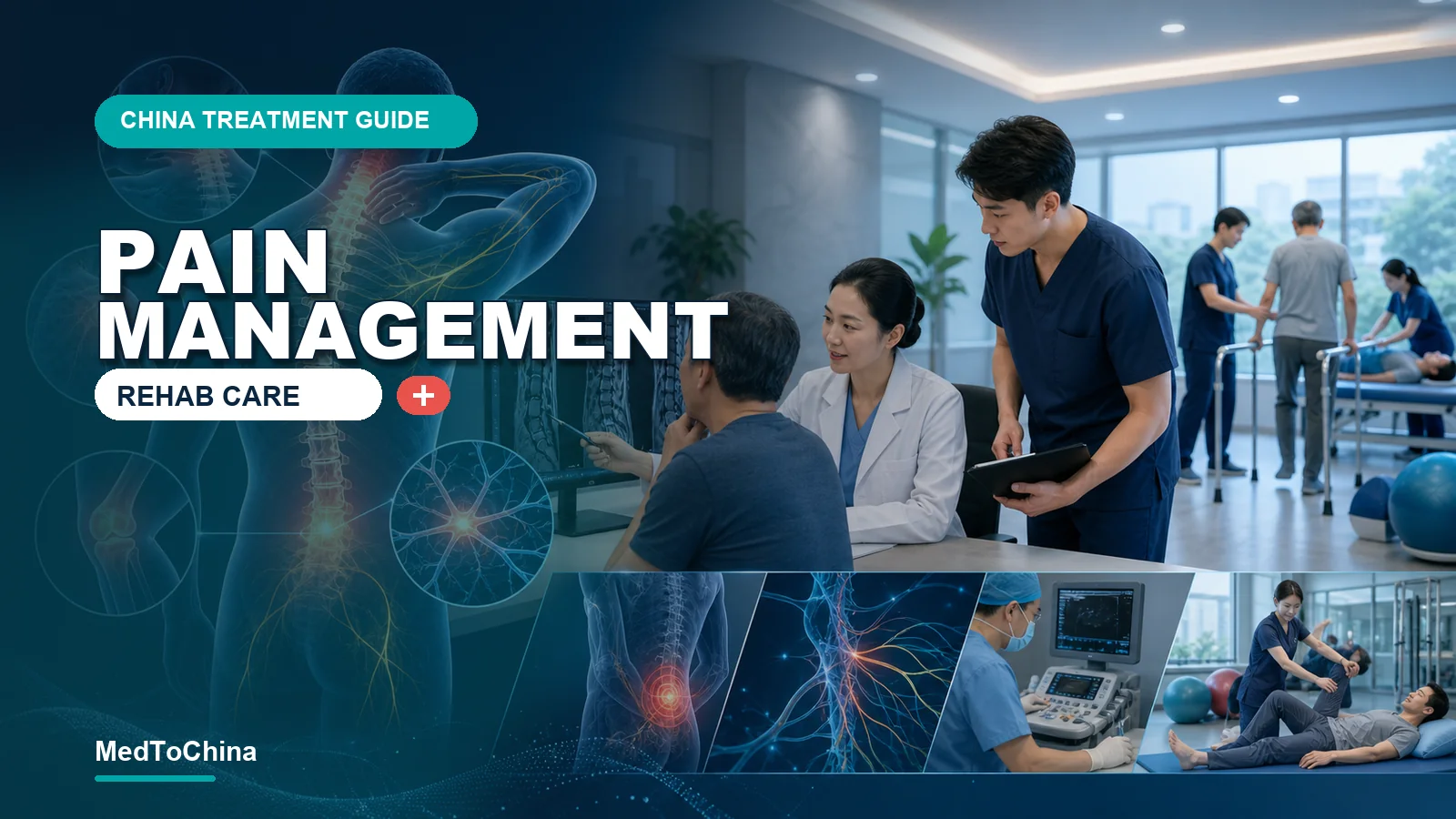
This page focuses on chronic and complex pain conditions. Pain management is a medical approach to diagnosing pain drivers and reducing pain with medication, procedures, rehabilitation, psychological support, and disease-specific treatment when needed. For patients and families, the medical terms can feel confusing. What matters most is understanding whether the condition is mild, urgent, progressive, treatable without surgery, or serious enough to require specialist intervention.
A good international-care plan should never start with travel alone. It should start with a clear medical question. Is the diagnosis correct? Are additional tests needed? Are there safe non-surgical options? If a procedure is needed, what are the risks, expected benefits, recovery steps, and follow-up requirements after returning home?
Who May Need Evaluation
Patients who may need evaluation include people with low back pain, sciatica, neck and shoulder pain, joint pain, neuropathic pain, postherpetic neuralgia, cancer pain, post-surgical pain, trigeminal neuralgia, or long-term pain that has not improved. Some people are looking for a first specialist review. Others already have a diagnosis but want a clearer plan, faster access, or a second opinion before committing to treatment.
Warning signs vary by condition, but patients should take symptoms seriously when they are getting worse, limiting daily life, causing repeated medical visits, or creating anxiety because the next step is unclear. International travel should not delay emergency care. If symptoms are sudden, severe, or unstable, the patient should seek local urgent medical attention first.
Diagnosis and Tests
Diagnosis may involve medical history, pain mapping, neurological examination, MRI or CT, X-rays, lab tests, medication review, cancer evaluation when relevant, and functional assessment. The exact workup depends on age, symptoms, previous results, medical history, and the hospital's clinical judgment. For international patients, the most useful preparation is to collect complete records before asking about hospital options.
Records should be clear, recent, and ideally available in English or with translation. Images are often as important as written reports. When possible, patients should bring original imaging files, lab results, discharge summaries, medication lists, allergy history, and previous operation notes. This helps hospitals avoid repeating unnecessary tests and helps coordinators identify the right department.
Treatment Options
Treatment may include physical therapy, medication review, nerve blocks, epidural steroid injections, radiofrequency procedures, trigger-point injections, cancer pain care, rehabilitation, sleep and mental-health support, and selected traditional Chinese medicine integration. The best option is not always the most aggressive option. A responsible care plan should balance symptom severity, diagnosis, evidence, patient goals, travel safety, recovery time, cost, and follow-up needs.
Some patients need monitoring or conservative treatment. Some need a procedure or surgery. Others need a multidisciplinary plan because the problem involves more than one organ system or specialty. Patients should be cautious of any service that promises a single treatment before a qualified doctor has reviewed the case.
Why Consider Treatment in China
International patients usually consider China because of access, coordination, cost expectations, or waiting time. large hospitals can coordinate pain medicine, rehabilitation, orthopedics, neurology, oncology, imaging, and Chinese medicine services when appropriate. For patients from the United States, the issue may be high out-of-pocket costs or insurance limitations. For patients from Canada, the United Kingdom, or Australia, waiting time for elective or specialist care may be a major concern. For patients from the Middle East, Southeast Asia, and Africa, the priority may be access to tertiary hospitals, senior specialists, international departments, and a smoother care journey.
China is not the right choice for every case. The strongest candidates are medically stable patients who can travel safely, have clear records, and can stay long enough for evaluation, treatment, early recovery, and follow-up. The value is not only the medical appointment. It is the ability to coordinate hospitals, translation, logistics, and post-visit documentation in a structured way.
Beijing, Shanghai and Guangzhou Hospital Access
Beijing, Shanghai, and Guangzhou are important medical hubs with Grade 3A public hospitals, international departments, private hospitals, and specialty centers. Depending on the condition, patients may need a large public hospital with deep specialty experience, an international department with language support, a private hospital with more flexible scheduling, or a specialty hospital focused on a specific field.
Hospital selection should be based on diagnosis, urgency, complexity, budget, language needs, preferred city, and the expected length of stay. MedToChina can help patients understand possible pathways, but the hospital and doctors determine medical suitability.
Cost, Scheduling and Expectations
International patients often ask for a price before doctors have reviewed the case. A rough range may sometimes be available, but final costs depend on the hospital, diagnosis, tests, procedure type, anesthesia, medicines, implant or device choices, length of stay, complications, and follow-up needs. For this reason, cost discussions should be treated as planning estimates rather than guaranteed quotes.
Scheduling also varies. Some cases can be arranged quickly when records are complete and the patient is medically stable. Complex cases may require additional review, specialist triage, or repeat testing after arrival. Patients should leave room in their travel plan for unexpected findings, extra appointments, or changes in treatment recommendations.
The most realistic expectation is a coordinated pathway, not an instant answer. Good planning reduces confusion and helps patients avoid arriving in China with missing records, unrealistic timelines, or the wrong hospital department.
What Patients Often Ask Online
Patient forums such as Reddit are useful for understanding what people worry about, even though they are not medical evidence. For this condition, common online concerns include whether nerve blocks work, how long injections last, fear of being dismissed, opioid limits, chronic back pain frustration, cancer pain control, and whether rehabilitation can help. These questions are important because they reflect the real patient experience: fear of pain, uncertainty about recovery, confusion about options, and concern about whether care abroad is safe.
Medical decisions should not be based on forum stories. However, those stories can help patients prepare better questions for doctors. A useful consultation should address expected benefits, realistic limitations, alternatives, side effects, follow-up, travel timing, and what to do if symptoms change after returning home.
How MedToChina Supports the Care Journey
A typical MedToChina pathway may include:
- The patient contacts MedToChina through the website or WhatsApp.
- The patient shares symptoms, goals, and available medical records.
- A care coordinator reviews the request for hospital-matching purposes.
- Possible hospital pathways in China are discussed.
- Appointment timing, translation, city choice, travel needs, and expected process are coordinated.
- The hospital performs the medical evaluation and explains treatment options.
- If treatment proceeds, the hospital manages medical care while MedToChina supports communication and logistics.
- After the visit, patients keep discharge summaries, test results, and treatment documents for follow-up at home.
This model is designed for coordination. It is not a substitute for a doctor's diagnosis.
What Records to Prepare
Before contacting MedToChina, prepare pain location and duration, MRI or CT reports, prior injections, medication list, cancer records, neurological symptoms, surgery history, and pain scores or functional limits. Patients should also share age, sex, nationality or current country, travel availability, preferred city in China, major medical conditions, current medications, allergies, and the main question they want answered.
Good records make the process faster and safer. They help the coordinator avoid sending the patient to the wrong department and help hospitals understand whether the case is appropriate for planned care in China.
Risks, Limits and Travel Considerations
Every medical pathway has risks. These may include incorrect expectations, incomplete records, complications from procedures, delayed recovery, medication issues, language barriers, and difficulty managing follow-up after returning home. Procedures and surgeries may also involve bleeding, infection, anesthesia risk, pain, scarring, or the need for further treatment, depending on the condition.
International travel adds another layer of planning. Patients should consider flight duration, mobility, infection risk, blood clot risk, medication supply, passport and visa requirements, caregiver support, and whether they have a local doctor for follow-up after returning home. Patients with unstable symptoms, emergency conditions, or high travel risk should seek local medical care first.
Frequently Asked Questions
What types of pain can a pain clinic treat?
Pain clinics often assess back pain, neck pain, nerve pain, joint pain, cancer pain, post-surgical pain, and complex chronic pain. The right pathway depends on diagnosis.
Are nerve blocks permanent?
Usually no. Some blocks are diagnostic or temporary. Radiofrequency or other procedures may last longer for selected patients, but results vary.
Will I only receive painkillers?
Good pain care should not rely only on medication. It may combine diagnosis, procedures, rehabilitation, sleep support, mental-health support, and disease-specific treatment.
Can cancer pain be controlled?
Many cancer pain cases can be improved with structured medication, procedures, oncology coordination, and palliative care, but plans must be individualized.
Is travel safe with severe pain?
It depends on mobility, neurological symptoms, cancer status, clot risk, and medication needs. Some patients should not travel until stabilized.
Can MedToChina prescribe pain medication?
No. MedToChina does not prescribe medication. It can coordinate hospital access and translation support.
Talk to MedToChina
Considering care in China for chronic and complex pain conditions? Send your questions and medical records through WhatsApp. MedToChina can help you understand hospital options in Beijing, Shanghai, and Guangzhou, coordinate appointments, arrange medical translation, and support travel planning.
MedToChina is not a healthcare provider and does not provide diagnosis, treatment, or medical advice. All medical decisions must be made with licensed physicians.
Medical Disclaimer
This article is for general educational and planning purposes only. It does not replace professional medical advice, diagnosis, or treatment. Not every patient is suitable for treatment or international travel. Always consult licensed medical professionals before making healthcare decisions.
References
- CDC 2022 Clinical Practice Guideline for Prescribing Opioids for Pain. https://www.cdc.gov/mmwr/volumes/71/rr/rr7103a1.htm
- IASP. Definitions of Chronic Pain Syndromes. https://www.iasp-pain.org/advocacy/definitions-of-chronic-pain-syndromes/
- WHO. Cancer Pain Relief. https://www.who.int/publications/i/item/9241544821
- MedToChina. https://medtochina.net/