
General
Medical Treatment in Shanghai: What International Patients Should Know Before Planning Care
Learn how international patients can think about medical treatment in Shanghai, including hospital types, international services, records, travel planning, payment questions, and WhatsApp communication before coming to China.
MedToChina Editorial Team · 7 min read · August 28, 2026
Quick Summary
- Shanghai is one of China’s major medical-service hubs and may be relevant for international patients seeking planned care, specialist evaluation, or international medical services.
- The right Shanghai pathway depends on specialty fit, records, language support, payment process, expected stay, and safe follow-up after returning home.
- Patients should not choose a Shanghai hospital only because of brand recognition; condition fit and care pathway matter more.
- Public tertiary hospitals, international departments, and private hospitals may each suit different needs, but service scope varies.
- MedToChina can receive records and questions through WhatsApp before discussing what information may be needed for possible care planning in Shanghai.
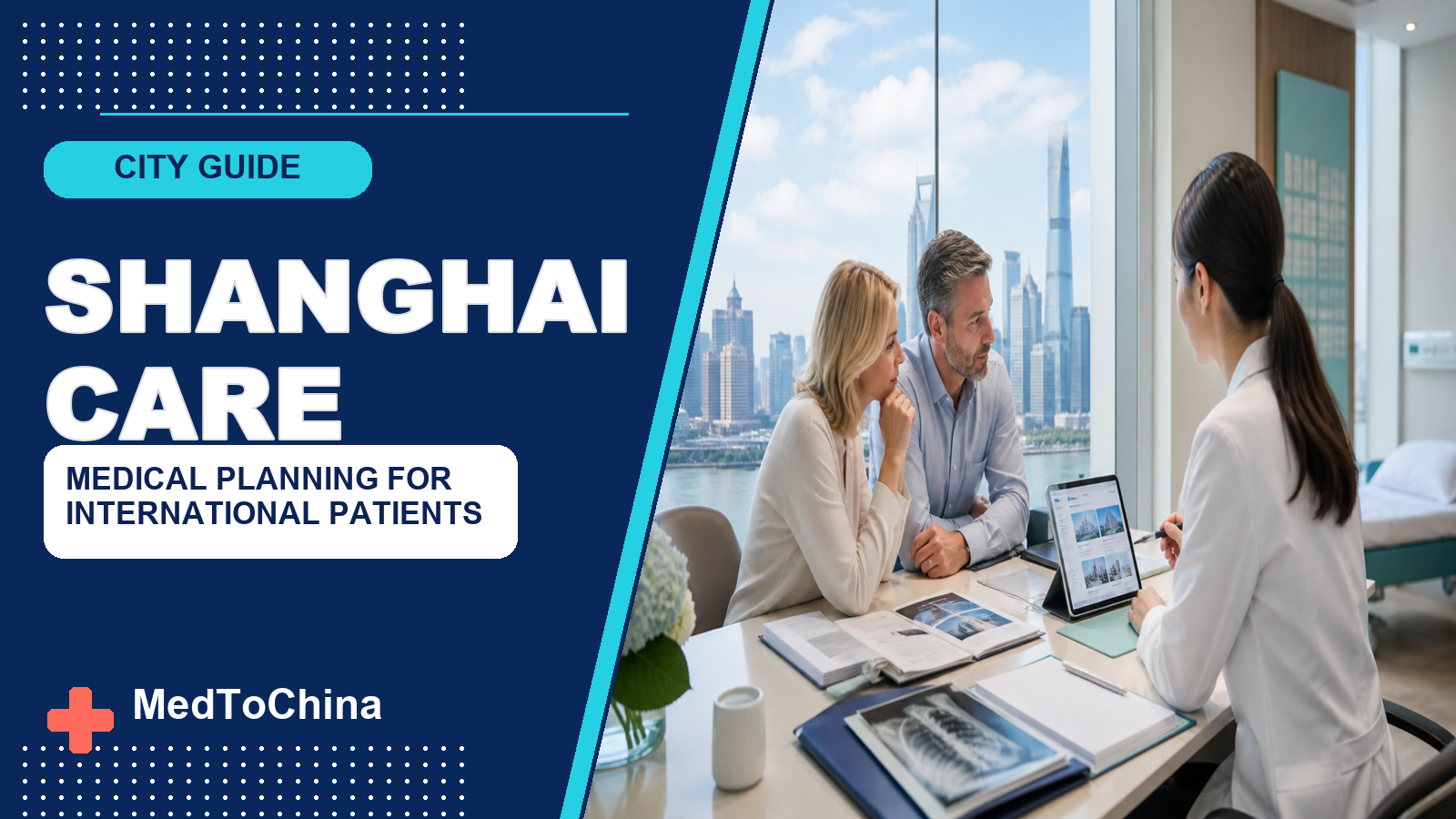
International patients searching for medical treatment in Shanghai are usually not looking for a tourism-style city introduction. They want to know whether Shanghai is a practical place to discuss medical care in China, how hospital choices differ, what records are needed, and what should be clarified before travel. This guide is written for overseas patients considering planned medical care in China through information submission and WhatsApp follow-up.
Why international patients may consider Shanghai
Shanghai is one of China’s largest medical and transportation centers. For overseas patients, that can make it relevant for planned care that requires specialist depth, city-level convenience, and a broad mix of hospital settings. The city combines major public tertiary hospitals, international medical services, private hospitals, strong air links, and a large supply of hotels and recovery-friendly accommodation.
The practical value of Shanghai is not only that it is well known internationally. It is that the city can offer different care settings for different needs. Some patients may care most about specialist resources in a high-volume public hospital. Others may care more about communication, payment clarity, or the logistics of traveling with a companion. Shanghai can be worth discussing when those practical questions matter.
Even so, Shanghai is not automatically the best city for every overseas patient. A famous city name does not answer whether the needed specialty is available, whether the patient is fit to travel, or whether the likely pathway is realistic. Those questions depend on the condition, records, timing, and treatment goals.
What Shanghai’s hospital landscape can look like
Shanghai’s hospital landscape can be understood as several overlapping pathways rather than one single system. Public tertiary hospitals usually carry strong specialist depth, high patient volume, and broad subspecialty coverage. International medical services or international departments may provide a smoother experience for registration, payment, language support, and communication, but they do not necessarily offer every inpatient or high-complexity treatment through the same route. Private hospitals may provide a more familiar service model for some foreign patients, yet the service range and specialist availability can differ from major public hospitals.
Official Shanghai guidance for overseas visitors also distinguishes between public and private medical institutions. That is useful because international patients often assume that all hospitals work in the same way. They do not. Appointment flow, waiting process, payment method, inpatient arrangements, and follow-up may vary significantly.
Patients should therefore avoid asking only, "Which hospital is the best in Shanghai?" A better question is, "Which type of Shanghai pathway fits my condition, records, language needs, budget range, and travel situation?"
International medical services in Shanghai
Shanghai has publicly stated that it is strengthening international medical services. Official city sources have described pilot public hospitals, multilingual support, and service pathways aimed at overseas visitors and foreign residents. This context matters because it shows that foreign-patient communication is not an afterthought in the city.
At the same time, patients should keep expectations realistic. "International medical services" does not mean that every department offers the same level of English support, every test can be arranged quickly, or every complex treatment fits a simplified pathway. Service scope may differ by hospital, specialty, doctor schedule, and whether care is outpatient or inpatient.
For some patients, Shanghai’s international service environment may make first communication easier. For others, the real decision still depends on records and specialty fit rather than the existence of an international desk or English-language page.
Which patients may need more careful Shanghai planning
The more complex the case, the more planning matters. Cancer care, hematology, major surgery, cardiovascular disease, neurology, fertility care, rare disease, complicated orthopedics, and multi-specialty evaluation often require more than one appointment and more than one department. These situations usually need records before travel and may require longer local stay planning.
Some lower-complexity or more standardized services may be easier to plan. Executive screening, ophthalmology workups, second-opinion-style record review questions, dental procedures, selected fertility testing, and some outpatient evaluations may have a more predictable travel structure. Even then, timing, fasting rules, medication questions, and report turnaround still matter.
For international patients, the issue is not whether Shanghai has good hospitals in general. The issue is whether the patient’s specific question can be translated into a safe and realistic care pathway.
Travel and stay logistics in Shanghai
Shanghai is often attractive because the travel side may feel easier than in many cities. It has major international airports, urban rail connections, broad hotel supply, and neighborhoods familiar to international visitors. Those advantages help, but medical travel should not be planned like a normal city trip.
Patients should ask practical questions early:
- How far is the accommodation from the hospital?
- Is there elevator access and enough room for a caregiver?
- If the patient has mobility limits, is local transport realistic?
- Will the patient need rest days before tests or procedures?
- Is a short-stay hotel enough, or is a longer apartment-style stay safer?
A patient traveling for a checkup may need one type of setup. A patient traveling for surgery, repeated treatment, or monitoring may need a very different plan. Distance, stair access, diet, recovery support, and return-airport timing all become more important than general city convenience.
Cost, payment, and communication questions
Before planning care in Shanghai, international patients should clarify what a cost estimate may include, what it does not include, whether a deposit is required, how payment is handled, whether inpatient and outpatient billing differ, and what documents can be issued for reimbursement or insurance review. International departments, VIP-style services, and private hospitals may use different billing structures from standard public hospital pathways.
It is also important not to compare Shanghai with another China city using only a headline price or a marketing phrase. A more useful comparison looks at specialty fit, communication support, stay length, expected diagnostics, surgery or treatment setting, and likely follow-up needs after leaving China.
For some patients, a clearer and more manageable pathway may be more valuable than a lower but less predictable estimate.
What records to prepare before asking about Shanghai care
Before any detailed discussion, overseas patients should organize:
- Diagnosis and main medical question
- Recent reports and discharge summaries
- Imaging files or radiology reports when relevant
- Pathology and biomarker reports for cancer-related questions
- Lab tests, medication list, allergies, and major past treatment history
- Current symptoms, performance status, and major travel-safety concerns
- Country of residence, preferred timeline, language needs, and budget range
For surgery, prior operation notes and anesthesia-related issues can matter. For cancer, pathology, staging, biomarker results, and recent scans are especially important. For checkups or screening, age, sex, symptoms, family history, and prior screening results should be included.
The point of sending records first is not bureaucracy. It is to avoid discussing the wrong city or the wrong pathway before the facts are clear.
How to think about hospital choice responsibly
Overseas patients often start with hospital names because names are easy to search. In practice, the safer sequence is:
- Clarify the medical question.
- Organize the available records.
- Check whether travel appears reasonable.
- Understand likely cost and stay implications.
- Then discuss possible Shanghai pathways.
This order helps avoid common mistakes. A famous hospital may not be the best practical fit if language support is limited for that specialty, if the patient needs a different care setting, or if the case requires records that are not yet ready. City choice should support the treatment question, not replace it.
MedToChina’s role at the page level is to help patients understand this framework. Specific resource discussion should happen later through WhatsApp after the patient’s condition, records, budget range, and travel goals are understood.
Why Shanghai may be part of a China care discussion
For international patients considering medical care in China, Shanghai is often discussed alongside Beijing and Guangzhou because it combines major hospitals with strong international transport and a wide range of service environments. That can be useful for patients who value city convenience, global flight access, and the possibility of choosing between different hospital types.
But the city itself is only one part of the decision. Patients still need to think about whether they can travel safely, whether follow-up can be handled after returning home, how long they may need to stay in China, and whether a companion is needed. These are practical questions that affect whether a Shanghai plan is realistic.
How MedToChina supports communication and preparation
MedToChina can receive your Shanghai-related questions, records, and travel constraints through WhatsApp. After understanding your medical condition, country of residence, available records, language needs, budget range, and preferred timeline, the customer service team can discuss what information may still be needed before possible care planning in China.
The page itself does not diagnose, select a doctor, guarantee hospital access, or promise an outcome. The useful first step is to submit organized information and questions. Customer service can then follow up on missing records, unclear goals, or practical concerns through WhatsApp.
What to send before WhatsApp communication
- A short diagnosis and treatment timeline
- Key reports, imaging, pathology, and lab results when relevant
- Current medication list and any significant allergies
- Current symptoms and major travel-safety concerns
- Country of residence, preferred travel window, and language needs
- Your main planning question, such as city choice, records gap, cost estimate, or expected stay
FAQ
Is Shanghai a good city for medical treatment in China?
Shanghai has major medical resources and international-service capacity, but suitability depends on your condition, records, budget, language needs, and follow-up plan.
Are public and private hospitals in Shanghai the same for international patients?
No. They may differ in specialist depth, registration flow, billing, service model, and inpatient arrangements.
Do Shanghai hospitals offer international medical services?
Some hospitals and pilot institutions do, but scope varies by specialty, service setting, and hospital process.
Should I choose a hospital only because it is famous?
No. Specialty fit, records, travel readiness, communication needs, and practical care pathway matter more than general reputation alone.
What should I send before asking about Shanghai care?
Send your diagnosis, key reports, current symptoms, country of residence, preferred timeline, and the main decision you are trying to make.
WhatsApp CTA
Send your diagnosis, key records, current symptoms, country of residence, preferred timeline, and Shanghai-related questions through WhatsApp. MedToChina’s customer service team can discuss what information may still be needed before exploring a possible care pathway in China.
Medical Disclaimer
This article is for general health information and international patient planning only. It does not provide a diagnosis, treatment recommendation, eligibility decision, or guarantee of hospital access, and it does not replace in-person evaluation by qualified medical professionals. Suitability for travel, testing, treatment, surgery, or follow-up must be assessed by licensed clinicians who can review the patient’s full medical history and current condition.