
Insurance & Claims
After Care in China: Responding to an Insurer's Request for Missing Documents
Organize a written insurer request, China medical records, invoices, and receipt tracking after your medical care in China.
MedToChina Editorial Team · 10 min read · November 12, 2026

Quick Summary
An insurer's request for more documents after medical care in China is not, by itself, a coverage decision or a promise of payment. Treat the written notice as a checklist: keep its claim reference, list every requested item, identify who issued the original document, and keep a record of what you send and how it was received. Do not guess missing facts, alter a hospital record, or assume another insurer's document rules apply to yours. MedToChina can help overseas patients organize available China-care records and practical communication through WhatsApp; your insurer decides claim handling and payment.
Start with the insurer's written request, not a memory of the call
After submitting an insurance claim for care received in China, you may receive a message saying that additional information is needed. The message may arrive in a member portal, email, letter, or claim-status notice. Start with the actual written request. Save the complete notice as a PDF or image before you begin collecting documents.
This matters because a request can refer to a specific claim, service date, provider, or form. An Explanation of Benefits, or EOB, may contain a claim number, dates of service, provider details, service descriptions, and remark codes. CMS explains that an EOB is not a bill; it is a statement explaining how a claim was processed. Keep it alongside the insurer's request, but do not assume it tells you what to pay or that the claim is finalized.
Create one working copy for organization and keep the original notice unchanged. If the notice is vague, preserve the exact wording. “Please provide supporting documentation” is not the same as a request for a named document. Your first task is to make the request traceable, not to infer what an insurer might prefer.
Build a missing-document tracker
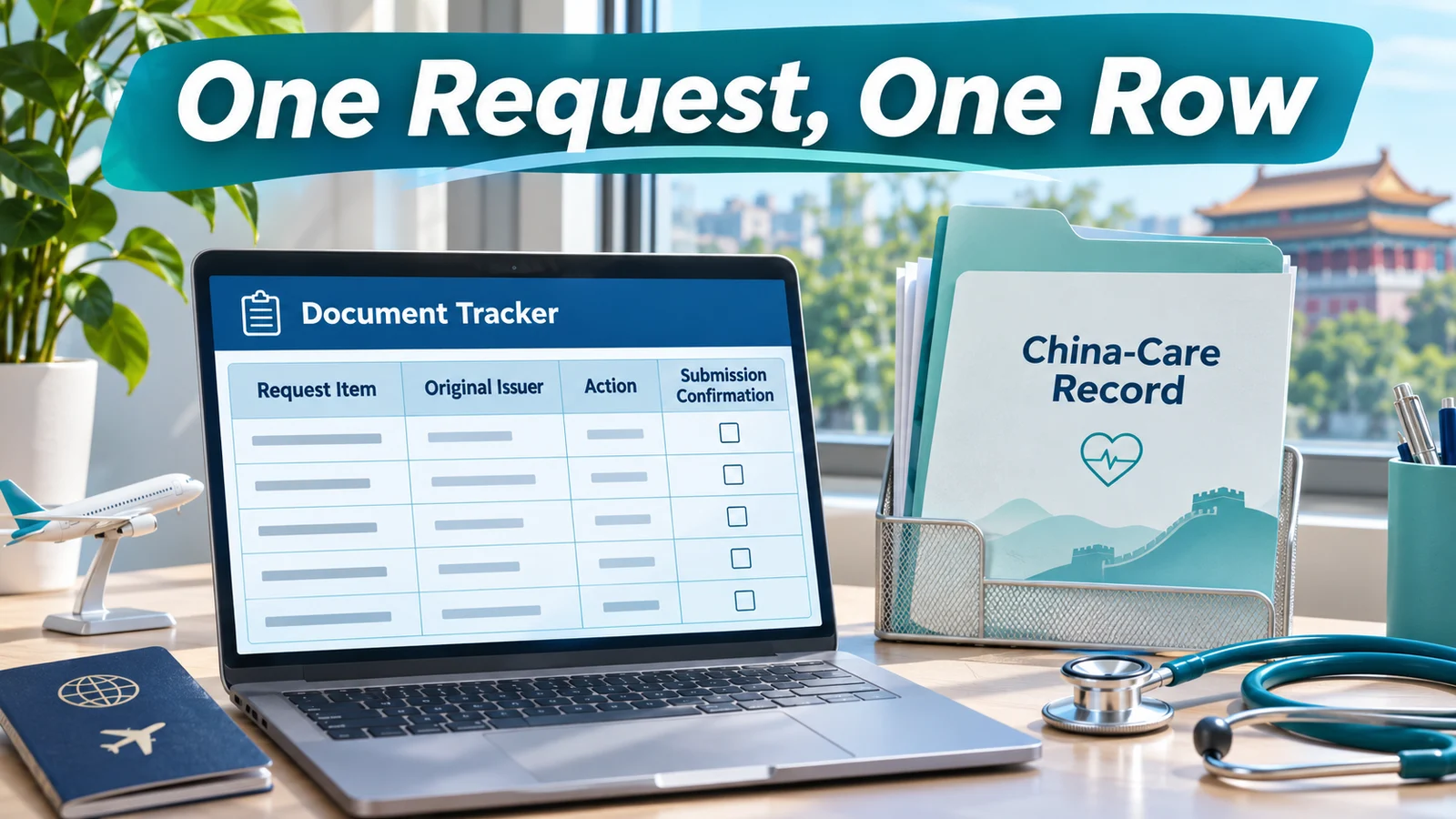
A small tracker prevents an international claim from becoming a collection of unlabeled files. Use a spreadsheet, notes table, or paper page with one row for each requested item. Keep the insurer's wording in the first column.
Suggested columns:
- Request item: Exact wording from the notice
- Claim reference: Claim number as shown
- Date(s) of service: Dates exactly as shown
- Original issuer: Hospital, clinic, lab, patient, or insurer
- Existing file: File name and language
- Action taken: Requested / available / unclear
- Submission method: Portal, email, mail, or other method named by insurer
- Receipt or confirmation: Upload ID, email sent time, or delivery record
Do not replace the insurer's exact wording with your own conclusion. If a notice says “itemized bill,” write that phrase. If it says “medical record,” do not automatically label an invoice as the requested record. The tracker should show where a document came from and whether it responds to the stated request.
If more than one claim is involved, keep separate rows or separate trackers. A document from one admission, clinic visit, or date of service may not belong to another claim. Date labels are especially helpful when care in China involved several departments or follow-up visits.
Identify who can provide each document
Before asking for a new copy, identify the original issuer. Common sources include:
- The hospital billing or international-service office for invoices, itemized billing documents, payment receipts, or hospital-issued confirmations.
- A clinic, department, laboratory, or imaging center for records created by that service.
- The insurer or plan administrator for the claim notice, claim number, coverage correspondence, or form.
- You or a policyholder for proof of payment, travel-related paperwork, or policy documents already in your possession.
The right source depends on the request. A hospital cannot rewrite an insurer's notice. An insurer cannot normally recreate the original hospital invoice. Keep the roles separate in your tracker.
If you contact a hospital office in China, send the claim reference only when it is relevant to locating the request. Explain what document you are seeking, the patient name as used by the hospital, the date of service, and the department or facility if known. Ask whether an existing document can be reissued, and retain the answer. Do not ask anyone to create a document with facts they cannot verify.
For documents in Chinese or another language, preserve the original first. A translation may be useful only if the insurer asks for one or you need it to understand the record. Keep the translated copy linked to the original by page number or file name. Do not edit the original scan or remove information because it looks unfamiliar.
Keep invoices, receipts, and clinical records distinct
Insurance requests can use broad terms, but different records serve different purposes. An invoice or itemized bill generally describes charges. A receipt may show a payment transaction. A clinical document may describe care, findings, or a service record. A claim notice or EOB is an insurer document.
Put each document into a plainly named folder:
- Insurer notices and claim references.
- Hospital invoices and itemized billing documents.
- Payment receipts or transaction confirmations.
- Clinical records, test reports, and discharge materials.
- Translations, if any, marked as translations.
- Submission confirmations and communication log.
Do not combine pages into a new document if doing so breaks the original order or makes the source unclear. If you create a cover page for your own use, label it “patient-prepared index” and do not present it as a hospital or insurer record.
An insurer may ask for a document that you do not have. Write this down without filling the gap with an estimate. For example: “Itemized document requested on [date]; original issuer contacted on [date]; awaiting response.” That is more useful than substituting a different record and assuming it satisfies the request.
Check the claim reference and service dates before sending
Before uploading or emailing anything, compare four fields across the notice and the document:
- Claim number or reference number.
- Patient name spelling.
- Date or date range of service.
- Hospital, department, clinic, or issuing entity.
The goal is not to decide whether an insurer should pay. It is to reduce obvious misfiling. A document can be authentic and still relate to a different visit, family member, or claim. If the notice and the document do not appear to connect, flag the mismatch in your tracker and ask the insurer how it should be handled.
Do not create a new date, change a name field, or add a code to make files appear consistent. If a passport spelling and hospital registration spelling differ, preserve both and keep the relevant supporting record. State the discrepancy factually when the insurer requests an explanation. For conflicting medical records, see how to keep the original and corrected versions.
CMS guidance on claim disputes advises people to keep copies of information they receive and send, including notes and dates from relevant conversations. This is a useful general recordkeeping practice for an international claim as well: keep a dated communication log, but do not treat it as proof that a claim will be approved.
Ask targeted clarification when the request is unclear
If a request does not identify the document clearly, use the insurer's official member-service channel shown on the notice or insurance card. Ask short, factual questions:
- Which claim reference does this request apply to?
- Which date or dates of service are included?
- Is the requested item an invoice, payment record, clinical document, translation, or a different document?
- Is there a named submission channel or a reference that should appear with the files?
- If an original China-issued record is not available, can the insurer explain what alternative it will consider?
Write down the date, time, representative name or identifier if provided, and a neutral summary of the answer. A phone conversation can clarify process, but keep the written notice and any written follow-up. Do not rely on an informal conversation as a change to the insurer's requirements unless the insurer confirms it through its own documented process.
Different policies and jurisdictions have different rules. This guide does not set a filing deadline, authentication requirement, tax rule, translation standard, or appeal path. Follow your policy documents and the insurer's own written instructions.
Submit copies, preserve originals, and capture proof of submission
When your insurer accepts digital submission, use the channel specified in its notice or member portal. When it asks for a particular format, follow that instruction rather than converting files unnecessarily. Before submitting, check that each file opens, contains every page, and has a name that makes its source and date clear.
For your own records, retain:
- The original hospital and insurer documents.
- A copy of exactly what you sent.
- The submission date and method.
- Any portal upload reference, confirmation email, or courier receipt.
- A log of follow-up messages or calls.
CMS advises retaining originals and submitting copies in the context of claim and appeal paperwork. That distinction is useful for international patients too: you may need the original China-issued record later, even after you send a digital copy.

What MedToChina can and cannot do
If you received care in China and need to organize existing hospital materials for an insurer, you can send MedToChina your available records and questions or contact us on WhatsApp. We can help you identify the documents you already hold, organize a practical document list, and support communication around China-care records and travel-related logistics.
MedToChina does not decide coverage, promise reimbursement, interpret policy terms, issue insurer requirements, or alter hospital documentation. The insurer controls its claim process. Hospital-issued clinical and billing documents remain the responsibility of the issuing institution.
FAQ
Does a request for more documents mean my claim was denied?
Not necessarily. Insurers may request additional information while reviewing a claim. Read the wording of your notice and claim status. A request is not a promise that payment will follow, and it is not automatically a final denial.
Should I send every medical document I have?
Start with the items named in the request. Keep other records organized in case clarification is needed. Avoid sending unrelated sensitive information simply because it is available.
What if the hospital document is in Chinese?
Keep the original Chinese document intact. Check the insurer's written request or ask through its official channel whether it needs a translation or another format. Do not create your own translated clinical interpretation.
What if I cannot obtain a requested document?
Record the request, the original issuer, the attempts you made, and any response received. Ask the insurer what alternative document, if any, it will consider. Do not substitute an invented or altered record.
Can MedToChina guarantee that an insurer will reimburse care in China?
No. We can support record organization and practical communication. Reimbursement, coverage, and claim decisions are made by the insurer under the policy and its own process.
Send Your Existing Records
For help organizing China-care documents after an insurer requests more information, submit your available records and questions to MedToChina or contact us on WhatsApp. We can help you prepare a clear document inventory for communication. Insurance coverage and payment decisions remain with your insurer.
Medical and Insurance Disclaimer
This article provides general education and document-organization information for overseas patients who received medical care in China. It is not medical advice, legal advice, tax advice, insurance coverage advice, a claim decision, or a promise of reimbursement. Follow your insurer's written instructions and seek professional advice appropriate to your policy or jurisdiction when needed.
References
- Centers for Medicare & Medicaid Services. How to Read a Health Insurance Explanation of Benefits.
- Centers for Medicare & Medicaid Services. Has Your Health Insurer Denied Payment for a Medical Service?.
- UnitedHealthcare. Get the Facts: Why Was My Claim Denied, and What Can I Do About It?.
- Blue Cross Blue Shield. Frequently Asked Questions.