
General
Drug Approval and Hospital Availability in China: What International Patients Should Check
A practical guide for international patients on why a medicine approved in China may still require hospital, supply, clinical and travel checks.
MedToChina Editorial Team · 7 min read · October 16, 2026
Quick Summary
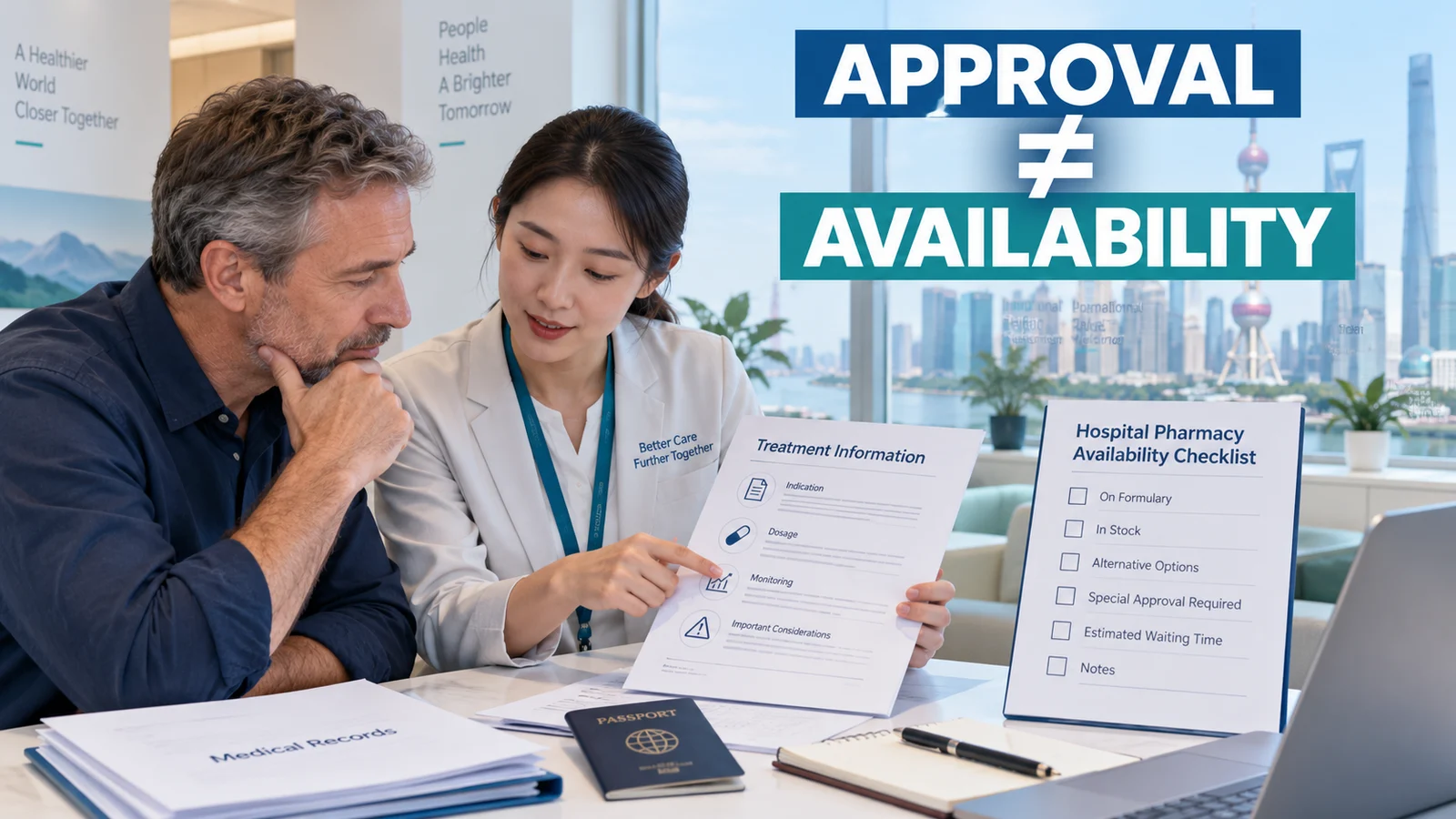
A medicine being approved for marketing in China and a hospital being able to use it for one specific patient are different questions. Approval is a regulatory status. Hospital availability can also depend on the approved indication, the hospital's medicine list and purchasing process, current supply, the treating team's clinical judgment, required tests, and the patient's condition.
For international patients, travel timing, documentation and local-care continuity add further practical questions. This guide explains how to prepare for a factual discussion about a medicine in China. It does not confirm that a medicine is in stock, appropriate, reimbursable, obtainable, or suitable for any individual. It also does not replace advice from the patient's current treating team.
Reviewed October 16, 2026.
Approval Is Not the Same as Hospital Use
China's Drug Administration Law establishes a regulatory approval and marketing-authorization framework for medicines. In broad terms, approval concerns whether a medicine may be marketed under its approved information. It does not mean every hospital carries it, every department can prescribe it, every formulation is currently supplied, or every patient meets the relevant clinical conditions.
Think of the process as several separate checkpoints:
- Regulatory status: Is the medicine authorized in China, and for what labelled use?
- Hospital formulary and procurement: Is it included in the hospital's medicine list or obtainable through its current process?
- Supply and timing: Is the right product, strength and formulation available when it is clinically needed?
- Clinical assessment: Does a qualified treating team consider it relevant after reviewing diagnosis, tests, prior therapy, risks and current condition?
- Patient logistics: Can records be transferred, travel be arranged safely, and follow-up be coordinated?
These checkpoints should not be collapsed into a single claim such as "the drug is available in China." Each can change over time and may vary by hospital, city, product and patient.
What Marketing Approval Tells You
Approval information can help a patient ask sensible questions. Official product information may identify the marketing authorization holder, approved process, quality standards, package insert and label information. It can also indicate a specific indication, dosage form, warnings, storage requirements and other conditions of use.
However, do not rely on a search result, news story, social-media post or a medicine name alone. Brand names, transliterations and formulations can differ across markets. A medicine may have a related but non-identical product name in another country. An approval may concern one indication but not another, or one formulation but not another.
For any proposed medicine, preserve the exact generic name, brand name if known, dose form, strength, disease type, biomarker or pathology information, and the reason the current team discussed it. This avoids confusion before any China-care discussion begins.
Why a Hospital May Not Have Immediate Access
Hospital access involves more than regulatory authorization. Public medical institutions use formulary, procurement and medicine-management processes. National and local procurement policies, demand estimates, supplier arrangements, storage, department practice and clinical demand can affect what a hospital carries at a given point. A specific medicine could be on a medicine list but not immediately on hand, or an institution may use a different pathway to assess a request.
This is not evidence that a hospital's quality is better or worse. It is a normal operational distinction: regulatory approval, institutional adoption, procurement, inventory and individual clinical use are separate layers. A hospital pharmacist and treating clinical team are the appropriate sources for current, patient-specific confirmation.
For complex therapies, further details can matter: infusion capacity, monitoring requirements, test turnaround, handling conditions, required supportive care, and whether the relevant department can assess the patient's records. None of these should be inferred from an online approval notice.
The Clinical Question Is Separate Again
Even if a medicine is authorized and can be sourced by an institution, a clinician still has to decide whether it is relevant for the patient. That may depend on the exact diagnosis, pathology, stage, prior treatment, organ function, infections, allergies, interactions, laboratory findings and treatment goals. Some medicines need particular biomarker, pathology or safety information; some require monitoring or may not be appropriate when specific risks are present.
Patients should never change medicines, bring prescription medicines across borders, order products from informal sources, or arrange travel based solely on an assumed access pathway. The current treating team should remain involved in immediate-care and travel decisions.
Records to Prepare Before Asking About a Medicine in China
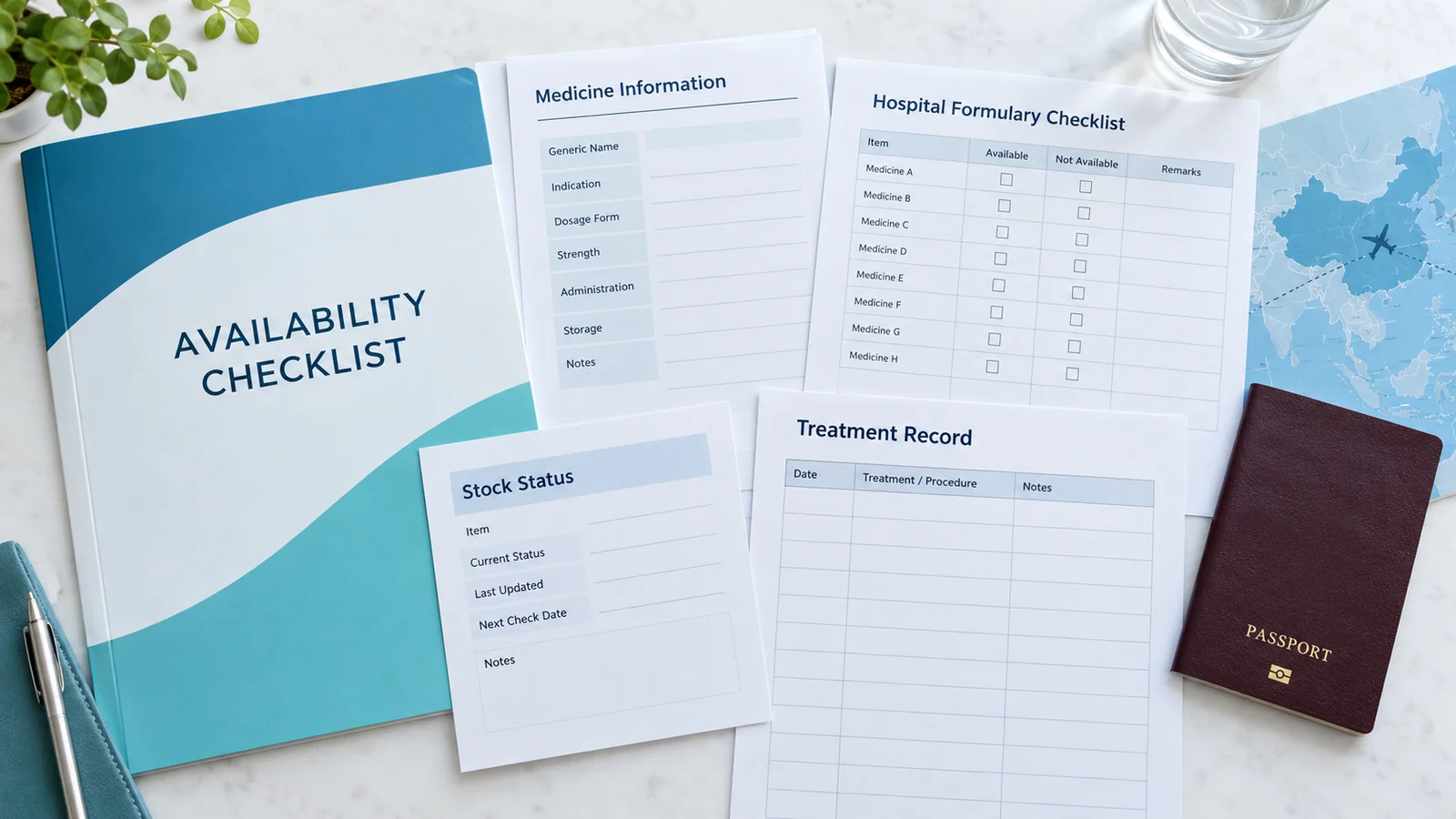
Prepare one secure, dated folder. Start with:
- Latest oncology, hematology, neurology or specialty clinic summary, as relevant
- Original diagnosis and pathology report, plus newer biopsy or pathology review if available
- Relevant biomarker, molecular, laboratory and imaging reports
- A treatment timeline: names, dates, doses or cycles where recorded, response, reason for stopping and major adverse effects
- Current medicine list, allergies, recent hospitalizations, infection history and significant safety events
- The exact medicine question: generic name, brand if known, form, strength, indication discussed and question for the clinical team
- Current treating-team contact details and a short symptom summary
Keep original-language documents. If a translation is needed, preserve dates, measurement units, medicine names and uncertainty. A translation should not turn a suspected condition or incomplete result into a confirmed finding. Do not send passports, payment information or full medical files through public channels.
Questions to Ask Without Assuming an Answer
When preparing a China-care conversation, use questions that separate the stages:
- Is the question about marketing authorization, hospital formulary, supply, clinical relevance, or all of these?
- What exact generic name, formulation, strength and intended indication should be checked?
- Which pathology, biomarker, imaging or treatment records are needed before a clinical team can review the situation?
- Are there safety issues, current symptoms, ongoing treatment or recent admissions that the current team says must be addressed before travel?
- Does the hospital need a complete medical summary before it can say which documents should be translated or transferred?
- What information about expected monitoring, local follow-up and return travel should be considered if an in-person visit becomes relevant?
These questions are not a request for a promise. They help prevent the common mistake of treating an approval notice as a complete care plan.
Cost, Timing and Travel: Keep Expectations Realistic
Regulatory approval does not establish a price, an insurance outcome, a schedule, an appointment, a supply date or a course of treatment. International patients may face administrative, translation, payment, travel and accommodation steps that are separate from the medical discussion. Requirements can also change while a case is being reviewed.
Do not make irreversible travel or payment decisions until the relevant clinical and hospital processes have been clarified. If the patient has urgent symptoms or is clinically unstable, local care should take priority over travel planning. Ask the current treating team about medical fitness to travel and continuity of medicines before leaving the country where care is underway.
How MedToChina Can Support Communication
MedToChina can help international patients organize the medicine question, medical records and practical questions for a China-care service conversation. This support is for communication and logistics. It does not assess a patient, prescribe a medicine, determine eligibility, confirm supply, or make a treatment decision. Any clinical decision must remain with qualified clinicians who review the patient's specific case.
A Simple Preparation Sequence
First, ask the current treating team which issue is clinically urgent and whether travel should wait. Second, collect the exact medicine details and the records that explain the diagnosis, treatment history and current status. Third, make a dated one-page index so a receiving service can see which documents are included. Fourth, use a secure agreed channel to send questions and records; do not rely on a public post or a screenshot of a product name. Finally, keep local care in place while any China-care discussion is developing. This sequence reduces administrative confusion but does not decide a treatment pathway.
Frequently Asked Questions
If a medicine is approved by NMPA, can I assume a hospital will provide it?
No. Approval and hospital availability are different issues. A hospital may need to consider its formulary, procurement process, current stock, department process and clinical assessment.
Can a customer-service team confirm a medicine is right for me?
No. Customer service can help organize records and questions. Whether a medicine is relevant must be decided by qualified clinicians.
Should I travel first and ask the hospital later?
Avoid making travel plans based on an assumed access pathway. First organize records and discuss immediate safety and travel suitability with the current treating team. A service conversation can then clarify what information may be needed.
Why do product names matter?
Different names, formulations, strengths and indications can create confusion across markets. Use the exact product details from the current prescription, package information or treating-team record.
Related MedToChina Resources
- China hospital cost estimates for international patients
- China hospital prepayment guide for international patients
- China hospital invoices and itemized bills
- China-ready medical records checklist
Send Your Records or Questions Through WhatsApp
If you are considering a medicine-related care discussion in China, submit your information or send records and practical questions through WhatsApp. MedToChina can identify missing information and explain preparation steps for a service conversation. It cannot confirm that a medicine, hospital service or treatment pathway will be available.
Medical Disclaimer
This article provides general administrative and educational information. It is not medical advice, diagnosis, treatment advice, regulatory advice, travel clearance, or a promise that any medicine, hospital service, insurance outcome, supply, price, schedule or treatment result will be available. Treatment and travel decisions must be made with qualified clinicians who know the patient's condition. Seek urgent local medical care for concerning symptoms.
References
- National Medical Products Administration. Drug Administration Law of the People's Republic of China.
- National Medical Products Administration. Announcement on Issues Pertaining to the Implementation of the Provisions for Drug Registration.
- State Council of the People's Republic of China. China to further develop centralized drug procurement.
- National Health Commission. Medical Institution Centralized Drug Procurement Work Specifications.